
← Back To Blog
Agency Marketing Strategy: A Repeatable Playbook for 2026
Most agency marketing advice is backwards. It tells you to polish your brand, post more thought leadership, ask happy clients for referrals, and trust momentum to show up. That works right up until one client churns, one referral partner goes quiet, or your bench sits idle for a month while you keep calling it a temporary dip.
A real agency marketing strategy isn't a campaign. It's an operating system. It decides how you position the firm, which channels you run, how fast you respond, what gets measured every week, and who owns each part of the pipeline. If that system is missing, growth feels random even when revenue looks decent on paper.
That matters because this is a large, competitive market. The global marketing agencies market was estimated at USD 452.96 billion in 2025 and is forecast to reach USD 591.63 billion by 2031 at a 4.55% CAGR, while North America held 36.05% of the market in 2025 and Asia-Pacific is projected to grow at 14.24% CAGR from 2026 to 2031 according to this marketing agency market breakdown. Big market. Plenty of demand. Still no mercy for agencies running on hope.
Why Most Agency Marketing Plans Stall Before They Scale
The referral-only model isn't a strategy. It's a dependency.
Too many agencies under twenty people build the whole company around warm intros because referrals feel efficient. They are efficient, until they stop. Then the same shop that looked healthy two months ago is suddenly freezing hires, pushing discounts, and pretending a thin pipeline is just seasonality.

A crowded market makes that worse, not better. In the U.S., the marketing agencies market was valued at USD 182.49 billion in 2025 and is expected to reach USD 251.07 billion by 2031 at a 5.46% CAGR. One industry summary also reported 114,014 advertising agency businesses in the U.S. in 2026, up 4.4% year over year and growing at a 6.7% compound annual growth rate from 2021 to 2026, according to Mordor Intelligence market reporting. If you're one of thousands of firms competing for the same buyers, "good work speaks for itself" isn't a plan.
The three stall points
Most agencies stall for the same reasons:
- Positioning is fuzzy. They say "full-service" because they don't want to exclude anyone.
- Pipeline comes from one source. Usually referrals, sometimes founder-led outbound.
- Response speed is slow. Proposals go out late, follow-ups slip, and buyers move on.
Those three failures create the same downstream mess. Lost quarters. Idle delivery capacity. Stalled recruiting. Leadership meetings that revolve around pipeline anxiety instead of execution.
Practical rule: If your agency can't explain who it serves, what outcome it owns, and which acquisition channels it can turn on this week, you don't have a marketing system. You have activity.
There's also a retention side to this. Agencies fixate on lead generation and ignore the revenue already under management. Strong delivery communication, expectation-setting, and account controls matter just as much, which is why these client retention strategies for agencies are worth folding into the same operating system instead of treating retention as a separate discipline.
Marketing effort versus marketing system
A marketing effort is a burst. A marketing system is documented, scheduled, reviewed, and owned.
The difference shows up in weekly behavior:
- Documented positioning lives in proposals, profiles, outreach, and sales calls.
- Tracked channel mix tells you where leads originate and where to add or cut effort.
- Weekly pipeline reviews force decisions before a dry month becomes a bad quarter.
Agencies scale when they diversify before they optimize. Get the system running first. Then make each piece better.
Lock In Positioning, Niche, and Messaging That Travel
Most agencies make positioning too abstract. Keep it tighter. You need language that survives contact with a proposal, a LinkedIn message, a freelance marketplace profile, and a discovery call.
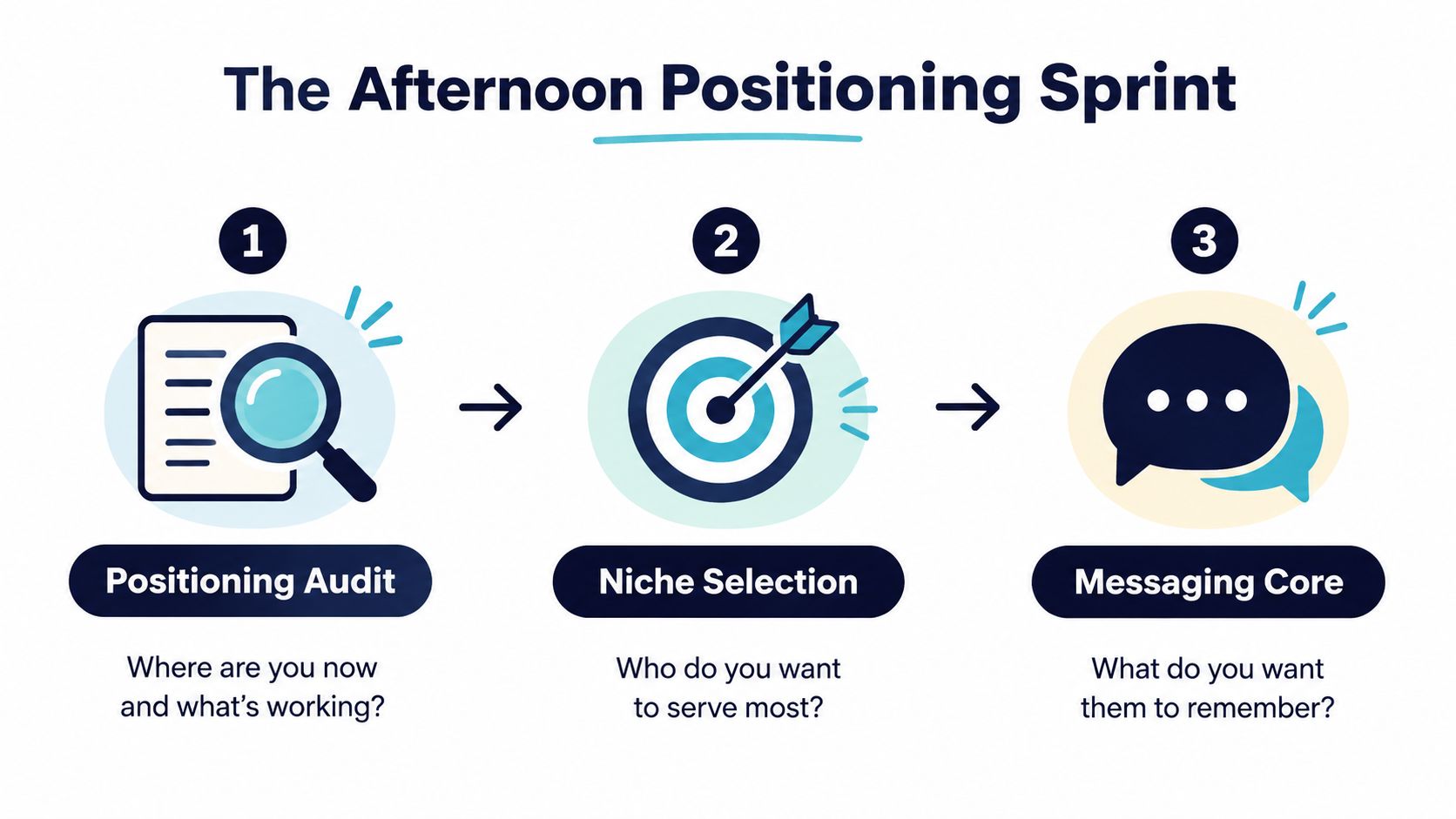
Run a blunt positioning audit
Take one afternoon and answer three questions without agency fluff.
Who do you serve
Be narrow enough that a buyer can recognize themselves fast. "B2B SaaS" is better than "startups." "Multi-location home services brands" is better than "small businesses."
What outcome do you deliver
Don't describe activities. Describe the business result clients buy. Pipeline, qualified demos, creative production velocity, lower CAC volatility, cleaner analytics, stronger retention. Pick the outcome you can defend.
Why are you the safer choice
Buyers compare you against freelancers, in-house hires, and other agencies. Your answer can't be "we care more." It has to be operational. Faster execution, deeper category knowledge, tighter reporting, or a delivery model that removes a bottleneck.
Choose a niche that can support repeat sales
Don't pick a niche because you like the logo set. Pick one that can buy repeatedly and explain its pain quickly.
Use three filters:
- Market size. There needs to be enough buyer volume to keep the pipeline alive.
- Repeat purchase behavior. Ongoing services beat one-off projects if you want stable growth.
- Competitive density. A crowded category isn't bad if your angle is specific enough.
If your shortlist still feels muddy, study a few strong unique value proposition examples and rewrite yours until it sounds like a business case, not a slogan.
Agencies lose deals when the buyer has to interpret the offer. Clear positioning removes interpretation.
Build messaging that travels
Now turn the positioning into a portable messaging stack.
Use three layers:
- One-line promise that states audience and outcome
- Three proof points that show capability without rambling
- Problem, agitation, result language for outreach and proposals
A weak line sounds like this: "We help brands grow online."
A stronger line sounds like this: "We build paid acquisition systems for DTC brands that need cleaner attribution and faster creative testing."
Package it so the team actually uses it
Most firms fail. They workshop messaging, approve slides, then never operationalize it.
Create a simple internal pack with:
- Approved headline variants for your website, proposals, and social profiles
- Proof snippets for different services and buyer types
- Objection responses for freelancer comparisons, budget pushback, and in-house alternatives
- Proposal boilerplate that sales can adapt quickly without rewriting the firm every time
If the positioning only exists in a founder's head, it isn't positioning. It's memory.
Build a Channel Mix You Can Actually Run With a Small Team
Small teams don't need more channel ideas. They need fewer channels run consistently.
One of the clearest signals in the market is that agencies still over-rely on referrals while struggling to build predictable pipeline. A 2026 agency report found 50.4% of agency owners say pipeline is their biggest challenge, 63% receive five or fewer inbound leads per month, and 67% still rely on referrals as their main acquisition channel. The same report also noted client loss tied to in-housing, budget constraints, perceived performance gaps, and a projected 15% headcount reduction in 2026, which means leaner teams need more reliable acquisition systems, not more random activity, as summarized in this agency pipeline analysis.
What to run first
For most agencies between two and twenty people, five channels keep coming up:
- Upwork proposals
- LinkedIn outbound
- SEO content
- Referral partnerships
- Paid ads
The mistake is trying to "have a presence" in all five at once. That spreads the same limited team across different motion types, different tools, and different feedback loops.
A better default is a 60/30/10 split:
- 60% of effort into fast-feedback channels
- 30% into compounding channels
- 10% into experiments
For a small team, fast-feedback usually means freelance marketplaces plus direct outbound. Compounding usually means SEO content and partnerships. Experiments can be paid ads, webinars, niche communities, or sponsorships.
Agency Channel Mix Benchmarks for Small Teams
| Channel | Avg. CPL | Weekly Hours | Best Team Size |
|---|---|---|---|
| Upwork proposals | Variable | 5 to 10 | Solo founder to small team |
| LinkedIn outbound | Variable | 5 to 8 | Solo founder to two-person team |
| SEO content | Variable | 6 to 12 | Two-person to five-person team |
| Referral partnerships | Variable | 2 to 4 | Any team size |
| Paid ads | Variable | 4 to 10 | Five-person team with budget discipline |
I'm keeping CPL qualitative here because your niche, ticket size, and sales process swing it too hard for fake precision to be useful.
Match channels to staffing reality
A solo founder can usually sustain one direct-response channel and one relationship channel. A two-person team can add a compounding content layer. A five-person team can run a proper mix if one person owns pipeline operations instead of squeezing it between delivery calls.
If you manage client publishing at scale, infrastructure matters too. Teams handling multi-account content workflows often benefit from tools built for reseller operations, and a social media API for resellers is one example of backend support that can reduce manual coordination.
Operating principle: Pick channels your current team can execute every week without heroics. A neglected channel isn't diversification. It's clutter.
If you're evaluating the stack behind that execution, this guide to a marketing platform for agencies is a useful lens for deciding what belongs in your system versus what just adds tabs.
Win on Upwork With a Fast-Response Bidding System
Most agencies lose on Upwork before a client even reads the full proposal. They respond too late, chase weak jobs, and write generic intros that sound like recycled cover letters.
Speed matters, and not in a vague way. An independent 2026 analysis of 59,339 proposals found that freelancers who applied 2 to 4 hours after a job was posted achieved a 24.3% reply rate, according to this proposal timing dataset analysis. If you wait until the afternoon to "catch up on proposals," you're competing in a colder inbox.
Set up a response system, not a browsing habit
Build a simple daily workflow:
- Saved searches for your exact service keywords and client filters
- Alerts or feeds that notify the person responsible immediately
- Weekly Connects budget tied to a proposal target, not random bidding
- Qualification rules before anyone writes a word
Screen jobs by client spend, payment verification, job history, scope clarity, and fit with your service lane. Bad-fit jobs eat time twice. First in the proposal, then again in the call.
Know the outbound benchmarks
Agency outbound performance is usually weaker than owners want to admit. Benchmarked agency performance shows cold email reply rates of 2% to 8%, LinkedIn message reply rates of 5% to 15%, and close rates from outbound of 5% to 12%. The same benchmark notes that deliverability should stay at 98%+ delivery and under 2% hard bounces, with reply-to-meeting conversion usually around 15% to 30%, based on agency lead generation benchmarks. Those numbers are a reminder to stay disciplined about list quality and response handling everywhere, including marketplace work.
Upwork Proposal Benchmarks by Response Time
| Response Time | Proposal Conversion Rate | Hire Rate | Avg. Project Value |
|---|---|---|---|
| Within the first response window | Higher | Variable | Variable |
| Later the same day | Lower | Variable | Variable |
| Next day or later | Lower still | Variable | Variable |
I'm not filling that table with made-up precision. The useful lesson is simple. Faster, qualified bids get seen earlier and discussed sooner.
Write proposals like diagnosis, not autobiography
The strongest proposals usually do three things in the first few lines:
- Name the actual problem the client is trying to solve
- Show a short proof snippet tied to similar work or process
- Offer a scoped mini-plan with the next logical steps
A five-bullet structure works well:
- problem you noticed
- likely cause
- first fix
- what happens in the first forty-eight hours
- clean CTA for a call or message
If you want to tighten speed and consistency, review systems built around Upwork bidding automation and compare them against your current manual process. The point isn't to remove judgment. It's to remove delay.
Measure What Matters in an AI-Mediated Buyer Journey
Attribution got messier because discovery got messier. Buyers now ask AI tools for vendor ideas, compare options in search, scan your site, look at your profile, and only then talk to a human. If you still judge performance only by last click, you're reading the final frame and pretending you saw the whole film.

The pain is already visible inside agencies. In 2026, 48% of marketing agencies said tracking AI-driven discovery is their hardest attribution problem, 55% said clients now regularly ask whether marketing performance connects to revenue, and 10% of agency leaders cited attribution or ROI clarity as a reason clients leave. The same analysis noted broader adoption trends, with 87% of organizations using some form of AI and 54% already deploying AI agents across the sales cycle, as covered in this agency attribution benchmark report.
Weekly metrics that actually help operators
Track these every week:
- Branded search lift because it shows whether awareness and demand are moving together
- Direct traffic quality because AI-assisted discovery often lands there instead of through neat source labels
- Proposal-to-call rate because response quality matters more than raw activity
- Pipeline velocity by channel because slow-moving deals create false confidence
These metrics help a small team act quickly. You don't need a bigger dashboard. You need fewer metrics reviewed on a fixed cadence.
Stop asking which channel "caused" the deal in a single-touch sense. Ask which channels consistently create qualified conversations and shorten time to revenue.
A simple stack works fine here: GA4 for traffic behavior, Search Console for query signals, and a CRM with mandatory source tagging. If one person owns marketing, the dashboard must tell a story without exports and spreadsheet archaeology.
Here's a practical explainer worth watching before you overcomplicate your setup:
Monthly numbers leadership will ask for
Review these monthly:
- Sourced pipeline by channel
- Assisted conversions
- CAC payback
- AI-citation share for core service pages
The CEO only cares about three questions in plain English. Which channels are creating revenue opportunities. Which ones are supporting them. How quickly those opportunities turn into cash.
If your reporting can't answer that cleanly, it isn't strategic reporting. It's decoration.
Automate the Repetition So Your Team Sells Instead of Sends
Most agencies don't break because demand disappears. They break because admins multiply. Follow-ups pile up, proposals get rewritten from scratch, reporting turns into copy-paste labor, and senior people spend their best hours moving data between tabs.
Automation should fix that. It should buy back attention.
Automate the four workflows that waste the most time
Start with these:
- Lead enrichment and routing so inbound and sourced leads hit the right owner fast
- Proposal generation from modular templates tied to service, niche, and scope
- Weekly client health reporting so account managers spot risks before renewal talks
- Pipeline status updates for leadership without manual recap work
This doesn't require a giant stack. A CRM, document automation tool, reporting dashboard, and communication layer cover most of it.
The automations agencies get wrong
Some automations create more mess than order.
Bad automation usually looks like this:
- Fully automated cold sequences with no human review
- Proposal templates that ignore service differences
- Reporting dashboards that flood clients with metrics nobody will discuss
- Internal notifications sent to everyone, so nobody owns the action
The fix is simple. Automate the repeatable structure, not the judgment.
That can include tools across categories such as HubSpot, Pipedrive, Notion, PandaDoc, Looker Studio, and marketplace workflow tools. One option in the Upwork category is Earlybird AI, which connects to an Upwork account, searches for matching jobs, drafts personalized proposals, replies to client messages, and supports multi-user workflows for agencies. That's useful if marketplace lead generation is already part of your acquisition system and you want tighter response handling without adding more manual bidding overhead.
Use a 30 60 90 rollout
Don't automate all at once.
Month one should focus on foundations:
- cleaned CRM stages
- source tagging
- proposal templates
- owner assignments
Month two should focus on integrations:
- reporting connections
- routing rules
- message triggers
- internal alerts
Month three should focus on optimization:
- trimming noisy workflows
- tightening handoffs
- reviewing pipeline lag
- improving reporting clarity
Automation should remove repetitive work from senior staff. If it creates more checking, fixing, and apologizing, you automated the wrong step.
Troubleshoot the Breakdowns and Ship a 90-Day Rollout
Most agencies don't need a reinvention after thirty days. They need a diagnosis.
When the system starts wobbling, the failure usually sits in one of four places: bad top-of-funnel fit, weak first-contact messaging, sloppy follow-up, or unclear ownership. Fix the actual constraint. Don't reset the whole plan because one channel underperformed for a week.

Common breakdowns and direct fixes
Proposal ghosting on Upwork
Tighten the first two lines. Lead with diagnosis, not biography. Cap submissions so quality stays high and the team doesn't drift into junk bidding.One channel dries up
Reallocate effort to the next-best performer instead of waiting for the dead channel to revive itself. Diversification only works if time moves with results.Discovery call conversion drops
Audit the script. Cut leading questions, sharpen the problem framing, and make follow-up happen within forty-eight hours while the conversation is still warm.Delivery starts slipping
Add a weekly pipeline standup and give each channel one owner. Shared responsibility is usually no responsibility.
A 90-day rollout that actually ships
Use a simple sequence.
Weeks 1 and 2
Finalize positioning, niche language, proposal templates, and qualification rules.
Weeks 3 through 6
Launch the channel mix. Start marketplace cadence, outbound rhythm, and referral partner outreach. Review pipeline weekly.
Weeks 7 through 10
Layer in automation for proposals, reporting, and status updates. Remove bottlenecks before they become habits.
Weeks 11 and 12
Audit attribution, compare channels by pipeline quality, and reset the mix based on real performance.
Pre-mortem checklist
Before rollout, ask these questions:
- Who owns each channel
- What qualifies as a good lead
- How fast must the team respond
- Which metrics get reviewed weekly
- What gets paused if delivery capacity tightens
The agencies that scale aren't the ones with the prettiest playbook. They're the ones that run the same system every week, make hard cuts fast, and stop confusing motion with marketing.
Earlybird AI helps agencies turn Upwork into a repeatable acquisition channel instead of a manual scramble. It handles job discovery, personalized proposals, replies, follow-ups, and multi-user workflows so your team can respond faster and keep pipeline moving without adding SDR overhead. If that fits the system you're building, visit Earlybird AI.


