
← Back To Blog
AI Sales Automation Software: A Practical Buyer's Guide
You're answering an Upwork message while revising a client deliverable, and three more invitations are waiting. One looks relevant, but the opportunity may be gone by the time you write a proposal. Another client has asked a follow-up question you forgot to answer. Your pipeline isn't empty because demand disappeared. It's leaking because your attention is fragmented.
AI sales automation software can close that operational gap, but only if you buy it for the right workflow. The useful systems don't just generate more messages. They monitor relevant opportunities, draft context-aware outreach, manage follow-up, update pipeline records, and hand important conversations back to a human before trust suffers.
This guide focuses on freelancers and small agencies, especially teams selling through Upwork. You'll learn what the software should do, how proposal timing affects the workflow, which buying questions vendors tend to avoid, and how to measure whether automation is returning productive selling time or merely increasing activity.
The Moment a Freelancer Realizes They Need an AI Sales Partner
A solo freelancer's workday rarely separates sales from delivery. A new Upwork invite arrives during a design review. A promising job appears while the freelancer is on a client call. By evening, the proposal is still unwritten, the inbox contains an unanswered question, and the follow-up list has become another source of stress.
An agency owner faces the same problem at a larger scale. Several bidders may watch different accounts, each using slightly different qualification rules and follow-up habits. One person submits quickly but sends generic proposals. Another writes thoughtful messages but misses opportunities. Nobody has a dependable view of which signals became conversations and which conversations became meetings.
A practical AI sales partner turns those scattered actions into a controlled pipeline:
- Opportunity monitoring: The system watches selected sources and filters opportunities against the service, buyer, budget context, and project type you want.
- First-touch assistance: It drafts a proposal or reply using approved positioning, relevant work, and the client's stated problem.
- Follow-up management: It remembers the next action, pauses when a buyer responds, and routes complex questions to a person.
- Pipeline visibility: It records what happened so you can improve qualification instead of relying on memory.
Practical rule: Automate the work that steals attention, not the judgment that wins trust.
The research supports that distinction. A 2022 study of 196 B2B salespeople found positive direct and indirect effects from sales force automation, with adaptive selling and relationship quality helping performance. It also identified a negative route through role overload and burnout, showing that automation works when it reduces administration without overwhelming the seller. The study of sales force automation and salesperson performance is a useful warning against treating more automation as automatically better.
By the end of this guide, you should be able to evaluate a platform like a sales operations lead, even if you've never hired an SDR. The standard is simple: does the system help you reach the right buyer at the right moment while preserving the human decisions that make the sale?
What AI Sales Automation Software Actually Is
Think of AI sales automation software as a careful sales associate who never sleeps. It monitors incoming opportunities, recognizes useful buying signals, drafts a first response, updates the pipeline, and asks a human to make the final call when the conversation becomes important or unusual.
That analogy matters because it sets the correct boundary. The software isn't merely a website chatbot, and it isn't a generic CRM with an AI button. It operates between lead detection and booked meeting, combining workflow triggers with language generation and structured pipeline actions.
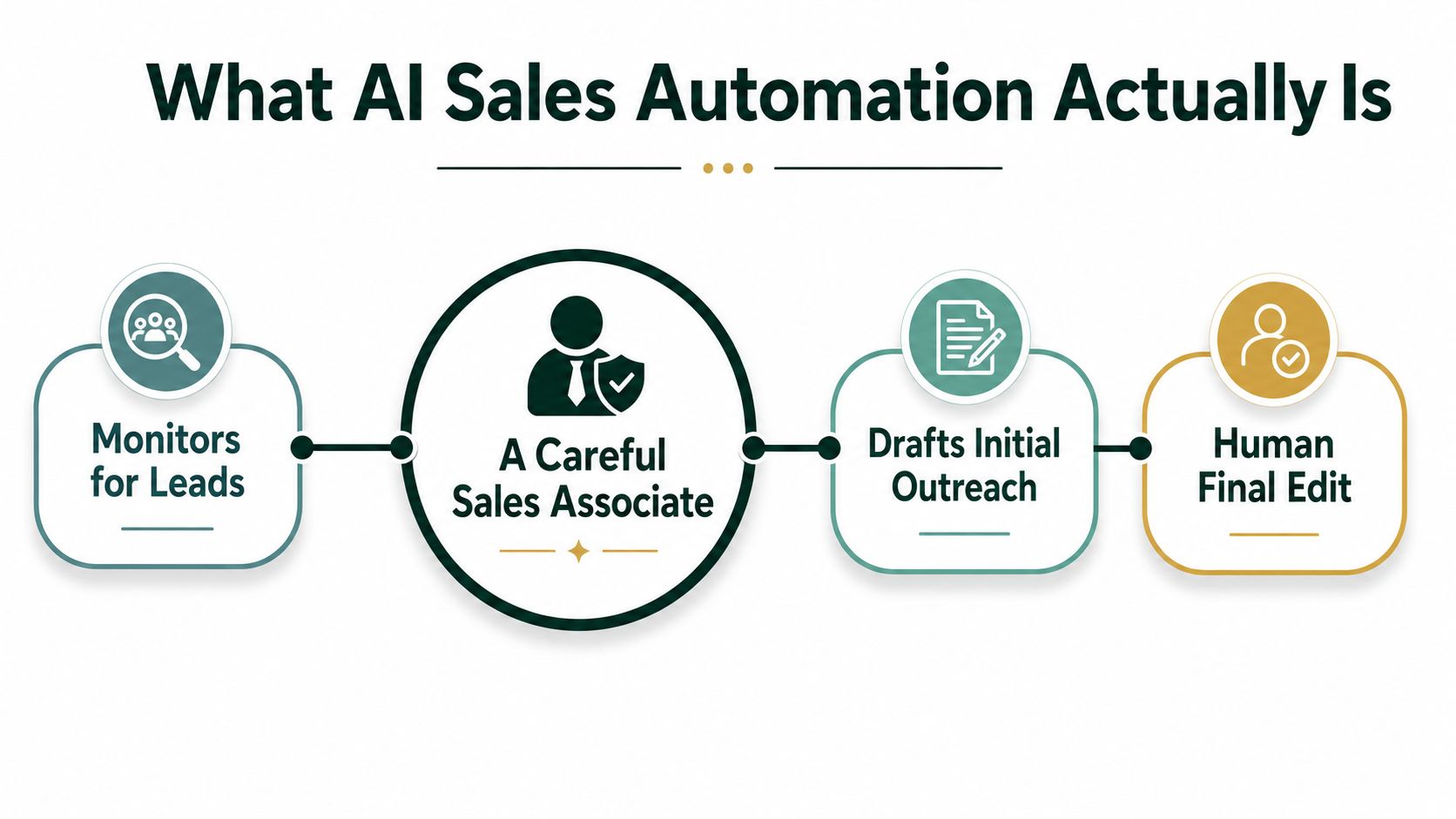
The operating layer between signal and conversation
A capable platform typically performs four connected jobs:
- Signal detection identifies a new job, account change, reply, invite, or other event that deserves attention.
- Context assembly pulls together the information needed to judge fit, such as service category, client request, past interaction, and approved offer language.
- Generative drafting creates a proposal, message, follow-up, or internal note that reflects that context.
- CRM-native action logs the activity, changes a stage, schedules the next step, or sends the draft to a human reviewer.
Traditional sales force automation usually follows explicit if-then rules. If a deal changes stage, create a task. If an email is opened, send another message. AI-powered systems can interpret less structured information, identify patterns, and produce language, but they still need boundaries. A tool that can write a fluent proposal but can't explain why the opportunity qualified is not a sales system. It's a text generator attached to your inbox.
A 2026 field experiment found that GenAI increased sales in most tested workflows, but the measured effect ranged from no detectable impact to 16.3%, depending on the value AI added compared with existing practices. The research summary on workflow-dependent GenAI sales effects supports a firm buying principle: don't ask whether AI works in general. Ask which task it improves, compared with your current method, and under which human controls.
For a plain-language overview before reviewing vendors, this guide to sales automation provides useful grounding. Your own evaluation should then move from definition to workflow fit.
Core Capabilities Every Buyer Should Expect
Buy the system for jobs, not feature names. A vendor can claim “AI prospecting” while offering little more than keyword alerts, or advertise “autonomous outreach” that sends the same generic message to every prospect.

Start with signal quality
The first job is finding opportunities that deserve a response. For an Upwork freelancer, that means filtering projects by service, deliverables, client language, and fit rather than reacting to every new posting. For an agency, it means routing opportunities to the right bidder and preventing duplicate work across accounts.
The system should show why it selected a job. If the explanation is only a keyword match, qualification remains weak. Look for adjustable rules, thumbs-up or thumbs-down feedback, exclusion criteria, and a visible record of rejected opportunities.
Draft proposals from evidence
Proposal generation should use the client's actual request, your approved positioning, relevant portfolio examples, and a defined call to action. It should not invent experience, promise unavailable timelines, or force a sales script into a technical brief.
Use a human approval gate for high-value or unusual work. A freelancer may allow automatic drafting for familiar projects, while an agency may require a reviewer before anything leaves a bidder account.
Treat timing as a decision
Fast submission helps only when the timing strategy matches buyer behavior. Independent Upwork proposal-timing research found that freelancers applying 2 to 4 hours after posting achieved a 24.3% reply rate, while proposals sent in the first few minutes performed much worse. The proposal timing analysis makes the point clearly: the best automation doesn't just send first. It selects an appropriate window.
The same logic applies to messages. Upwork recommends replies within 24 hours, with 1 to 2 hours preferred when possible. Upwork's guidance on proposal visibility and response speed gives sellers a concrete operational benchmark.
Continue until the next meaningful step
Follow-up should stop when the client replies, asks for a human, declines, or reaches a defined meeting stage. It should also change based on context. A short reminder for a logo project isn't appropriate for a complex development engagement.
Keep the pipeline usable
A platform should record proposals, replies, follow-ups, meeting status, owner, and next action. Analytics should answer operational questions, including which signals produce replies and how long it takes to move from detection to a booked meeting.
That broader vocabulary aligns with the sales prospecting meaning explained, particularly the distinction between identifying potential buyers and creating a repeatable process for engaging them.
Finally, look for profile and offer optimization. If the system sees which project types generate useful conversations, it should help you refine your positioning instead of only increasing outreach volume.
How Freelancers and Agencies Use It Day to Day
Maya is a solo brand designer with strong work and inconsistent availability. She doesn't need an automated salesperson to negotiate scope or defend her creative decisions. She needs help noticing suitable jobs, preparing a relevant first draft, and keeping a promise to follow up.
Her workflow starts with a narrow qualification profile. The system surfaces brand identity projects that match her services and suppresses requests outside her preferred work. Maya reviews the strongest drafts during a scheduled window, edits the opening line, checks the portfolio reference, and approves the proposal. When a client replies, the system handles a simple acknowledgment, then routes pricing, strategy, and timeline questions to Maya.

Her day improves because the software removes scanning and remembering. It doesn't remove her from the moments where a buyer is deciding whether to trust her.
A shared SDR layer for a small agency
Northbeam Studio has five people and several Upwork bidder accounts. Its challenge isn't writing one proposal. It's coordinating opportunity ownership, maintaining consistent positioning, and ensuring that one client doesn't receive multiple competing responses.
The agency uses a shared queue. Each opportunity receives a fit label, a designated account, and a reviewer. Low-complexity jobs can move through a prepared sequence, while strategic engagements require an approval step. The owner sees reply quality and meeting progress across the operation, but each freelancer sees only the conversations assigned to them.
Useful agency habits include:
- Queue ownership: Assign each opportunity before drafting begins.
- Reviewer handoffs: Escalate pricing, scope ambiguity, complaints, and technical objections.
- Account discipline: Keep activity patterns plausible and follow platform rules.
- Feedback loops: Mark good and poor matches so qualification improves over time.
This operating model also helps agency owners connect sales automation to broader positioning and delivery decisions. The agency owner SEO resource offers relevant context for owners balancing acquisition with operational growth.
A practical Upwork workflow can also combine automated prospecting with a deliberate human review process. Teams exploring that connection can reference AI for sales prospecting, then define exactly which actions the system may take without approval.
The video below offers another visual way to think about automated bidding and workflow handoffs.
The best day-to-day setup feels uneventful. Opportunities are sorted, drafts are ready, replies are visible, and humans step in where judgment carries the most value.
A Buyer's Checklist That Goes Beyond Feature Lists
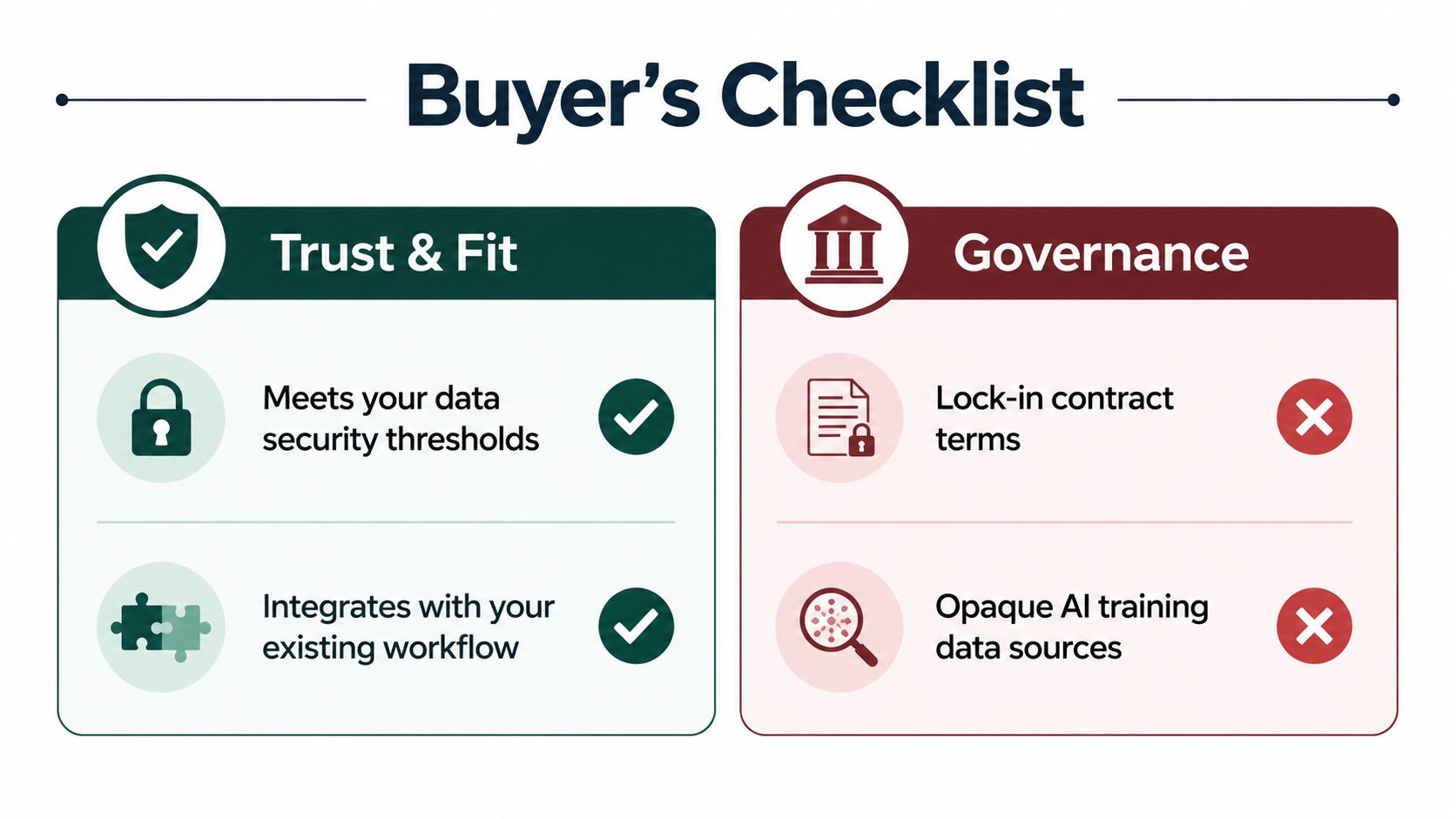
A feature comparison won't tell you whether automation will improve your sales process. Ask whether the platform can operate safely inside your existing workflow, preserve buyer confidence, and give your team control over data and decisions.
Trust is a conversion requirement
Buyers may welcome a faster, more convenient sales process, but they don't want opaque communication. A Gartner-cited survey found that 67% of B2B buyers prefer a sales-rep-free experience, while 69% still want to validate AI-generated insights with a human. The buyer-journey findings reported by CX Today point to a practical threshold: automate access and preparation, but make human validation easy.
For Upwork sellers, trust declines when a proposal sounds detached from the brief, a follow-up ignores the last reply, or an automated answer makes a claim the freelancer can't support. Require the system to expose source context, preserve approval controls, and make it obvious when a message was generated.
Fit matters more than a long integration list
Check whether the platform works with the places your team already sells. An agency focused on Upwork needs reliable account workflows, message handling, proposal visibility, calendar coordination, and multi-user permissions. A B2B sales team may prioritize CRM synchronization, conversation records, and lead routing.
Ask vendors to demonstrate one complete path from signal detection to booked meeting. Don't accept a collection of disconnected feature demos.
Use best sales automation tools as a starting point for narrowing your shortlist, then test each candidate against your actual account structure and offer.
Governance should disqualify weak vendors
Ask where customer and prospect data goes, how access is controlled, whether the provider uses your information to train models, and how quickly the vendor responds when a platform changes its rules. Procurement teams increasingly care about AI regulation, regional data handling, security reviews, and the ability to fit the tool into a composable revenue stack.
Reject vendors that:
- Hide decision logic: You can't inspect why a lead qualified or why a message was sent.
- Force full autonomy: The platform won't let you require approval for sensitive conversations.
- Offer vague data terms: The contract doesn't clearly explain retention, processing, and access.
- Ignore account health: The vendor treats submission volume as the only success metric.
- Lock your workflow: Export, permission, and cancellation terms are unclear.
A trustworthy platform should make restraint a feature. If the sales team can't pause, edit, reroute, or audit the workflow, the system isn't ready for unsupervised use.
Implementing AI Sales Automation Without Breaking What Works
Roll out automation as an operational change, not a software installation. Start with one channel, one offer, and a controlled group of accounts. Choose a workflow where the administrative burden is obvious but the consequences of a poor automated message are manageable.
Phase one requires narrow guardrails
Define the qualification rules before connecting the platform. Specify which jobs are eligible, which claims are approved, which messages require review, and which topics always return to a human. Keep proposal drafting separate from automatic submission until the team has reviewed the output in real conversations.
For Upwork, set response-time targets around the platform's own guidance. Upwork recommends replying to invites and messages within 24 hours, ideally within 1 to 2 hours. Its guidance on proposal views and response timing gives you a defensible benchmark without chasing speed for its own sake.
Phase two measures movement, not noise
Track reply rate, meeting-booking rate, time from signal detection to booked meeting, and the number of conversations requiring human correction. Add account-health signals, such as warnings, failed actions, or unusual activity patterns.
The most revealing metric is often signal-to-meeting latency. Message volume can rise while qualified conversations fall. A system that identifies a relevant project, creates a useful proposal, and shortens the path to a meeting is doing meaningful work.
Phase three expands only after quality holds
Add accounts or channels when the pilot shows stable qualification and acceptable message quality. Keep complex negotiations, custom scopes, complaints, and sensitive commercial discussions with people.
Document the handoff. The human reviewer should know what the client asked, what the system sent, what the buyer responded to, and what action comes next. Without that context, automation creates another form of administrative work instead of removing it.
Real ROI, Honest Pitfalls, and Your Next Step
Calculate payback from time returned and qualified opportunities, not from the number of automated actions. For a freelancer, the question is whether reclaimed selling time can be used for paid delivery, stronger proposals, or client conversations. For an agency, ask whether the system reduces repetitive bidder work without requiring another layer of supervision.
Gartner's 2026 survey of 210 CSOs and senior sales leaders found that AI tools saved sellers an average of 4.8 hours per week. Yet 72% of sales organizations weren't reinvesting those savings into higher-value selling, while teams that did reinvest were 2.2 times more likely to exceed customer growth goals. The Gartner findings and survey details support the central ROI lesson: time savings become revenue only when you assign that time a job.
Use a simple calculation. Estimate the weekly hours the system can return, assign those hours to delivery or selling, and compare the resulting contribution with the software and oversight cost. Then validate the estimate against booked meetings, qualified replies, and revenue, not optimistic projections.
The problems that appear after launch
- High-value conversations become over-automated: The system keeps sending when the buyer expects a specialist.
- Generic drafts lower reply quality: Activity looks healthy, but prospects stop engaging.
- Platform changes break brittle workflows: A sequence depends on an interface or rule that changes without warning.
An operations view of the broader process is available in AI for revenue operations, but the immediate action is narrower. Select one offer, define the approval rules, establish your response and meeting metrics, and review the first conversations manually. Leave additional channels, aggressive sequencing, and full autonomy for the next quarter.
Earlybird AI connects to an Upwork account to find suitable jobs, craft personalized proposals, reply to client messages, manage follow-up, and support call booking, with analytics, profile optimization, and multi-user workflows for agencies. Visit Earlybird AI to see whether its controlled approach fits your Upwork sales process and start by testing one clearly defined offer.