
← Back To Blog
Client Referral Program Guide for Agencies That Converts
You've just delivered a successful project. The client praises the work, says they know several businesses that need help, and then the conversation ends. Weeks later, your agency is back to outbound prospecting, marketplace applications, and an unpredictable pipeline. The missed opportunity usually isn't a lack of goodwill. It's a lack of a clear, easy way for a satisfied client to make an introduction.
A client referral program turns that informal goodwill into a trackable revenue system. Instead of hoping clients remember to recommend you, you define the right moment to ask, make the introduction simple, set transparent reward terms, and measure what happens after the referral arrives.

Introduction to Client Referral Programs for Agencies
A design agency finishes a website redesign for a growing services company. The launch goes smoothly, the client sends a warm thank-you message, and the account manager receives a compliment about the agency's communication. That client might know other founders with the same problem, but nobody gives them a specific request, a shareable message, or a reason to act now. The potential referral stays inside a private conversation.
This happens because agencies often treat referrals as a pleasant side effect of good work. Good delivery matters, but it doesn't create a reliable acquisition channel by itself. A referral needs a trigger, a process, an owner, and a way to connect the introduction to a proposal, a signed agreement, and collected revenue.
The business case is stronger than many agency owners expect. A 2026 industry synthesis reports that referral leads convert 30% better than leads from other channels, referral programs can produce 3–5 times higher conversion rates, and the average referral campaign delivers a 5.7x ROI. The same synthesis says referred customers can reduce acquisition costs by 35–45% and deliver 16% higher lifetime value than non-referred customers. These figures are reported in GrowSurf's referral marketing statistics, and they point to a practical conclusion: referrals can improve both the front end of the funnel and the economics after the sale.
This guide approaches referrals as an operating system for an agency. You'll learn how to define the program, choose incentives that fit your margins, protect trust with clear rules, and connect referral activity to automated sales workflows. The aim isn't to pressure every client for introductions. It's to help the right client make the right introduction at the right time, then ensure your team follows up while the recommendation is still fresh.
What a Client Referral Program Really Is
A client referral program is a structured agreement that encourages existing clients to introduce qualified prospects to your agency. The structure usually includes four elements: who can refer, what counts as a referral, what reward applies, and how the agency tracks the result.
Think of ordinary word-of-mouth as a road without signs. A client may mention your agency during a conversation, but you don't know who heard the recommendation, when to follow up, or whether that person ever became an opportunity. A formal program adds the signs. It gives the client a simple destination, such as a referral form, email introduction, or unique link, and gives your team a record of the source.
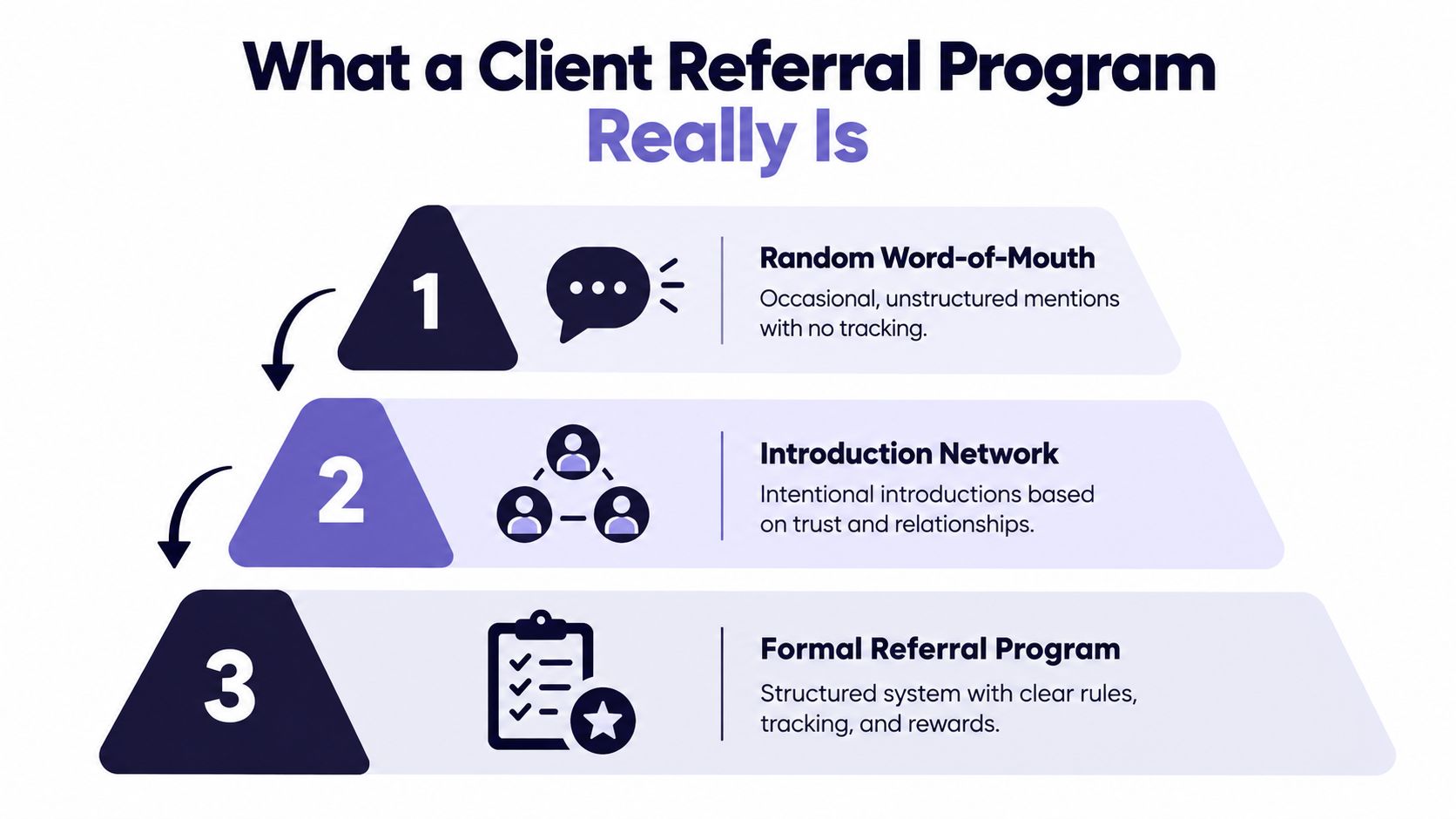
Three levels of referral activity
Random word-of-mouth happens without planning. A client tells a colleague about your work, but the agency may never learn about the conversation.
An introduction network is more intentional. Your client understands the type of company you help, recognizes a relevant situation, and connects you directly with someone who may need the same service.
A formal referral program adds rules and accountability. The client knows what to share, the prospect understands why the introduction is happening, and your agency records the source and outcome.
A referral program isn't the same as a testimonial. A testimonial validates your work publicly, while a referral creates a direct path to a potential buyer. It also isn't automatically an affiliate program. An affiliate arrangement often centers on tracked links and commission, whereas an agency referral program can be as personal as a warm email introduction and can reward a client with a credit, service benefit, or other agreed value.
How the process works
Start with a client who has experienced a clear result and has a healthy relationship with your team. Ask for an introduction when the client has a reason to feel confident, such as a successful launch, positive review meeting, or completed milestone. Give them a short description of the ideal prospect and a message they can forward without rewriting.
Then define the qualification point. You might count a referral when the prospect accepts an introduction, when a discovery call occurs, or only when a contract is signed. Choose one rule and put it in writing. Your outbound and inbound channels can continue operating alongside the program. Referrals add a trust-based path that your existing sales process can manage.
Why Agencies Benefit Most From Referrals
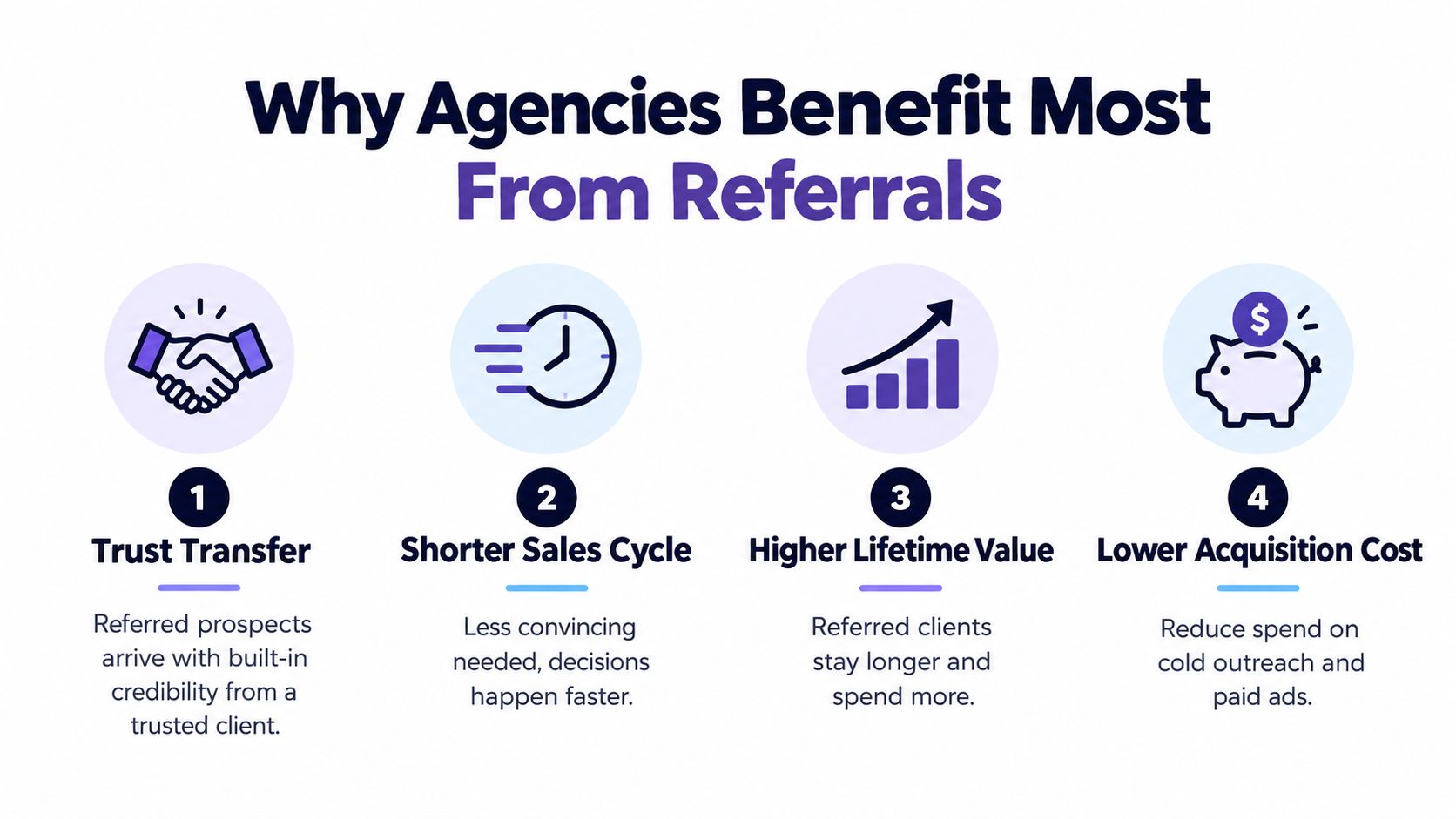
Agencies sell expertise before they sell an output. A prospect must believe your team understands the problem, can manage uncertainty, and will communicate well throughout a project. A trusted client can transfer some of that credibility before your sales team says a word.
That trust transfer matters because agency sales are often high-touch. A referred prospect may still need a discovery call, scope discussion, and commercial review, but they usually enter with more context than a cold contact. The client who makes the introduction has already done part of the explanation.
Referrals improve the economics of trust
The performance data supports this pattern. GrowSurf's synthesis reports that referred leads convert 30% better than leads from other channels and that referral programs generate 3–5x higher conversion rates than other acquisition sources. Those figures don't mean every referral will close, and they shouldn't replace your own reporting. They do show why an agency should compare referrals with cold outreach and paid acquisition rather than judging the program by lead volume alone. See this guide to generating leads without cold calling for a broader view of channel design.
The same source reports a 5.7x average ROI for referral campaigns. It also associates referred customers with 35–45% lower acquisition costs and 16% higher lifetime value than non-referred customers. For an agency, the practical interpretation is straightforward: a referral can require less persuasion before the sale and may produce stronger commercial value after onboarding.
The pipeline effect for small teams
Small and midsize agencies often depend on a few people to deliver work, sell new projects, and maintain client relationships. Cold outreach can fill the top of the funnel, but it consumes time before a prospect has shown meaningful intent. Referrals let account managers and delivery leads create demand from relationships they already maintain.
A 2016 business-customer referral dataset found that the average program enrolled 5,850 customers, with 2,106 enrolled customers making referrals on average, or roughly 36% of enrolled customers actively referring others. That early benchmark illustrates that formal programs had already become structured at meaningful scale. The figures appear in Review42's referral marketing statistics.
Recent figures in the same source report that companies with formal referral programs experience 86% more revenue growth over two years than companies without them, while 69% of companies with referral programs report faster time-to-close on referred leads. Treat these figures as benchmarks, not promises. Your agency still needs strong delivery, accurate qualification, and timely follow-up.
A referral channel works best when your agency measures revenue quality, not just introductions. A large number of weak referrals can create more work than value. A smaller flow of well-matched opportunities can stabilize the pipeline and protect delivery capacity.
Choosing Incentives That Motivate Without Backfiring
The right reward makes participation easier. The wrong reward creates suspicion, margin pressure, or a complicated explanation that clients won't remember. Start by matching the incentive to the relationship and the economics of the service, not by copying a consumer brand's offer.
Single-sided or double-sided
A single-sided reward pays only the existing client or only the new client. It's simple to explain and may suit a close-knit client base where the referrer already feels strongly invested in your agency. The drawback is that one participant receives no direct benefit, which can reduce motivation on that side of the introduction.
A double-sided reward gives value to both the referrer and the new client. Benchmark content from GrowSurf reports that double-sided rewards can lift participation by 91%. This structure may work well when a new client needs a reason to take the first conversation, while the existing client wants recognition for opening the door. The figure is included in GrowSurf's customer referral statistics.
For agency services, the rewards don't need to be identical. You might offer the existing client a service credit while giving the new client a project discount, onboarding benefit, or useful consultation. Make sure the terms explain when each reward becomes available.
Flat or tiered
A flat incentive gives the same reward for each qualifying referral. It's easy for your account team to administer, easy for clients to understand, and predictable for forecasting. This is usually the safest starting point when your agency hasn't collected enough data to know which referral patterns produce profitable work.
A tiered incentive increases the reward as referral value or volume increases. GrowSurf reports that tiered incentives can generate 27% more referrals than flat rewards. Tiers can encourage continued advocacy, but they also require clearer tracking and stronger controls. A tier should reward useful outcomes, not merely a high number of names.
Cash, credit, or recognition
Cash is flexible, but it can make a trusted introduction feel like a transaction. Credits toward future services protect cash flow and keep the client connected to your agency. Non-monetary recognition, such as a private thank-you, a public partner feature with consent, or an added strategic session, can suit relationships where money would feel awkward.
Keep the rule short enough to say aloud. Current benchmark content reports average participation of only 2.3–5.2% of the customer base, and another 2026 summary says simple programs outperform complex ones by 2.6x. Those figures reinforce a useful operating principle: reduce steps before adding clever mechanics.
Practical rule: If a client can't explain the reward and qualification rule in one breath, simplify the program before launch.
Legal and Ethical Guardrails You Must Follow
A referral program sits inside a relationship built on trust. Your agency protects that trust by making the commercial arrangement visible, limiting what clients share, and avoiding language that could mislead either side.
Start with disclosure. Tell the new prospect if the referring client may receive a reward. The disclosure doesn't need to dominate the introduction, but it should be clear enough that the prospect understands the relationship. Don't ask clients to present a paid recommendation as an independent opinion.
Protect personal information
Ask clients to make introductions themselves whenever possible. A direct email or message lets the potential prospect choose whether to continue. Avoid collecting or importing someone's contact details without a lawful basis and appropriate permission. Your referral form should collect only information your team needs to respond.
Use plain terms for:
- Eligibility: State who can participate and whether current, former, or partner clients qualify.
- Qualification: Explain whether the reward depends on a meeting, signed agreement, payment, or another event.
- Timing: Tell participants when the reward is issued and what happens if a project is canceled or refunded.
- Exclusions: Identify duplicate leads, existing opportunities, self-referrals, and conflicts of interest.
- Privacy: Explain how you'll use the prospect's information and how the agency will contact them.
Your client agreement should support the referral program rather than contradict it. Keep commercial scope and delivery obligations in the correct document, and use a clear relationship between the master service agreement and statement of work when a referred opportunity becomes a project.
Platform rules need separate attention. If referrals involve Upwork, don't assume your agency's normal process overrides marketplace terms. Upwork's affiliate program pays 70% of the first contract spend for a new client referred to Upwork, capped at $150 per transaction, plus 5% commission for repeat contracts up to $150, according to Upwork's affiliate terms. Upwork also states that a referrer and, where applicable, the referee may earn a maximum of $500 in Referral Rewards per calendar year in its legal terms.
For client budgeting, Upwork lists Basic plan Marketplace fees of 3% or 5%, while Business Plus fees are 8% or 10%, depending on the applicable project and plan terms, as shown on Upwork's client pricing page. Its Bring Your Own Client program says the freelancer pays a 0% service fee when the client joins through the freelancer's unique link, while the client still pays the standard 3% marketplace fee on each payment, according to Upwork's community guidance. Review the current terms before promoting any platform-related referral offer.
Program Structures and Measuring ROI With Automation
A referral program becomes useful when it fits the way your agency already works. Don't create a separate maze of forms and spreadsheets. Attach the ask to a client moment that already exists, then move the resulting opportunity through the same qualification and sales stages as every other lead.
Three structures agencies can use
The post-project trigger asks for an introduction after a clear milestone, such as a successful launch or completed deliverable. It works because the client has a fresh reason to discuss the agency's value.
The ongoing advocate tier identifies clients who consistently give positive feedback or introduce relevant contacts. You can give these advocates a simple recurring benefit, provided the eligibility and reward terms remain transparent.
The partner-sourced pipeline treats complementary professionals, such as consultants or technology specialists, as referral partners. This structure needs especially clear boundaries around conflicts, client ownership, and disclosure.
The benchmark for agency-like businesses is often operational. Yuktis reports a 20%–30% referral rate, 1.5–2.5 referrals per referring client per year, and a 40%–60% close rate on referred opportunities in its agency client referral program benchmarks. Use these as comparison points, then replace them with your own data as your program matures.
Track the whole path to revenue
Your minimum record should connect the referring client, introduction date, prospect, service type, sales owner, stage, proposal, close status, collected revenue, reward, and acquisition cost. A referral dashboard should answer questions such as:
- Participation: Which eligible clients made an introduction?
- Quality: Which referrals matched your ideal project criteria?
- Conversion: What portion reached a call, proposal, and signed agreement?
- Economics: What revenue and gross margin came from referred clients after rewards and delivery costs?
- Speed: How quickly did your team respond, and how long did the opportunity take to close?
A practical workflow might capture the introduction, create a lead record, assign an owner, notify the sales team, send a personal response, and schedule follow-up tasks. For agencies that manage several bidders or accounts, automation can also prevent two people from contacting the same prospect. Resources such as tracking warm introductions can help teams think through attribution before they choose software.
Earlybird AI can be used as one option in an automated Upwork sales workflow. It connects to an Upwork account, learns project preferences through thumbs-up and thumbs-down feedback, searches for relevant opportunities, drafts personalized proposals, and replies to client messages. It also provides analytics, profile optimization, and multi-user workflows, which can help an agency connect fast follow-up with referral and marketplace activity. For broader pipeline management, compare those requirements with a CRM for agencies that supports source attribution and ownership rules.
Launching Your Client Referral Program With Confidence
A workable program doesn't need a large technology project. It needs a clear promise, a suitable audience, a small set of rules, and a reliable way to observe the result.
Begin with clients who have recently expressed satisfaction and whose networks resemble the companies your agency serves well. Write one sentence describing the ideal referral. For example, you might ask for an introduction to a services company preparing for a website redesign, rather than asking broadly for “anyone who needs marketing.”
Choose one trigger and one reward model. A post-project request with a simple flat incentive is easier to operate than a multi-stage scheme when your team is collecting its first data. Decide in advance whether the reward applies after an accepted introduction, a completed call, a signed agreement, or collected payment.
Document the rules before the first ask:
- Define eligibility: Identify participating clients and excluded situations.
- Write the message: Give clients a short introduction template they can forward.
- Assign ownership: Name the person responsible for responding and updating the record.
- Track source and outcome: Record the referral through revenue collection, not just the first meeting.
- Review quality: Compare close rate, speed, revenue, margin, and reward cost.
- Improve one variable: Change the trigger, message, or incentive based on observed behavior.
Start with a small group, then listen to what clients find confusing. If people open the message but don't introduce anyone, reduce friction or clarify the ideal prospect. If introductions arrive but rarely close, refine qualification and the description of your best-fit work. Volume isn't the goal. Profitable, well-matched relationships are.
A referral program compounds through consistent delivery. Every successful project gives your team a stronger moment to ask, a clearer example to share, and better evidence about which clients and services produce valuable introductions. Pair that discipline with prompt follow-up, and referrals can become a dependable part of the agency's revenue system rather than an occasional surprise.
Earlybird AI helps agencies automate Upwork prospecting, personalized proposals, client replies, follow-ups, analytics, and multi-user sales workflows. Visit Earlybird AI to connect referral follow-up with a more consistent process for turning qualified opportunities into conversations.


