← Back To Blog
8 Common Mistakes in Proposal Writing to Avoid

Good proposals don't usually get ignored because the freelancer lacks credentials. They get ignored because the proposal creates avoidable friction. A generic opening makes the client work to see relevance. An unclear outcome makes them guess at the value. Slow timing lets other applicants shape the conversation first, while vague scope, unanswered objections, poor formatting, and a missing next step add more reasons to delay.
That matters on Upwork, where a client may scan several applications before deciding which conversations deserve attention. Proposal performance data reported in a 2024/2026 proposal benchmark summary puts the average win rate around 43% to 45%, but unsolicited proposals win only 18% of the time, while top performers can exceed 75%. The difference isn't just writing talent. Targeting, timing, clarity, and follow-through shape the decision.
This guide breaks down eight common mistakes in proposal writing. Each one includes a practical micro-sample, why the mistake costs opportunities, an exact replacement line, and an automation-prevention step for an Upwork workflow. Automation should support relevance, review, and follow-up, not replace judgment. Even something as small as understanding why your proposal cover page matters can improve how quickly a client understands your offer.
1. Generic One-Size-Fits-All Proposals
A proposal that could be sent to any client usually feels like it was sent to no client in particular. “I'm an experienced professional who can help with your project” says nothing about the buyer's brief, product, industry, deadline, or problem. It forces the client to search for evidence that you understood the assignment.
A stronger opening borrows a specific detail from the job post and connects it to a relevant capability:
“You're rebuilding the onboarding flow for a B2B analytics product, so I'd start by mapping the points where new users abandon setup.”
That sentence gives the client a reason to keep reading. It demonstrates attention before mentioning credentials. A portfolio example should serve the same purpose. If the client needs a SaaS landing page, lead with a comparable SaaS page, not your favorite branding project.
Replace the template with a brief-specific opening
Use the client's own language where it helps, but don't repeat the entire posting. Mention the project's central challenge, the intended audience, or the desired deliverable. Then explain the first useful action you'd take.
A practical replacement line is:
“Your brief points to [specific challenge], and I'd address it by [first action], with the goal of helping you achieve [relevant outcome].”
Before submitting, check three things:
- Brief match: Does the first paragraph mention a real detail from this job?
- Proof match: Is the attached example similar in format, audience, or problem?
- Context match: Have you adapted your language to the client's industry and situation?
For agencies managing repeated applications, agency proposal templates can provide structure without requiring identical copy every time. The template should hold the workflow, not dictate the message.
Automation-prevention step: Configure your proposal system to require a brief-specific field before drafting. Earlybird AI can learn preferred project types through thumbs-up and thumbs-down feedback, but a human should still verify that the opening references the actual posting and that the selected proof is relevant.
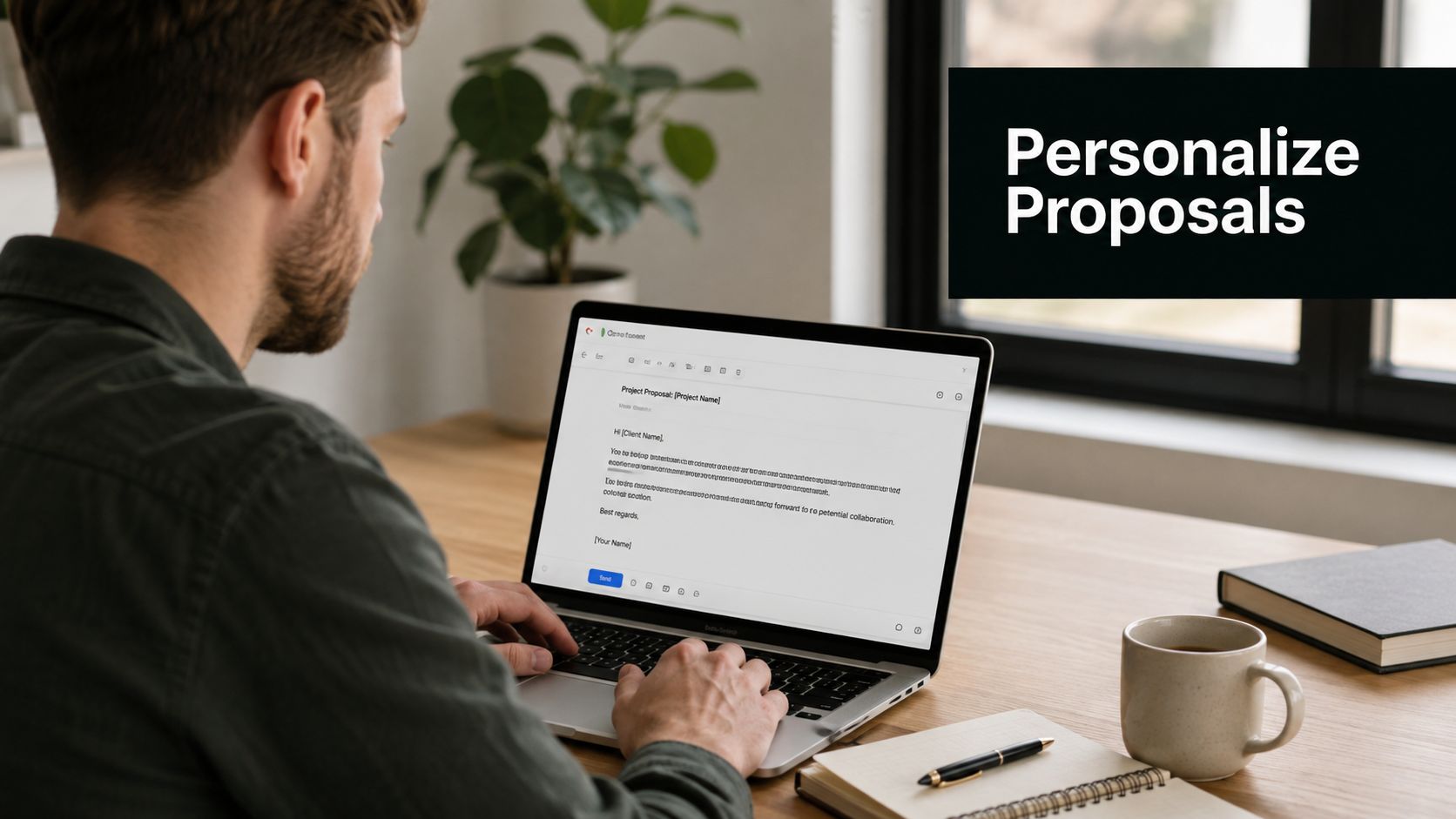
2. Focusing on Services Instead of Client Outcomes
Clients aren't hiring a list of services. They're hiring a change in their situation. A proposal that spends most of its space on your tools, years of experience, and process makes the buyer translate your credentials into a business result.
Compare these two lines:
- “I provide SEO strategy, technical audits, and content optimization.”
- “I'll identify the search opportunities closest to your current product offering, prioritize the technical fixes that block discovery, and give your team a practical content roadmap.”
The second version still describes SEO work, but it frames the work around decisions and outcomes. It also avoids promising a ranking or financial result you can't control. Outcome-focused writing must remain credible. Don't guarantee a specific position, conversion lift, or acquisition-cost reduction unless the evidence and project conditions support it.
State the result before the method
Open with the client's goal. If the job post asks for a website redesign, discuss clearer navigation, stronger user flow, or a more manageable design system. If it asks for a sales deck, discuss helping the sales team explain the offer and handle buyer questions. Your experience belongs after that connection.
An exact replacement line is:
“The useful result here isn't just [service]. It's [client outcome], supported by [specific deliverable or method].”
This approach also improves pricing conversations because the client can see what the work is meant to accomplish. A useful solution-selling approach keeps the buyer's problem at the center instead of making the proposal read like a résumé.
Practical rule: Describe what changes for the client, then explain what you'll do to create that change.
Automation-prevention step: Add an outcome check to your drafting workflow. Before sending, highlight every sentence that begins with “I” or “we.” Keep the relevant ones, but replace any service description that lacks a clear connection to the client's goal. Automation can suggest outcome language, but you must remove unsupported promises and confirm that the outcome fits the brief.
3. Overlooking Proposal Timing and Response Speed
A thoughtful proposal that arrives after the client has already formed a shortlist may never receive a fair reading. Speed doesn't mean sending careless copy. It means building enough preparation into your workflow that you can respond while the opportunity is still active.
The mistake is treating every proposal as a fresh writing project. By the time you research the client, choose samples, draft an introduction, and review the scope, faster applicants may already have started a conversation. The answer isn't to automate indiscriminately. Poorly matched applications submitted quickly still waste connects, time, and attention.
Build a fast qualification path
Prepare a short internal profile of your ideal project. Define the services you want, industries you understand, minimum scope clarity, preferred client signals, and reasons to reject an opportunity. Set alerts for matching work and keep relevant portfolio examples ready. That preparation lets you spend your limited manual time on judgment rather than repetitive searching.
Your exact replacement line can be:
“I've reviewed the brief and can take the first useful step quickly, starting with [specific discovery, audit, or draft] so we can confirm direction before deeper implementation.”
This line communicates readiness without making an unsupported claim about delivery speed. It also gives the client a concrete reason to reply.
Automation-prevention step: Use automation to surface matching jobs and prepare a draft, but require a human approval gate before submission. Check the client's requirements, budget, attachments, location expectations, and deadline. Earlybird AI is positioned to support Upwork job discovery, personalized proposal drafting, rapid submission, replies, and follow-ups, but the workflow should reject poor-fit opportunities rather than send to every match.
A fast process should protect quality. That means maintaining approved proof, reusable questions, and scope language, while still reviewing every client-specific detail before the proposal leaves your account.
4. Vague Pricing or Unclear Project Scope Definition
Ambiguous scope makes clients hesitate because they cannot tell what they are buying. “I can provide custom design support and adjust the scope as needed” leaves deliverables, revision limits, dependencies, timeline, and final cost unresolved. Flexibility without boundaries shifts planning risk to the client.
Show the work as specific commitments:
“I'll deliver the landing page wireframe, high-fidelity desktop and mobile designs, and handoff notes, with two review rounds. We'll begin with a short discovery phase, then move into design and final delivery after approval.”
On Upwork, missing information may prevent an exact price. Explain the pricing model, state the assumptions behind the estimate, and identify what would change it. If the brief provides enough detail, offer a responsible range or a defined project structure instead of writing only “pricing based on scope.”
Make the boundaries easy to approve
Include:
- Deliverables: Name the files, pages, features, or outputs the client will receive.
- Milestones: Show the work sequence and the approval point for each phase.
- Revisions: State how feedback will be handled and what falls outside the agreed work.
- Dependencies: Identify access, content, approvals, or decisions required from the client.
- Exclusions: List related work that requires separate approval.
Use this exact replacement line:
“This proposal includes [deliverables] across [phases], with [revision or review terms]; work outside that scope will be confirmed before it begins.”
Detail has a trade-off. Clear boundaries reduce uncertainty, while excessive explanation can bury the decision. Proposal benchmark data reports that 3 to 5 page proposals had a 48% win rate, compared with 35% for proposals longer than 20 pages, as noted in the proposal statistics summary. Keep the scope precise and easy to scan.
Automation-prevention step: Use saved scope blocks and pricing prompts, but make the system flag missing deliverables, timeline assumptions, exclusions, and unsupported estimates. Compare the final amount and every included item with the job post before submitting. Automation can standardize structure, but it cannot determine whether the requested work is feasible at the proposed price. That judgment remains with the proposal writer.
5. Neglecting to Address Client Objections or Concerns
Clients rarely state every concern in the job description. They may worry that a freelancer hasn't worked in their niche, that the timeline is aggressive, that communication will be difficult, or that the proposed method won't fit their existing tools. If your proposal ignores those concerns, the client fills the gap with assumptions.
A newer freelancer doesn't need to pretend to have experience they don't possess. They can reduce perceived risk by showing how they'll work. For example:
“I haven't worked on this exact product category, but I have handled the same workflow problem in adjacent B2B projects. I'll begin by reviewing your current process and confirm the implementation plan before production starts.”
That answer is more credible than an inflated claim of direct specialization.
Turn risk into a process explanation
Read the job post for signals about what could go wrong. A tight deadline calls for prioritization and decision checkpoints. A complex technical integration calls for access requirements and testing assumptions. A sensitive brand project calls for approval stages and communication expectations.
Use this exact replacement line:
“The main risk I see is [specific concern]. I'll manage it through [specific mitigation], with [review, test, or approval point] before the next phase.”
You can also include a relevant testimonial, case example, revision policy, or communication schedule. Don't add guarantees casually. A guarantee creates a commitment that may be impossible to control, especially when the client owns approvals, access, data, or implementation.
“If a concern is predictable, address it before the client has to ask.”
Automation-prevention step: Add an objection prompt to the proposal workflow. Require the drafter to identify one likely concern from the posting and propose a realistic mitigation. Then review the language for overpromising, especially around deadlines, results, availability, and prior experience. Automation can identify likely objections, but only a human can judge whether the proposed response is honest and operationally possible.
6. Poor Formatting Readability and Professional Presentation
A proposal can contain the right strategy and still fail because the client can't find it. Dense paragraphs, inconsistent spacing, spelling errors, and buried pricing make the document feel harder to manage than the project itself.
Most clients skim before they commit to a full read. Put the essential information where a skimming reader will see it: the problem you understood, the result you'll pursue, the first deliverable, the timeline, and the next action.
Use a structure that supports scanning:
- The challenge: Reflect the client's stated need in plain language.
- The approach: Explain the first steps and the reasoning behind them.
- Deliverables: List what the client receives.
- Timeline and investment: Show the practical commitment.
- Relevant proof: Include only examples that support this project.
- Next step: Tell the client how to proceed.
Replace a vague process sentence with:
“Project plan: first, audit the current flow and confirm priorities; next, produce the initial structure for review; then, complete the approved implementation and handoff.”
Let the page carry part of the argument
Use short paragraphs, descriptive headings, bullets, and restrained emphasis. Bold the client outcome or key deliverable, not every other phrase. A professional proposal should feel approachable, but it shouldn't look like a colorful sales flyer when the client expects technical precision.
A proposal-management study cited by Upland's Qvidian report found that content retrieval and maintenance, slow subject-matter-expert responses, and personalization remain major workflow challenges. That makes a maintained content library useful, but only if someone reviews the material for current relevance.
A short visual demonstration can reinforce the value of readable structure:
Automation-prevention step: Run spelling, formatting, and completeness checks automatically, then read the proposal once as the client. Confirm that the first screen communicates relevance and that no generated sentence introduces a false claim, irrelevant example, or awkward tone.
7. Weak or Missing Call to Action
A proposal that ends with “Let me know if you have any questions” hands the entire next move back to the client. The client may be interested but still delay because they don't know whether you expect a call, a message, an approval, or a contract.
A useful call to action should answer three questions: what happens next, when it can happen, and what the client needs to do. It doesn't need artificial pressure. It needs a clear path.
Replace the weak ending with:
“If the scope fits, reply with your preferred kickoff time from [option one] or [option two]. I'll confirm the first milestone and send the project details for approval.”
The exact times should be real and appropriate to your availability. Don't promise immediate availability if your calendar is full. Don't create urgency by inventing a deadline. A credible next step can be as simple as asking one decision-making question:
“Would you like me to begin with the audit or the implementation plan?”
Match the CTA to the buying stage
A client who posted a detailed job may be ready for a start-date discussion. A client with an exploratory brief may need a short clarification call. A client who hasn't shared essential information may need to answer one focused question before you quote accurately.
Your CTA should reflect that stage:
- For a defined project: Offer a kickoff and confirm the first milestone.
- For an unclear project: Ask one question that clarifies scope.
- For a comparison stage: Point to the most relevant proof and invite a decision.
- For a time-sensitive project: State when you can start without overstating urgency.
Automation-prevention step: Set a required CTA field in your proposal workflow, then review it for specificity and truth. Automated follow-up can remind a client, but it shouldn't send repeated messages that ignore the client's latest response. The system must stop or change course when the buyer declines, asks for different information, or raises a new concern.
8. Failing to Track Follow Up and Iterate on Proposal Performance
Sending proposals without recording what happens afterward turns every application into an isolated guess. You won't know whether clients respond to the opening, the proof, the scope explanation, the price presentation, or the call to action. You will keep rewriting everything.
Track the stages that matter to your workflow: opportunity qualified, proposal submitted, client replied, follow-up sent, call booked, project awarded, and reason lost when known. Segment observations by project type, client profile, service, and proposal angle. You don't need a complex dashboard at first. A consistent record is more useful than a complex system nobody maintains.
Test one meaningful change at a time
Change the opening while keeping the proof and CTA stable. Then compare that version with your usual approach over a useful set of opportunities. Later, test whether a clearer scope section affects replies or whether a more direct question improves conversations. Avoid treating every positive result as proof of causation. Project quality and client urgency also influence outcomes.
Your exact replacement line is:
“I'll record the response, follow-up, and decision for this proposal, then use the pattern to refine the next version.”
Follow-up needs the same discipline. A reminder should add value, answer a question, or make the next action easier. It shouldn't merely repeat “checking in.”
Automation-prevention step: Connect proposal submission, replies, follow-ups, and outcomes to one record. Review the data weekly, remove poor-fit patterns, and approve any new template before broad use. Automation should make learning easier, not turn untested copy into a larger stream of irrelevant applications.
Turn Every Proposal Into a Feedback Loop
The eight mistakes belong to one workflow, not eight unrelated writing problems. Start by qualifying the opportunity. If the client, project, budget, timing, or required expertise doesn't fit, don't force a proposal. A fast rejection of a poor-fit job protects more capacity than a polished application that was unlikely to succeed.
For qualified work, personalize the opening with a real detail from the brief. Lead with the client's desired outcome, then connect your method and proof to that outcome. Define deliverables, timing, pricing assumptions, revisions, dependencies, and exclusions before the client has to ask. Address the most likely objection directly. Format the proposal so a busy reader can find the value, scope, and next step without digging.
Then ask for one clear action. Offer a realistic kickoff option, request one missing decision, or propose a short conversation with specific availability. A proposal shouldn't end with a vague invitation to continue. It should make the next move obvious without using pressure or unsupported promises.
Before submission, use a lightweight review:
- Does the opening prove that this proposal is for this client?
- Is the promised outcome relevant and credible?
- Can the client see exactly what is included?
- Have you addressed the largest foreseeable concern?
- Can the proposal be skimmed quickly?
- Is there one clear next step?
- Has a human checked every generated detail?
That last review matters because operational errors can undermine otherwise strong writing. A separate industry dataset reports that 67% of B2B sales teams use dedicated proposal software, while 31% of manually assembled proposals contain at least one pricing or content error, according to Business Research Insights. Software can reduce repetitive defects, but it doesn't remove the need for approval.
Once a proposal is sent, record the outcome. Review response, follow-up, and acceptance patterns weekly. Look for repeated objections, weak project categories, unclear pricing, or openings that attract replies but not qualified conversations. A disciplined feedback loop helps you improve the system without rewriting your entire approach after every result. The same principle can reduce mental load with continuous improvement cycles, provided the review leads to a specific process change.
Earlybird AI can support an Upwork workflow by matching jobs to preferred project criteria, drafting personalized proposals, submitting them rapidly, replying to client messages, following up, and providing analytics. It can also support profile optimization and multi-user workflows for agencies. Use those capabilities as controlled assistance, with human review, accurate claims, and account-safe, compliant behavior. The goal isn't to eliminate judgment. It's to reserve judgment for relevance, risk, scope, and the final decision.
Audit your next five proposals against these eight points. Mark the first place each proposal creates friction, replace that line with a specific outcome or next step, and record what happens afterward. By the end of the review, you'll have more than improved copy. You'll have a clearer Upwork sales process.
Earlybird AI helps freelancers and agencies find suitable Upwork projects, draft personalized proposals, respond to client messages, and manage follow-ups with workflow analytics. Visit Earlybird AI to see how it can support a faster, more consistent proposal process while keeping human review at the center.