← Back To Blog
10 Compliance Automation Tools for Smarter GRC
The broadest framework catalog isn't automatically the best choice. A platform can list every major standard and still create more work if its integrations are shallow, its evidence model is rigid, or nobody owns the resulting exceptions. The better question is: which compliance job are you buying it to solve?
A startup preparing for its first SOC 2 audit needs a different operating model from an agency answering security questionnaires every week. A regulated enterprise may need linked risk, audit, vendor, and internal-control workflows, while a privacy team may care more about consent, data mapping, and data-subject requests than control monitoring.
This roundup evaluates compliance automation tools by how they operate, not by feature count alone. The practical criteria are automation depth, pricing transparency, integration quality, implementation effort, governance controls, and the limitations that appear after procurement. If your immediate goal is to automate SOC 2 audits with ThreatExploit AI, that may be the right starting point. If your problem is broader, the platforms below fall into four useful groups: sales-focused trust automation, specialized compliance software, configurable GRC, and broad privacy or risk suites.
1. Vanta
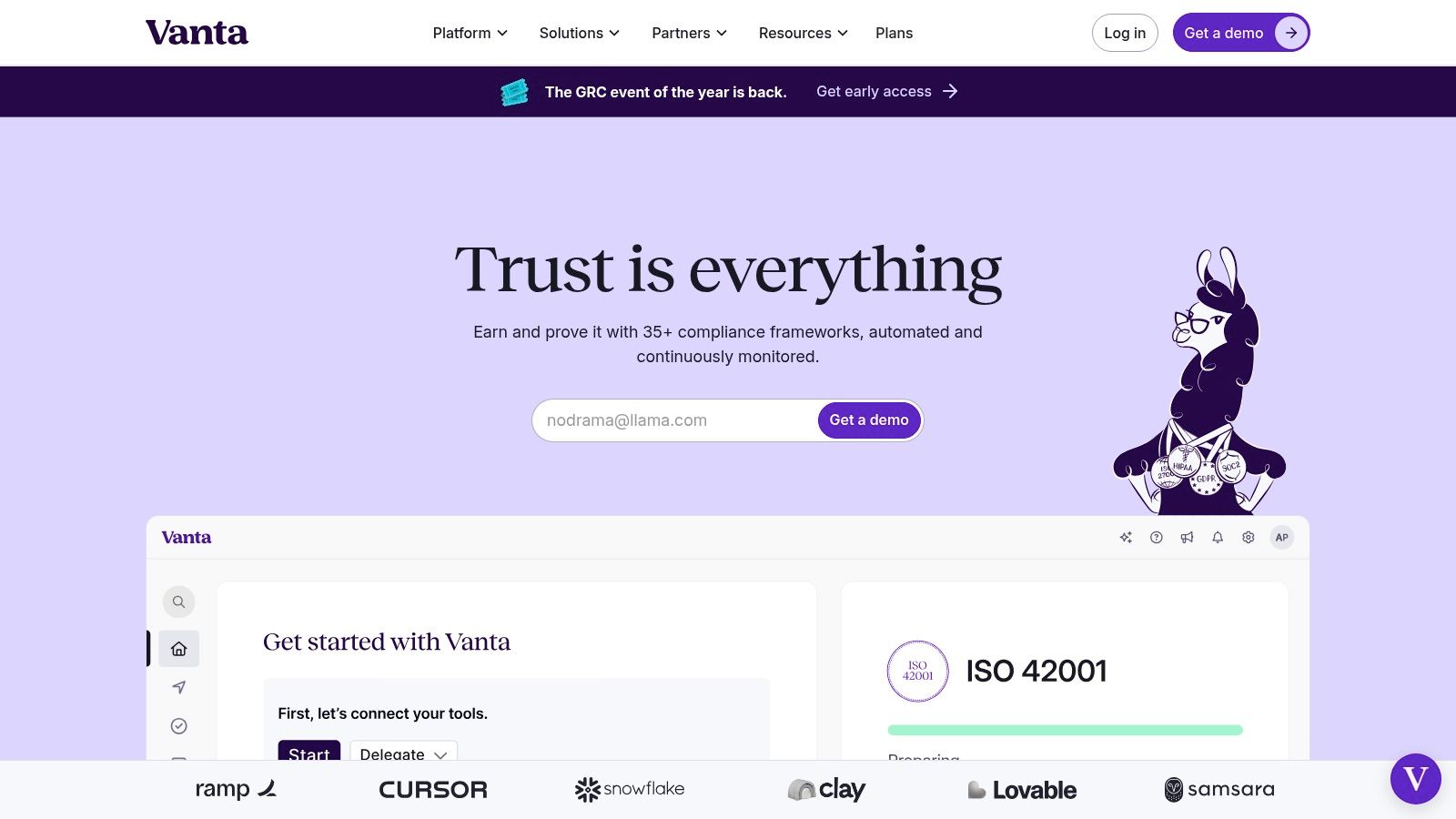
Vanta is strongest when compliance is part of the sales process. It connects with cloud, identity, HR, device, and productivity systems to collect evidence, monitor controls, manage policies, and present a customer-facing trust center. That makes it a natural fit for startups and SMBs selling into larger buyers, especially when security reviews arrive before the company has a dedicated compliance operations team.
Its operating model is automation first, with human review around exceptions and audit judgment. The platform supports cross-framework reuse across programs such as SOC 2, ISO 27001, HIPAA, and GDPR, while third-party risk workflows and questionnaire assistance extend the value beyond a single audit. The ecosystem includes 300+ integrations, according to the product plan supplied for this comparison, but buyers should test whether the specific connector collects the exact evidence their auditor accepts.
Practical rule: Treat workflow orchestration as a design problem, not merely an integration problem. Map who receives an alert, who fixes it, and who approves the exception. Guidance on workflow orchestration is useful when those handoffs span engineering, HR, and sales.
Vanta's main drawback is commercial predictability. List pricing isn't public, quotes can vary by frameworks and users, and renewal costs may rise as the program expands. It suits teams that want a mature, recognizable compliance experience. It may frustrate buyers seeking deep custom risk modeling or a fully transparent price before a detailed sales process.
2. Drata
Drata is a good match for cloud-native teams that want continuous compliance without assembling separate tools for trust management, questionnaires, and expanding GRC work. Its core approach combines deep integrations with continuous control monitoring. That model works well when evidence should refresh from live systems rather than sit in folders waiting for an audit request.
The platform covers SOC 2, ISO 27001, HIPAA, PCI DSS, GDPR, NIST, and other frameworks. Cross-framework control reuse can reduce duplicate evidence work, while its Trust Center lets teams share approved reports and security information with prospects. AI-assisted questionnaire support is useful for repetitive reviews, but answer quality still depends on the source material, control ownership, and a clear approval process. Teams exploring automating repetitive tasks should apply the same discipline here: automate predictable actions, then reserve human attention for judgment.
Where Drata fits best
Drata sits between a narrowly focused audit tool and a heavyweight enterprise GRC suite. It can support a fast SOC 2 or ISO journey while giving growing teams room to add third-party risk and AI governance workflows. Its modern interface is approachable for SMBs, but the broader module set can introduce governance work that a first-time audit team hasn't planned for.
The trade-off is pricing and scope control. Quotes vary by framework and tier, and advanced functions may be add-ons. Before signing, ask for a written breakdown of the base platform, each framework, questionnaire automation, vendor risk, AI governance, implementation, and renewal assumptions. Drata is compelling when the roadmap includes more than one compliance program. For a single, simple audit, its broader capabilities may be more than the team can operate well.

3. Secureframe
Secureframe stands out for buyers whose compliance scope includes public-sector or defense-related requirements. Alongside SOC 2, ISO 27001, HIPAA, PCI DSS, GDPR, and CMMC, its Federal Suite addresses CMMC 2.0 and FedRAMP 20x readiness. That focus changes the implementation conversation. The platform isn't just collecting screenshots. It must support stricter evidence quality, defined ownership, scope boundaries, and governance routines.
Automated evidence collection and continuous monitoring form the operational core. Cross-framework mappings allow teams to reuse controls, while evidence-quality checks can reduce avoidable audit rework. Access to a vetted auditor network may also help organizations that need guidance selecting an audit partner, particularly when internal teams don't yet know how federal expectations differ from commercial frameworks.
The federal-readiness trade-off
Federal capabilities don't remove the need for disciplined governance. A team still has to define the system boundary, classify environments, approve policies, manage exceptions, and prove that evidence represents the right scope. Buyers should ask which features are available in the purchased package and which require additional configuration or services.
Secureframe is a practical choice for organizations that need broad framework coverage and structured enablement, not merely a quick trust portal. Pricing isn't public, and complex scopes can extend timelines and cost. It may be excessive for a small SaaS company pursuing only a first SOC 2 report. It becomes more credible when public-sector sales, CMMC preparation, or FedRAMP-related readiness is part of the commercial plan.
4. Sprinto
Sprinto targets fast-moving technology companies that want a guided path from manual compliance work to continuous monitoring. Its cloud-first design connects control mapping, evidence collection, policy management, assets, vendors, and questionnaires in one operating workflow. That combination is useful for engineering-led teams where compliance tasks must fit existing development and IT routines rather than become a separate administrative project.
The platform supports SOC 2, ISO 27001, HIPAA, PCI DSS, and other programs. Developer-friendly integrations can shorten setup, while automated monitoring helps surface control issues during normal operations. The policy, asset, and vendor modules also give an SMB a path beyond its first audit without forcing it immediately into the complexity of a large enterprise GRC suite.
Sprinto's quoted plans are positioned as cost-efficient for startups and SMBs, but pricing isn't listed publicly and varies by scope. Ask whether the quote includes every framework, the number of users, implementation help, audit support, and questionnaire workflows. A low initial price can become less meaningful if essential functions are separated into higher tiers.
A fast first audit isn't the same as a mature compliance program. Confirm that the platform can preserve ownership, exception history, and recurring evidence after the initial report is complete.
Sprinto is best for small and midsize engineering teams that value speed, guided setup, and practical automation. Its limitation is enterprise governance depth. Organizations managing many entities, complex risk registers, or intricate internal-audit relationships may eventually need a heavier platform. For a focused first or second framework, however, Sprinto can avoid the unnecessary design burden of a configurable GRC system.

5. Thoropass
Thoropass, formerly Laika, combines compliance software, hands-on experts, and an affiliated CPA firm. Its operating model is therefore different from a pure software purchase. The same relationship can cover readiness, ongoing monitoring, evidence preparation, and audit or attestation work across SOC 2, ISO, HIPAA, PCI, and HITRUST.
That integrated model appeals to first-time audit teams. Instead of translating platform data for an outside auditor and coordinating separate providers, the buyer can receive practical guidance through one service structure. Cross-framework reuse and an expanding catalog, including ISO 42001 for AI management systems, support organizations that expect their compliance needs to broaden.
One relationship, one important question
The convenience comes with a governance question. Some buyers prefer to keep their software provider and auditor separate because independence optics matter to their customers, board, or internal policy. That doesn't make the Thoropass model unsuitable, but it does mean the procurement team should document who prepares evidence, who evaluates it, and who issues the final report.
Pricing varies. Published ranges in the supplied product notes describe packages from four-figure to low-five-figure levels, but buyers should treat those as indicative ranges rather than a universal quote and verify the current commercial terms directly. Ask about framework scope, audit timing, included expert hours, remediation support, renewal structure, and ownership of exported evidence.
Thoropass is a strong fit for a company that wants an end-to-end service rather than a software-only deployment. It may be less suitable for a mature compliance department that already has an auditor, established controls, and internal expertise.

6. Hyperproof
Hyperproof is built for compliance operations rather than a single point-in-time audit. It centralizes controls, evidence, risks, issues, policies, vendors, and questionnaires, making it a better fit for teams running multiple frameworks or entities. Its value appears when compliance managers need to assign work, track remediation, preserve history, and explain program status to several stakeholder groups.
The platform includes a multi-framework control library and automated evidence collection, but its deeper differentiator is extensibility. APIs, webhooks, and SDK capabilities let teams connect custom systems and create workflows that aren't available through a standard connector. That matters when critical evidence lives in internal applications, data warehouses, ticketing tools, or bespoke security systems.
What operational maturity changes
Hyperproof tends to make more sense after a company has moved beyond basic audit preparation. A small team with one framework may not have enough recurring risk, issue, or vendor activity to justify the platform's broader operating model. A mature program can benefit from the centralization because it reduces the risk of each framework becoming its own spreadsheet or evidence repository.
Pricing isn't public and is generally positioned above startup-oriented tools. Buyers should test the API limits, webhook behavior, role model, reporting, and evidence export before assuming extensibility solves every integration problem. Custom automation still needs maintenance, ownership, and change control.
Hyperproof is a strong choice for compliance leaders who want a durable control-operations system. It isn't the obvious choice for teams seeking the fastest possible first audit with minimal configuration.
7. AuditBoard
AuditBoard is designed for organizations that don't want compliance isolated from internal audit, SOX, IT risk, cyber risk, and third-party risk. Its CrossComply capability supports multi-framework management across SOC, ISO, NIST, PCI, GDPR, and CMMC, while the wider suite uses a connected data model to link controls, risks, audits, and remediation.
That operating model suits mid-market and enterprise teams with established audit or risk functions. AI-assisted mapping and impact analysis can help identify changing requirements and affected controls, but the output still needs a control owner who understands the business process. Integrations with Jira, ServiceNow, Azure DevOps, business-intelligence tools, and APIs support connections into delivery and remediation workflows.
Why integration depth matters
A compliance finding has more value when it can create an accountable task in the system where work already happens. Teams evaluating automated business intelligence should apply a similar standard here: dashboards are useful only when the underlying data is complete, timely, and tied to decisions.
AuditBoard's weakness is the implementation burden. Quote-only pricing and enterprise-oriented packaging can make it difficult for a small company to justify. Onboarding and configuration investment are also necessary to access the connected risk and audit model. Organizations that already manage SOX or internal audit may find that investment rational. A startup seeking one customer-facing SOC 2 report likely won't.
8. OneTrust
OneTrust is the broad-suite option for organizations where privacy governance is as important as security compliance. It supports consent operations, data mapping, data-subject access requests, incident and breach response, third-party risk, and broader GRC workflows. That makes it very different from tools built mainly around SOC 2 evidence collection.
The platform fits companies handling personal data across US and European markets, especially when privacy, security, and vendor governance must share information. A privacy team can manage requests and data flows while security and risk teams work from related governance structures. The benefit is breadth. The cost is the organizational discipline required to define owners, approval paths, retention rules, and acceptable automation boundaries.
Privacy automation needs accountable owners
Consent and DSAR workflows often touch legal, product, engineering, marketing, and customer support. Automating the routing doesn't decide whether a request is valid, whether a record should be withheld, or whether a retention exception is defensible. OneTrust can coordinate those decisions, but it can't replace the governance model behind them.
Pricing is quote-based and may become premium as modules are added. Implementation can also be complex, particularly when data mapping depends on inconsistent inventories or fragmented application ownership. OneTrust is a strong fit for privacy-led governance at scale. It may be the wrong first purchase for a small software company that only needs basic audit evidence and a customer trust page.
9. LogicGate Risk Cloud
LogicGate Risk Cloud is for organizations that need to design their own GRC workflows. Its no-code builder can model compliance, cyber risk, enterprise risk, third-party risk, audits, and related approvals without requiring every process to fit a preconfigured startup compliance template.
That flexibility is valuable when regulatory requirements, business units, or customer commitments don't align neatly with standard frameworks. Controls can connect to risks, vendors, audits, and remediation activities, while reporting and integrations support a broader risk picture. An app or library approach may accelerate initial setup, but the buyer still owns the process design.
Configuration is a capability and a cost
A configurable platform can reproduce a bad process just as efficiently as a good one. Before implementation, define the control taxonomy, risk scoring approach, evidence standards, approval paths, and reporting audience. Without that design work, no-code flexibility can produce inconsistent workflows that are difficult to govern.
LogicGate is typically enterprise-oriented, and pricing isn't public. It requires design time, skilled administration, and continuing ownership as regulations and business processes change. That makes it less suitable for a team that wants a guided first SOC 2 program. It becomes more attractive when the organization has outgrown point solutions and needs custom workflows across compliance, risk, vendors, and audit.
10. TrustCloud
TrustCloud, formerly Kintent, is built around the commercial side of compliance. TrustShare helps automate security questionnaires, TrustOps supports compliance workflows, TrustRegister organizes risk information, and TrustLens supports a live branded trust experience. That combination suits SaaS vendors and agencies whose compliance program directly affects sales conversations.
The platform can pre-fill questionnaire answers from verified controls and prior responses, then route the result for review. Its trust portal can include NDA gating and data rooms, giving prospects a more controlled way to access reports, policies, and supporting material. Modular packaging can keep the purchase focused when a company doesn't need a full enterprise GRC implementation.
Best for revenue-linked trust work
TrustCloud is strongest when the pain is repetitive security reviews and the need to present evidence clearly to buyers. AI assistance still requires setup and training. Teams should verify answer provenance, approval requirements, stale-response handling, and how the system distinguishes verified evidence from an earlier answer that may no longer be accurate.
The platform is better suited to light-to-mid compliance operations than very large bespoke GRC programs. A company with complex entities, extensive internal audit requirements, or advanced enterprise risk modeling may eventually prefer a heavier suite. For sales-driven teams, though, TrustCloud's operating model is more direct than buying a broad platform for a narrow questionnaire problem.
Turn the Shortlist Into a Safe Rollout
The market is moving from manual evidence folders and isolated point solutions toward continuous compliance operations. One market estimate puts regulatory compliance management software at USD 12.41 billion in 2025, rising to USD 19.8 billion by 2030 at a 9.5% CAGR. A broader estimate places compliance software at USD 35.82 billion in 2025, with projected growth to USD 78.85 billion by 2033 at a 10.5% CAGR. These are market estimates, not a reason to buy the largest platform. They show why buyers should choose an operating model that can survive changing obligations and expanding scope. The regulatory compliance management software market estimate provides the relevant market context.
Start by writing down the compliance job in operational terms. Is the immediate requirement a first SOC 2 audit, ISO 27001 evidence collection, questionnaire response, privacy request handling, vendor risk, or a connected enterprise risk program? Then name the frameworks, entities, environments, and evidence owners. A platform can't compensate for an undefined scope.
Match the platform to the team
For an SMB or agency with one main framework and a sales-driven need, a specialized tool such as Vanta, Drata, Sprinto, Secureframe, Thoropass, or TrustCloud is usually easier to operate than a full GRC suite. Choose based on the dominant bottleneck. TrustCloud may fit questionnaire volume, Thoropass may fit a first audit needing hands-on guidance, and Secureframe may fit public-sector or federal readiness.
A full GRC platform is justified when the organization manages multiple entities, frameworks, risk registers, audit teams, vendors, or complex approval workflows. Hyperproof, AuditBoard, and LogicGate become more relevant when compliance must share data and accountability with risk and internal audit. OneTrust is the better category to investigate when privacy operations and data governance drive the buying decision.
Validate the plumbing before the promise
Request a real integration workshop, not just a product tour. Map required connections across:
- Cloud systems: Confirm which accounts, subscriptions, regions, and environments the collector can access.
- Identity providers: Test user lifecycle, access reviews, privileged roles, and evidence timestamps.
- Ticketing and development tools: Verify that findings create actionable tasks with owners and due dates.
- HR and device systems: Check joiner, mover, leaver, training, endpoint, and encryption evidence.
- Internal APIs: Ask about authentication, rate limits, retries, custom fields, and maintenance ownership.
Automated evidence commonly follows a control-to-API pipeline. A collector pulls structured data, stores a timestamped evidence artifact, and links it back to a control ID. The practical workflow described in GRC as code and automated control evidence is control, API source, Python collector, evidence artifact, and audit package. That architecture is useful, but only if the source data is authoritative and the exception path is visible.
Protect evidence quality and accountability
Require every evidence item to carry its control reference, source system, owner, collection time in UTC, review or expiry date, environment or scope, version or snapshot identifier, and status. Accepted evidence should be locked for the review period, while exceptions should follow a separate approval route. These details are emphasized in modern GRC evidence guidance.
For ISO 27001 work, separate documentation, records, and observations. Finalize the Statement of Applicability before mapping controls to evidence sources, then schedule recurring collections so the program demonstrates ongoing operation rather than a one-time snapshot. ISO 27001 evidence guidance explains that distinction and the need for recurring collection schedules.
AI deserves its own review. Ask whether generated policies, questionnaire answers, regulatory mappings, or alerts are traceable to approved sources. Define which controls require human review, who can accept an exception, how false positives are resolved, and what happens when an integration stops collecting data. Continuous monitoring can reduce effort, but an attractive dashboard can create false confidence if stale evidence and unresolved exceptions are hidden. Compliance automation guidance on continuous monitoring is useful for assessing whether a product supports regulatory change, impact assessment, and workflow execution rather than merely document storage.
Finally, make the commercial and exit terms explicit. Clarify pricing by framework, user, entity, module, implementation service, support tier, and renewal. Confirm data residency, subprocessors, encryption, role-based access, audit logs, retention, deletion, backup handling, and evidence export format. Run a scoped proof of concept using representative systems and a real questionnaire or control set. Don't proceed until security, privacy, retention, export, audit independence, and vendor-independence requirements are documented and approved by the people who'll own the program after procurement.
Earlybird AI automates Upwork job discovery, personalized proposals, client replies, and follow-ups for freelancers and agencies managing sales activity. If your agency is evaluating automation for repeatable lead workflows alongside its compliance operations, visit Earlybird AI to see how the platform supports multi-user outreach and opportunity management.