← Back To Blog
Continuous Improvement Process: A Practical Agency Guide

You've probably watched this happen: an agency team identifies a recurring problem, discusses several fixes in a meeting, and fills a shared document with sensible ideas. Everyone agrees the proposal process is slow, client handoffs are inconsistent, or follow-ups disappear. A quarter later, the same issue returns with a new label and no reliable change behind it.
That isn't an idea problem. It's an execution problem. A working continuous improvement process connects an observation to a controlled experiment, a measured result, and a new standard that people follow. For agencies, that loop has to fit client work, uneven workloads, hybrid teams, and fast-changing tools. The practical model below combines the core frameworks, a lean agency roadmap, an applied Upwork outreach example, and the metrics that reveal whether improvement is real. For project leads balancing delivery with operations, this guide for busy project managers offers useful context on keeping improvement work manageable.
Why Most Improvement Programs Stall Before They Start
An account director brings three missed follow-ups to the meeting. A project manager shows that strategists use different intake forms, while the sales lead reports that proposals wait too long for approval. The group agrees on the diagnosis, assigns a vague action to “the team,” and returns to client work.
That handoff usually ends the improvement effort. No one owns the change, no one records current performance, and no review date exists to test whether the fix worked. The shared document becomes an idea cemetery. By the next meeting, new suggestions have arrived while the original problem continues unnoticed.
The gap between ideas and operating change
Service agencies have a distinctive failure point because their workflows cross roles quickly. One person finds a lead, another qualifies it, a third drafts the proposal, and an owner approves it while handling delivery issues. If a handoff waits more than one business day, the opportunity may miss its relevance window or require another follow-up, yet the agency may still lack a process owner and a consistent baseline.
The result is initiative fatigue. Staff hear “new process” and expect another document that will be ignored when workload rises. More training rarely changes that response. The recurring constraints are decision rights, data quality, and follow-through, especially when teams define the same metric differently. APQC's discussion of process and performance priorities highlights measurement, governance, and execution as persistent constraints, rather than idea generation alone (APQC's 2025 process and performance priorities).
Practical rule: An improvement idea becomes active when one person owns the test, one metric has a baseline, and one review date is on the calendar.
Start with a process that repeats often and a problem the team can observe directly. For an agency, that might be lead qualification, proposal approval, client onboarding, or a reporting handoff. Keep the first change narrow enough to inspect, such as testing one proposal checklist with one service team rather than rewriting every workflow at once.
The aim is a working loop, not an impressive transformation plan. The team should be able to identify a failure, test a specific change, measure the result, and decide whether to make it standard work. Project leads balancing delivery with operations can also use this guide for busy project managers for practical context on keeping improvement work manageable. Once the loop proves reliable, the agency can apply it to outreach, hiring, delivery reviews, and reporting without creating separate bureaucracy for each process.
Defining the Continuous Improvement Process
A continuous improvement process gives an agency a repeatable way to improve work under real operating conditions. The team plans a change, tests it on a limited scope, measures the result, standardizes what works, and uses the learning to shape the next cycle. The word “continuous” does the heavy lifting here. It signals an ongoing operating cycle, so a process stays open to review even after an improvement becomes routine.
An agency's proposal workflow shows how this works. Publishing a new template may change the document, but the workflow improves only when the team tests the template with live opportunities, reviews response quality and conversion signals, updates the standard, and asks what the next test should examine. The same cycle applies to lead qualification, client onboarding, reporting handoffs, and delivery reviews.
Why measurement belongs in the definition
Continuous improvement has deep statistical roots. Walter A. Shewhart developed statistical process control at Bell Laboratories in the 1920s, and that work later became a foundation for modern quality engineering and lean Six Sigma (review of continuous improvement's development). Later research extended the focus to process and inventory optimization. Lean manufacturing and the Toyota Production System then helped establish continuous improvement as an operating philosophy used across industries and social organizations.
For service agencies, measurement determines whether a change deserves adoption. A useful discussion can produce ideas, but the team needs a defined current condition, a deliberate intervention, and a comparison with the prior condition before calling the process better. That discipline also exposes trade-offs. A faster proposal review may increase throughput while weakening qualification or personalization, so speed alone cannot serve as the verdict.
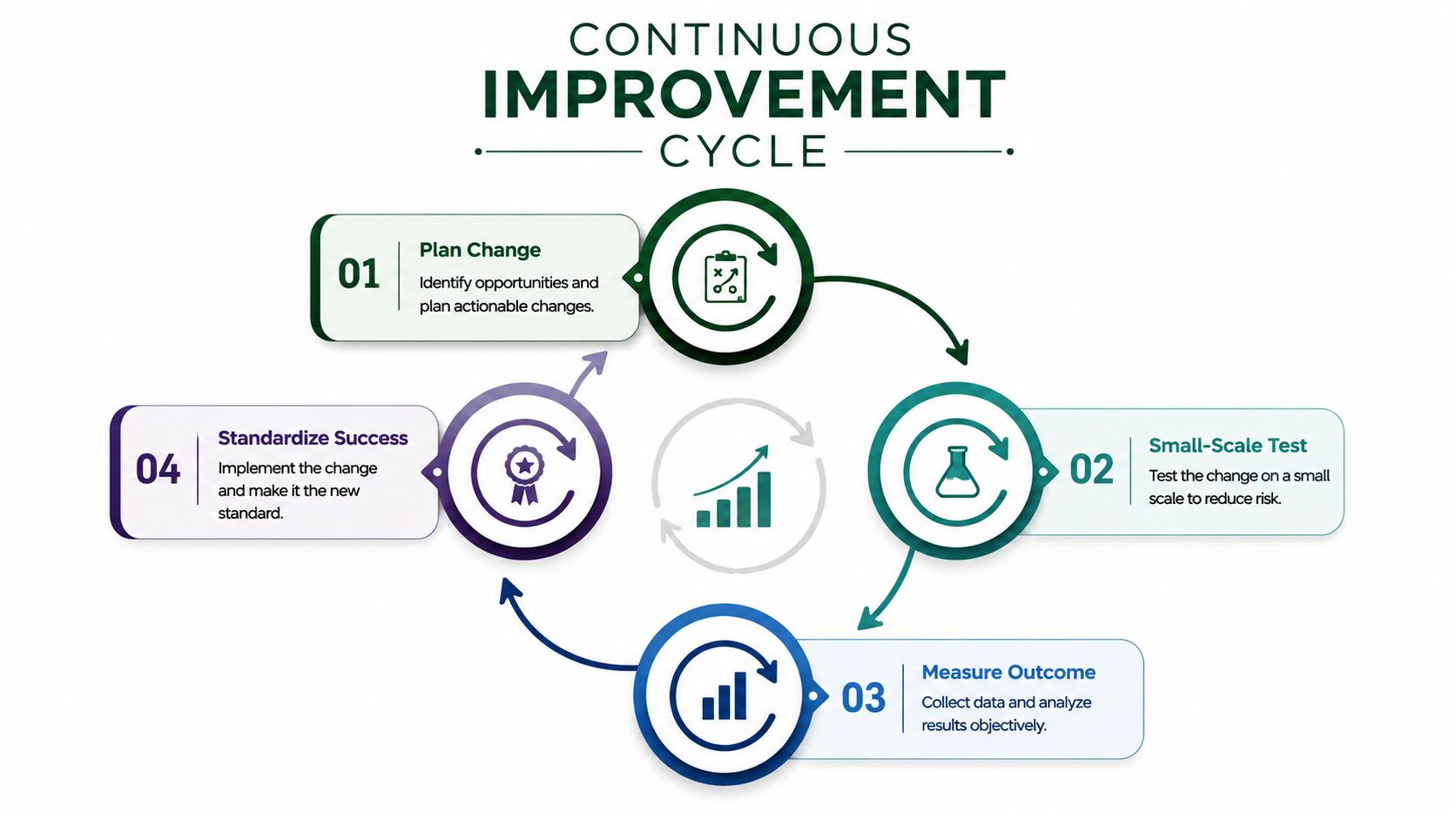
The operating loop
Use this model for agency work:
- Plan the change. State the problem, suspected cause, proposed intervention, owner, baseline, and measure.
- Test it narrowly. Change one workflow element across a defined set of work instead of rewriting the whole operation.
- Measure the outcome. Compare results with the baseline and inspect quality, not only speed.
- Standardize or reject it. If the change works, update the checklist, template, automation, or training. If it fails, record the learning and plan the next test.
Standardization determines whether the cycle creates operating value. An experiment that never reaches normal work remains a temporary exception. Improvement counts when it survives the next planning cycle and remains usable under normal workload.
Comparing PDCA, Kaizen, and Six Sigma
These frameworks solve different problems, so choosing one should depend on the process, not on which label sounds most impressive. PDCA is usually the fastest starting point, Kaizen is strongest as a habit and management style, and Six Sigma fits problems where variation, defects, and evidence require more formal analysis.
FrameworkCycle structureData intensityBest fitPDCAPlan, Do, Check, ActLight to moderateSmall experiments and fast workflow changesKaizenFrequent incremental improvements, often followed by SDCA standardizationLight to moderate, with practical observationTeam habits, everyday waste reduction, and shared ownershipSix SigmaDefine, Measure, Analyze, Improve, ControlHighPersistent defects, significant variation, and complex root-cause work
PDCA for fast agency experiments
The ASQ description of the PDCA cycle defines four moves. Plan identifies the opportunity and prepares a change. Do tests it on a small scale. Check reviews the evidence and learning. Act standardizes a successful change or starts another plan.
That structure works well when an agency suspects a bottleneck but doesn't yet know which intervention will help. For example, a proposal team might test a revised qualification checklist on a narrow segment of opportunities. The evidence can be practical, such as completion time, first-pass quality, and client response, provided the team records the measures consistently.
Kaizen and the discipline of standard work
Kaizen emphasizes frequent, incremental improvement and broad participation. It doesn't require every change to become a formal project. The people closest to the work can identify friction, test a modest adjustment, and share what they learn.
Kaizen works best when paired with SDCA, meaning the team improves a process and then standardizes it before pursuing the next improvement. This stabilizing step prevents an agency from constantly changing its workflow without giving staff a dependable default (Kaizen's explanation of the improvement and standardization cycle).
Six Sigma when variation is the problem
Six Sigma is heavier. Motorola is credited with creating it as a formal improvement framework in 1987, and its DMAIC cycle means Define, Measure, Analyze, Improve, Control. The method commonly targets a process capability associated with 3.4 defects per one million opportunities (statistical quality control and Six Sigma background).
An agency rarely needs a full Six Sigma program to fix a broken handoff. It may need Six Sigma thinking when inconsistent data, repeated defects, compliance risk, or complex dependencies make quick experimentation unreliable. A practical rule is simple: use PDCA for a small uncertainty, Kaizen for a recurring team habit, and Six Sigma when variation itself demands rigorous analysis. Teams looking to streamline processes for your team can use that distinction before selecting tools or training.
A Step-by-Step Roadmap for Small and Midsize Agencies
A small agency doesn't need a dedicated operations department to begin. It needs a narrow process, a named owner, a baseline, and a review rhythm that survives busy client weeks.
Start with ownership and evidence
Assign one process owner. Choose the person accountable for the workflow's performance, not necessarily the person who performs every task. The owner writes the problem statement, coordinates the test, and makes sure the standard changes when the decision is made. The common failure is shared ownership, which usually means nobody has authority to resolve a disagreement.
Identify one measurable problem. “Our sales process feels inconsistent” is too broad. “Proposal approvals wait for review” is closer, but still needs a defined measure. Choose one observable failure, such as elapsed time, rework, missed handoffs, or incomplete information.
Set a baseline. Record the current condition before introducing a fix. Use the data already available in your CRM, project system, inbox, or spreadsheet, but define terms first. A baseline without a consistent definition creates arguments later instead of learning.
Run, stabilize, and repeat
Run one PDCA cycle on a small scope. Test one change with a limited group, service line, or workflow stage. Give the team a clear start and stop point, then inspect both efficiency and quality. Agencies often fail here by changing several variables at once, which makes a positive or negative result impossible to interpret.
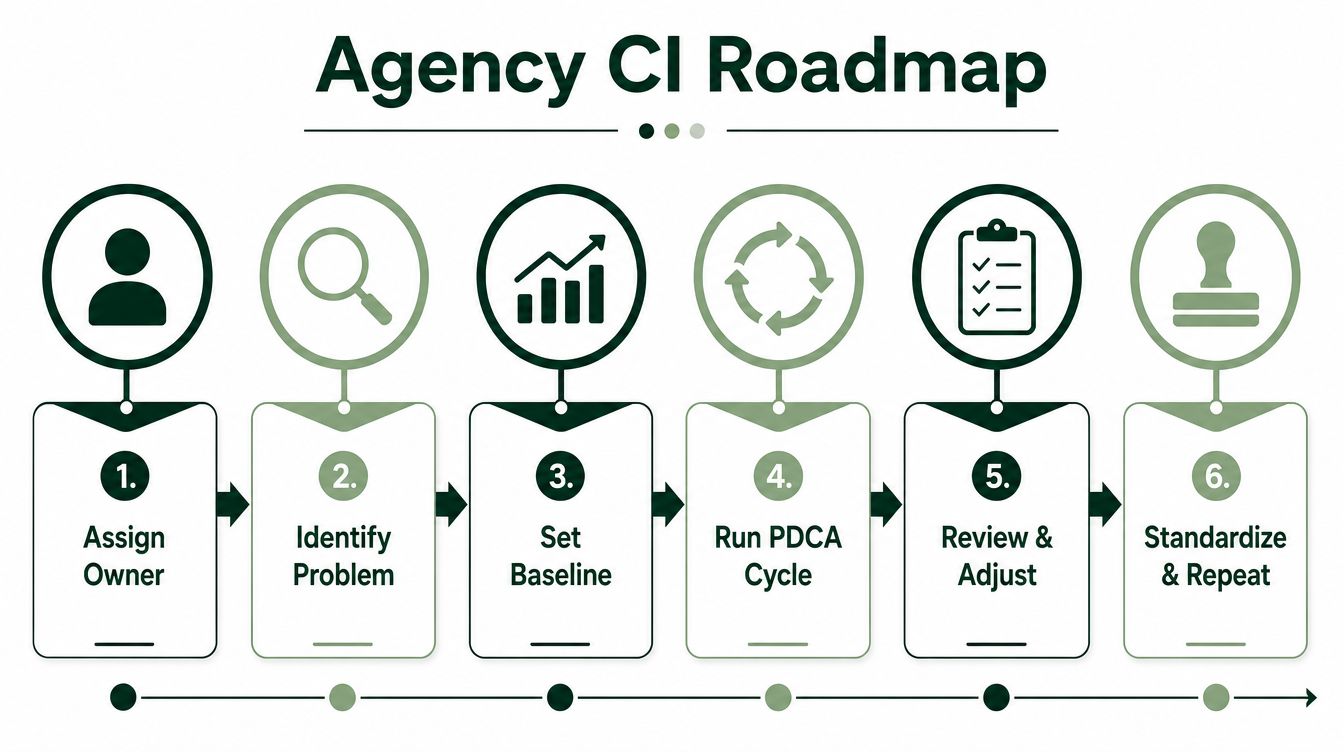
Review and adjust. The owner brings the baseline, test result, exceptions, and team feedback to a short review. Keep the change, modify it, or stop it. Don't continue a weak intervention because the team has already spent time creating it.
Standardize the win. Update the actual operating material, not just the meeting notes. That might mean a qualification field, a proposal checklist, a handoff rule, or an automation setting. Tell the people affected what changed and where the new default lives.
The final move is to schedule the next loop. A quarterly cadence gives a small or midsize agency enough time to observe a change without turning CI into a daily interruption. For broader operating context, an agency leader may also find this grow your marketing agency playbook useful when connecting process discipline with commercial priorities. Teams working on Upwork-specific operations can also review agencies on Upwork as they define ownership across multiple bidders.
Applying Continuous Improvement to Upwork Outreach and Proposals
Upwork outreach is a good CI candidate because it contains a visible sequence: scan jobs, qualify opportunities, draft proposals, submit, respond to clients, follow up, and book calls. Each stage creates measurable timestamps and decisions, which makes the workflow easier to improve than a vague goal such as “generate more leads.”
Start by defining the funnel metrics. Track proposal-to-reply rate, time to first proposal, reply-to-call rate, and the quality of opportunities entering the pipeline. The first baseline should describe the current process before automation or template changes. If the agency can't agree on what counts as a reply or a booked call, the dashboard will create false precision.
Use PDCA on one outreach variable
A useful first cycle might test proposal personalization. The team can keep the target project type constant, change the opening structure, and compare reply quality with the existing approach. Another cycle might test response speed, while a later one examines follow-up timing. Changing all three together creates activity, but not learning.
Earlybird AI can fit into this loop as an Upwork automation platform. The publisher describes it as connecting to an Upwork account, learning preferred projects through thumbs-up and thumbs-down feedback, searching for opportunities, crafting personalized proposals, and replying to client messages. Its stated workflow submits proposals within about 10 minutes of posting and replies in under 5 minutes, which can compress the Do and Check stages when the team is testing outreach changes (automate Upwork proposals).

Keep human judgment at the decision points
Automation can increase the number of experiments, but it can also hide quality problems. A faster proposal may attract replies that don't fit the agency's services. An automated message may answer promptly while missing a scope concern. The Check stage should therefore include human review of message relevance, qualification, and next-step quality, not only delivery speed.
A practical loop looks like this:
- Plan: Choose one audience, one proposal adjustment, and one primary KPI.
- Do: Run the change through a controlled workflow and record exceptions.
- Check: Review response, call conversion, message quality, and disqualified leads.
- Act: Keep the change only if it improves the commercial outcome without lowering quality.
The mindset shift: Stop treating prospecting as a sequence of manual tasks. Treat it as an engineered process with inputs, controls, feedback, and standards.
KPIs, Tooling Patterns, and Common Pitfalls
A CI dashboard should help an owner make a decision, not reward the team for producing more activity. For an agency, the most useful measures connect operational effort with commercial quality.
Cycle time shows how long work takes from one defined stage to the next. First-pass yield shows how often work moves forward without rework, such as a proposal passing internal review without revision. Proposal-to-reply rate indicates whether the outreach earns a response, while reply-to-call rate tests whether those responses become qualified conversations. Standard-work adherence reveals whether the agreed process is being followed.
Match each tool to the control it supports
A dashboard establishes the baseline and makes trends visible. A workflow tool assigns the owner, captures due dates, and records decisions. A CRM or structured spreadsheet can hold the process definition when the agency isn't ready for a larger platform. AI-assisted outreach can reduce repetitive work, but the team should preserve human approval at points involving fit, promises, pricing, or sensitive client information.
The same logic applies to reporting. A resource such as SEO agency reporting guidance can help teams think about which measures belong in a recurring operating review rather than scattering metrics across disconnected documents.
Four failure patterns deserve active controls:
- Too many ideas at once: Limit active experiments so the team can identify cause and effect.
- No clear process owner: Assign decision authority before asking for suggestions.
- Unmeasured improvement: Define the baseline and metric before changing the workflow.
- Unreviewed AI output: Audit automated work for relevance, compliance, and exception handling before treating the result as valid.
The operating cadence can stay lean. At each review, the owner should state the baseline, the change tested, the result, the exceptions, and the decision. That record becomes the agency's improvement memory. Without it, teams repeatedly re-litigate old choices and mistake renewed discussion for progress.
A Short Case Example and What to Measure Next
Consider a representative three-person design agency that applies a CI loop to its Upwork funnel. It starts with a 4% reply rate and a 36-hour average first-response time, then runs four weekly PDCA cycles focused on personalization and faster responses. Within a quarter, the reply rate reaches double digits, sales cycles shorten, and one new client covers the tooling cost.
The important lesson isn't the headline result. It's the measurement chain, proposal quality, reply quality, booked calls, and revenue. Track leading indicators that predict the next quarter, not activity that merely looks busy.
Earlybird AI connects to Upwork, learns preferred projects from feedback, searches opportunities, drafts personalized proposals, and replies to client messages automatically. Visit Earlybird AI to see how its analytics and workflow automation can support a measurable continuous improvement process for your agency.