
← Back To Blog
Cover Letters on Upwork That Win Clients
You've found a promising Upwork job, read the description twice, and started typing: “Hi, I'm an experienced freelancer…” It's true, but it could fit almost any project. A client scanning proposals has little reason to keep reading unless your opening shows that you understand the work in front of them.
That's why the strongest cover letters on Upwork aren't miniature biographies. They're compact risk-reduction documents: they show the client you understood the problem, can handle the work, and have a sensible next step in mind.
How Upwork Cover Letters Actually Work
A client opens a queue of proposals. One begins with a broad introduction; another immediately refers to the project's specific challenge. The second gives the client a reason to read further, while the first asks the client to do the work of figuring out whether the freelancer is relevant.
On Upwork, the cover letter is the proposal message attached to your application. Every submitted proposal includes one, and the message appears alongside your rate, profile, and any work samples you choose to share. That makes it your first written explanation of fit and approach, not just an introduction to your profile.
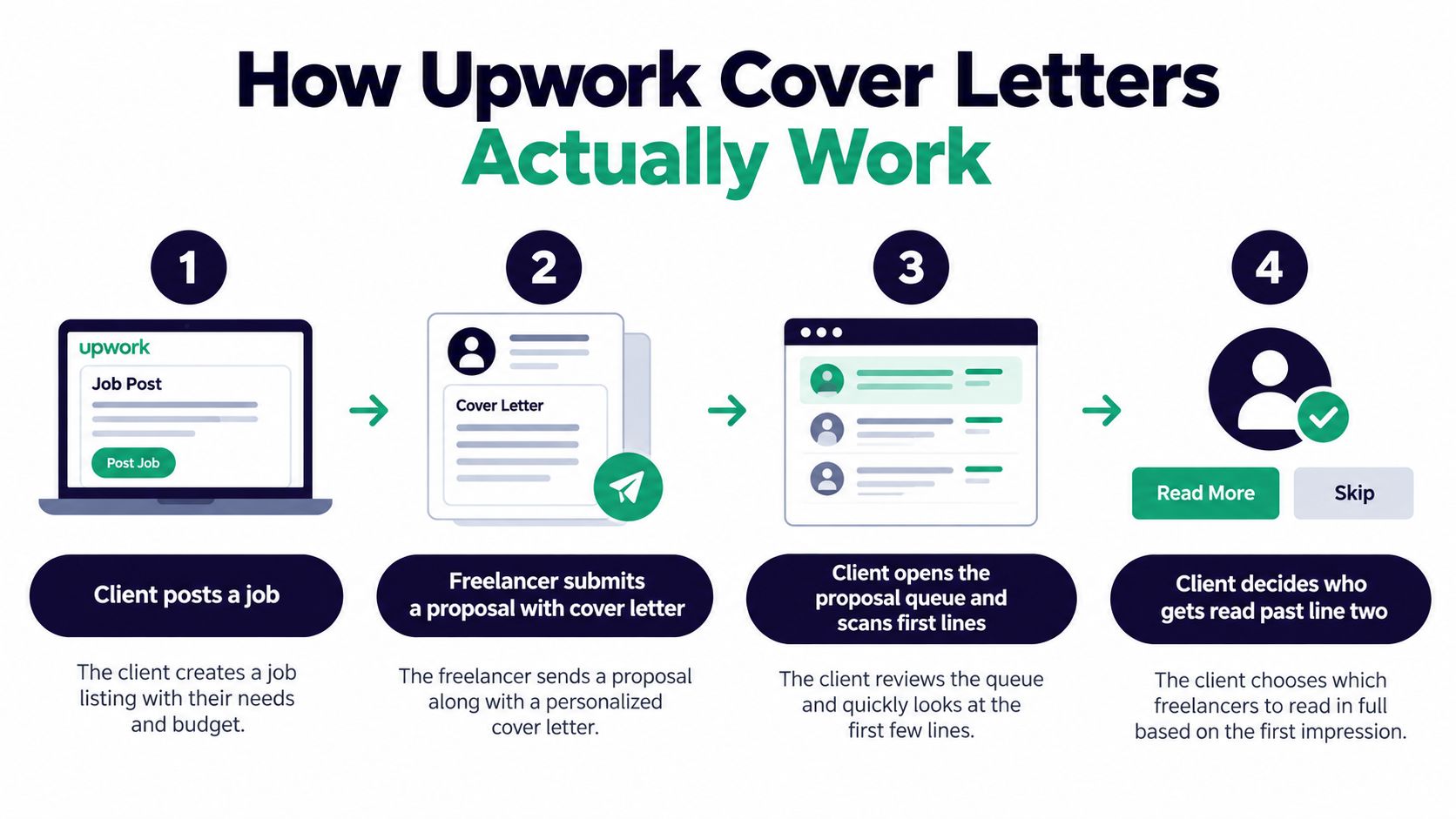
The opening matters because Upwork says clients may preview only the first one or two sentences while reviewing proposals. The platform recommends tailoring each letter to the particular client and project instead of sending a generic template. Upwork's cover letter guidance also points freelancers toward details from the job description, a brief explanation of how they'd solve the problem, and relevant examples or work links.
That changes the writing priority. Don't lead with your whole career history. Lead with the client's need, then connect it to a credible way forward.
Practical rule: If your first sentence could be pasted into a different proposal without changing a word, it isn't specific enough.
A cover letter is also part of a paid application decision. Upwork proposals require Connects, and freelancers can use additional Connects to boost visibility. That makes each application a choice, not just an administrative step. Before spending time on a proposal, review how bidding on Upwork works and decide whether the project fits your services, experience, and capacity.
The Anatomy of a Winning Cover Letter
A useful cover letter has a job to do in every part. Think of it as a short sequence of answers to a client's unspoken questions: Did you understand the work? Can you do it? What would happen next?
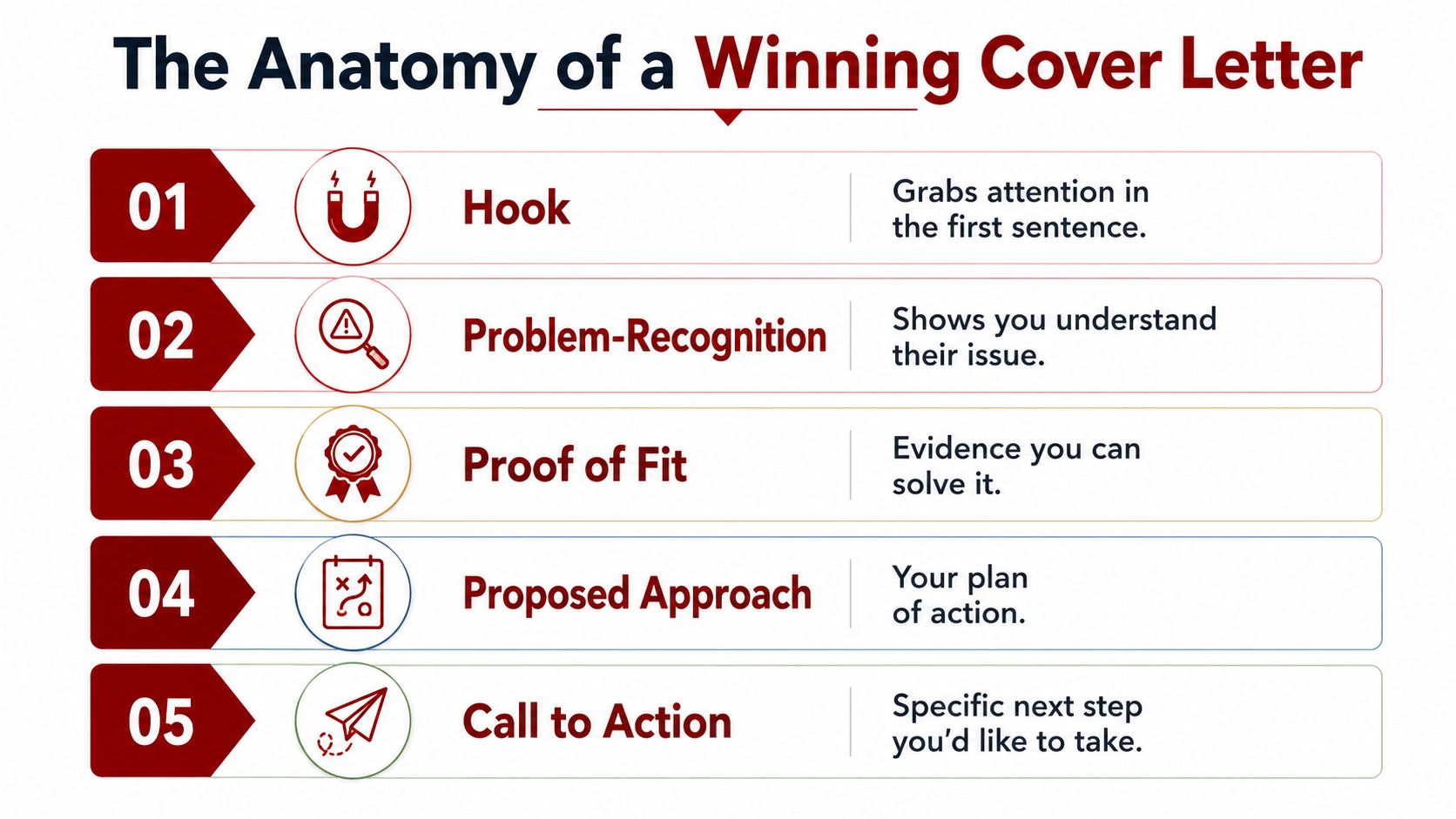
- Hook: Start with a detail from the job, not a generic greeting or an account of your career. For example: “Your product page needs clearer feature comparisons, especially for shoppers weighing the two subscription plans.” The client can tell immediately that you read the post.
- Problem recognition: Show that you understand the obstacle behind the requested deliverable. If the client wants a website redesign, the underlying issue might be a confusing checkout flow, not a desire for a prettier homepage. Name what you can reasonably infer, and don't pretend to know what the client hasn't said.
- Proof of fit: Point to a closely related project, skill, or sample. Keep it relevant. A short explanation of how you handled a similar checkout flow says more than a list of unrelated industries you've worked in.
- Proposed approach: Describe a practical first step or sequence of work. For instance: “I'd start by mapping the existing checkout, then share a revised flow before moving into visual design.” When timing matters, state a realistic timeline or milestone assumption, and be clear about what could change it.
- Call to action: Finish with a specific, easy-to-answer invitation. “Would you like me to outline the first milestone around the checkout flow?” gives the client a clear opening to respond.
Upwork recommends a concise letter, often about 200–300 words or fewer depending on the project, that recognizes the client's problem, demonstrates relevant expertise, offers a realistic timeline, and identifies information needed to finalize the scope. You can find the details in Upwork's proposal-writing guidance.
The price you propose should also match the scope and your capacity. If you need to sense-check your rate before committing to a project, NAS Ledger's freelance pricing tool can help you think through the numbers without turning the cover letter into a pricing essay.
Reading the Job Post Like a Brief
A job post is a working brief, even when it's short or loosely written. Your task is to separate what the client explicitly requests from the constraints and uncertainties that affect delivery.

Read the post with three questions in mind:
- What must be delivered? Identify the requested output, tools, skills, and any instructions the client expects applicants to follow.
- What could limit the work? Look for dependencies, missing materials, approval steps, deadlines, or unclear responsibilities that might affect your approach.
- How does the client communicate? A detailed post may signal that the client values process and specifics. A concise post may require you to ask a focused question rather than assume the scope.
Then choose one observation that proves you've understood the assignment. If a marketing coordinator post asks for a campaign calendar that supports product launches, an opening could mention coordinating content around launch dates. “I'm a skilled marketer who can help your business grow” doesn't reflect that detail, even if the claim is sincere.
This is why surface-level personalization often fails. Using a client's name or repeating a keyword from the post doesn't show that you grasp the problem. The useful signal is the connection between the requested work and the reason it matters.
You can apply the same kind of qualification thinking to proposal writing: identify what the client needs, what's unclear, and whether your service is a genuine fit. This guide to qualifying sales leads offers a related way to think about fit before you invest effort in a conversation.
Don't invent a hidden pain point to make your letter sound insightful. If the post doesn't provide enough information, acknowledge the uncertainty and ask a concise question that would help define the work.
Length, Format, and When to Break the Rules
For many projects, two or three short paragraphs are enough. That format gives you room to recognize the client's need, show relevant proof, describe your approach, and ask for a next step without making the client sift through a biography.
The word-count decision should follow the complexity of the brief. Upwork's recommendation is to keep the letter to approximately 200–300 words or fewer depending on the project, as covered earlier. Use less when the scope is simple and your fit is easy to show. Add detail only when it answers a real question about delivery.
A longer letter can make sense for a multi-phase agency engagement or a technical post that reads like a request for proposal. If you need extra space, use it to clarify phases, dependencies, milestones, or assumptions. Don't use it to repeat your profile, add generic praise, or list every tool you know.
A useful test: every paragraph should reduce a hiring uncertainty or help the client decide what to do next.
Keep paragraphs short and easy to scan. A compact list can help when a project has distinct deliverables, but a cover letter shouldn't turn into a full project plan before the client has agreed on scope.
For a larger engagement, it may help to consider how a more formal proposal differs from the initial application message. LiveDocument's discussion of when one page is too few provides useful context for deciding when the work needs a separate, more detailed document. Keep the Upwork cover letter focused on earning that next conversation.
A Real Cover Letter Before and After
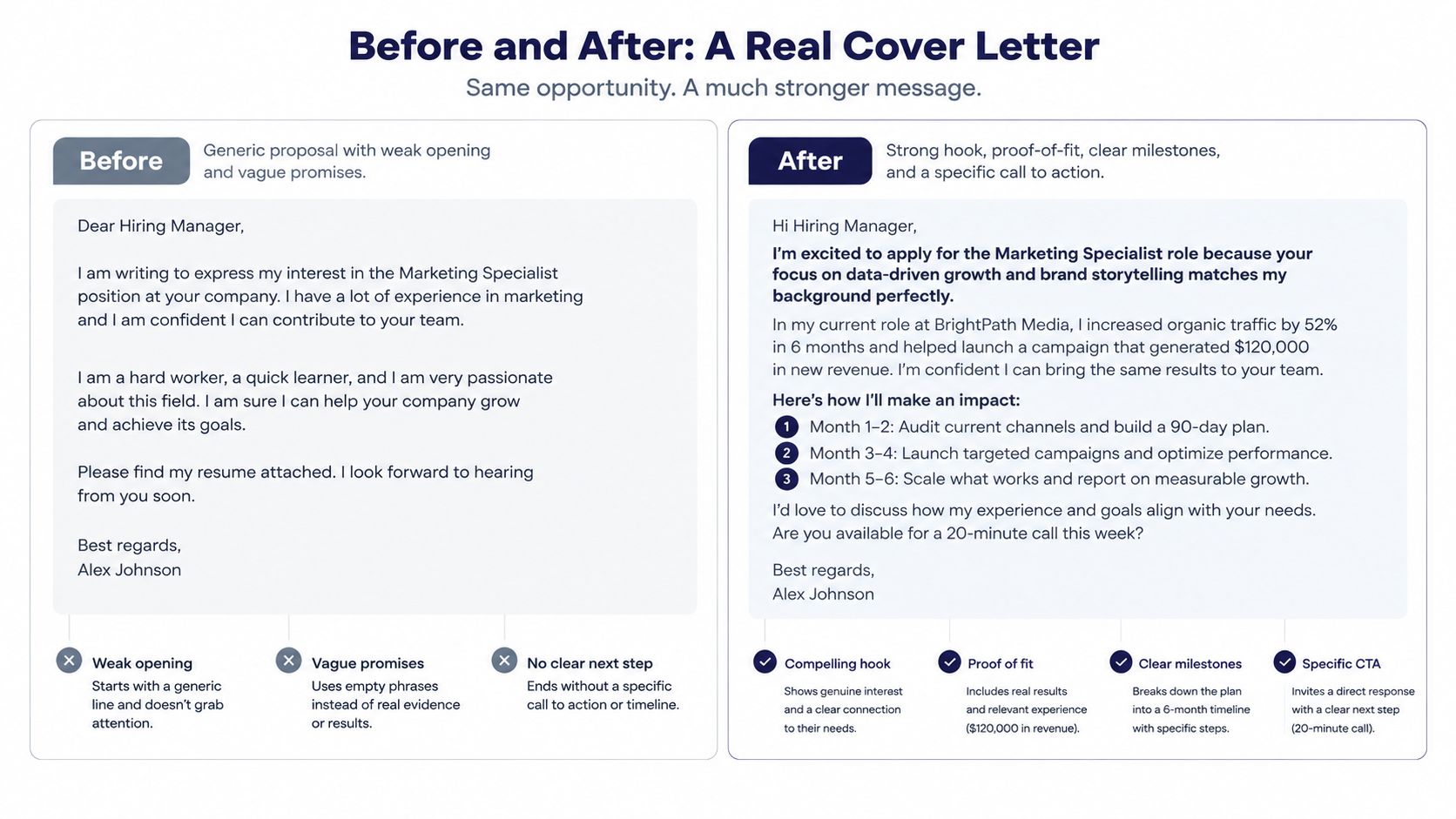
Consider a client who needs a marketing coordinator to organize a product launch. The following example is illustrative, not a real client outcome. It shows the difference between a self-focused introduction and a message that reduces uncertainty.
Before
Hi, I'm an experienced marketing freelancer and I'd love to help with your project. I'm reliable, hardworking, and skilled in many areas of marketing. I can start right away and deliver great results. Please check my profile and let me know if you'd like to work together.
The writer may be qualified, but the client can't tell whether they've read the post. “Many areas” doesn't establish a relevant skill, “great results” offers no evidence, and “let me know” leaves the next step vague.
After
Your launch calendar needs to keep email, social posts, and product updates aligned around the release date. I can help organize those moving pieces into a schedule your team can review and update.
I've coordinated content calendars where several channels had to follow one launch plan. I'd start by gathering your release dates, existing assets, and approval steps, then draft the calendar for review before scheduling begins.
If you can share the launch date and the channels involved, I can suggest a first milestone and a realistic schedule. Would you prefer to begin with the calendar structure or a review of your existing launch materials?
The opening reflects a specific coordination problem instead of claiming broad enthusiasm. The proof line connects experience to the work without inventing a result, while the proposed approach gives the client a clear first step. The closing asks for information that affects scope and offers a direct way to continue the conversation.
The example also avoids an easy trap: promising a timeline before learning what materials or approvals are available. A timeline is useful when it's grounded in an assumption the client can confirm, not when it's a guess presented as a commitment.
How AI Proposal Tools Fit Into the Workflow
AI can help with repetitive parts of proposal work, such as extracting requirements from a job post, organizing relevant experience, and producing a first draft. It can also help you compare the draft against a checklist. But speed doesn't guarantee relevance, and polished wording can still miss the client's actual request.
Use automation as a drafting assistant, not as the decision-maker. Before submitting, check whether the proposal names a real detail from the job, whether the sample you mention is related, and whether any promise about timing or outcomes is supported by what you know. Remove claims the tool supplied that you can't verify.
This distinction matters because Upwork's own proposal guidance emphasizes client-specific writing, relevant expertise, a realistic timeline, and questions needed to confirm scope. A draft that sounds smooth but lacks those elements hasn't reduced the client's risk. It has only made the gap harder to notice.
Common Mistakes That Kill Reply Rates
A weak proposal isn't always a sign that you lack the right skills. Often, it means the message makes the client work too hard to see the connection between your skills and the job.
- Leading with your biography: “I'm a passionate freelancer with extensive experience” centres you before addressing the client. Try: “Your brief calls for product descriptions that keep technical details clear for non-specialist buyers.”
- Repeating your profile: A list of skills already visible elsewhere adds little. Instead, name one relevant skill and explain how you'd apply it to this project.
- Attaching unrelated samples: A strong portfolio piece can still weaken a proposal if it doesn't match the work. Select a sample that makes the client's decision easier, or explain why a comparable piece isn't available.
- Burying the answer: If the client asks applicants to describe a process or confirm a requirement, don't hide your response beneath general claims. Answer the instruction directly, then add proof.
- Making unsupported promises: “I'll deliver exactly what you need” says nothing about how you'll do it. Offer a realistic first step and state what you still need to confirm.
- Ending without a next step: “Let me know” leaves all the work to the client. Ask one focused question or invite a short discussion about a specific part of the project.
These habits are fixable. Before sending, remove any sentence that doesn't help the client understand your fit, your approach, or the next decision.
Your Pre-Send Quality Checklist
Run this check before you submit. If a proposal misses one of the core tests, revise it before adding more words.
- Opening-line test: Does the first sentence connect to a specific need in the job post?
- Proof-of-fit test: Have you named a relevant skill, example, or work sample that you can support?
- Milestone test: Is your first step clear, and does your timeline depend on realistic assumptions?
- Question test: Have you asked for any information needed to define the scope?
- Length test: Can you remove anything that repeats your profile or doesn't help the client decide?
- Call-to-action test: Is the next step specific and easy to answer?
A strong cover letter doesn't need to prove everything about you. It needs to give the right client enough relevant evidence to continue the conversation.
Earlybird AI connects to your Upwork account, identifies relevant jobs, and drafts personalized proposals based on each post, with automation options for sending proposals and replying to client messages. If you want to explore how that workflow could support your proposal process, visit Earlybird AI.


