
← Back To Blog
Data Entry on Upwork: The Complete Freelancer Guide
You open Upwork, type in data entry, and the screen fills with near-identical jobs that all look safe, simple, and low-margin. That's the trap. The work isn't scarce, the attention is, and every Connect you spend is part of the acquisition cost whether you win or not.
For data entry on Upwork, the game is not typing faster than everyone else. It's deciding which jobs are worth the proposal spend, which profile signals make clients trust you, and which gigs are so cheap they drain your hourly rate. Upwork's own scale shows why this matters, with 785,000 active clients and $787.8 million in full-year 2025 revenue, plus $5,129 in GSV per active client in Q4 2025, up 7% year over year investor report.
What Data Entry on Upwork Looks Like Today
The first thing most freelancers notice is how similar the listings feel. One job says Excel cleanup, another says CRM update, another says research or transcription, and the pay often looks too low to justify much thought. That sameness is why so many people burn Connects on weak-fit bids and call it trying.
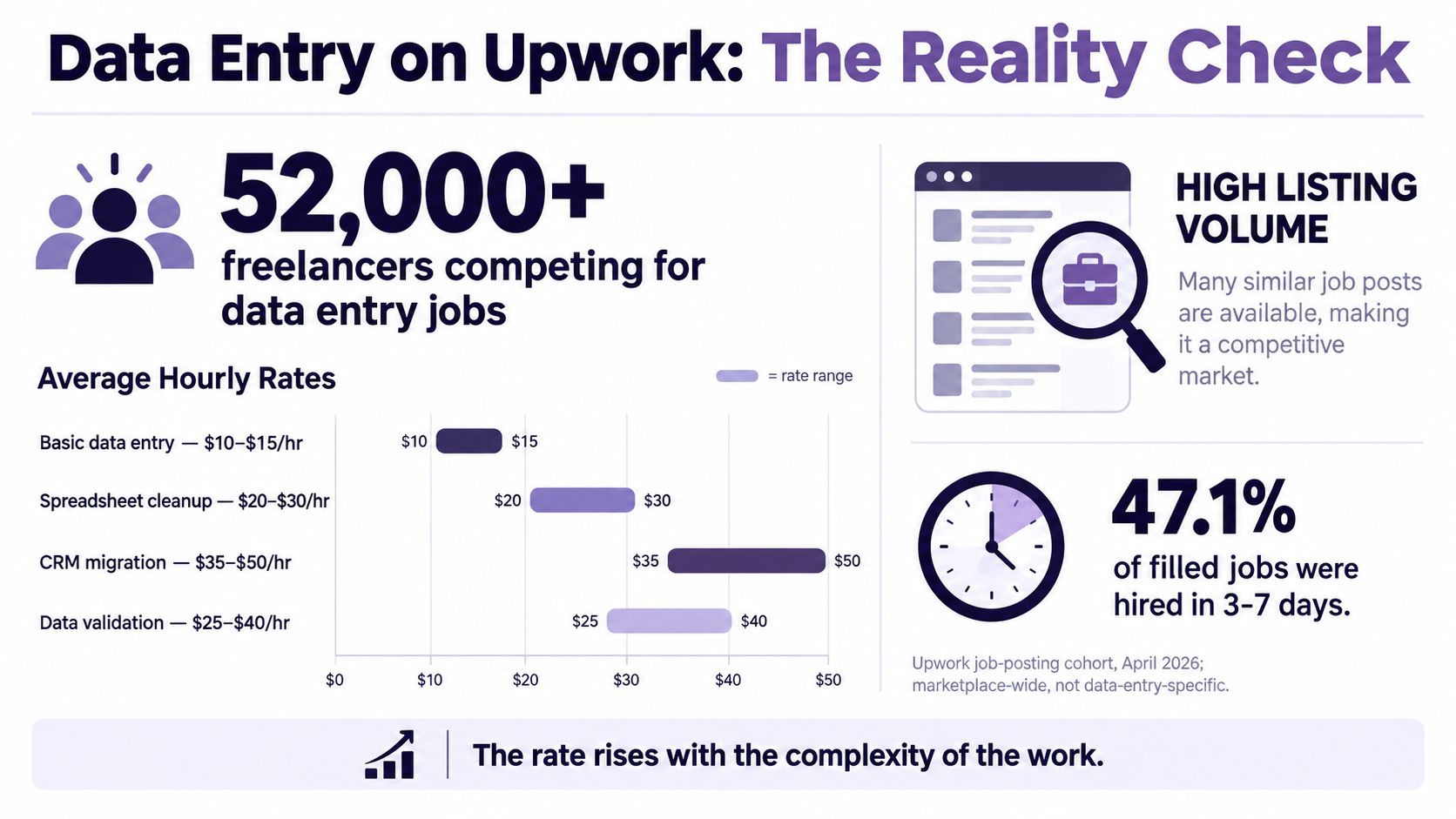
The marketplace is still large enough to support repeat work, not just casual browsing. As noted in the investor figures above, Upwork reported 785,000 active clients in 2025. For a freelancer, that means data entry on Upwork can become a steady income stream, but only if each proposal has a real chance of paying back the time and Connects spent on it.
What the search page really means
A generic search result is usually not a signal to bid. It is a signal to qualify harder. Many postings are tiny, some are badly scoped, and a few are better suited to spreadsheet cleanup, research, or migration work than plain typing.
Practical rule: if the listing looks interchangeable with ten others, your proposal probably is too.
The competition is broad and global. Marketplace data shows more than 52,000 freelancers list data entry as a skill on Upwork, and the platform hosts more than 18 million freelancers across 180+ countries marketplace data. That is not a local pool. It is a market where buyers can compare dozens of similar profiles in minutes.
That changes the economics of every bid. Treat each Connect-spent proposal like acquisition cost, and the only jobs worth chasing are the ones where the likely fee can cover that cost and leave room for repeat work. Data entry on Upwork is selective work. Bid like a small business, and the screen starts to look less like noise and more like a filter for demand worth pursuing.
Which Data Entry Skills Clients Actually Buy
A client who posts a data entry job is usually buying a mix of cleanup, judgment, and consistency. The typing is the easy part. The work that gets retained is the part that keeps records clean, systems aligned, and errors from spreading.

The sub-niches that matter
A strong profile points to one or two lanes, not all of them:
- Spreadsheet cleanup: fixing formatting, removing duplicates, standardizing fields, and making messy files usable.
- CRM migration: moving contacts or records from one system to another without breaking the structure.
- Data validation: checking records against source material and correcting mismatches.
- Web research: gathering structured information and entering it into a sheet or database.
- Transcription: converting audio or scanned material into usable text.
- Database maintenance: keeping records current, consistent, and searchable.
- Multilingual processing: handling work that crosses language or regional formats.
The more specific the lane, the less it feels like commodity typing. That changes the pricing conversation fast. A client with a CRM cleanup problem does not want a general admin helper. They want someone who can move records safely and catch errors before those errors spread.
One lane can also support a clearer proposal. If you say you handle spreadsheet cleanup and CRM migration, the buyer can place you against a real problem instead of a generic promise.
Why specialization changes your odds
Broad claims get buried quickly in a crowded market. A profile that says “data entry specialist” is too wide to feel different. A profile that says “spreadsheet cleanup and CRM migration” gives the client a reason to stop scrolling.
That is the filter that matters. Clients want proof that you have handled the kind of mess they are facing, not a vague promise that you can type fast. If you can point to a cleaned spreadsheet, a migration you completed, or research inputs you validated, you are competing as a specialist with a narrower, more useful offer.
For bidders, that also changes the economics. Each proposal has to justify its own cost, so the jobs worth chasing are the ones where your specific skill mix makes a reply more likely and a repeat project more realistic.
Pricing, Contracts, and the Connect Economics
A data-entry job only makes sense if the numbers work before you send the proposal. Upwork's rate guidance puts data entry specialists at about $10 to $20 per hour, with the final rate moving with task complexity, data volume, software, turnaround, experience, and specialized work such as medical or legal projects rate guidance. That range is the anchor, but live listings still vary enough that each post needs its own read.
Hourly or fixed price
Hourly contracts fit loose scope, ongoing work, or clients who expect the task to expand. Fixed-price contracts fit better when the dataset, output, and approval standard are clear. Upwork's hiring guidance says clients pay only for approved work, so tighter deliverables reduce room for disputes hiring guidance.
That changes the pricing question. A $10 spreadsheet cleanup and a migration that takes careful verification do not have the same margin. The choice is expected profit versus the full cost of winning the work.
What a proposal really costs
Upwork says freelancers pay a 0% to 15% service fee on earnings, while Connects cost $0.15 each and typical proposals use 4 to 16 Connects, which means about $0.60 to $2.40 in direct application cost per bid freelancer pricing. That is before the time spent reading the post, tailoring the pitch, and deciding whether the client looks worth the risk.
A practical break-even check keeps that cost visible. At a 10% win rate, a 12-Connect bid costs $1.80 in application spend, so each win carries about $18 of acquisition cost. If a $40 fixed-price job nets $34 after the 15% fee, you have $16 left before your hours. That is the number that matters.
Useful test: if the job cannot cover your proposal cost, platform fee, and unpaid setup time, it is not cheap work, it is bad work.
Many freelancers miss this and keep spraying bids at low-value jobs. They win a few, then realize the cost to acquire each contract is too high. The cleaner model is to compare expected profit, not gross job value, against Connect spend and the probability of winning.
For a broader pricing reference, the cost of 1000 words is a useful reminder that output has an acquisition cost before delivery starts. If you are still working out where your Connects come from, this guide on how to get Connects on Upwork is worth keeping nearby.
The practical takeaway is blunt. Bid on work that fits your niche, your speed, and your likely margin. Treat every proposal like an acquisition cost with a break-even point, not a shot in the dark.
Profile Setup That Beats a 52,000-Talent Pool
A data-entry profile should filter buyers, not broadcast to everyone. The strongest profiles make one clear promise, show evidence of accuracy, and remove doubt about turnaround. If you read like a generalist, clients price you like one.

What to put in the headline and overview
Put one specialization word in the first three words of your headline. “Data entry specialist” is vague. “Spreadsheet cleanup and CRM migration” is sharper. “Data validation and research support” works better if that is the work you want to attract.
Your overview should speak to one buyer type. Small businesses want clean spreadsheets, verified records, and consistent databases. Agencies care more about repeatable process, fast turnaround, and clean handoffs. A profile that tries to attract everyone usually convinces no one.
That is also why profile structure matters before you ever send a proposal. If the first line of your profile does not tell the client what you do, you waste the same attention you later pay for in Connects. For a tighter layout, Upwork profile optimization gives a useful framework for cutting weak phrases and keeping the parts that signal fit.
What to show in the portfolio
Three samples are enough if they are useful:
- A cleaned spreadsheet that shows before-and-after structure.
- A CRM import or migration sample with field mapping explained.
- A research deliverable with source notes and clean formatting.
If you want a practical model for making those samples readable, building your portfolio page is a useful reference even if your work is more operations-focused than creative.
Keep the proof simple. Clients do not need a gallery, they need evidence that you catch errors and ship clean files.
Surface the skills that match the work, Excel, Google Sheets, CRM tools, research, transcription, and any industry-specific format knowledge. If you have done legal, medical, or multilingual processing, say so only if you can support it. Specific proof wins more often than broad confidence, because buyers want to see that you can handle their format without a long explanation.
Proposals That Win Data Entry Jobs
A winning proposal for data entry on Upwork does three things fast. It shows you understood the task, proves you can handle it, and asks one smart question that makes the client feel understood. Everything else is fluff.
The structure that actually gets read
Use this order:
- Specific hook. Mention the exact file, workflow, or pain point.
- Proof line. Show a sample, a process, or a relevant result.
- Clarifying question. Ask about the missing detail that affects execution.
- Clean close. Make the next step obvious.
That works because clients skim. They're usually looking for confidence, not a paragraph of enthusiasm. If your first lines don't match the job, you've already lost most of the attention.
The market's pricing spread makes this even more important. Live listings include $5 fixed-price data-entry posts and hourly listings around $4 to $9 per hour, which means scope varies wildly and you can't assume every job deserves the same effort live listings. If the job is tiny, keep the proposal tiny. If the job is higher-value, give more proof.
Two short examples
For a low-budget Excel cleanup:
I can clean the spreadsheet, standardize the fields, and flag duplicates before delivery. I've handled similar cleanup work where the main risk was broken formatting, not typing speed. Is there a required column order or naming convention you want me to preserve?
For a more valuable CRM migration:
I can map the source fields, move the records carefully, and verify a sample before full import. The main thing I'd want to confirm is whether you need any deduping rules applied before the migration. If you want, I can start with a small test batch first.
The exact wording should change, but the shape should stay the same. If you need a model for the mechanics of sending proposals, the guide on submitting a proposal on Upwork is a helpful companion.
The most useful snippets are short ones you can reuse without sounding canned:
- Proof opener: “I've done similar cleanup work where accuracy mattered more than speed.”
- Scope question: “Do you want the final file returned in the same format or a cleaned version?”
- Risk signal: “I'd like to confirm the approval criteria before I start.”
A proposal that reads like a job-specific note beats a polished essay almost every time.
Safety, Fraud Checks, and Workflow Discipline
A verified client isn't the same thing as a safe workflow. That's the mistake freelancers make when they treat payment status as the only filter. Data-entry work can still expose you to bad instructions, off-platform pressure, or sensitive data problems even when the client looks legitimate.
The pre-acceptance check
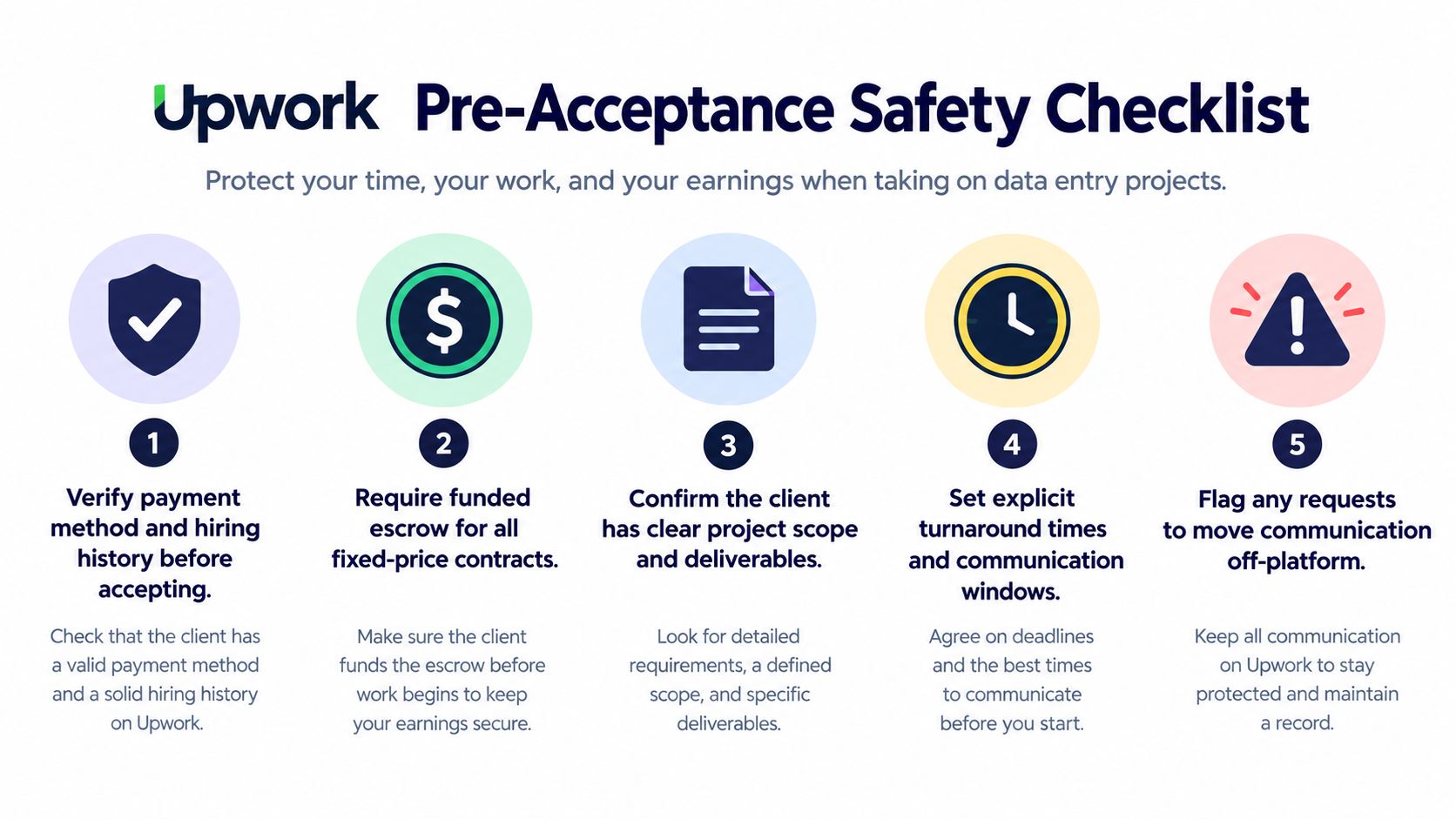
Before you accept any data-entry job, confirm the payment method and hiring history, require funded escrow for fixed-price work, and keep the files and conversation on-platform until trust is established. Then classify the data. Personal, financial, and health-related records deserve a different level of caution than a basic spreadsheet.
The video below is a useful companion if you want a visual reminder of the sequence.
Rule of thumb: if the client pushes for speed before scope, or privacy before process, slow the conversation down.
Warning signs documented for this kind of work include requests for off-platform payment, upfront fees, equipment-check payments, and sensitive information such as Social Security numbers, bank credentials, or identity documents in chat warning signs. That doesn't mean every low-budget project is a scam. It means you need a standard review before you spend proposal credits or open files.
What agencies should control
If you're running multiple freelancers or accounts, the workflow should be tighter. Use least-privilege access, keep an audit trail, and set escalation rules for odd client behavior or unclear data permissions. Make sure someone reviews intake before the work starts, not after a problem appears.
The safest projects are the ones with explicit deliverables, explicit approval criteria, and explicit deletion rules. If those pieces aren't clear, the job isn't ready, no matter how attractive the budget looks. Good data-entry work is boring in the right way. It's controlled, documented, and hard to misunderstand.
Building a Repeatable Data Entry Pipeline
The freelancers who do best with data entry on Upwork don't think in isolated bids. They run a loop. Filter by Connect economics, keep the profile narrowly positioned, bid only on jobs that fit the specialty, and run a safety check before every acceptance.
The weekly review is where the actual management happens. Track response rate, win rate, and effective hourly rate after fees and proposal spend. If a client type keeps producing weak returns, drop it. If one niche keeps converting, raise the rate and tighten the offer.
The goal is not more proposals. The goal is more profitable contracts.
That's also where scale starts to make sense. If you're targeting repeat work, a system matters more than hustle. Earlybird AI connects to Upwork, learns from your feedback, drafts and submits personalized proposals, replies to client messages, and keeps follow-up moving so you can spend less time on manual outreach and more time on delivery. For freelancers and agencies trying to turn data-entry leads into a repeatable pipeline, that kind of automation can sit beside the human filter instead of replacing it.
When the economics, profile, proposal, and safety process all point in the same direction, data entry stops feeling random. It becomes a small operating system with clear inputs and clearer returns.
If you're ready to turn Upwork data entry into a more disciplined pipeline, visit Earlybird AI and see how automated job search, proposal drafting, and follow-up can support the way you already work. If you want fewer wasted bids and a cleaner process for winning repeat clients, that's the place to start.


