
← Back To Blog
Freelance Lead Generation Playbook

Sending more freelance proposals doesn't automatically produce more clients. It often produces a thinner wallet, a weaker reputation, and a calendar filled with conversations that were never a fit.
That volume-first advice made more sense when entry-level work was easier to find and fewer sellers competed for the same brief. Today, freelance lead generation works better as a positioning and speed-to-inbox system. You need a clear market position, a strict client filter, fast human review, and a pipeline that extends beyond one marketplace.
The opportunity remains substantial. Upwork's 2026 freelancing analysis says 28% of skilled knowledge workers operate as freelancers or independent professionals, while freelancers generated $1.5 trillion in earnings in 2024. That scale creates demand, but it also creates a crowded supply side. Your advantage won't come from looking like another applicant.
Why Most Freelance Lead Generation Advice Fails
Proposal volume alone produces little without accurate targeting, a clear offer, and fast timing. Fifty poorly matched applications create activity, not pipeline, and they consume Connects before you learn whether the buyer is a fit.
The entry point has tightened. One 2025 Upwork market analysis found that entry-level projects fell below 9% of listings, down from about 15% in 2024, while the overall marketplace declined by about 9% year over year and 11 of 12 categories declined. New freelancers now compete for fewer beginner-friendly briefs against sellers with sharper positioning and AI-assisted workflows.
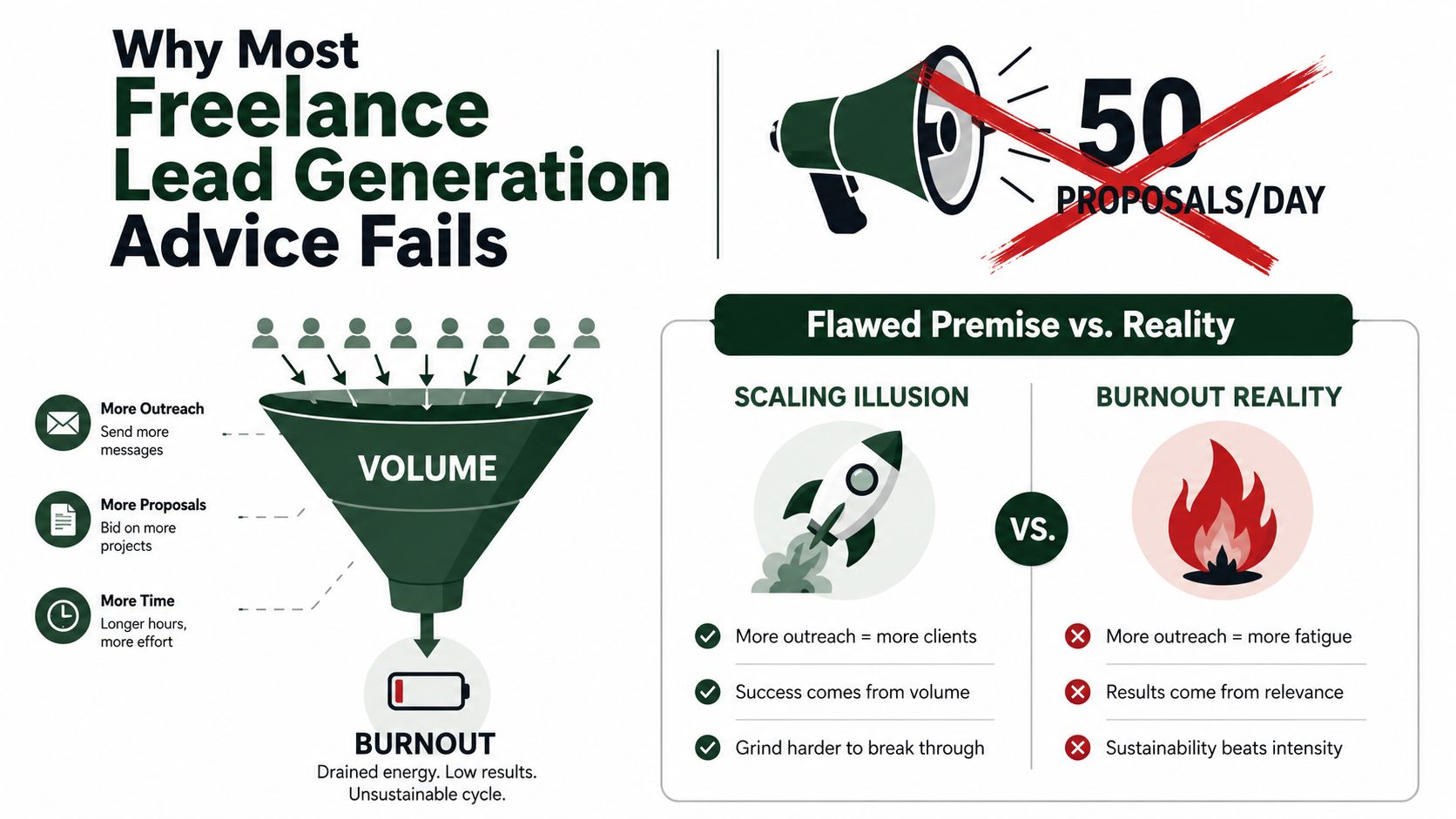
Volume hides the real problem
Generic proposals make the buyer qualify the freelancer. They open with a service list, mention every capability, and attach a portfolio without showing why the work matters to that client.
Use a first line that connects the brief to a likely constraint: “You're hiring for [outcome], and the gap appears to be [specific problem].” Follow it with one relevant proof point and a low-friction next step, such as a request for the existing brief or analytics. That structure gives the client a reason to keep reading without forcing a full sales call.
Practical rule: If you can't explain why this client is a fit in one sentence, don't spend Connects on the proposal.
Relationship-based acquisition also deserves a place in the operating plan. A 2023 Freelance Business Community survey summarized by Upwork's freelancing stats resource reported that 53.9% of freelancers rely on past or existing clients, 44.7% use recommendations and referrals, and 34.8% use social media, while only 14.7% find clients through freelance platforms. Upwork can start conversations, but it should not carry the entire acquisition strategy.
A defensible system combines targeted platform activity with referrals, authority content, and direct outreach. The Lead Printer's revenue system approach provides useful context by treating lead generation as an operating system rather than isolated messages. Build the workflow around speed to the inbox, rapid qualification, and several routes to the same buyer.
Defining your ideal client profile
A useful ideal client profile does more than describe who might buy. It tells you which briefs deserve attention while entry-level opportunities shrink and competition on Upwork rises. “B2B companies that need marketing” is too broad to guide search, proposals, or referrals. Define a buyer you can recognize through public evidence.
Start with the industry vertical where your experience, vocabulary, and proof already fit. Add company characteristics such as approximate headcount, business model, growth stage, and the commercial problem your service solves. Revenue is often difficult to verify, so look for hiring activity, product launches, funding announcements, or a mature marketing operation.
Then identify budget signals. A serious buyer usually describes a concrete outcome, provides useful context, mentions a timeline, or has hired for comparable work before. On Upwork, review past projects, payment verification, average feedback, and hiring behavior. On LinkedIn, use Sales Navigator to filter by industry, role, geography, and company attributes before contacting anyone.
For a broader framework, use this guide to ideal customer profiles, then convert the ideas into a scoring process. This target market segmentation guide can help separate a broad market from a segment you can reach.
Why volume strategies fail
Sending more proposals does not fix weak targeting. It creates a larger writing queue, slows response time, and spends Connects on buyers who were unlikely to fit. Lead generation works better as a speed-to-inbox system: identify a credible match, qualify quickly, and respond while the buyer is still reviewing options.
Use a fast qualification rubric
Score each opportunity before drafting. The system is intentionally simple. It cannot predict a close, but it prevents weak briefs from consuming your best working hours.
| ICP Dimension | Green Flag (Score +2) | Yellow Flag (Score +1) | Red Flag (Score 0) |
|---|---|---|---|
| Industry fit | Your strongest niche and clear relevance | Adjacent market with transferable proof | No meaningful experience |
| Company profile | Buyer has visible commercial activity and a defined team | Some signals, but limited context | No credible business context |
| Budget signals | Scope and expectations match your offer | Budget is unclear but the problem is credible | Price shopping or unrealistic expectations |
| Decision-maker access | Founder, department head, or clear project owner | Coordinator involved with access uncertain | No identifiable owner |
| Project complexity | Work matches your process and proof | Some gaps that can be managed | Vague scope, procurement-heavy, or outside capability |
A proposal should reach the writing queue only after it earns a strong score. Red flags include vague deliverables, an undefined decision-maker, excessive approval layers, and a client comparing specialized work with the cheapest hourly rate. New freelancers can still pursue imperfect briefs when the learning value is clear. Use the rubric to separate a promising opportunity from a lottery ticket, then reserve broader acquisition for referrals, authority content, and direct outreach.
Understanding the Proposal Funnel Benchmarks
Most freelancers collapse five distinct funnel stages into one conversion number. That makes a weak inbox, poor fit, unclear positioning, and weak sales execution look like the same problem. Track each stage separately, especially as entry-level Upwork opportunities attract more competition and speed increasingly affects who gets seen.
A practical funnel has five stages:
Visibility: The client sees your profile or application.
Application: You submit a proposal or start direct outreach.
Reply: The buyer responds with interest, questions, or a request for detail.
Conversation: The exchange becomes a call or structured qualification conversation.
Close: Both sides agree on scope, price, and terms.

Measure each leak separately
One proposal benchmark report gives focused Upwork freelancers approximate reply rates of 20–40%, shortlist rates of 10–25%, and win rates of 3–10%. It also reports agency win-rate targets of roughly 5–12%. Treat these as directional benchmarks, then compare performance by niche, client quality, proposal type, and seller profile. The freelance proposal success-rate benchmark provides the underlying figures.
Personalization helps, but it cannot compensate for poor fit. The same report places personalized proposal reply rates around 8–30%, compared with 2–5% for template-only submissions and 1–2% win rates for those submissions. Use templates for structure, then make the opening lines specific to the buyer's situation.
Record these fields in a spreadsheet or CRM:
Job identifier: Keep the source, niche, project type, and date.
Proposal category: Mark whether it was customized, lightly adapted, or templated.
Response outcome: Separate no response, reply, shortlist, interview, and contract.
Timing: Record how soon you submitted after seeing the opportunity.
Reason lost: Note price, fit, timing, silence, or an unknown outcome.
Timing needs its own field. A bidding analysis reported a 6.2% reply rate for submissions made 5–10 minutes after a job was posted, while the 12–15 minute window reached 8.07%. The Upwork proposal response-rate analysis supports a practical rule: reach the inbox quickly, but preserve enough time to diagnose the brief and write a relevant first line.
Building a Multi-Channel Outreach System
A single platform is a single point of failure. Upwork can supply intent-rich opportunities, but relationships, referrals, and direct outreach create resilience when marketplace volume changes.
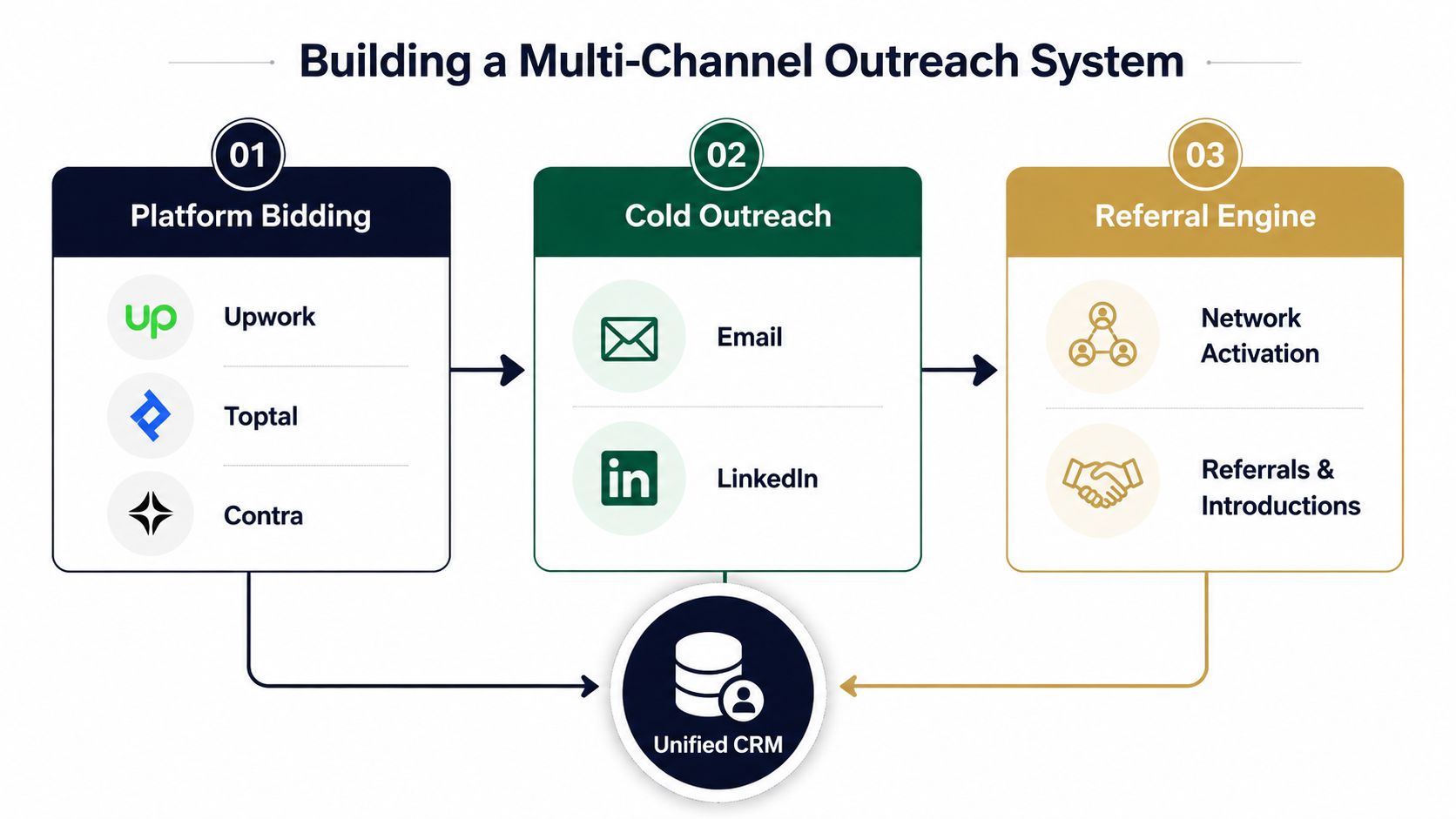
Platform bidding
Treat Upwork as a filter, not a feed to clear. Prioritize jobs with a defined business problem, credible client history, payment verification, and a scope that matches your strongest proof. Search terms should describe the problem you solve, not every service you can perform.
Your proposal should open with an observation about the brief. Follow it with one relevant proof point, a short explanation of your approach, and a question that moves the buyer toward clarification. Don't attach a generic service menu. The buyer needs confidence that you understood the assignment.
Direct outreach
Cold outreach works when the target list is narrow and the message earns attention. On LinkedIn, connect with a founder or department leader whose company displays a relevant trigger, such as a new service launch, a hiring push, or a clear gap in its customer-facing content.
A concise sequence might look like this:
Connection message: Mention the business context without pitching a full service.
Value message: Point out one specific opportunity and offer a useful observation.
Email follow-up: Send a short note with one relevant work sample and a direct question.
Keep the message about the buyer's situation. Don't use automation to flood unrelated contacts, and don't assume a prospect owes you a response.
Referrals and authority
Referrals convert trust you've already earned into new conversations. At project completion, ask whether the client knows another team facing a similar problem, then give them language they can forward. Content supports the same process when it demonstrates judgment rather than repeating generic tips.
A sustainable cadence might include a case study when you have a meaningful project to document and regular LinkedIn posts built around lessons from real work. The lead generation best practices guide offers additional context for organizing acquisition across channels. For operational details on sequencing and systems, see sales outreach automation.
Record every source in one CRM. The purpose isn't administrative neatness. It's knowing which channel produces qualified conversations, which creates noise, and where your next hour will have the greatest commercial value.
Scaling Proposals with Safe Upwork Automation
Automation should remove repetitive administration, not impersonate you. The safest workflow separates discovery, drafting, tracking, and submission so a human still controls the final message and account activity.
Start with alerts. Upwork's native search feeds can notify you when a relevant brief appears, and a workflow can route those alerts to Slack or Discord through a service such as Zapier. That approach reduces manual searching without using a script to scrape client information.
AI can help draft a proposal when you provide a structured prompt containing the job description, your selected proof, your offer boundaries, and your preferred voice. The human review remains essential. Rewrite the first two lines, remove unsupported claims, check the scope, and confirm that the proposed next step fits the client's request.
A CRM should track proposal status, follow-up dates, client questions, and the reason an opportunity was won or lost. It shouldn't need unofficial access to your account.
| Automation Type | Tool Example | Risk Level | Recommended Action |
|---|---|---|---|
| Job alerts | Upwork native search feeds routed through Zapier | Lower | Use alerts to trigger human review |
| Proposal drafting | Claude or GPT with a controlled prompt template | Moderate | Edit every draft before submission |
| Pipeline tracking | Airtable, HubSpot, or a spreadsheet | Lower | Track status without account scraping |
| Auto-submission extensions | Browser extensions that click submit | High | Avoid |
| Client-data scraping | Scripts that collect buyer information | High | Avoid |
| Unofficial account login | Tools using unofficial APIs or stored credentials | High | Avoid |
A controlled operating sequence
A practical workflow looks like this:
Alert: A relevant job reaches your review queue.
Qualification: You score the client and scope against the ICP.
Draft: AI creates a structured starting point.
Review: You personalize the opening, proof, and question.
Submit: You send only after checking accuracy and fit.
Track: The CRM records the opportunity and next action.
Earlybird AI is one example of an Upwork-focused platform that searches for relevant jobs, drafts and submits personalized proposals, replies to client messages, and supports call booking workflows. Any tool in this category should be evaluated against Upwork's current terms, account permissions, data handling, and the amount of human control it preserves. The guide to automating Upwork proposals provides a useful framework for that review.
Follow-Up Sequences That Book Calls
A proposal isn't a sales process. It's an opening message inside a sales process. Many freelancers send one application, wait, and label the opportunity dead before the buyer has finished comparing options.
Follow-up timing depends on the channel and the client's behavior. On Upwork, keep follow-ups inside the proposal thread before hire and avoid moving the conversation outside the platform prematurely. Email and LinkedIn allow more flexibility, but the principle stays the same: every touch should add context, reduce uncertainty, or make the decision easier.
A four-touch framework
Day 0, initial proposal: Lead with the client's likely constraint. “Your brief points to a conversion problem between qualified traffic and booked conversations. I'd start by reviewing the current journey, then prioritize the pages or messages creating the largest drop.”
Day 2, value addition: Share something useful, such as a relevant case study, a short Loom audit, or a micro-deliverable. Don't produce a full unpaid strategy. Give the buyer enough insight to see how you think.
Day 5, direct question: Ask one decision-oriented question. “Is the main blocker timeline, internal approval, or uncertainty about the implementation scope?” A focused question is easier to answer than “Just checking in.”
Day 10, graceful close: Give the buyer an easy exit and a path back. “I'll close the loop for now. If this project moves forward later, send me the current brief and I'll confirm whether the timing still works.”
The sequence should feel like professional persistence, not pressure. Each message needs a reason to exist.
Use touchpoint data
Track replies by touchpoint, not only by total sequence. If the first message earns attention but the second creates silence, your value-add may be too generic or too demanding. If buyers reply but don't book, your qualification question or call-to-action needs work.
Don't promise a response rate for any sequence. The verified benchmark data supports broad proposal ranges, but your own results will vary by client quality, specialization, timing, and proof. Use the framework as a controlled experiment, then adjust one variable at a time.
Tracking KPIs and Iterating Your Pipeline
Proposal count is an activity metric. It tells you how much work you did, not whether your pipeline is becoming healthier. A useful dashboard follows the buyer's movement from visibility to decision.
Track five core measures:
Proposal-to-view ratio: Tells you whether your positioning and opening earn attention.
View-to-reply ratio: Shows whether the message creates enough relevance to start a conversation.
Reply-to-call conversion: Exposes weak qualification, unclear offers, or poor next steps.
Call-to-close rate: Indicates whether the sales conversation attracts the right buyers and sets a credible scope.
Deal cycle length: Shows how long opportunities remain active before a decision.
Benchmark against the stage you control
The proposal benchmark source gives focused Upwork freelancers approximate 20–40% reply rates, 10–25% shortlist rates, and 3–10% win rates. Agencies commonly target roughly 5–12% win rates as a baseline. Use these ranges as directional reference points, not as a promise that every niche should perform identically. The figures are documented in the proposal and pitch benchmark report, which has already informed the funnel analysis above.
| Funnel Stage | Healthy Benchmark | Warning Threshold | Common Fix |
|---|---|---|---|
| Replies | Focused freelancers often target 20–40% | Results consistently below the benchmark range | Tighten fit and personalize the opening |
| Shortlists | Focused freelancers often target 10–25% | Applications attract attention but not interviews | Improve proof and clarify the delivery approach |
| Wins | Focused freelancers often target 3–10% | Conversations rarely become contracts | Qualify budget, authority, scope, and urgency |
| Agency wins | Agencies often use 5–12% as a baseline | Results remain below the agency baseline | Rework positioning, account allocation, and sales calls |
Review the dashboard weekly, but don't pivot after a handful of proposals. Separate outcomes by niche, project type, proposal style, and channel. A weak result may reflect poor targeting rather than poor copy.
Fix the leak, then test
Low visibility usually points to weak keyword targeting, an unclear profile headline, or a mismatch between your advertised service and the jobs you pursue. Low replies usually point to a generic first line, weak evidence, or a proposal that makes the client work too hard to understand your relevance. Replies without calls often indicate that your question is passive or your next step is vague.
Run controlled tests. Change one element, such as the opening line, proof sample, or call invitation, while keeping the ICP and offer stable. Record the result and wait for enough comparable opportunities to identify a pattern. Don't optimize for send volume when the leak is qualification.
The strongest pipeline is not the one with the most applications. It's the one that sends fewer, better-matched proposals, follows up responsibly, and learns from every stage.
Earlybird AI helps freelancers and agencies run Upwork-focused lead generation by finding relevant jobs, preparing personalized proposals, responding to client messages, and supporting follow-up and call-booking workflows. Visit Earlybird AI to see whether its automation and analytics fit your client acquisition process.