
← Back To Blog
How to Build Client Relationships: A Guide for 2026

A promising client can disappear after a project that technically went well. The deliverables arrived, the quality was solid, and nobody made an obvious mistake. Yet the client felt uninformed, had to chase updates, or discovered that your team had solved the wrong version of the problem.
That's the uncomfortable reality of client work. Good execution earns satisfaction, but reliable relationship management earns continuity. If you want repeat engagements, referrals, and larger scopes, you need more than strong work. You need an operating system for trust, communication, account visibility, and recovery when plans change.
The Foundation of Lasting Client Partnerships
A client relationship often breaks in the space between what you meant to communicate and what the client understood. You might see a delayed approval as a minor scheduling issue. The client might see it as a sign that nobody is managing the project. You might assume a quiet stakeholder is satisfied. They might be disengaging because progress feels invisible.
That's why “provide good service” is an incomplete strategy. A service provider waits for instructions, completes assigned work, and reports when asked. A strategic partner connects the work to business priorities, identifies risks early, and helps the client make better decisions. The difference isn't personality. It's the consistency of the behaviors surrounding delivery.
PwC's 2024 Trust Survey illustrates why you can't assume clients see the relationship as positively as you do. 90% of business executives believe customers highly trust their companies, while only 30% of consumers agree, creating a 60-percentage-point gap. The survey covered 548 business executives and 2,515 US consumers, and it also found that 67% of consumers prioritize hearing how personal data is protected and shared. These findings are summarized with the survey context by Shno's customer trust statistics overview.
Replace assumptions with visible proof
Clients judge trust through observable moments:
- Clarity: They know what's happening, what's needed from them, and what happens next.
- Continuity: Important context doesn't vanish when a team member is unavailable.
- Ownership: Someone notices a risk before the client has to raise it.
- Relevance: Recommendations connect to the client's stated goals instead of your preferred services.
- Accountability: Problems are acknowledged directly, with a practical recovery plan.
A useful relationship dashboard can help you monitor whether those behaviors are happening. Track signals such as response consistency, unresolved actions, stakeholder engagement, and follow-up completion with a system like client engagement metrics, rather than relying on memory or general sentiment.
The mindset shift is simple but demanding: your job isn't only to complete the assignment. Your job is to make progress understandable and the relationship easy to continue. Every later workflow, from onboarding to renewal, should reinforce that promise.
Mastering the First Impression and Onboarding
The first interaction tells a client whether you're thinking about their problem or only about winning the work. A weak proposal repeats the brief, lists capabilities, and ends with a generic invitation to talk. A stronger message identifies the likely business challenge, explains how you'd investigate it, and names the information you need before recommending a solution.
Don't pretend you know everything from a short project description. A practical opening might say that you've noticed a likely constraint, outline an initial hypothesis, and propose a discovery conversation to test it. That approach signals judgment without overpromising.
Communication also shapes credibility immediately. A 2025 survey of freelancers and clients identified communication skills as the top credibility factor, while prompt response was the most common client-valued interaction trait at 28.8%. The finding is reported in Rease's survey coverage of freelancer-client communication.

Build an onboarding record, not just a kickoff call
A kickoff meeting creates momentum, but the written record prevents later disputes. Send an onboarding document that captures:
- Business context: What changed, why the project matters, and which internal priority it supports.
- Desired outcome: The result the client wants, described in business language rather than only deliverables.
- Scope boundaries: Included work, excluded work, assumptions, dependencies, and the process for approving changes.
- Stakeholders: Decision-maker, day-to-day contact, subject-matter reviewers, and anyone who controls access or approvals.
- Communication rules: Primary channel, meeting rhythm, expected response windows, escalation route, and backup contact.
- Evidence of success: The metrics, qualitative signals, or decisions that will show whether the project is working.
A kickoff agenda can stay concise:
- Confirm the business objective and current situation.
- Review deliverables, dependencies, and decision rights.
- Agree on communication channels and response expectations.
- Identify risks, approvals, and access requirements.
- Define the first milestone and the client's immediate actions.
- Schedule the first review and confirm the written follow-up.
Treat the first 30 days as a calibration period. Ask whether the communication rhythm feels useful, whether the reporting format answers the right questions, and whether responsibilities are clear. Onboarding software can help teams standardize those steps, and a curated guide to top user onboarding software can help you compare options without building every checklist from scratch.
The trade-off is speed versus completeness. A rushed kickoff gets work moving but leaves ambiguity behind. An overbuilt process overwhelms a small client. Use the lightest documentation that makes ownership, scope, and next actions unmistakable.
Building Trust with Proactive Communication
Proactive communication isn't a personality trait reserved for naturally organized people. It's a system that answers the client's next question before they need to ask it.

A useful cadence has three layers. Respond to inbound messages promptly, send a predictable project update, and create a scheduled conversation for decisions that deserve discussion rather than another email. The exact rhythm depends on project complexity, but the principle stays constant: the client shouldn't have to discover your operating rhythm through trial and error.
Upwork provides a concrete benchmark for platform-based work. Its responsiveness tag is awarded when a freelancer responds to at least 90% of recent invites or proposal messages within 24 hours, and the tag updates daily using replies from the previous 90 days. The benchmark is documented in Upwork responsiveness guidance discussed by the freelancer community. Whether or not you use the tag, the operating lesson is valuable: responsiveness is measurable, rolling, and cumulative.
Use a weekly pulse report
A weekly update should reduce uncertainty, not create a second reporting burden. Keep it brief and make every line actionable:
- Progress: What was completed, reviewed, tested, or decided.
- Current status: What's on track, at risk, or waiting for client input.
- Next actions: What your team will do next and what the client needs to provide.
- Blockers: The specific issue, its consequence, and the decision or access required.
- Relevant insight: A recommendation, observation, or trade-off that helps the client steer the work.
Write “The landing page is ready for review, but analytics access is still pending, so performance validation can't begin” instead of “We're waiting on access.” The first version explains the consequence and gives the client a reason to act.
Bad news requires the same discipline. Tell the client what happened, what it affects, what you've already done, and which options remain. Don't bury a missed deadline inside a long status email. A short, direct message protects trust better than optimistic vagueness followed by another surprise.
Practical rule: Never send a client a problem without pairing it with a recommendation, an owner, and a decision date.
Use a shared workspace or CRM to record commitments immediately after meetings. Your internal communication playbook should define who answers urgent messages, when an issue moves to escalation, and how coverage works during leave or time-zone gaps. For a more detailed operating reference, document these rules alongside client communication best practices.
A safe automation layer can flag unanswered messages, create follow-up tasks, and remind owners about upcoming check-ins. It shouldn't invent project status, make promises without approval, or send emotionally sensitive responses without human review. Automation should protect consistency while people retain judgment.
Here's a practical explanation of how teams can think about communication systems and client trust:
The goal isn't to respond instantly at all hours. It's to establish a dependable window, honor it, and make exceptions visible when something urgent occurs.
Systematizing Your Account Management Workflow
Delivery teams often focus on tasks and deadlines, while clients experience the relationship as a sequence of decisions, updates, outcomes, and unresolved concerns. Account management connects those pieces. It gives each client a living record of priorities, performance, stakeholders, risks, and opportunities.
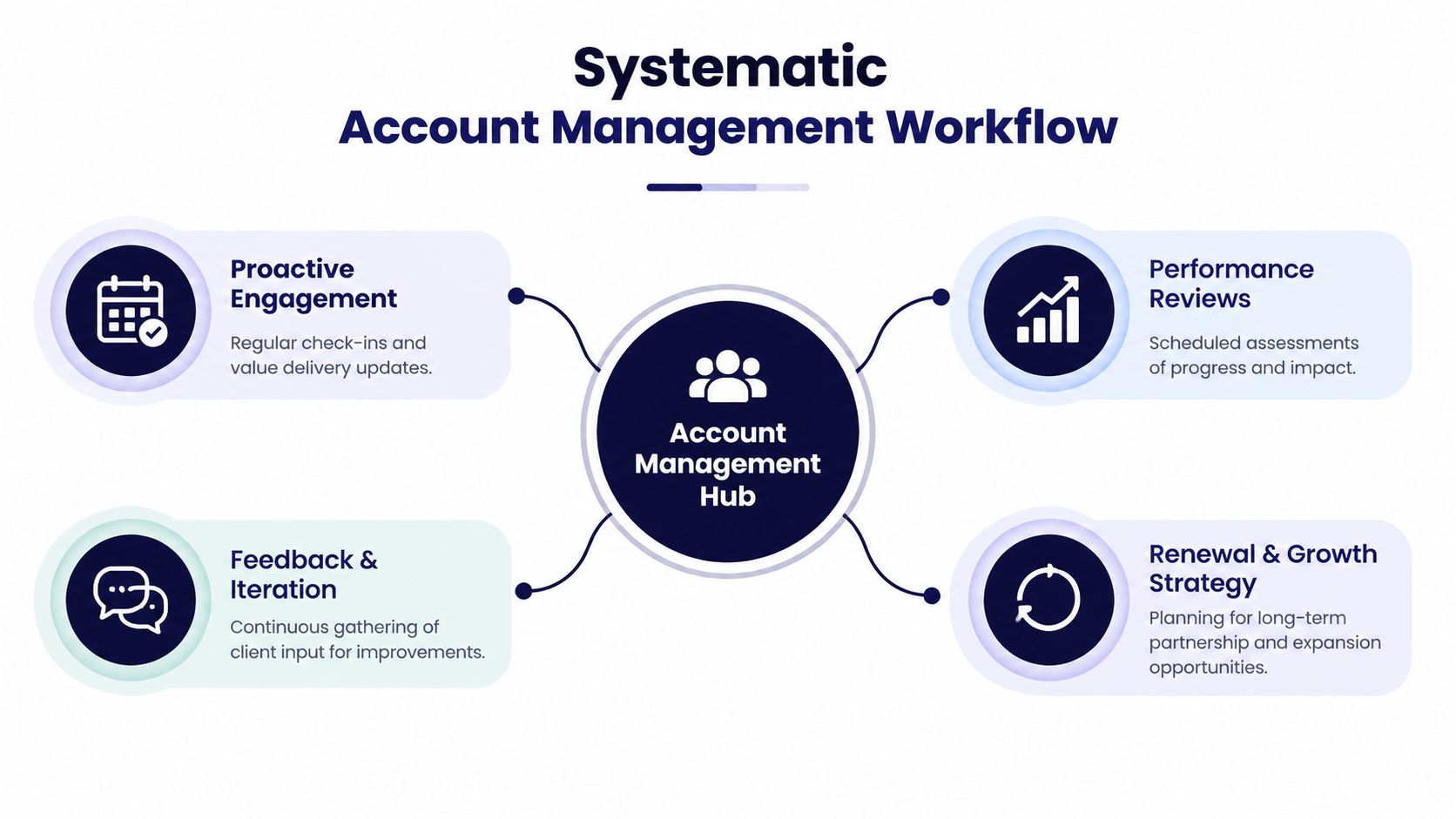
The core workflow is straightforward. Capture the client's goals during onboarding, record meaningful interactions, review delivery evidence, ask for feedback, and turn the resulting insight into the next useful action. Without this loop, check-ins become ceremonial and expansion conversations feel disconnected from the client's priorities.
Create a recurring account rhythm
Use different meetings for different jobs. A monthly check-in can cover current progress, open decisions, upcoming work, and immediate risks. A broader business review should examine what changed, what the work produced, what the client learned, and which priorities now deserve attention.
A strong review agenda includes:
- Outcome recap: Connect completed work to the original objective.
- Evidence: Show deliverables, adoption signals, decisions enabled, or other agreed indicators.
- Client perspective: Ask what was useful, confusing, slow, or missing.
- Forward view: Discuss upcoming priorities and constraints.
- Action register: Assign owners and dates before ending the meeting.
This structure prevents a common mistake, using every client conversation to ask whether they have more work. Expansion should follow evidence. If the client says their next priority is improving a specific workflow, an adjacent service is relevant only when it directly supports that priority. A helpful recommendation explains the connection, the expected effort, and the alternative of doing nothing.
A B2B case study identified superior service quality, effective communication of customer value, proactive customer management, and after-sales follow-up and support among the strongest retention drivers. The findings are available in the AaltoDoc study on B2B retention. The implication is practical: retention belongs to the full service lifecycle, not only to the person responsible for renewals.
Automate the repetitive layer carefully
Your CRM can create reminders for review meetings, flag inactive accounts, store stakeholder notes, and generate follow-up tasks from completed calls. A platform such as the best CRM for agencies can help centralize this information when several people manage the same account.
Keep human approval for anything that changes scope, discusses sensitive performance, responds to dissatisfaction, or recommends a commercial commitment. Review automation rules regularly. A reminder that fires at the wrong time, or a generic message sent after a client has raised a concern, can make the relationship feel mechanical.
Your account hub should answer five questions at a glance: What does this client care about now? What have we promised? What is blocked? Who is involved? What useful conversation should happen next?
Navigating Challenges and Driving Renewals
Strong relationships don't eliminate difficult conversations. They make those conversations easier to handle because expectations, decisions, and evidence already exist.

Use the Acknowledge, Analyze, Act framework when a project slips, feedback turns negative, or scope expands beyond the agreement.
Acknowledge the issue clearly
Start by naming the problem without defending yourself. “The second review is late, and that means your launch decision can't happen on the original schedule” is better than “We've had a busy week.” Acknowledge the client's impact, not only your internal cause.
Analyze the root cause
Separate the immediate symptom from the process failure. Was the brief ambiguous? Did two reviewers give conflicting direction? Did your team underestimate the dependency? A useful analysis identifies the condition that allowed the problem to occur, then shows how you'll prevent a repeat.
Act with a defined recovery
Offer a specific path forward. State what will change, who owns it, what the revised decision point is, and what trade-off the client must accept. If the issue is scope creep, present options rather than arguing over every request. The options might involve reducing an existing deliverable, extending the schedule, or approving additional work through the agreed change process.
Recovery earns credibility when the client can see the correction in your next behavior, not just in your apology.
Renewal preparation should begin before the contract end. Keep a running record of completed work, decisions enabled, risks resolved, client feedback, and priorities that remain open. Near renewal, turn that record into a clear narrative: where the client started, what changed, what still needs attention, and how the next phase builds on the foundation already created.
Trust has a direct relationship with loyalty. A widely cited customer-loyalty statistic reports that 95% of customers say trust in a company makes them more likely to stay loyal, while B2B retention research places average annual retention at around 82% across B2B firms. The figures are collected in ServiceNow's customer retention statistics resource.
A renewal presentation should make value easy to understand for both the day-to-day contact and the budget holder. If your team needs a repeatable format for summarizing outcomes and next steps, resources on how to create customer success presentations can help structure the story.
Don't treat renewal as a sales ambush. Ask what has changed, confirm whether the original success criteria still matter, and present a roadmap that responds to the client's current situation. The strongest renewal conversation feels like the next planning meeting, not a last-minute request for another signature.
Turning Good Relationships into Sustainable Growth
Sustainable growth comes from connecting four systems: structured onboarding, proactive communication, disciplined account management, and credible service recovery. Onboarding establishes shared meaning. Communication keeps progress visible. Account management turns delivery into an ongoing business conversation. Recovery proves that your process can withstand pressure.
The result is more durable than a collection of pleasant interactions. Clients know what to expect, your team knows what to record, and leadership can see which relationships need attention. Referrals, testimonials, case studies, and expanded scopes become natural outcomes of documented value and dependable execution, not favors requested at random.
The commercial logic is also clear. Relationship-building became a formal discipline as companies shifted from one-time transactions toward longer-term retention, and loyalty-management spending reflects the importance businesses place on repeat relationships. One 2023 estimate placed the global loyalty management market at $5.57 billion, with a projection of $28.65 billion by 2030, as reported in Semrush's customer retention statistics roundup. The projection is a market estimate, not a guarantee, but it reinforces the strategic direction.
Review your client process this week. Check whether every active account has a documented objective, a communication cadence, a next action, and an owner for unresolved risks. The best answer to how to build client relationships is not charm at scale. It's a repeatable system that makes trust visible in every interaction.
Earlybird AI helps freelancers and agencies manage Upwork outreach by searching for suitable projects, creating personalized proposals, replying to client messages, and following up until a call is booked. Visit Earlybird AI to see how its communication and workflow automation can support a more consistent client relationship process.