
← Back To Blog
How to Earn Money on Upwork: A Practical Income Playbook
The most popular advice about earning on Upwork is to apply to more jobs. That can be a costly way to stay busy without getting paid. A proposal takes time, Connects can cost money, and even a successful project may not be worthwhile once you account for fees and unpaid prospecting.
A better approach is to treat each bid as an investment. Choose work that fits your expertise, price it to meet your income goals, and measure whether your proposals turn into profitable client relationships. That's the practical answer to how to earn money on Upwork: build a system that improves the return on your effort, rather than just increasing the number of applications you send.
Why Upwork Income Depends on More Than Volume
A large marketplace can create opportunity, but it can't promise you a steady paycheck. In its 2024 Impact Report, Upwork reported more than $25 billion in cumulative lifetime earnings for talent as of December 31, 2024, approximately $4 billion in gross services volume during 2024, and 832,000 active clients. Those figures show that clients spend substantial amounts through the platform. They don't tell you what an individual freelancer will earn.
Your results depend on what you sell and how clearly clients can see its value. A specialist with relevant portfolio work, sensible pricing, strong proposals, positive reviews, and the capacity to deliver reliably is in a different position from someone listing a long menu of skills without evidence. Availability matters too. A freelancer who can respond promptly and turn a successful first project into repeat work has more ways to build income than one who starts from scratch with every contract.
Practical rule: Treat the marketplace's scale as access to potential buyers, not as a forecast of your personal earnings.
The number of clients isn't the same as the number of suitable clients for your service. Competition exists across fields such as development, design, marketing, writing, and consulting. Agencies may see a substantial pool of buyers, but they still have to win work that fits their team, covers delivery costs, and leaves a viable margin.
A more useful way to approach the platform is as a sequence of decisions. First, position a specific service for a clear buyer. Then set pricing that accounts for fees, choose projects carefully, write proposals that address the client's actual problem, and build relationships that can lead to further work. Outreach tools may help when volume becomes a genuine operational constraint, but no tool can fix a weak offer or poor targeting.
Positioning Your Service So Clients Choose You
Clients don't hire a list of skills. They hire someone who seems suited to solve their particular problem. That's why a focused profile can make a stronger case than a broad one, even when both freelancers have similar experience.
Consider a profile headed “Full-Stack Developer.” It might list several languages and frameworks, but clients have to guess whether the freelancer has solved a problem like theirs. A more specific headline, such as “Shopify Developer for Checkout and Store Improvements,” tells a certain buyer why to keep reading. The overview can then explain the type of stores served, the issues addressed, and what the freelancer can deliver.

Show proof that fits the promise
A headline only gets a client's attention. The first lines of the overview, portfolio, and review history help earn trust. Put the most relevant details first: a clear description of the buyer you serve, the problem you take on, and a reason to believe you can handle it. Use portfolio examples that match that promise rather than showing everything you've ever made.
For example, a developer targeting checkout work could feature a store audit, an implementation sample, and a short explanation of a checkout issue they resolved. The point isn't to make a claim about an outcome you can't demonstrate. It's to give a prospective client enough relevant evidence to judge your approach.
Narrowing your focus also gives you a firmer basis for pricing. A buyer looking for an expert in a defined problem can compare you on relevant capability, not just on your willingness to be available for any task. That doesn't mean every specialist can charge more or that generalists can't earn well. It means a clear offer makes the reason for your price easier to understand.
Make the profile and proposal tell the same story. If your profile emphasizes a particular service but your bid reads like a general pitch, clients may question the fit. Use the headline to get noticed, the overview and portfolio to support your claims, and the proposal to connect that evidence to the client's project.
Pricing Your Work Around the 10% Fee
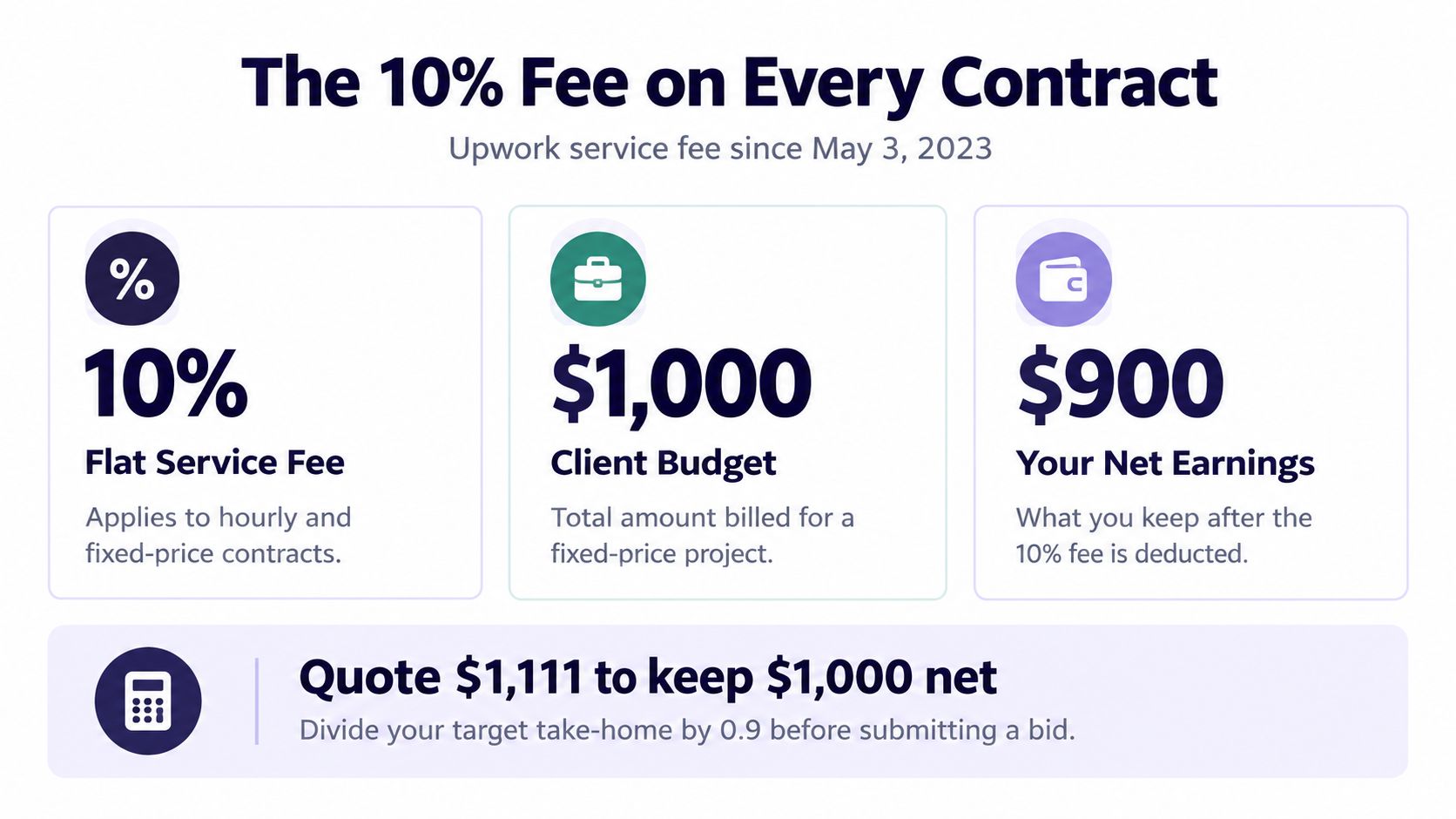
A contract's headline amount can overstate what you earn. Since May 3, 2023, new Upwork contracts have carried a flat 10% service fee, including hourly, fixed-price, Project Catalog, and agency contracts, according to this overview of Upwork's fee change. Build the deduction into your quote before you send it.
For example, a $500 contract leaves $450 before taxes and other costs; a $2,000 project leaves $1,800. To receive $1,000 before taxes, you'd need to bill approximately $1,111.11, since 90% of that amount is $1,000. These figures show the fee's effect, not your full project profit.
Set a floor before you bid
Start with the net hourly return you need. Estimate the total hours, including research, meetings, revisions, and delivery. Multiply by your target, then raise the client-facing quote enough to cover the platform fee. If the budget cannot meet your minimum after those costs, declining is often better than accepting and hoping the work takes less time.
The same calculation applies to hourly contracts and agency work. When billing for a team, allow for both the platform deduction and the amount paid to the person doing the work. A contract can look attractive as gross revenue yet leave too little for coordination, revisions, and profit.
Check the charge that applies to your contract before settling on a rate. For more detail, read how much Upwork takes from freelancers. Set your price from the income you need, not from the client's budget alone. That gives each proposal a clear break-even point: after the fee and the cost of applying, the likely return must justify the time you spend pursuing the work.
Calculating Which Proposals Are Worth Sending
Sending more proposals does not automatically mean earning more. Treat each application as an acquisition cost: Connects, time spent reviewing the client and tailoring your bid, and any unpaid calls or follow-up. Upwork's freelancer pricing page says freelancer service fees can range from 0% to 15% of earnings and that proposals often require Connects. A contract's gross value is only one part of whether pursuing it makes financial sense.
Track what your bidding effort returns: cost per qualified proposal, reply and interview rates, win rate, average contract value, and net hourly earnings. These figures help you spot which types of opportunities justify the time and Connects, rather than judging your results by proposal count alone.

Compare the return, not just the bid count
For example, one freelancer might send 60 low-budget proposals and win 2% of the time, while another sends 12 selective proposals and wins 15% of the time. These are hypothetical figures, not expected results. They show why volume alone can mislead: a large batch of bids may cost more in Connects and unpaid time while producing fewer contracts.
Assess the job before applying. A clear budget helps you judge whether the scope can pay enough. A credible client history and a close fit with your portfolio strengthen the case for spending Connects. Consider repeat-work potential too. A modest first project may be worthwhile if it could lead to ongoing work, while an isolated task may not repay substantial sales effort.
Run the break-even calculation before you bid. Estimate the time spent finding and pursuing the project, then add the time needed to deliver it. Calculate the expected earnings after the applicable service fee and Connects cost, and divide by those hours. A $100 contract can leave a poor return if acquisition and delivery take too long. If the likely net hourly return falls below your floor, skip the proposal. For practical guidance on bidding on Upwork, focus your applications on jobs where the expected return justifies the cost.
Writing Proposals and Messages That Get Replies
Once a project looks economically worthwhile, write to the client's problem, not to your own résumé. A proposal doesn't need to repeat the entire job post. It needs to show that you understand the work, have relevant evidence, and can suggest a sensible next step.
A useful proposal has four parts:
- Relevant opening: Refer to the client's specific goal or concern. “I'm an experienced developer who can help” could fit almost any job, so it gives the client little reason to respond.
- Proof of fit: Mention one or two relevant projects or examples. Explain why they apply to this project instead of listing every skill you have.
- Concrete approach: Describe the first deliverable or initial step. For example: “I'd start by reviewing the checkout flow and identifying the issues that should be addressed first.”
- Clear next action: Ask a specific question about scope or suggest a short call if a conversation would help clarify the project.
Make it easy to answer
Keep the proposal short enough to scan. Personalization means responding to the substance of the client's request, not copying its wording back line by line. If a client describes a slow product launch, connect your relevant experience to that challenge and outline how you'd begin. Don't claim a result you can't support or imply that you've done the exact work if you haven't.
The first client message deserves the same care. Answer the question they asked, share any missing detail they need to assess fit, and ask only questions that move the conversation forward. A message that talks around the project or sends a generic sales pitch makes it harder for the client to judge whether you're paying attention.
Respond promptly when you can, and make the reply specific. A quick, useful answer signals that you're engaged and helps a client keep evaluating the project. But speed isn't a substitute for accuracy. If you need to check something before committing to scope or timing, say so clearly instead of promising more than you can deliver.
Turning One-Time Clients Into Repeat Work
A repeat client can earn more than a string of first-time projects, but only if the work stays profitable and the relationship is managed well. Deliver what you agreed, communicate clearly, and make the next relevant task easy to discuss. The goal is useful continuity, not an automatic upsell.
Protect the payment process from the start. For fixed-price work, confirm the milestone is funded before beginning, then submit the deliverable through the agreed process. The Upwork payment protection rules set the minimum milestone deposit at $5 and say that funds are released automatically after 14 days if the client takes no action after submission.
Make the next project natural
Keep pre-contract discussions and payment arrangements on Upwork. Its circumvention policy says communication and payment discussions should remain in Upwork Messages before a contract begins, with limited exceptions for Enterprise clients. Taking payment or sharing payment details elsewhere can violate the Terms of Service, put your account at risk, and remove protections such as Hourly Payment Protection.
Once work starts, agree on deliverables and milestones, and send progress updates before the client has to ask. Raise scope changes early so neither side is surprised by extra work. Finishing ahead of schedule can help, but reliability and clear expectations matter more than adding unrequested tasks.
For example, after writing a landing page, a copywriter could recap the work and suggest email or blog content as a possible next phase, if that suits the client's needs. The suggestion should follow naturally from the project and solve a real need, rather than sound like a sales script.
Close out with a concise summary of what you delivered, any open questions, and a specific offer to help with the next related task. This gives the client a clear way to continue without pressure. For guidance on keeping the exchange clear and professional, use these client communication best practices.
Comparing Ways to Scale Outreach Safely
Scaling outreach means choosing who does the work, how much control you need, and what risks your process creates. Manual bidding gives the freelancer direct control over every search and message, but it takes time. Delegating research or proposal preparation to a virtual assistant or team member can free up hours, though the freelancer still needs to review targeting and voice.
AI drafting tools can speed up research and help prepare proposal drafts, provided a person checks the facts, fit, and tone before sending. Automation platforms may handle more of the workflow, but they also require careful attention to account permissions and platform rules. No approach makes poor targeting profitable, and faster outreach doesn't justify sending irrelevant messages.

Keep the workflow within the rules
Upwork says freelancers should request an API key for workflow automation. It warns that unapproved bots, including those that spam proposals or invites or scrape public or private data, can lead to warnings, temporary restrictions, or permanent blocking. Its guidance on using bots and automation properly is essential reading before building an automated process.
A practical workflow should specify who can access accounts, which tools have permission to act, what a human must review, and how proposals and messages are checked. Teams also need a way to monitor activity and handle client replies responsibly. If you can't clearly explain what an automated tool does on your account, don't let it act unchecked.
Earlybird AI is one option for freelancers and agencies exploring a more automated workflow. The publisher describes it as connecting to an Upwork account, using thumbs-up and thumbs-down feedback to learn preferred projects, finding jobs, drafting personalized proposals, responding to client messages, following up, and offering analytics, profile tools, and multi-user workflows. Evaluate any platform against Upwork's rules and your own review process before using it. Automation can reduce manual work, but the target, proposal quality, and client fit still need human judgment.
Your Next Step to Start Earning on Upwork
A full proposal calendar can still produce little income if each bid costs more time and Connects than it returns. Start with a specific service and buyer. Make your headline, overview, and portfolio show the problem you solve, so clients can judge the fit quickly.
Set a minimum project price that covers delivery time and the cost of winning the work, including Upwork's 10% fee and the Connects spent applying. A low price only makes sense when the expected return still clears that floor. Decline jobs that do not.
For two weeks, track each proposal's Connects, research and writing time, replies, interviews, and wins. This is a suggested tracking window, not a benchmark. Calculate the return: compare the earnings from won jobs after the fee with the time and application costs across all bids. If targeted applications bring better returns, send fewer proposals. A rising bid count alone does not mean progress.
If volume, response speed, or bidder coordination is taking time from paid work, assess whether Earlybird AI's job discovery, proposal and message automation, analytics, profile tools, and multi-user workflows fit your process. Review the tool against Upwork's automation requirements, and keep human judgment over client fit and proposal quality. If those tasks are not your bottleneck, bid manually and track the same costs and returns. Sustainable income comes from choosing work that pays enough to justify both the application and the delivery.


