
← Back To Blog
How to Find Profitable Niches for Freelancers and Agencies
Most niche advice starts with the wrong question. “Where is demand high and competition low?” sounds sensible, but it pushes freelancers toward broad categories where demand is visible, competitors are numerous, and buyers have little reason to choose another provider. A profitable niche isn't defined by attention alone. It's defined by repeated pain, reachable buyers, willingness to pay, and workable delivery economics.
The practical answer to how to find profitable niches is to study what people complain about, identify who already spends money on the problem, test whether those buyers take action, and then check whether your platform and operating model leave enough margin. Search trends can help you generate candidates, but they shouldn't decide your business.
Why Most Niche Advice Fails Freelancers
The phrase “high demand, low competition” hides two separate questions: Do people care, and will they buy? Search volume can answer the first imperfectly. It can't establish the second. A large audience may enjoy content about a topic while refusing to pay for help, switching providers, or solving the problem urgently.
Complaint density gives you a stronger starting signal. Look in communities where people describe failed workarounds, delayed operations, confusing software, missed deadlines, and expensive manual processes. A complaint that appears repeatedly in different places tells you more than a broad keyword with impressive visibility. The most useful complaints contain a consequence, such as lost time, missed revenue, compliance exposure, or staff frustration.
Practical rule: Don't call a market attractive until you can describe the recurring failure in the buyer's own operational terms.
This is why undersupplied B2B micro-verticals often deserve more attention than glamorous categories. Independent niche research points to operationally painful areas such as freight logistics middleware, small-practice healthcare billing, eldercare coordination, and legal deadline tooling, particularly where buyers already spend money but software penetration remains limited. The demand-to-supply gap becomes clearer when you compare search activity, forum discussions, and job postings with the number of mature solutions, as outlined in this research on undersaturated startup opportunities.
The trade-off is that these markets may look less exciting and require more domain learning. They can still outperform popular categories because a buyer with an urgent workflow problem evaluates a specialist differently from someone browsing a commodity service.
Apparent demand versus buying behavior
A freelancer sees engagement, saves, or repeated questions and assumes a niche is working. Those signals can indicate interest, but they don't prove commercial intent. A person can admire an interior design portfolio without clicking through, booking a consultation, or purchasing a service. The offer has to connect the content or conversation to a concrete problem.
For service businesses, that connection might be a billing audit, a logistics workflow, a deadline-monitoring system, or a proposal process designed for a specific buyer. If you're building a sales process around marketplace work, practical guidance on closing automation clients can help you think beyond attention and toward the next commercial action.
The strongest niche candidates usually have three traits:
The pain is specific: Buyers can explain what breaks and what the failure costs them.
The buyer is identifiable: You know the role, company type, workflow, and place where that person looks for help.
The remedy is already funded: The buyer pays employees, contractors, software vendors, or consultants to address part of the problem.
Broad trends still matter, but they should generate hypotheses rather than conclusions. A niche becomes credible when complaints, buyer access, and payment behavior point in the same direction.
Scoring Niche Candidates with a Weighted Framework
Gut instinct is useful for generating ideas and unreliable for ranking them. A weighted scorecard forces you to compare a promising niche with the other candidates competing for your time. Score each dimension on a consistent scale, then document the evidence behind the score rather than writing down a number because the niche feels exciting.
The documented framework assigns these weights:
Problem intensity, 20%: How painful, urgent, and costly is the problem?
Revenue potential, 20%: Can buyers support a commercially viable offer?
Obstacle level, 15%: How difficult will access, delivery, compliance, or trust-building be?
Founder fit, 15%: Do you understand the workflow and have credible proof?
Interest trend, 15%: Is attention growing, stable, or fading?
Target clarity, 15%: Can you identify and reach the exact buyer?
Calculate a weighted score for every candidate. The framework classifies 6.5 to 7.9 as a good opportunity worth pursuing, according to the documented niche-finding methodology. Treat that range as a research threshold, not a promise of profitability. A high score built on assumptions is weaker than a lower score supported by direct customer evidence.

Build evidence before you score
Research each candidate across multiple environments. Search complaint-heavy communities, inspect service listings, read job descriptions, review competitor positioning, and speak with people who perform or purchase the work. A keyword tool can show interest, but it won't tell you whether buyers dislike current options or whether providers can deliver profitably.
Use a separate note for each score:
Problem intensity: Copy recurring complaints and describe the operational consequence.
Revenue potential: Record existing spending behavior and possible offer formats.
Obstacle level: List trust, technical, regulatory, and distribution barriers.
Founder fit: Identify relevant experience, relationships, and proof of competence.
Interest trend: Compare recent discussions and job activity without confusing novelty with durability.
Target clarity: Name the buyer, their role, company type, and acquisition channel.
A useful comparison also separates competition level from accessibility. A crowded category may contain a narrow underserved segment, while a low-competition category may have no reachable buyers. Use this competition analysis resource to organize what competitors sell, whom they serve, how they position themselves, and where customers still complain.
Avoid the intuition trap
The most common technical mistake is skipping evidence thresholds. Founders see one enthusiastic comment, one rising keyword, or one personal connection and treat it as validation. Require repeated signals from independent sources before promoting a candidate.
A practical decision rule is simple: keep a candidate in research only when you can state what evidence is missing. If you can't identify the next proof you need, you're probably defending the idea rather than testing it. Score the niche again after collecting that evidence, and abandon candidates whose weak dimensions remain weak despite further research.
Converting Broad Markets into Reachable Micro-Niches
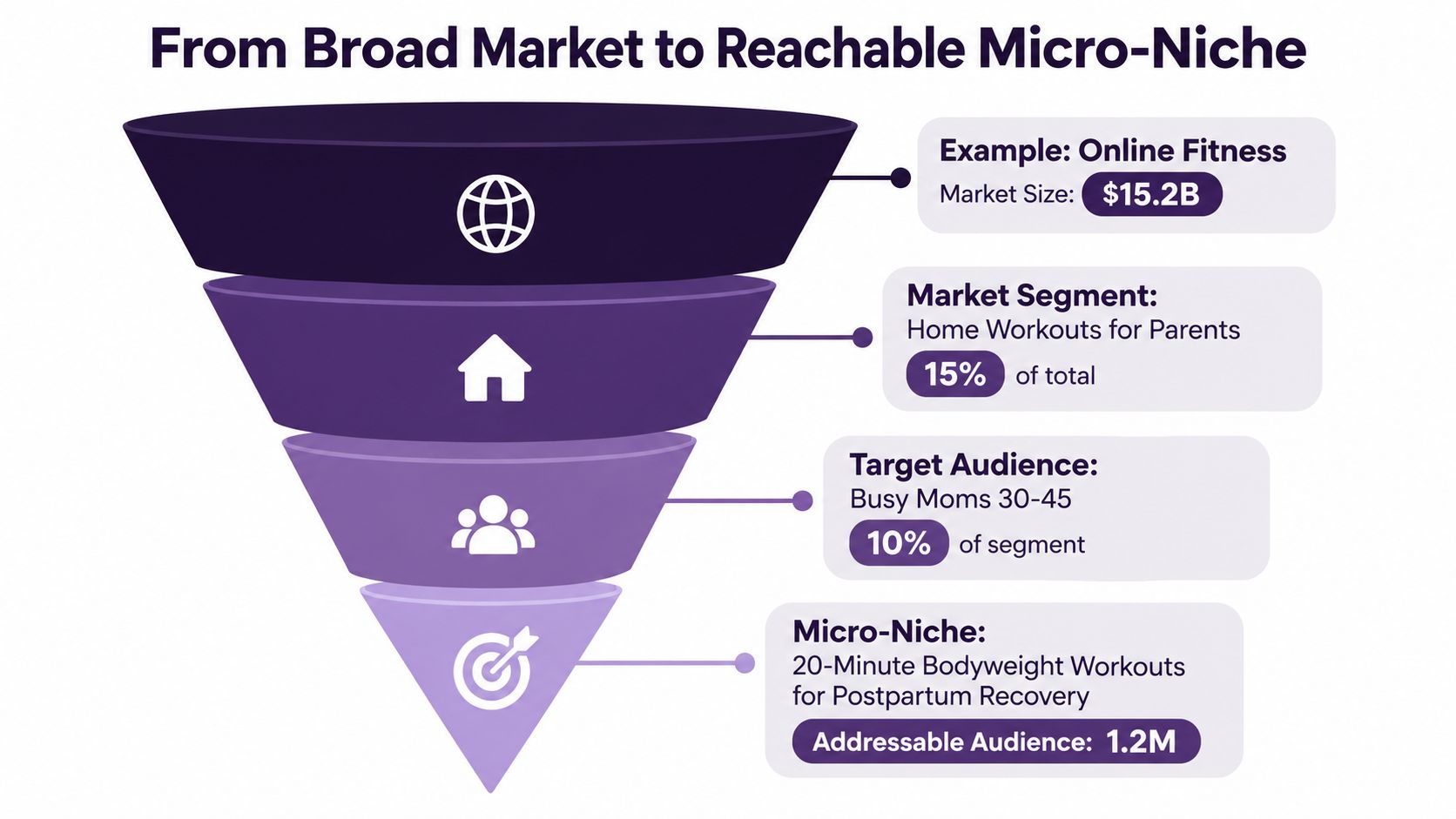
Broad markets help with orientation, but they rarely predict revenue. The useful unit is a buyer group narrow enough to describe in one sentence: who has the problem, what triggers a purchase, where you can reach them, and what the offer may be worth. A smaller micro-niche is often easier to investigate because its reachable customer count and buying context are visible.
A documented sizing framework starts with the people who have the problem, then applies planning assumptions that 10% to 20% are actively seeking a solution, 5% to 15% are realistically reachable, and 2% to 5% will convert, as described in this niche market research guide. Treat these figures as a funnel for testing assumptions, not as a forecast. The exercise exposes how quickly a broad audience becomes a smaller group that a freelancer can contact and serve.
Use TAM, SAM, and SOM with Rigor
TAM, or total addressable market, is the full customer universe if every suitable buyer could purchase. SAM, or serviceable available market, limits that universe by the geography, platform, industry, offer, or customer type you can serve. SOM, or serviceable obtainable market, estimates the share you could realistically win over a defined period.
Build each layer from customer counts and price. If you can identify suitable companies and estimate the annual or project value of your service, a bottom-up calculation is more useful than a large industry figure. Record how you found those customers, why they fit, and what supports the proposed price. A spreadsheet that exposes weak assumptions is more valuable than a polished market-size claim.
The largest audience may produce the least revenue. A smaller segment with obvious access, expensive operational pain, and repeat purchases can create a steadier pipeline than a broad category whose members rarely respond.
Segment by buying behavior
Research on small and medium-scale furniture manufacturers reported a mean profitability score of 4.1667 for firms using niche marketing segmentation. Demographic segmentation scored 4.3125, while behavioral segmentation scored 3.7708. Geographic and psychographic segmentation scored 1.6667 and 1.6383, respectively, in the peer-reviewed study published by the Global Business and Management Research journal.
The practical implication is straightforward. Start with actions and conditions that change the buying decision. “Healthcare companies” gives a freelancer little to qualify. “Small practices that manually reconcile rejected insurance claims” identifies a workflow, a likely consequence, and a reason to seek help.
A reachable niche is defined by a buyer you can identify and a problem you can observe, not by a category label.
Use demographic details when they alter the offer. Use behavioral signals when they show timing or intent, such as a recently posted job, a new tool adoption, a public process complaint, or a previous attempt to hire help. The strategy tips from Bulby also point toward opportunities where the audience, problem, and next action align.
A clear target market segmentation framework turns the definition into a prospecting list. Specify the buyer's role, company type, triggering event, acquisition channel, and observable complaint. That description should tell you whom to contact and what evidence would justify a paid conversation.
Validating Demand Before Committing Resources
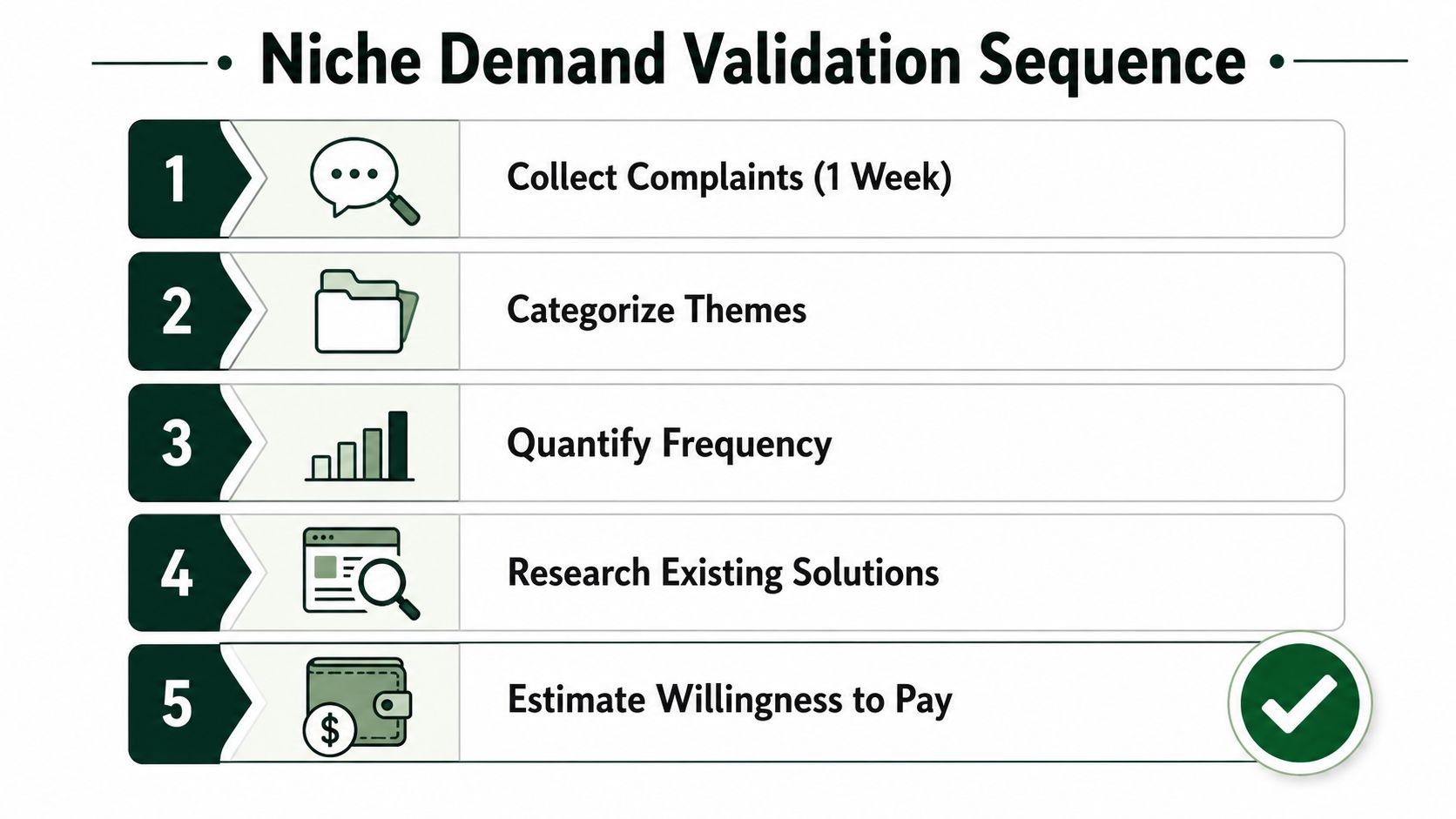
Validation should begin with complaints, not branding. Spend about one week collecting posts, reviews, support discussions, job descriptions, and direct comments related to the candidate problem. Save the exact language, note the source context, and avoid counting variations of the same complaint as separate evidence.
Then follow a five-step sequence:
Collect complaints: Gather raw statements for the initial research period.
Categorize themes: Group complaints by workflow, consequence, buyer role, and existing workaround.
Count recurrence: Keep problems that appear at least 5 times across sources, as specified in the documented validation framework.
Qualify the market: Check whether the audience can pay and whether the market is growing, stable, or shrinking.
Contact real complainers: Reach out to 10 people who described the problem and ask whether it still exists, what they tried, and what they paid for.
Test actions instead of enthusiasm
Stated interest is cheap. Behavioral demand is stronger. Ask a prospect to share a process document, schedule a diagnostic call, introduce the decision-maker, approve a small paid test, or provide access to the information required for a proposal. Each action reveals more than a positive survey response.
Run bottom-up sizing before interviews, then conduct 15 to 20 customer interviews, and test behavior before mapping competitors and timing. This ordering helps you learn whether the problem is commercially real before allowing competitor anxiety to distort your view. The validation sequence is described in this market research validation guide, which also notes that 70% of new products fail at launch and that early-stage idea validation can make companies 2.5 times more likely to succeed than companies that don't validate.
Those figures are directional evidence from independent guidance, not a guarantee for a service niche. The operational point remains useful: validate behavior before investing in a full website, content library, automation stack, or specialized delivery process.
Look for payment signals
A prospect's complaint becomes commercially meaningful when it connects to a budget or a costly workaround. Ask:
What happens today: Which person, tool, or contractor handles the problem?
What failure costs: Does the issue delay work, create rework, or threaten revenue?
What has been attempted: Which solutions did the buyer try and reject?
What would change: What result would justify paying for a new approach?
Poor satisfaction with current solutions can create an opening, but dissatisfaction alone isn't enough. A buyer may dislike a tool and still tolerate it because changing systems is harder. The strongest prospects can describe both the pain and the action they're prepared to take.
For agencies, reporting often becomes part of that proof. A resource on SourceLoop attribution and reporting offers useful context for connecting activity to outcomes, which helps distinguish a service that sounds valuable from one whose results buyers can evaluate.
A data analytics workflow for Upwork can also help you track which niche signals lead to replies, interviews, and paid work. Validation doesn't end when you select a niche. It continues as real behavior either confirms or weakens your assumptions.
Understanding Upwork Platform Economics and Niche Profitability
A niche can have demand and still be unprofitable on Upwork. Platform floors, service fees, client charges, proposal competition, and project structure all affect what remains after delivery. Calculate the economics before you decide that a low-ticket category is worth pursuing.
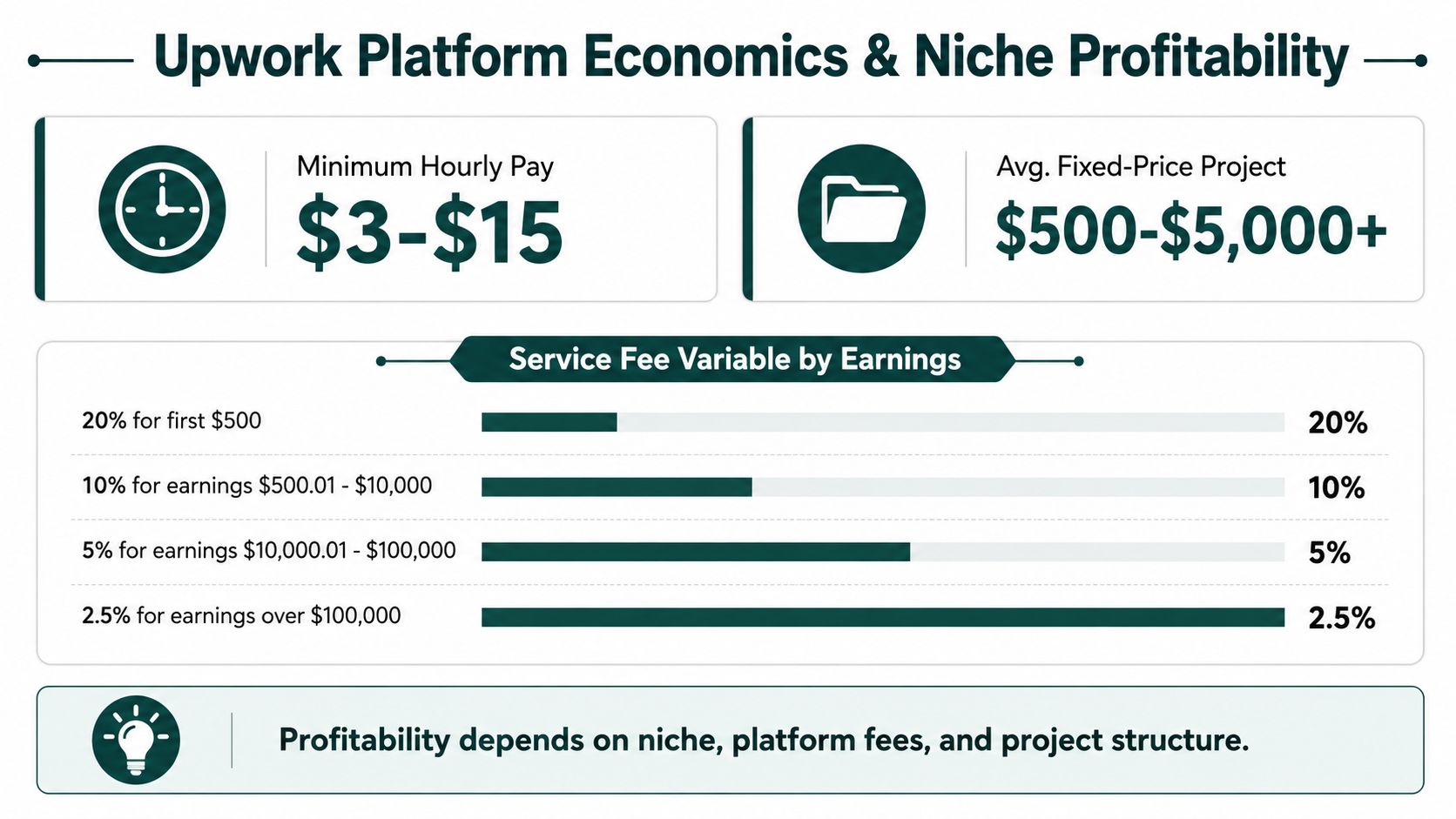
Upwork sets minimum contract rates. Hourly contracts must pay at least $3.00 USD per hour, fixed-price projects must pay at least $5.00 USD, and a fixed-price contract with a defined number of hours must still produce an effective rate of at least $3.00 USD per hour. Bonuses can't replace those minimums, according to Upwork's minimum hourly and fixed-price rate policy.
Those floors are platform rules, not viable business targets. A niche dependent on tiny projects can consume more time in discovery, proposals, revisions, and administration than the contract value supports.
Model fees on both sides
Freelancers pay a variable Upwork service fee ranging from 0% to 15%, depending on the contract. Clients on Basic plans may pay marketplace fees of 3% or 5% on many payments, while Business Plus fees can be 8% or 10%, as shown in Upwork's fees and protection documentation.
The buyer doesn't necessarily calculate these charges the way you do, but the added cost can influence approval behavior and price sensitivity. When comparing niches, estimate the client's total platform spend and your net revenue after fees. Include unpaid prospecting, meetings, revisions, and account management. A project that appears attractive at the posted price may not survive that complete calculation.
Treat category choice as a measurable variable
Independent proposal-benchmark data analyzed 133,872 agency proposals and reported an overall reply rate of 7.45%. Under-fished niches reached 11% to 14%, while saturated areas including Web Dev, Mobile, and AI/ML fell to 5% to 7%.
The source is competitor-restricted for this publication, so use the figures as an external benchmark rather than a promise. The important conclusion is that category selection changes the odds of receiving a response. A stronger proposal helps, but it can't fully compensate for entering a category where many providers make similar claims.
Score each niche on:
Net project value: Revenue after platform fees and delivery time.
Buyer quality: Clarity of budget, scope, decision-maker, and urgency.
Repeat potential: Likelihood of follow-on work or recurring engagements.
Proposal density: How many credible providers compete for the same jobs.
Delivery advantage: Whether templates, systems, or specialization improve margins.
Choose a niche where the buyer's problem supports a meaningful project structure, not merely a high count of available postings.
Timing and Automation as Competitive Advantages
Niche selection only creates an opportunity. Your operating system determines whether you reach the buyer while the opportunity is still open. On Upwork, a proposal sent after several competitors have already established relevance faces a different environment from one sent while the client is still reviewing the first responses.
An analysis of 59,339 proposals found that freelancers who applied 2 to 4 hours after a job was posted achieved a 24.3% reply rate, as reported in this proposal timing analysis. That result doesn't mean every niche should wait two hours, and it doesn't guarantee a reply. It shows that timing can be measured and tested instead of treated as a vague productivity preference.
Build speed around relevance
Fast submission only helps when the project fits your niche. Generic automation can increase volume while lowering message quality, damaging trust and wasting proposal spend. The useful sequence is narrower:
Define the niche signal: Identify job language, buyer type, budget shape, and deliverable.
Filter opportunities: Reject projects outside the scorecard or with weak pain signals.
Personalize the proposal: Connect the buyer's stated problem to a relevant process or proof.
Track the result: Record submission time, category, message angle, reply, interview, and outcome.
Refine the filter: Keep learning from accepted and rejected opportunities.
Earlybird AI is one option for this workflow. It can search for projects, learn preferred niches through thumbs-up and thumbs-down feedback, craft personalized proposals, submit them, and provide analytics for freelancers or agencies managing multiple users. That makes it a tool for testing niche fit and improving response operations, not a substitute for deciding whether the underlying problem is worth serving.
Speed matters most when clients review proposals in batches and when the niche has a clear job-posting rhythm. In slower, relationship-led categories, proof and trust may matter more than minutes. Test timing by niche rather than imposing one universal rule.
Making the Final Niche Decision
A final niche decision should combine four types of evidence: recurring pain, reachable buyers, validated behavior, and viable economics. The candidate doesn't need perfect certainty, but it should survive direct questions about who buys, why they act, how you reach them, what they pay, and whether delivery leaves enough margin.
Kill the niche when any of these conditions remains true after investigation:
No urgent consequence: People complain, but the problem doesn't affect money, time, risk, or an important outcome.
No reachable buyer: You can describe the audience but can't identify where or how to contact decision-makers.
No payment path: Prospects like the idea but won't disclose an existing budget, paid workaround, or next action.
Unworkable delivery: The service requires custom effort that the market won't support financially.
Platform friction: Fees, minimums, or proposal competition erase the available margin.
A niche is not yet proven when you have a credible problem, identifiable buyers, and a specific validation test still outstanding. It is proven unprofitable when repeated conversations and behavioral tests show weak urgency, weak payment intent, or economics that don't work. Don't confuse those states. The first calls for another test. The second calls for a different niche.
Set a review milestone after your initial market entry. Compare the assumptions from your scorecard with actual opportunities, replies, interviews, paid tests, delivery time, and net revenue. If the evidence improves, specialize further. If it stays weak, change the offer or exit rather than trying to rescue a category through more content.
The best niche is rarely the broadest or trendiest. It's the one where a specific buyer repeatedly describes an expensive problem, takes action to solve it, and can be reached with an offer your team can deliver profitably.
Use Earlybird AI to turn your chosen niche into a measurable Upwork prospecting workflow, with project discovery, personalized proposals, reply tracking, and agency-friendly multi-user management. Visit Earlybird AI to evaluate how faster, more focused outreach can support your next niche test.