
← Back To Blog
How to Manage Client Expectations Without Friction

A website redesign can launch on time, stay within budget, and still produce a disappointed client. The work looks complete from the agency's side, but the client remembers unanswered messages, unclear review points, or a final result that didn't match the picture in their head. By delivery day, the project has met its formal requirements while missing the experience the client believed they were buying.
That's the practical challenge behind how to manage client expectations. You're not only managing scope or sending updates. You're closing the distance between what the client expects will happen and what they believe they received.
Why Client Expectations Drift and What the Expectation Gap Really Is
Consider an agency that redesigns a company website. The team delivers on the agreed date and spends no more than the approved budget. The client still leaves a three-star review, saying the agency was difficult to reach and provided too little visibility during production.
The agency measures performance through delivery. The client measures it through the entire experience, including how confident they felt while waiting. That difference is the expectation gap, the distance between a client's assumptions at kickoff and their perception at delivery. Perception, not effort alone, drives satisfaction.
Three failure points create most of the gap:
- Ambiguous discovery: The client says they want a “modern” website, while the team hears a specific visual direction. Neither side defines what success will look like.
- Silent execution phases: The team works efficiently in the background, but the client sees no evidence of progress and assumes the project has stalled.
- Uncalibrated revision limits: The agreement mentions revisions without explaining what counts as a revision, when feedback is due, or how new preferences affect the schedule.
PMI research found a 0.40 to 0.65 correlation between client expectation alignment and project success, a moderate-to-strong association in applied business research. Published in 2012, the research remains a useful historical marker because it connects expectation alignment with satisfaction, delivery quality, and perceived success. PMI's research on client expectation alignment and project success supports a straightforward operating principle: define expectations early, document them, and revisit them before assumptions harden.

Signals that the gap is forming
Watch the client's language, not just the project tracker. Vague feedback, such as “make it feel more premium,” usually means the success criteria weren't concrete enough. Repeated clarification requests indicate that the client and delivery team are working from different definitions. Silence after status updates can also be a warning, especially when the client stops confirming decisions or approving milestones.
A status update can be accurate and still fail if it doesn't answer the question the client is carrying: “Are we on track for the result I expect?” Every intervention in the following workflow exists to answer that question before delivery turns into a surprise.
Aligning Expectations Before the Project Kicks Off
The strongest expectation-management work happens before production starts, when changing the agreement is cheap and emotionally neutral. Use a proposal-to-statement-of-work review that forces both parties to make assumptions visible.
The proposal-to-SOW check
Confirm these items in writing:
- Objective: What business problem is the project meant to address?
- Deliverables: What files, pages, campaigns, or assets will the client receive?
- Revisions: How many review rounds are included, and what does each round cover?
- Turnaround: What does the agency need from the client before each milestone can begin?
- Payment: What are the payment stages and approval dependencies?
- Exclusions: Which requests require a separate agreement or change request?
A proposal can persuade someone to buy. A statement of work must help two teams operate. Keep the agreement accessible, and distinguish the master relationship terms from the project-specific deliverables with this explanation of master service agreements and statements of work.
Replace broad completion promises with named checkpoints. For a brand identity project, a workable three-milestone scope might look like this:
- Direction: Deliver a written creative brief and two strategic moodboards. The client chooses one direction by the stated decision deadline. Acceptance means one direction is approved for development.
- Identity development: Deliver the selected logo route, color system, type recommendations, and representative applications. Acceptance means the client approves the identity direction, not every possible application.
- Handoff: Deliver final logo files, a concise brand guide, and agreed application files. Acceptance means the listed files are present, correctly formatted, and ready for use.
The exact dates matter less than the dependency chain. If the client misses a decision deadline, the next milestone should move according to the agreed rule rather than creating a silent scramble.
Ask questions the proposal can't answer
A kickoff questionnaire should identify the final decision-maker, required contributors, preferred communication channels, review availability, internal approval constraints, and the client's own definition of success. Ask, “What would make this project feel successful when we review it after delivery?” The answer often reveals expectations that never appeared in the original brief.
Send a kickoff recap within one business day. Include the approved scope, milestone owners, decision deadlines, communication rules, and immediate next steps. Both sides should sign the same artifact, not rely on the same memory.
Setting Communication Cadences That Prevent Surprise
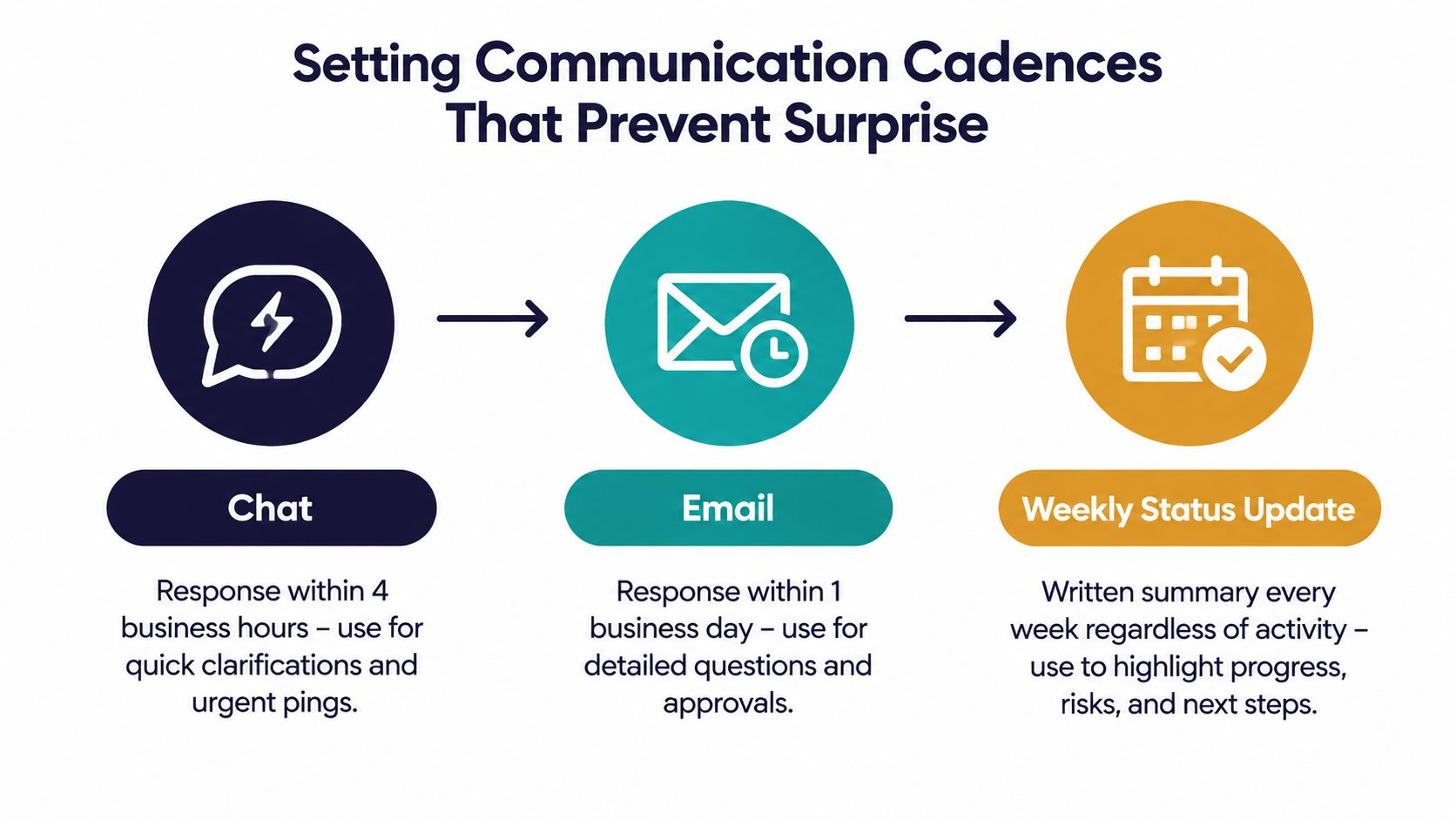
Fast replies feel helpful, but reactive availability creates a dangerous precedent. If you answer every message immediately, clients may interpret that behavior as the permanent service standard. A written cadence gives them confidence without requiring your team to remain constantly interruptible.
A practical channel system is:
- Chat: Respond within four business hours for quick clarifications and urgent pings.
- Email: Respond within one business day for detailed questions, decisions, and approvals.
- Weekly status update: Send a written summary every week, even when activity is limited.
One published agency guide recommends 24 hours for general inquiries, 8 working hours for project questions, and 2 hours for urgent issues. Its client communication guidance is useful when you need to separate ordinary responsiveness from urgent support. Choose the windows your team can sustain, then publish them at kickoff.
Log every substantive decision in one project thread. A new team member should be able to read a short stretch of history and reach the same understanding the client has. For complex work, structured stakeholder communication practices can help teams ship faster with clear communication without turning every update into another meeting.
No surprise should arrive verbally before it arrives in writing. If a client asks for a change on a call, summarize it in the project thread before assigning the work.
For more channel rules and practical operating examples, use this guide to client communication best practices.
Controlling Scope Creep With a Change Request Workflow
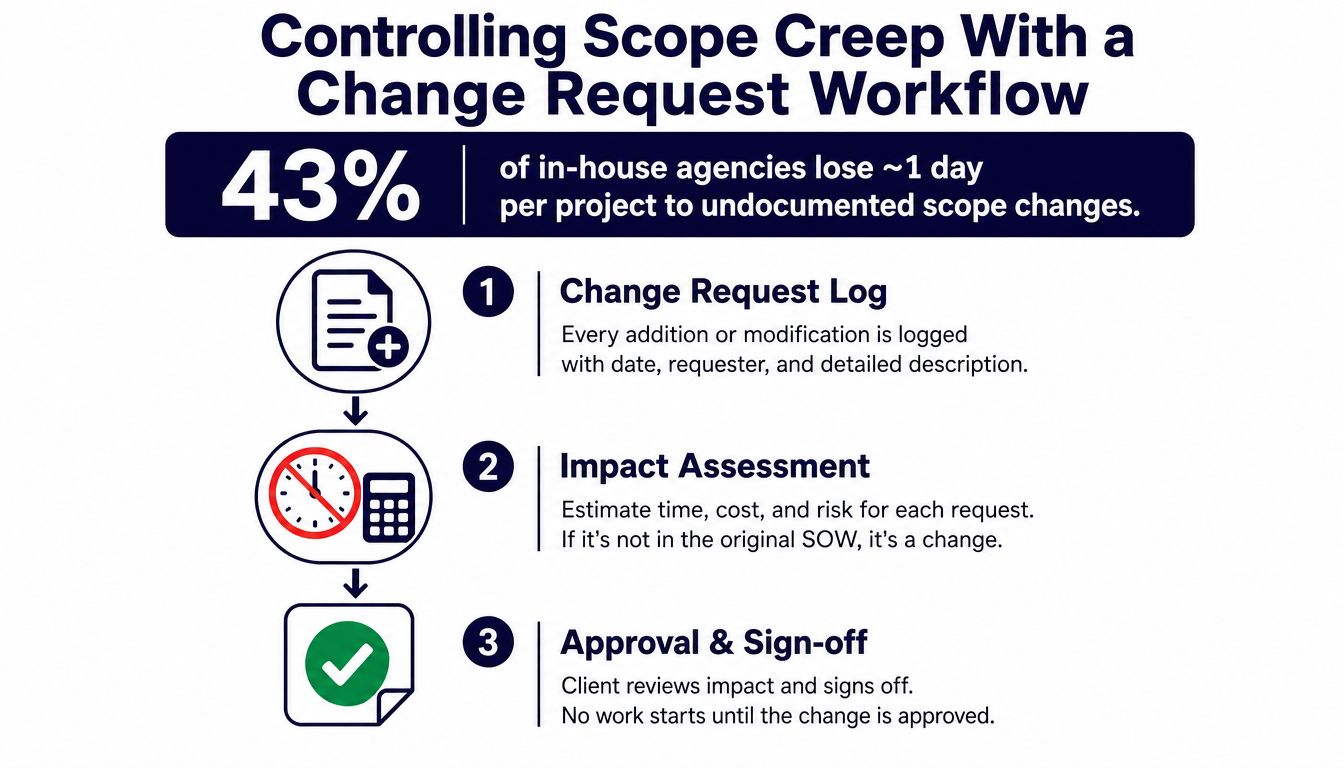
Scope creep isn't a personality problem. It's a control problem. A client may ask for a reasonable addition, and an agency may agree because the request sounds small. The risk appears when the team accepts that addition without recording its effect on effort, timing, or later decisions.
PMI-cited material reports that 52% of failed projects cite scope creep as a primary reason, while poor scope management costs U.S. organizations about $109 million for every $1 billion invested. The same research set reports that severe scope creep can push budgets 189% over plan and make projects take 2.5 times longer than expected. The cited scope-management evidence shows why expectation management functions as risk control, not polite administration.
The five-step change workflow
- Detect the trigger. Identify any new deliverable, changed requirement, extra review, or dependency that wasn't in the signed SOW.
- Log it promptly. Record the requester, date, description, and affected milestone. Don't trust a chat message to serve as the project record.
- Quote the delta. Prepare a short change order describing the added effort, revised deadline, cost if applicable, and delivery risks.
- Secure approval. Get written authorization before assigning or producing the extra work.
- Update the tracker. Change the project total, milestone dates, owners, and remaining decisions so the team operates from the new agreement.
A visual workspace can make the request history, decisions, and impact assessment easier to inspect. Tools such as visual workspace tools are useful when scattered notes make it difficult to see what changed and why.
Use this script when a client makes a “quick” request:
The original scope covers [original deliverable]. You've now asked for [new request]. We can add it for [hours or fee], which changes the delivery date from [old date] to [new date]. Please reply “Approved” if you'd like us to proceed under those revised terms.
Review the scope delta every week. Count additions, rejected requests, approved changes, and their effect on milestones. Also make this a standing rule: every verbal request receives a written follow-up within the same business day.
For a clearer foundation before production begins, review this resource on project scope definition. A precise SOW makes change control easier because the team has something specific to compare against.
Measuring Satisfaction and Resetting Mid-Project
A delivery survey arrives too late to manage satisfaction. By then, the client has already formed a final judgment. Track leading signals while the work is still recoverable.
Before kickoff, choose three indicators:
- Milestone acceptance rate: Whether the client accepts each checkpoint or sends it back for fundamental rework.
- Response-time variance: Whether decisions arrive within the agreed window or repeatedly delay dependent work.
- Weekly stakeholder pulse: Ask the primary stakeholder one consistent question about how confident they feel in the project's direction.
A solo freelancer can update these indicators in a few minutes each week. Keep the record simple, with one row for the current milestone, one note for the latest risk, one status for client responsiveness, and one sentence describing the next decision.
MetricTarget ThresholdCadenceMilestone acceptance rateAcceptance at each agreed checkpointAt every milestoneResponse-time varianceDecisions arrive within the written response windowWeeklyStakeholder pulseStable confidence from the primary stakeholderWeekly
Trigger a reset when a milestone is missed, two check-ins go unanswered, or a request contradicts the signed SOW. Don't wait for frustration to become a formal complaint.
A reset conversation that preserves trust
Use four moves:
- Name the gap factually: “The homepage approval is behind the agreed checkpoint, and the new request changes the approved content direction.”
- Restate the agreement: “The SOW called for approval of the existing direction before development.”
- Offer two paths with trade-offs: “We can keep the launch date by developing the approved direction, or revise the direction and move delivery to [new date].”
- Confirm the commitment: “Please confirm which path you choose. I'll update the project record immediately.”
After delivery, hold a 20-minute review call and send a one-page summary. Ask what was promised versus shipped, what surprised the client positively, and what they'd change next time. Feed those answers into the next proposal, not a folder nobody opens.
A One-Page Expectation Management Playbook
A playbook works when it tells someone what to create, who owns it, and what event activates the next action. Keep it short enough to use during a busy project.
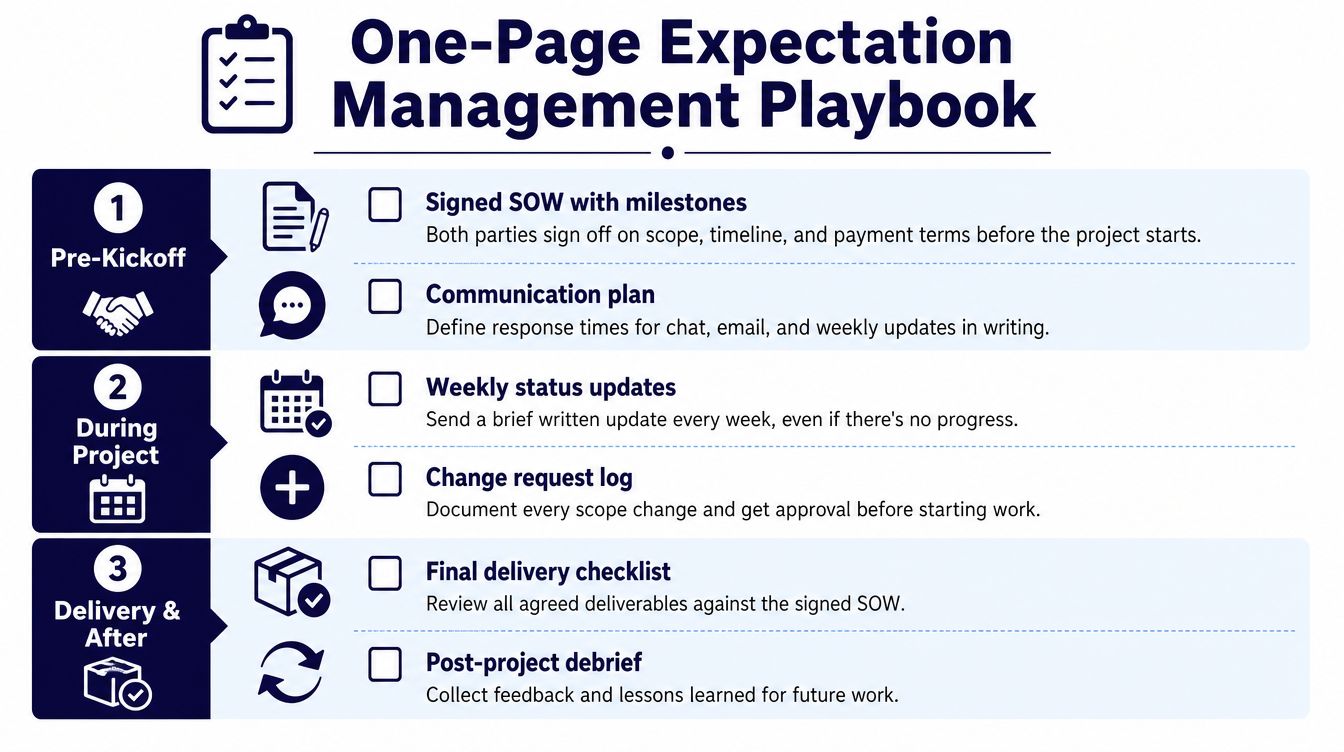
Pre-kickoff
Owner: Account lead and client decision-maker.
Artifacts: Signed SOW with milestone definitions, written communication plan with response windows, and a named decision-maker for each deliverable.
Trigger: The client signs and supplies the required inputs. Production begins only after the kickoff recap confirms the same scope.
During the project
Owner: Project manager or assigned client-communications owner.
Artifacts: Weekly status note, scope-change approval log, and a reset trigger list with an owner for each risk.
Trigger: A milestone reaches review, a dependency changes, or a request falls outside the SOW. The owner records the event and sends the relevant decision request.
Delivery and after
Owner: Delivery lead, then account lead.
Artifacts: Final delivery checklist, satisfaction survey, retrospective document, and a testimonial request only when the client's score is 9 or higher.
Trigger: The agreed deliverables pass final review. The post-project debrief records what to preserve and what to change in future proposals.
Operational rule: If an expectation matters to the client, it deserves an artifact.
Run this weekly checklist:
- Confirm the next milestone and decision owner.
- Review open blockers and unanswered client questions.
- Compare current scope with the signed SOW.
- Send the written status update.
- Record one risk and its next action.
The checklist should take under fifteen minutes. It won't replace judgment, but it catches the ordinary omissions that create avoidable expectation gaps.
Frequently Asked Questions From Freelancers and Agency Leads
How should I handle a client who keeps shifting goals?
Stop debating memories. Send a neutral recap that lists the signed scope, the latest request, and the contradiction between them. Keep the tone limited to observable issues, then offer an escalation path, such as a decision call with the named stakeholder and a written approval afterward.
If the client continues to reject documented agreements or the relationship becomes unworkable, use the exit clause in the contract. A professional exit is safer than allowing a project to continue without a shared definition of completion.
Who should reset expectations when a project slips?
The person closest to the delivery risk should alert the project owner, and the project owner should initiate the client conversation. Disclose the revised timeline, the factual root cause, and the corrective plan. Don't hide the problem until the original deadline passes.
Offer choices with trade-offs. A reset becomes trust-building when the client can see what changed, what remains possible, and what commitment you're making next.
How can a growing agency keep this consistent?
Standardize the kickoff template, run a weekly expectation audit, assign one client-communications owner per account, and store the change-request process in a shared system. Junior team members should inherit the workflow, not reconstruct it from scattered messages.
For teams managing several opportunities alongside delivery, Earlybird AI can automate Upwork searches, personalized proposals, and replies, while its dashboard provides call summaries, booking outcomes, and conversion tracking. That kind of visibility can support clearer scheduling conversations, but it shouldn't replace the written scope and cadence that govern active client work.
Use the operating system in this guide on your next project, starting with the kickoff recap, response windows, and change log. If you want to reduce manual follow-up while keeping client conversations organized, visit Earlybird AI to see how its Upwork automation and scheduling tools fit into a more predictable agency workflow.