
← Back To Blog
Lead Generation and Prospecting
The most popular advice in lead generation and prospecting is also the least useful: respond faster, send more proposals, and let automation handle the rest. That approach confuses activity with pipeline. On Upwork, every bid consumes a scarce resource, while buyers often decide which providers deserve attention before they reply. A fast, generic proposal can arrive first and still be irrelevant.
The practical advantage comes from combining speed, fit, evidence, and judgment. Automation should detect opportunities, organize research, draft relevant responses, and protect follow-up discipline. People should decide whether the project is worth pursuing, whether the claims are credible, and whether the opportunity deserves a personalized commercial conversation.
The Speed Versus Relevance Dilemma
Being first in a client's inbox sounds like a complete strategy. It isn't. Speed matters because intent can fade, but speed without relevance moves an unsuitable message through the system more efficiently.
Buyers are completing roughly 60–70% of their evaluation before contacting sales, which means a generic proposal often arrives after the buyer has already formed a shortlist. Research on buyer evaluation behavior supports a more demanding standard for outreach: the proposal must help the client validate a decision, not merely announce that an agency is available.
A client posting a technical migration project has already supplied useful buying signals. The brief may identify the platform, business risk, delivery deadline, required outputs, and concerns about the transition. A proposal that repeats “we can help” adds little. A stronger response identifies the likely bottleneck, cites relevant evidence, proposes an initial delivery hypothesis, and asks one question that affects scope.
Why volume fails on complex projects
High-volume bidding creates three problems.
- It consumes attention: The team spends time reviewing weak opportunities and correcting irrelevant drafts.
- It weakens positioning: Repeated generic claims make a specialist agency look interchangeable.
- It damages learning: If every project receives the same treatment, reply data can't reveal which categories, budgets, or client signals matter.
The better operating question isn't “How many proposals did we send?” It's “How quickly did we send a qualified response that gave this buyer a reason to continue?”
That distinction changes the role of prospecting software for B2B services. The useful system isn't a message cannon. It should help the team identify a fit, retrieve the right proof, and prepare a concise response while the opportunity is still active.
Practical rule: Automate the delay, not the judgment.
For an Upwork agency, the first response can be fast without being rushed. A workflow can detect a new posting, classify the service, compare the brief with the agency's evidence library, and flag missing information. If the fit is strong and confidence is high, the system can prepare a draft for submission. If the scope is unclear or commercially important, it should send the opportunity to a human.
Speed remains a conversion-control variable. Relevance determines whether that first contact earns a second one.
Separating Inbound Capture From Active Pursuit
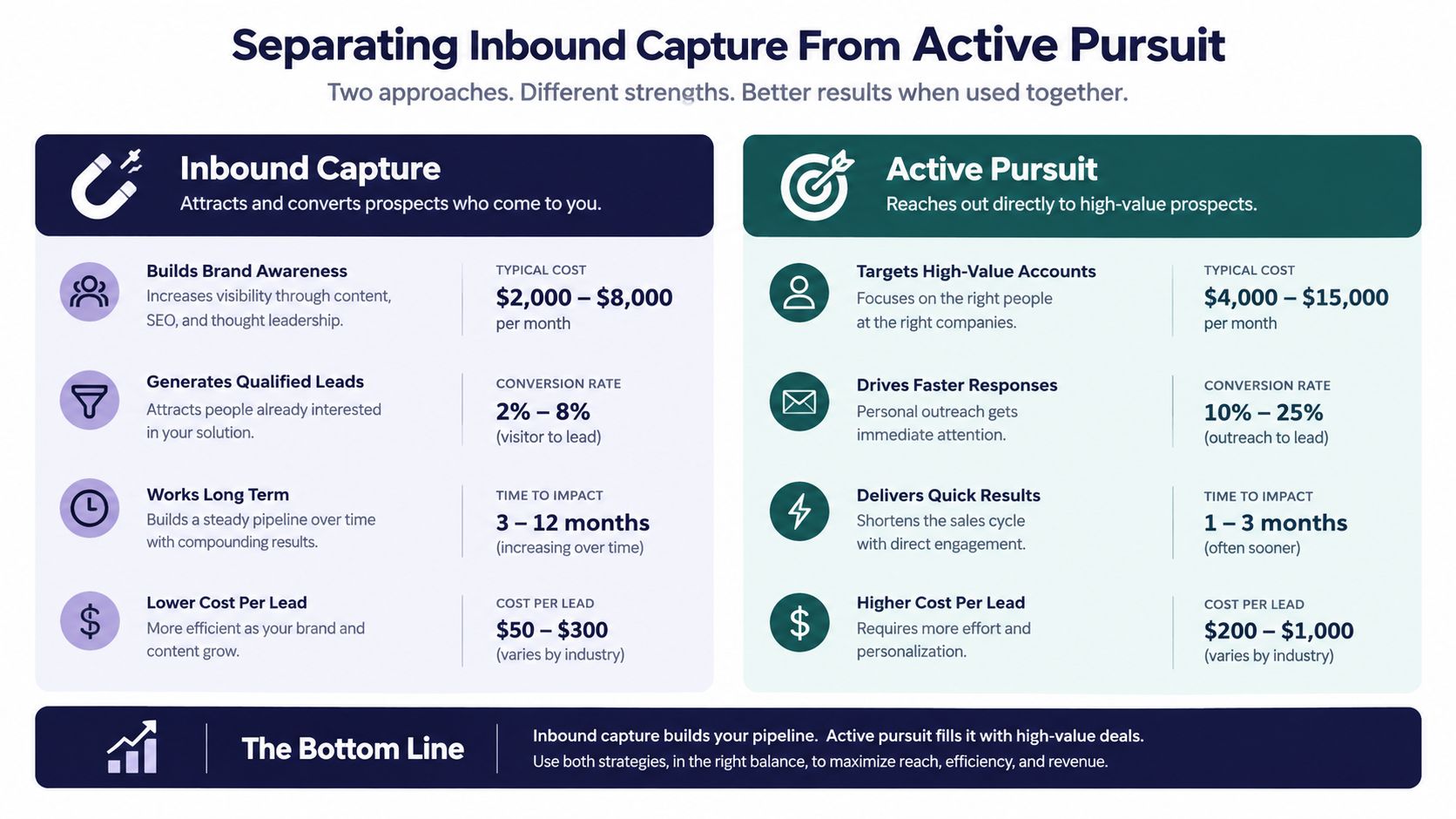
Lead generation and prospecting support the same revenue system, but they perform different jobs. Lead generation captures attention and creates identifiable interest. Prospecting selects a specific opportunity and pursues a conversation. Confusing the two produces poor handoffs and misleading performance reports.
Inbound capture might include a technical guide, an agency case page, a search result, a webinar, or a referral form. These assets attract people who are exploring a problem. The marketing process gives them useful information and records a signal, such as a form submission, return visit, content download, or direct inquiry.
Active pursuit starts with a defined person, company, or project. An agency reviews the signal, checks fit, chooses the relevant service line, and contacts the prospect with a message designed for that situation. A useful meaning of prospecting explained distinction is that prospecting requires deliberate qualification and direct engagement, not just collecting names.
Different signals need different owners
Consider an SEO agency publishing a guide about technical audits. A visitor reading it is an inbound lead, not automatically a sales opportunity. Marketing can nurture that interest with related resources and a clear route to request an assessment. Sales should act when the visitor submits a detailed brief, asks about a project, or demonstrates a service-specific need.
On Upwork, the boundary is even sharper. A job posting is an observable opportunity, but it still needs qualification. The agency should inspect the requirements, client history, budget clarity, hiring behavior, and relevance to its portfolio before spending bidding currency. A proposal is active pursuit, not inbound marketing.
Build the handoff around evidence
Marketing and sales should agree on the information required before a handoff. For an agency, that might include:
- Problem clarity: The buyer has described a business or delivery problem rather than listing vague tasks.
- Service fit: The project matches a defined capability and available team capacity.
- Commercial viability: The scope and budget support a sensible engagement.
- Next-step readiness: The buyer has provided enough context for a useful conversation.
Marketing owns the creation and distribution of material that makes the agency discoverable and credible. Prospecting owns the one-to-one action that turns a relevant signal into a qualified exchange. The teams should share outcome data, but they shouldn't use the same success metric.
A marketing asset may succeed by attracting qualified attention. A prospecting workflow succeeds when it creates a relevant reply, a booked conversation, a proposal, or a contract. Those outcomes depend on different decisions, so they need separate reporting and a clear handoff.
Managing Bidding Resources on Upwork
Upwork prospecting isn't the same as sending another cold email. Each proposal uses Connects, and the cost isn't fixed. Upwork explains that every job posting specifies its own Connects requirement, that the amount can change while the post remains active, and that higher-paying projects often require more Connects. Connects can also support visibility products such as boosted proposals and the Availability Badge. Upwork's explanation of Connects makes the core point clear: bidding is a resource-allocation problem.
Upwork states that Basic accounts receive 10 free Connects monthly, Freelancer Plus accounts receive 100 monthly, and additional Connects cost $0.15 each. The platform's guidance on getting more Connects also describes a reward mechanism in which a freelancer earns 18 Connects after submitting at least three proposals and spending at least 54 Connects on them.
Qualify before you spend
A practical workflow starts before the proposal draft.
- Confirm service fit. Reject projects that require a capability the agency can't deliver confidently. A broad service menu shouldn't justify weak bidding.
- Inspect the brief. Look for a defined outcome, usable requirements, realistic constraints, and a problem the team understands.
- Review the client context. Examine hiring activity, project history, feedback patterns, and whether the client appears to be comparing providers seriously.
- Assess commercial value. Consider budget clarity, complexity, delivery risk, and the likelihood of follow-on work.
- Choose the response path. Spend Connects only when the opportunity clears the agency's threshold. Otherwise, save the resource or ask for clarification when the platform context allows it.
A simple internal score can combine fit, evidence availability, client quality, scope clarity, and delivery capacity. The score doesn't need to be mathematically elaborate. Its value is consistency. Without one, bidders tend to chase whichever posting looks newest or easiest to answer.
Treat Connects as acquisition capital, not an attendance fee.
Proposal selection should also distinguish direct applications from invitations. Upwork states that invitations don't require Connects, so an agency should track those opportunities separately from selective outbound bidding. The team can then compare the quality and commercial outcomes of applications, invitations, and visibility products without treating them as interchangeable channels.
For a more detailed perspective on bidding on Upwork, focus on the decision before submission. The best proposal workflow doesn't maximize the number of bids. It protects the budget for projects where the agency can explain the problem, prove relevant capability, and propose a credible next step.
Engineering Personalization at Scale
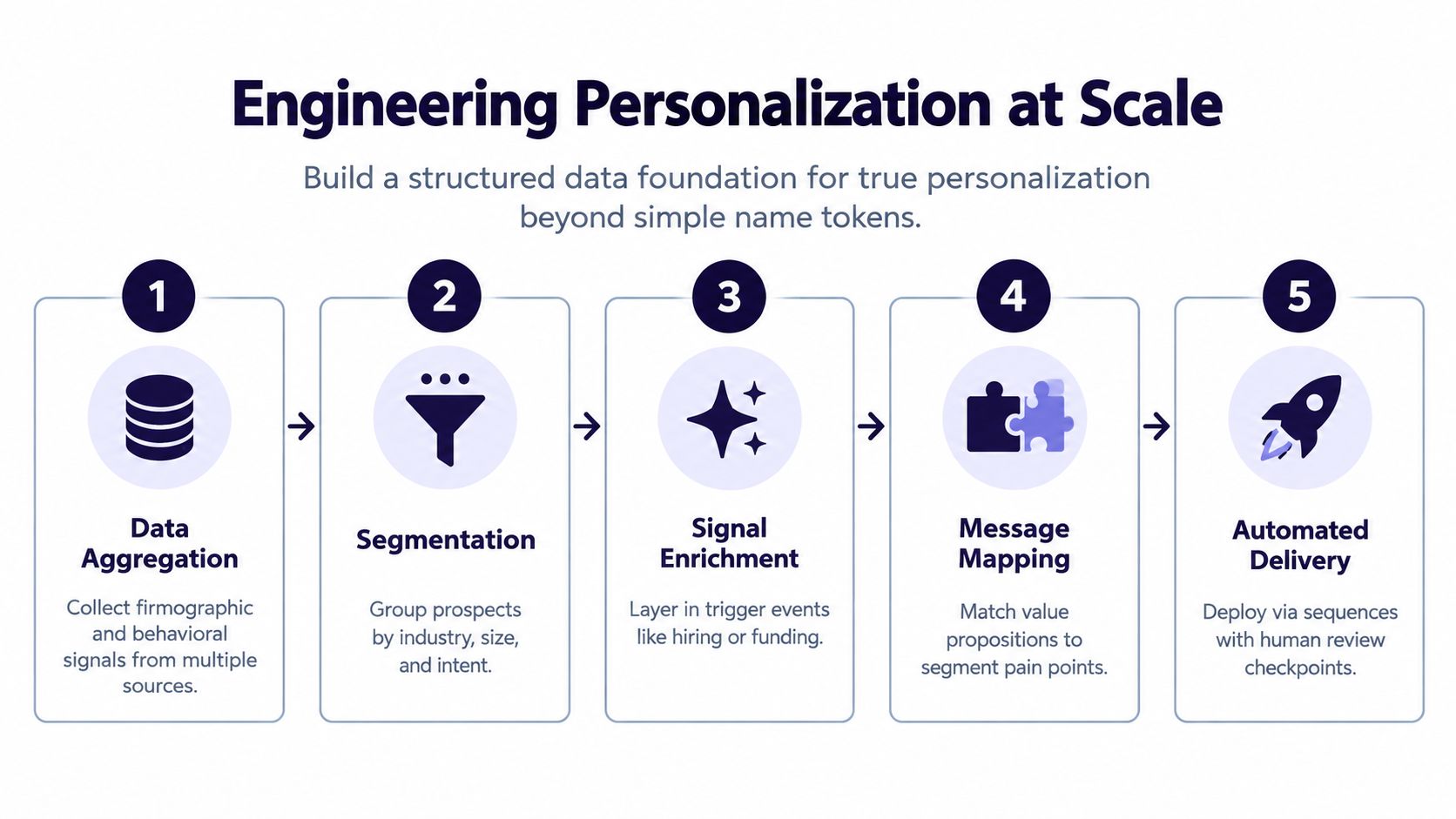
Personalization fails when teams define it as inserting a client's name into a template. Buyers recognize that pattern immediately. Useful personalization connects a specific project signal to a specific piece of evidence and a realistic delivery idea.
McKinsey's Global B2B Pulse research found that market leaders were four times more likely than peers to deploy one-to-one personalization, 20% versus 5%. McKinsey's research points toward an operating model, not a copywriting trick.
Create a traceable signal pipeline
Start by extracting structured information from every project brief:
- service requirements and deliverables
- industry and business model
- deadline and technical constraints
- success criteria
- stated risks or objections
- budget and engagement shape
Next, map those fields to an evidence library. A development agency might connect a migration requirement to a relevant portfolio example, a testing method, and an assumption about the first delivery phase. An SEO agency might connect a visibility problem to an audit process, a technical capability, and a measurement plan.
The generator should produce a constrained message from those approved inputs. It shouldn't invent results, imply experience the agency doesn't have, or promise an outcome that the brief can't support.
Make relevance compatible with speed
The fastest reliable workflow separates research once from decision repeatedly. The agency can maintain reusable evidence by service, industry, platform, project type, and risk. When a new posting arrives, automation retrieves the likely matches and prepares a draft. A human checks whether the selected proof actually answers the client's problem.
A strong proposal normally contains four elements:
- Recognition: Show that the agency understood the specific requirement.
- Evidence: Provide one relevant example, method, or capability.
- Delivery hypothesis: Explain how the work could begin or be organized.
- Targeted question: Ask for information that changes the recommendation.
A system should store the source signal, selected proof point, generated wording, approval status, and outcome. That record lets agency leaders discover whether a particular evidence type leads to qualified replies or merely makes messages sound polished.
The AI for sales prospecting conversation is most useful when it includes governance. Personalization at scale should reduce repetitive research while preserving accountability for every claim. If the system can't explain why a sentence appeared in a proposal, the message isn't ready for automatic submission.
Defining the Automation Boundary
Automation should stop wherever the cost of a wrong assumption exceeds the time saved. That boundary changes by project value, ambiguity, risk, and the agency's ability to verify the output.

A fully automated workflow can work for repetitive, low-ambiguity opportunities with clear requirements, approved evidence, and a narrow service scope. It can detect a posting, reject obvious mismatches, assemble a constrained proposal, and manage routine follow-up. The risk rises when the system encounters an unusual platform, an unclear deliverable, a sensitive client problem, or a claim that needs interpretation.
A human-in-the-loop workflow is usually the practical center for an agency. Automation handles discovery, extraction, ranking, drafting, and reminders. A qualified operator approves high-value proposals, edits the delivery hypothesis, checks proof, and decides whether the client deserves a call.
The manual model remains appropriate when the opportunity is strategic, technically complex, or poorly specified. It costs more attention, but the operator can ask better questions before making a commercial commitment.
A useful safeguard is a confidence threshold. High confidence can permit an automatic draft or submission when all required fields are present and the evidence match is strong. Medium confidence should require review. Low confidence should trigger a decline or a request for clarification, not an optimistic proposal.
Automation should increase the number of considered opportunities, not the number of unqualified promises.
Human approval also matters for projects with unusual value, unclear ownership, difficult compliance considerations, or a high likelihood of scope expansion. The agency should define these conditions before the system goes live. Otherwise, operators will make inconsistent exceptions under time pressure.
This short video offers another way to think about workflow design and the points where operational review belongs.
The right boundary isn't a permanent setting. Review proposal outcomes, declined opportunities, client questions, and scope problems. Expand automation only when the team can show that the system preserves relevance and trust. Pull work back to human review when errors become commercially meaningful.
Measuring Pipeline Velocity and Conversion
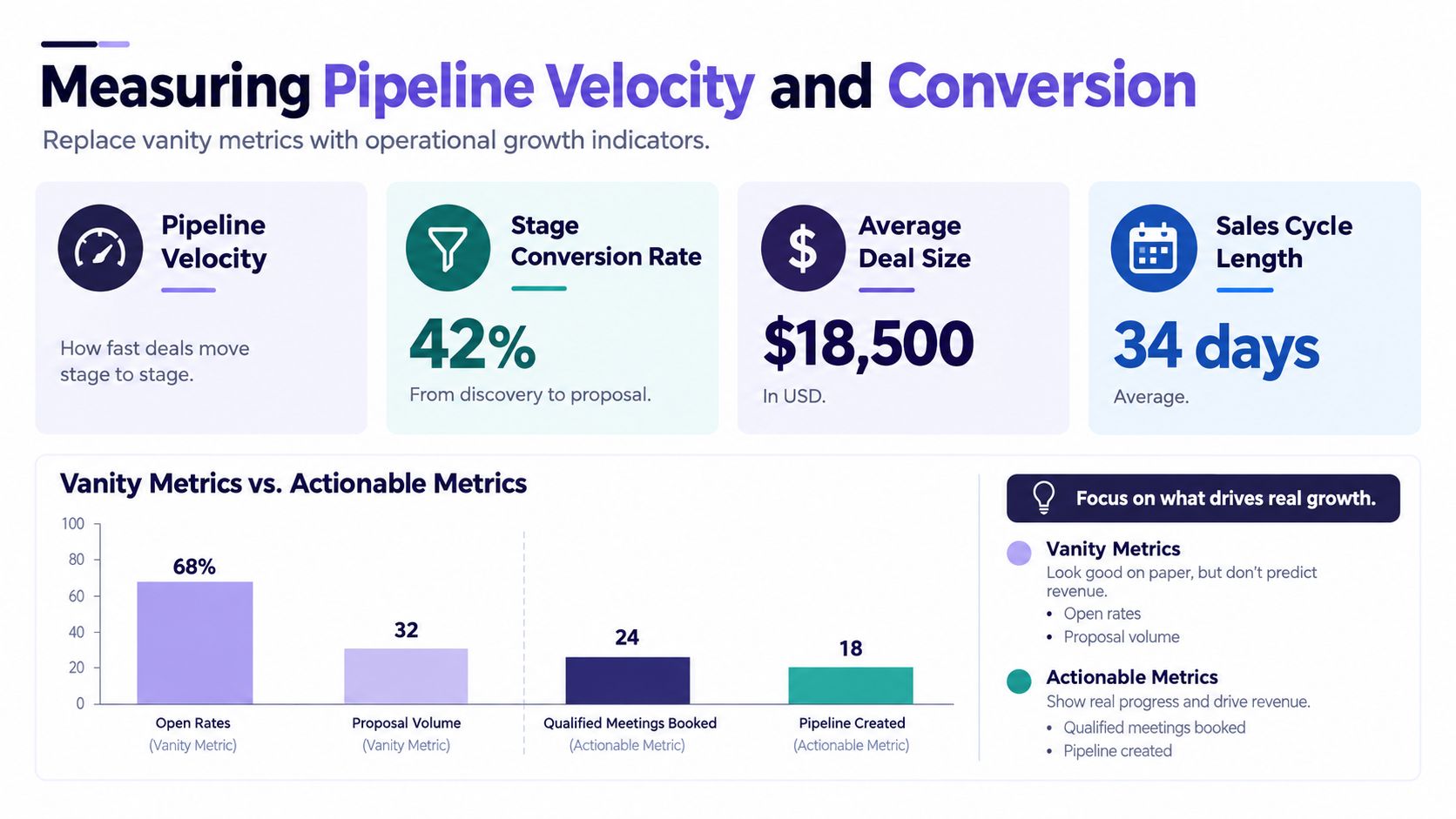
Proposal volume is an activity measure. It tells you that the system did something, not that the system created pipeline. Open rates are similarly weak for agency prospecting because they don't show whether the buyer was qualified, interested, or commercially suitable.
Response latency is more useful when measured end to end. Track posting detection time, qualification time, proposal-generation time, submission time, reply latency, and meeting-booking latency. A Harvard Business Review study covering 2,241 U.S. companies found that organizations contacting an inbound lead within one hour were 7 times more likely to achieve a meaningful conversation with a decision-maker than organizations waiting one additional hour, and 60 times more likely than organizations waiting 24 hours or longer. The speed-to-lead summary connects the result to intent decay, as attention and willingness to engage can decline while competing suppliers enter the conversation.
Separate speed effects from lead quality
Don't pool every Upwork opportunity into one average. Segment results by:
- Job category: Development, design, marketing, SEO, and content may respond differently to urgency and proof.
- Client geography: Time zones and working-hour overlap can affect replies and calls.
- Project budget: Higher-value work may require more review and produce a different sales cycle.
- Proposal variant: Compare concise evidence-led drafts with other approved formats.
- Response band: Compare prospects contacted under 5 minutes, 5–30 minutes, 30–60 minutes, and over 60 minutes.
The bands matter because a faster response can look successful when it merely targets better postings. Pair latency with project fit, client history, and scope clarity. Then inspect qualified-reply rate, interview rate, booked-call rate, proposal-to-contract conversion, sales-cycle duration, and revenue per proposal.
A useful dashboard should answer operational questions. Are relevant proposals being delayed by review? Are fast drafts earning replies but failing to book calls? Does one service category generate conversations but poor-fit contracts? Which evidence library entries support downstream revenue rather than superficial engagement?
For a practical explanation of what sales velocity means, treat the metric as movement through defined stages, not as a synonym for sending faster. A healthy pipeline moves qualified opportunities from detection to conversation, proposal, decision, and contract without hiding quality problems behind more activity.
Building a Sustainable Outreach Engine
A sustainable agency outreach engine doesn't behave like a broadcast machine. It behaves like a disciplined operating system that protects account safety, client trust, bidding resources, and team attention.
The foundation is a clear ideal project profile. Define the services, platforms, industries, budgets, delivery risks, and client behaviors that justify pursuit. Add explicit decline rules. An agency should be able to reject a poor-fit project without debating it from scratch each time.
The operating loop is straightforward:
- Detect: Monitor relevant opportunities and capture the original brief.
- Qualify: Score fit, clarity, evidence, commercial value, and capacity.
- Respond: Send a fast, project-specific message when confidence is sufficient.
- Review: Route ambiguous or high-value opportunities to a human.
- Learn: Record replies, calls, contracts, declines, and delivery outcomes.
- Refine: Update searches, evidence, thresholds, and messaging based on downstream results.
Account safety belongs inside this process, not after it. Outreach should respect platform rules, avoid unnatural bursts, use accurate claims, and preserve a human route for client conversations. A system that produces more proposals while reducing trust isn't scaling. It's creating future cleanup work.
Earlybird AI is one option for Upwork teams that want to automate saved-search monitoring, personalized proposal drafting, client replies, follow-ups, and calendar sharing, while using feedback on accepted or skipped jobs to refine opportunity matching. Whatever tool an agency chooses, it should connect automation to measurable commercial outcomes and retain human control where ambiguity matters.
The strongest prospecting programs make every stage accountable. Marketing creates useful authority and signals. Prospecting pursues qualified opportunities. Automation removes delay and repetitive work. Operators protect judgment, relevance, and the credibility that turns an initial message into a durable client relationship.
Earlybird AI helps freelancers and agencies automate Upwork opportunity discovery, personalized proposals, client replies, follow-ups, analytics, and multi-user workflows while keeping human review available for important decisions. Visit Earlybird AI to see how its workflow can help you replace proposal volume with a more disciplined, conversion-focused prospecting engine.


