
← Back To Blog
Machine Learning for Sales: A Practical Guide
An agency owner opens Upwork after dinner and finds 40 new job posts waiting. They sort them by hand, skim every brief, write a few proposals, and still wonder whether the best opportunity was buried near the bottom. By the time the shortlist is ready, the clients who needed a fast response may already be talking to someone else.
That's the practical problem machine learning for sales can address. It doesn't replace judgment, and it won't create useful predictions from empty data. It helps a small team turn past bids, replies, wins, losses, and client behavior into better prioritization. The same ideas used in large CRM departments can be adapted to an agency or solo Upwork seller, provided expectations stay realistic.
This guide explains what sales machine learning does, the techniques behind lead scoring and forecasting, practical use cases, a small-team implementation roadmap, speed-to-lead automation, cold-start limitations, compliance risks, and the metrics that help you judge ROI. You can also connect these ideas to the broader discipline of AI for revenue operations, where sales data, workflows, and automation work together.
Why Machine Learning for Sales Matters Now
A small agency usually doesn't lose opportunities because its owner can't recognize a good client. It loses them because attention is limited. One person is comparing budgets, another is handling delivery, and proposal writing happens between client calls. Manual triage turns every new opportunity into a fresh decision, even when many job posts resemble projects the agency has already won or rejected.
Machine learning changes that process by looking for recurring signals. A model might learn that certain service categories, client descriptions, project scopes, communication styles, or budget patterns tend to produce stronger outcomes for your team. It can then rank new opportunities so you spend your best working time on the most promising ones.
The commercial interest is substantial. One widely circulated estimate says companies adopting machine learning for sales can see a 50% increase in leads and appointments and a 40% to 60% reduction in call time, according to Autobound's overview of machine learning in sales. Treat that as an external estimate, not a guarantee for an individual seller. Your results depend on data quality, offer strength, response speed, and how consistently you record outcomes.
Practical perspective: ML is a prioritization assistant. It's not a substitute for a clear offer, relevant proof, or thoughtful client communication.
For a solo seller, the first useful outcome may be modest. You might stop wasting time on poor-fit jobs and respond faster to briefs that match your strongest work. For an agency, the same feedback loop can help several bidders learn from one shared history instead of repeating the same mistakes independently.
What Machine Learning for Sales Actually Means
Start with the distinction between rule-based automation and machine learning.
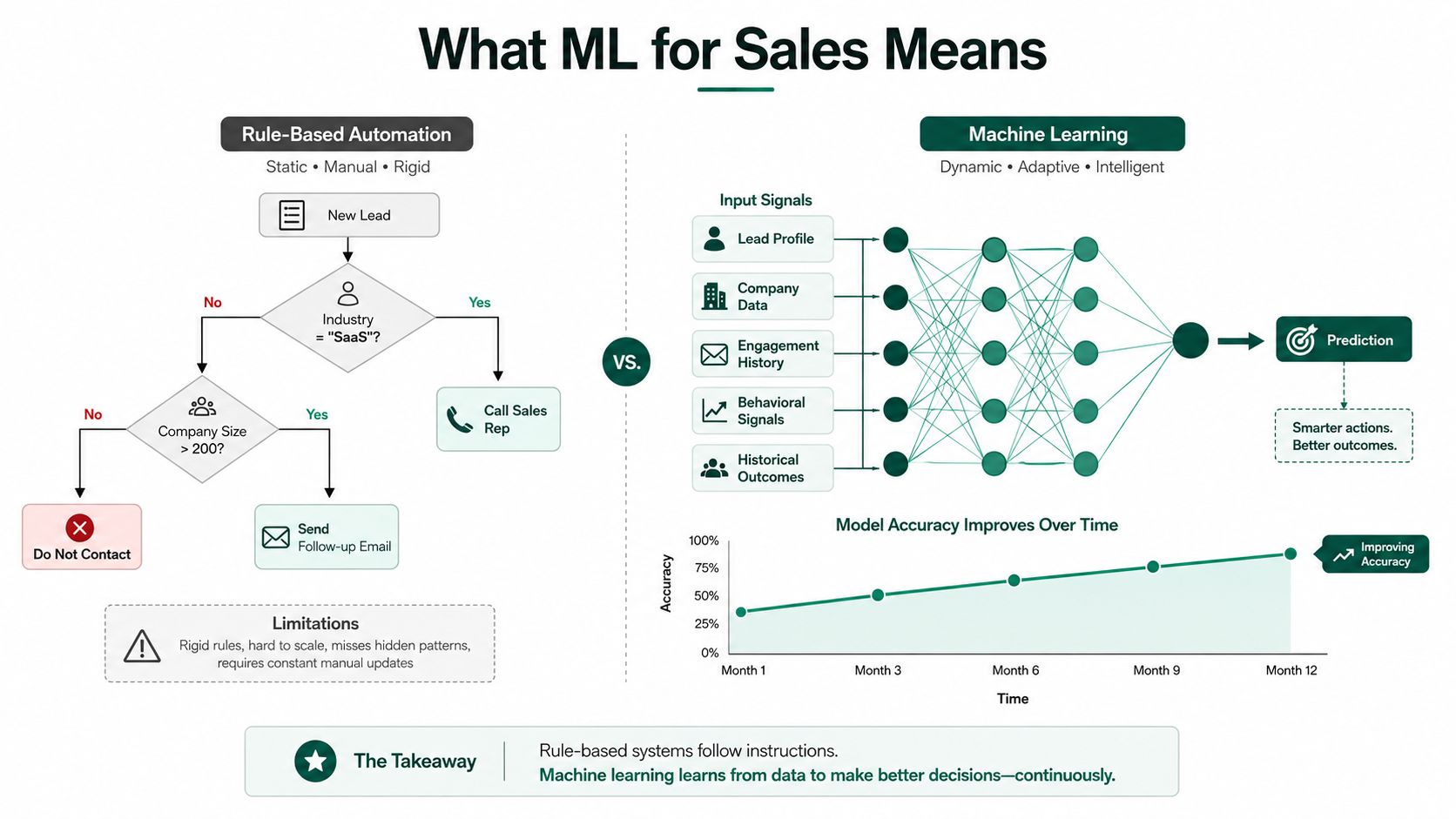
Rule-based automation follows instructions you define. If a job post contains a particular keyword, save it. If the budget is below a threshold, ignore it. If a client replies, send a notification. These rules are useful because they remove repetitive work, but they remain static until someone changes them.
Machine learning works differently. You give the system historical examples, such as projects you bid on, whether the client replied, whether you won, and what characteristics appeared in the brief. The model studies relationships among those examples and produces a probability or ranking for a new opportunity.
The past-deal student analogy
Think of a new sales hire who reads every past deal in your CRM. The hire notices that successful projects often involved a specific type of client, a clear business problem, a service your team delivers well, and a particular pattern of early engagement. The hire doesn't memorize one rule. They form a view from many examples and revise that view when new deals succeed or fail.
A sales model performs a similar task at scale. It can examine structured fields, such as category or budget, alongside less structured information, such as proposal text, job descriptions, emails, and transcripts. It then ranks leads, estimates outcomes, or suggests the next action.
Salesforce helped establish this shift when it introduced the industry's first predictive AI for CRM in 2016, embedding predictive lead scoring and predictive forecasting into sales and service workflows, as described in Salesforce's AI timeline. The same source describes an evolution from predictive AI to generative AI in 2023 and autonomous agents in 2024, and says Salesforce had processed over 11 trillion LLM tokens by the present day.
The market has grown alongside that change. One forecast estimated the AI for sales and marketing market at USD 40.78 billion in 2024, rising to USD 240.59 billion by 2030, according to the same Salesforce reference. For a small seller, that doesn't mean buying enterprise infrastructure. It means the underlying pattern has become accessible through tools that collect feedback, analyze text, and prioritize work.
Machine learning for sales learns from past outcomes so sellers can focus attention on the opportunities and actions most likely to produce a useful result.
Key Machine Learning Techniques Used in Sales
You don't need an academic vocabulary to use these systems well. You need to understand the question each technique answers and what evidence it needs.

Classification for lead scoring
Classification asks: Which lead belongs in the likely-to-convert group?
A classification model learns from labeled outcomes. In an Upwork workflow, the labels could be won, lost, no reply, or disqualified. Inputs might include the client's industry, project type, wording, scope, budget signals, and your prior interaction history. The output is usually a score or category that helps you decide which proposal deserves attention first.
Classification isn't magic. If your labels are inconsistent, the model learns inconsistent behavior. Marking every unanswered proposal as a lost deal, for example, may hide the difference between poor fit and slow follow-up.
Gradient boosting for messy patterns
Gradient boosting asks: Which combination of signals matters when simple rules miss the pattern?
A 2025 case study tested 15 classification algorithms on CRM data from January 2020 to April 2024. The published software-company case study found that Gradient Boosting Classifier delivered the strongest accuracy and ROC AUC among the tested approaches. The finding supports a practical lesson: non-linear ensemble models can outperform simpler scoring rules when conversion behavior depends on many interacting factors.
You don't need to build Gradient Boosting from scratch to benefit from the idea. When evaluating a tool, ask whether it learns from multiple signals rather than relying only on keyword filters.
Regression for pipeline planning
Regression asks: What value or timing should I expect from the opportunities already in progress?
A forecasting model can estimate likely deal value, expected close timing, or probable pipeline contribution. For an agency, this might mean combining active conversations, proposal stages, historical project sizes, and response behavior to create a more realistic view of upcoming work. If you want a broader foundation before automating, this guide to forecast sales for your small business offers useful context on forecasting methods.
Natural language processing adds another layer. NLP asks: What does the client's language reveal about intent, urgency, needs, and fit? It can analyze a brief, identify the central problem, and help draft a proposal that addresses the client's actual wording instead of recycling a generic pitch.
The video below provides additional visual context on the subject.
Clustering for useful segments
Clustering asks: Which accounts or job posts resemble one another?
A model might group opportunities by service type, client maturity, urgency, or buying behavior without requiring you to define every category manually. You could discover that one group responds well to concise technical proposals while another needs more explanation about process and outcomes.
The technique matters less than the decision it supports. If a cluster doesn't change who you contact, what you say, or how quickly you respond, it's interesting analysis rather than useful sales operations.
Real Use Cases From Lead Scoring to Churn Prediction
The value appears when a prediction changes a seller's next action. A score sitting in a dashboard doesn't create revenue. A prioritized queue, a faster proposal, or a timely client check-in can.
Lead scoring turns browsing into a shortlist
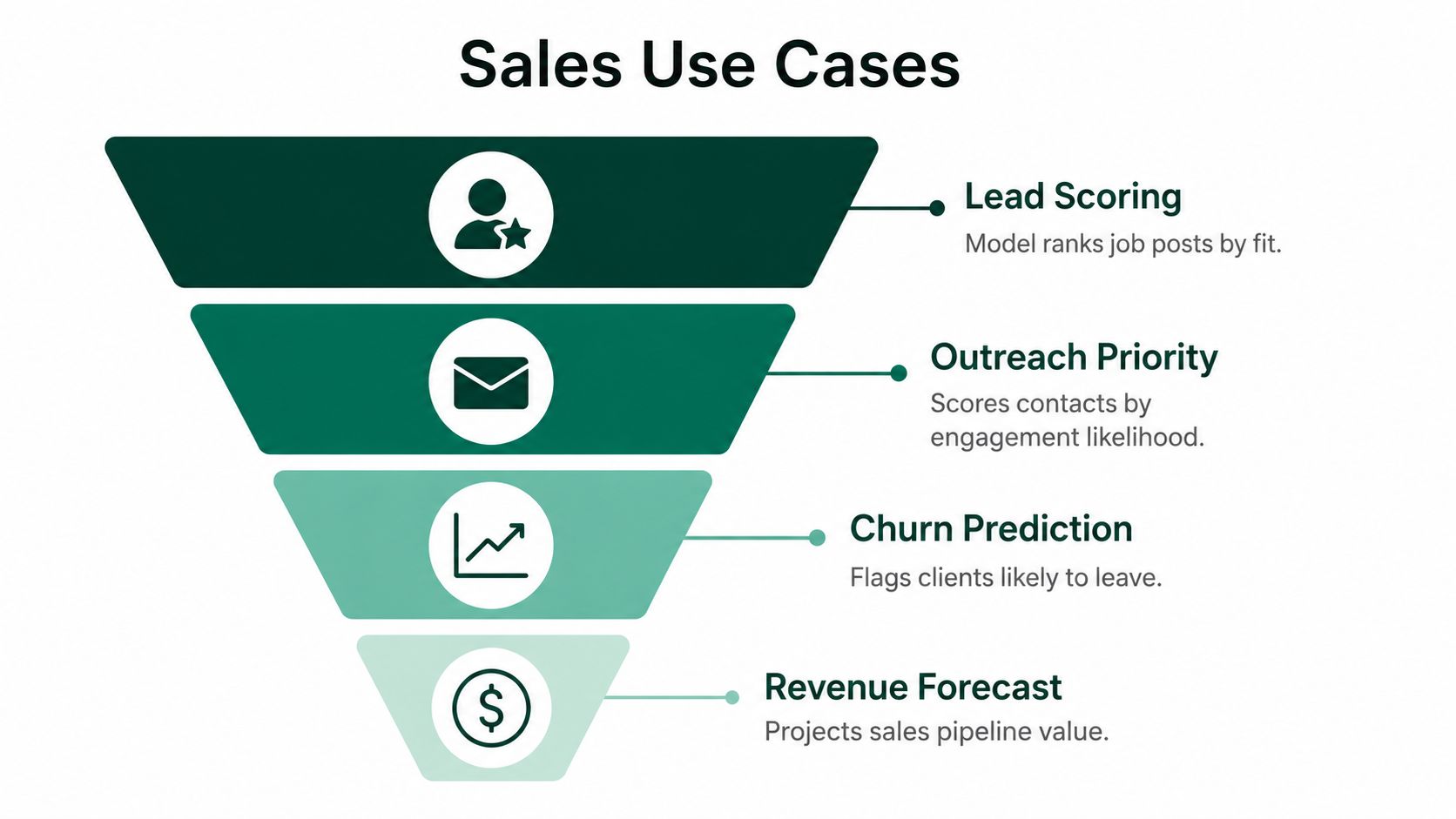
A predictive lead-scoring system uses historical conversion outcomes to rank leads by their likelihood to buy, replacing static rules with a model that learns which combinations of attributes and behaviors predict conversion, as explained by ActiveCampaign's guide to predictive lead scoring.
For an Upwork seller, the inputs might include project category, client language, scope clarity, budget fit, and whether similar jobs produced replies before. The model's job is to rank new posts. Your action is simple, review the highest-fit opportunities first and reject low-fit work before it consumes proposal time.
Outreach prioritization protects limited hours
Suppose five clients have replied, but you can only write two thoughtful follow-ups before your next delivery deadline. A ranking model can help determine which conversations deserve immediate attention by looking at engagement signals, previous response patterns, and the stage of each opportunity.
This isn't the same as blindly contacting whoever has the highest score. Review the reason behind the priority, then combine it with your knowledge of capacity, expertise, and client quality. A clean AI sales prospecting workflow can connect those rankings to actual outreach rather than leaving them isolated in analytics.
Personalization makes proposals more specific
NLP can extract the client's stated problem, desired result, tools, constraints, and urgency from a brief. A drafting system can use those signals to create a proposal opening that mirrors the project, while you verify the details and add proof from relevant work.
Data hygiene matters before you personalize. If you're sourcing contacts outside a marketplace, use a process such as email verification for B2B leads so invalid or risky addresses don't contaminate your outreach records. On Upwork, the equivalent discipline is keeping project notes and client history accurate.
Churn prediction supports retention
Churn prediction looks for changes in an active client's engagement that resemble patterns associated with previous departures. Inputs might include declining message activity, delayed approvals, reduced scope, unresolved issues, or a shift in project cadence. The model flags risk, and the seller takes a human action, usually a check-in that clarifies priorities before frustration becomes silence.
For a small agency, this can be more valuable than chasing every new lead. A short conversation with an existing client may reveal a blocked deliverable, a changing business need, or an opportunity to adjust the engagement. The model opens the door. Your judgment determines what happens next.
A Practical Implementation Roadmap for Small Teams
Small teams should start with feedback, not algorithms. If you haven't recorded which opportunities were good fits and what happened after each bid, a complex model has little to learn.
Phase one captures the learning material
Create one consistent record for every opportunity. Log the project link, service type, client description, your fit judgment, whether you bid, whether the client replied, and the eventual outcome. A simple thumbs-up or thumbs-down signal can work at the beginning, as long as everyone uses it consistently.
Add a short reason for the decision. “Strong fit, clear scope” teaches more than “yes.” “Outside expertise, unclear buyer” creates a useful negative example.
Phase two measures behavior
Once the basic labels exist, track the behaviors surrounding them. Record response time, reply status, proposal content, follow-up activity, and outcome. You're building the evidence needed to distinguish a poor lead from a good lead that received a late or weak response.
At this stage, basic analytics may reveal patterns without machine learning. You might find that certain service categories produce better conversations, or that a particular proposal structure earns more replies. Those observations become a baseline for evaluating future automation.
Phase three introduces a first model
Adopt a tool that can learn from your feedback, or work with a technical partner to build a small scoring workflow. Keep human review in place. The model should recommend which posts to inspect and which messages to draft, while a seller approves the decision.
Upwork's own guidance says sellers should aim to respond to clients within 2 hours when possible and, at minimum, within 24 hours, according to Upwork's advice on proposals being viewed. Treat those expectations as a service-level benchmark, not a promise that every lead deserves an immediate proposal.
Phase four expands the feedback loop
When several bidders work together, centralize the learning. One person's accepted or rejected recommendation should improve the shared system, while access controls keep client information appropriate for the team. Expand carefully into message prioritization, proposal drafting, forecasting, and retention signals.
Use this readiness checklist before buying complex tooling:
- Outcome labels: You can identify bids, wins, losses, replies, and disqualified opportunities.
- Response tracking: You know how long it takes to notice and answer a new lead.
- Reply baseline: You measure replies relative to proposals rather than relying on memory.
- Review process: Someone checks model recommendations and corrects bad classifications.
- Update habit: You add recent outcomes so the model doesn't rely only on old assumptions.
Automating Speed to Lead in Practice
A highly accurate model still fails if the seller contacts its top-ranked lead too late. Orchestration speed determines whether prioritization becomes a real competitive advantage.
A widely cited lead-response study found that responding within five minutes made teams about 21 times more likely to qualify a lead than waiting 30 minutes, according to Spiky's summary of lead response research. The implication for machine learning for sales is direct: ranking and response must operate as one workflow.
Manual work creates delays at every step. You open the marketplace, filter job posts, read the brief, decide whether it fits, draft a message, edit it, and send it. Even a disciplined seller can struggle to stay inside a narrow response window while delivering client work.
Earlybird AI is one example of a marketplace-focused workflow. It connects to an Upwork account, learns preferred projects from thumbs-up and thumbs-down feedback, searches for relevant jobs, creates personalized proposals, replies to client messages, and follows up toward a booked call. The platform describes proposals being submitted within about 10 minutes of a job posting and replies arriving in under 5 minutes, based on the product information provided for this guide.
The responsible setup still requires review of targeting, message quality, and account behavior. Automation should shorten the path from a relevant opportunity to a thoughtful response, not encourage indiscriminate bidding.
Risks, Cold Starts, and Compliance to Watch
Most sales content makes machine learning sound useful from the first day. Small teams should be more skeptical. A model trained on a thin or inconsistent history may produce confident versions of your existing guesses.
The cold-start problem appears when you have only a small set of past projects, new services, a different market, or a long sales cycle. In that situation, your first priority is collecting clean feedback. Use manual judgment as the control group, label outcomes consistently, and treat early scores as suggestions rather than decisions.
Model drift creates a second problem. Buyer language changes, budgets shift, platform behavior evolves, and the type of work you want may change. A ranking that worked previously can become less relevant if nobody reviews recent wins and losses.
A model can perform well across an aggregate dataset and still give weak advice for one seller's accounts.
Recent sales-AI guidance frames ML as dependent on historical structured and unstructured data. The Gartner guidance on sales AI also supports the contrarian point that broad performance doesn't guarantee strong individual recommendations when clean behavioral data and a fast feedback loop are missing.
Data and platform safeguards
Sparse data is only one issue. Data concentrated around a few top reps can make the system learn their portfolio rather than the agency's general fit. Review recommendations by seller, service line, and client type so one successful pattern doesn't become an inappropriate universal rule.
Compliance matters on Upwork too. Responsible automation should respect platform rules, mimic normal human behavior rather than generate abusive activity, use clean regional IPs, and never store passwords. For broader operational guidance, an AI governance guide for support teams can help you think through access, review, data handling, and accountability.
Start with human approval. Review model suggestions, record why you override them, and check drift signals monthly. This creates a safer feedback loop and gives the system better evidence for future recommendations.
Measuring ROI and Your First Steps
ROI begins with operational measurements, not an impressive model name. Independent lead-routing sources report that automation can reduce response times from about 13 hours to under 4 hours, as summarized by Outsales' lead response research. Faster handling matters because a prioritized lead only has value when someone acts on it.
Track a compact dashboard:
- Reply rate: How often targeted proposals produce a client response.
- Proposal-to-call conversion: Whether conversations advance to qualified calls.
- Sales-cycle length: How long it takes to move from first contact to a decision.
- Revenue per active bidder: Whether additional automation improves output without merely increasing activity.
- Forecast quality: Whether expected pipeline outcomes become more dependable over time.
Earlybird members report double-digit reply rates, shorter sales cycles, and meaningful revenue gains, with the product often paying for itself with one new client, according to the publisher's provided product information. Treat those outcomes as member-reported examples, not a forecast for your business. For a broader view of analytics workflows, see this guide to automated business intelligence.
This week, log win or loss feedback for every bid, measure your current response time, and pilot one automated workflow. Start with lead filtering or message triage, then compare the result against your own baseline before expanding.
Earlybird AI helps Upwork freelancers and agencies find relevant projects, learn from thumbs-up and thumbs-down feedback, draft personalized proposals, reply to client messages, and manage follow-ups. Visit Earlybird AI to see how a feedback-driven sales workflow can help you respond faster while keeping human judgment in the loop.