
← Back To Blog
Recurring Revenue Model: A Practical Guide for Agencies

Maya runs a five-person design agency. A client signs a $40,000 project, and the win feels substantial until the delivery plan reveals the true cost: another $40,000 worth of senior team time tied up in revisions, meetings, production, and scope questions. Once the work ends, the revenue ends too, so Maya returns to the sales pipeline before the team has fully recovered.
That cycle is familiar to growing agencies. Project revenue arrives in large, uneven amounts and depends on constant selling, while a recurring revenue model creates a base of contracted income that renews over time. The shift isn't from invoices to subscriptions. It changes how the agency packages value, protects capacity, recovers failed payments, and combines predictable services with flexible project or usage fees.
This guide approaches recurring revenue through those practical tensions. You'll see how agencies can measure recurring income, compare subscriptions with retainers and usage-based pricing, identify revenue that can be recovered before it becomes churn, and build an operating system that doesn't depend entirely on the founder.
The Moment Agencies Stop Trading Time for Money
Maya's $40,000 project looks different when viewed through cash flow. The client pays for a defined outcome, but the agency must spend people-hours immediately to deliver it. If revisions expand, the team absorbs the pressure unless the contract creates a clear boundary. When the project closes, Maya has to replace that revenue with another sale.
A recurring contract changes the question. Instead of asking, “What can we produce for this client this month?” Maya can ask, “What ongoing business result can we responsibly maintain?” That might be brand design support, a monthly creative production service, campaign assets, or a managed content system. The client receives continuing access and delivery, while the agency builds a base that renews instead of restarting from zero.
The distinction matters because recurring revenue is predictable income from regular transactions expected to continue over time, usually through subscriptions or renewals, as explained in Gainsight's guide to recurring revenue. Predictability doesn't mean the money is guaranteed. It means the agency can forecast contracted income with more confidence than a pipeline made entirely of unclosed projects.
Practical rule: Sell an ongoing outcome only when your team can define the recurring work, its boundaries, and the evidence that the client is receiving value.
A recurring book of business also creates a compounding operating habit. Each retained client gives the agency more visibility into hiring, delivery planning, and cash needs. That doesn't eliminate project work. It gives project work a stable base instead of making every new project responsible for payroll and growth.
The three tensions agency owners must resolve
First, recoverability matters. A client who appears to have churned may have an expired card, an unused retainer, unclear renewal communication, or a payment workflow that never followed up. Retention isn't only a product or relationship problem.
Second, pure subscriptions may be too rigid for bespoke agency work. A base retainer can cover continuity, while usage fees, one-off projects, or performance layers capture demand that would otherwise become unpaid scope.
Third, execution determines whether the model works. Agencies need defined deliverables, response expectations, onboarding, renewal triggers, and reporting. Without those systems, recurring revenue can become a monthly promise to do unlimited work.
Owners who want to understand the broader ways agencies generate income can also review this practical overview of how marketing agencies make money. The important pivot is simple: stop treating every month as a fresh sales contest, and start treating the client base as an asset that deserves deliberate management.
What the Recurring Revenue Model Actually Is
A gym membership offers a useful analogy. A member isn't paying for one visit each time they walk through the door. They pay for continuing access to a service that the gym delivers over the membership period. The gym can forecast membership income, while the customer values convenience, access, and an ongoing experience.
An agency's recurring revenue model works in a similar way. The client pays a regular fee for continuing access to a defined service, capacity block, or result-oriented program. The agency records the agreement as recurring only when the income is expected to renew under the commercial terms. A one-off website build isn't recurring just because the client may hire the agency again.

MRR and ARR create a shared vocabulary
Monthly Recurring Revenue, or MRR, is the normalized monthly value of active recurring subscriptions. Annual Recurring Revenue, or ARR, annualizes that recurring base. A common SaaS calculation sets ARR at MRR multiplied by 12, as described in this SaaS metrics guide.
Suppose an agency has one active client paying a $6,000 monthly retainer. Its MRR is $6,000, and its ARR is $72,000, calculated as $6,000 multiplied by 12. That ARR represents the annualized value of the current recurring agreement. It doesn't mean the agency has already collected $72,000, and it doesn't include an uncommitted project that might happen later.
Agencies should separate the recurring base into useful components:
- New revenue comes from newly signed recurring clients.
- Expansion revenue comes from an existing client increasing its package or usage.
- Contraction revenue comes from a downgrade.
- Churned revenue disappears when the client cancels or fails to renew.
- One-off revenue comes from projects, setup fees, rush work, or other non-recurring transactions.
Gross recurring revenue focuses on what remains before expansion offsets losses. Net recurring revenue includes expansion and contraction, so it better shows whether existing clients are growing or shrinking in value. Agencies must keep these categories separate from project invoices, or the dashboard will make a lumpy project business look more predictable than it is.
Billing cadence can also confuse owners. An annual contract billed monthly still creates a monthly operating view, while revenue recognition follows the service delivered. Under ASC 606, subscription revenue is recognized over time as performance obligations are satisfied through a five-step framework, described in this subscription revenue recognition guide. Finance should therefore distinguish cash collected, invoiced amounts, MRR, ARR, and recognized revenue.
For customer communication and retention planning, a clear map of customer lifecycle stages helps the team connect recurring delivery to onboarding, adoption, renewal, and expansion.
Subscriptions Retainers and Usage-Based Pricing Compared
Agencies usually choose among three recurring structures, and each one solves a different commercial problem. A subscription sells a defined package. A retainer reserves ongoing agency capacity. Usage-based pricing charges according to the amount consumed.
A subscription works best when the service can be standardized. A monthly content package, managed SEO tier, reporting service, or fixed creative library can fit this structure. The client understands what access or delivery they receive, and the agency can plan production around repeatable work.
The trade-off is flexibility. Subscriptions create stronger predictability when the scope stays consistent, but clients may resist paying for a bundle that doesn't match their changing needs.
A retainer fits bespoke relationships. The client pays for reserved time, expertise, availability, or a defined service commitment. This can work well for a brand that needs ongoing design direction but doesn't know exactly which assets it will request each month.
The cost is scalability and margin control. If the agency promises broad availability without usage limits, urgent requests and unused capacity can create a utilization cliff. One client may consume every available hour, while another pays for access they rarely use.
Usage-based pricing connects the bill to consumption. An agency might charge according to hours, seats supported, transactions processed, ad spend managed, or another measurable unit. This structure can align the agency's revenue with client growth, but it makes forecasting less comfortable because usage can move unexpectedly.
ModelHow It BillsBest Agency FitCore Trade-OffRevenue PredictabilitySubscriptionFixed fee for a defined recurring packageStandardized services with repeatable deliveryPredictability versus flexibilityHigh when scope remains stableRetainerFixed fee for reserved capacity or ongoing expertiseBespoke, trust-led client relationshipsContinuity versus scalabilityHigh at the contract level, variable in delivery costUsage-based pricingFee tied to measured consumptionServices whose demand can be tracked clearlyForecasting ease versus upsideModerate, because usage changes
The practical answer is often a hybrid. An agency can combine a base subscription for access, a retainer for strategic availability, and usage or project fees for work above the included scope. For example, a monthly SEO package may include reporting and a defined number of content briefs, while technical fixes and intensive migrations carry separate project pricing.
Before choosing a structure, compare the client's buying preferences with your delivery economics. A useful resource on best pricing models for you can help frame that decision. Your legal and commercial documents should also distinguish the ongoing relationship from individual deliverables. The difference between an MSA and SOW becomes especially important when recurring services sit alongside project work.
The Metrics That Separate Healthy Recurring Revenue From Fragile
A recurring revenue dashboard should answer one question: does the existing client base preserve and expand value without consuming more delivery effort than the agency can support? MRR and ARR show the size of the base, but they don't explain its quality.
Several operating thresholds are commonly used to diagnose recurring businesses. The benchmarks below come from the Metrics That Matter framework. Treat them as reference points, not universal laws for every agency, especially when project work sits beside retainers.
MetricHealthy ThresholdFragile SignalRecurring share of total revenue80%A small recurring base that leaves cash flow dependent on projectsCustomer retention85% to 90%Frequent client losses that require constant replacementGross revenue retention85% to 95%Downgrades and churn eroding the starting baseNet revenue retention100% to 110%Expansion fails to offset contraction and churn
Build the bridge, not just the ending number
Start with opening MRR. Add new recurring revenue and expansion revenue. Subtract contraction and churn. The result is ending MRR. ARR then annualizes the active recurring base, but it shouldn't include uncertain renewals, unapproved expansions, or likely projects.
For agencies, classify each client line by commercial behavior. A monthly strategy retainer belongs in recurring revenue if the agreement renews. A campaign project does not. A recurring creative package with additional production billed by usage needs two lines, one for the base and one for the variable component.
Customer concentration deserves attention even when retention looks strong. If one client supplies most of the recurring base, a single cancellation can distort the agency's entire forecast. Track concentration by client and by sector, then review whether the agency has enough diversified demand to absorb a loss.
Gross margin also needs an agency-specific interpretation. Include delivery labor, contractors, production software, and other direct costs attached to recurring work. A retainer that looks attractive on revenue can be fragile if senior staff perform every task and the client expects unlimited revisions.
Dashboard discipline: Track recurring revenue by client, package, owner, margin, renewal date, usage, expansion, contraction, churn reason, and payment status.
CAC payback, expansion share of ARR, and cohort retention curves can reveal problems before the bank account does. If new clients require heavy selling effort but existing clients rarely expand, the agency may be filling a leaky bucket. If retention stays stable while margins decline, the packaging or staffing model needs attention.
A one-page dashboard doesn't need every possible KPI. It needs enough detail for the owner to identify which clients are growing, which are shrinking, which contracts are underused, and which payments need recovery.
A Step-by-Step Plan to Build Recurring Revenue in Your Agency
Build the model in phases. The sequence below keeps the agency close to real client behavior instead of forcing a theoretical subscription onto every account.
Phase one, audit and convert
Review the current client list and mark relationships with repeated deliverables, ongoing dependencies, frequent support requests, or a clear need for continuity. The owner should identify which work already repeats before inventing a new offer.
The deliverable is a short conversion list with the client's current project pattern, likely recurring need, delivery owner, and commercial risk. This week, choose a small group of strong candidates and schedule discovery conversations focused on the outcome they need maintained.
Phase two, package and price
Create three levels of service, but keep the differences meaningful. One tier might provide access to a defined monthly deliverable. Another could include strategic support and faster response times. A higher tier might add deeper reporting, coordination, or reserved capacity.
Set scope floors, response-time guarantees, exclusions, and rules for work beyond the package. The owner or commercial lead should approve the pricing logic, while the delivery lead confirms that the team can fulfill it without relying on heroic effort.

Phase three, pitch and onboard
Present the offer as an operating outcome, not a list of tasks. A client may not care about a certain number of design hours, but they may care about having campaign assets ready without reopening procurement every month.
Once the client accepts, use an onboarding runbook. Assign a kickoff owner, document success milestones, confirm access and approvals, and schedule an adoption review after the first month. That review should ask whether the client used the service, understood its value, and knows what happens next.
Phase four, track and retain
Connect the commercial promise to daily operations. Your billing system should issue recurring invoices, your project system should track included usage, and your CRM should flag renewal dates, expansion signals, payment failures, and inactive accounts.
The finance owner monitors MRR, ARR, margin, payment status, and revenue movement. The account owner monitors engagement and outcomes. The founder should review exceptions rather than manually chase every renewal.
Use the following video as an additional practical reference while designing the operating workflow.
Automation can support the sales side too. For agencies that acquire work through Upwork, Earlybird AI connects with an Upwork account, learns preferred projects through feedback, searches opportunities, drafts proposals, and replies to client messages automatically. That can help maintain a steadier prospecting flow while the agency builds its recurring base, but the recurring contract still requires careful packaging and delivery management.
Why Most Recurring Revenue Strategies Quietly Leak Money
Churn is often treated as a marketing failure. A client cancels, and the agency immediately asks how to replace the logo. That response misses a more useful diagnosis: was the revenue lost, or did the agency fail to recover it?
A payment can fail without the client wanting to leave. A retainer can renew while the client barely uses it. A scope can expand until the agency delivers unpaid work that should have been a separate charge. These are different problems, and they need different responses.
A 2025 retention study reported overall churn near 10%, including about 7% voluntary churn and 1% involuntary churn, while its analysis of failed payments projected more than $129 billion in lost subscription revenue globally. These figures are reported in Churnkey's State of Retention 2025. The lesson for agencies isn't to copy those rates. It's to separate cancellation behavior from payment recovery and operational leakage.
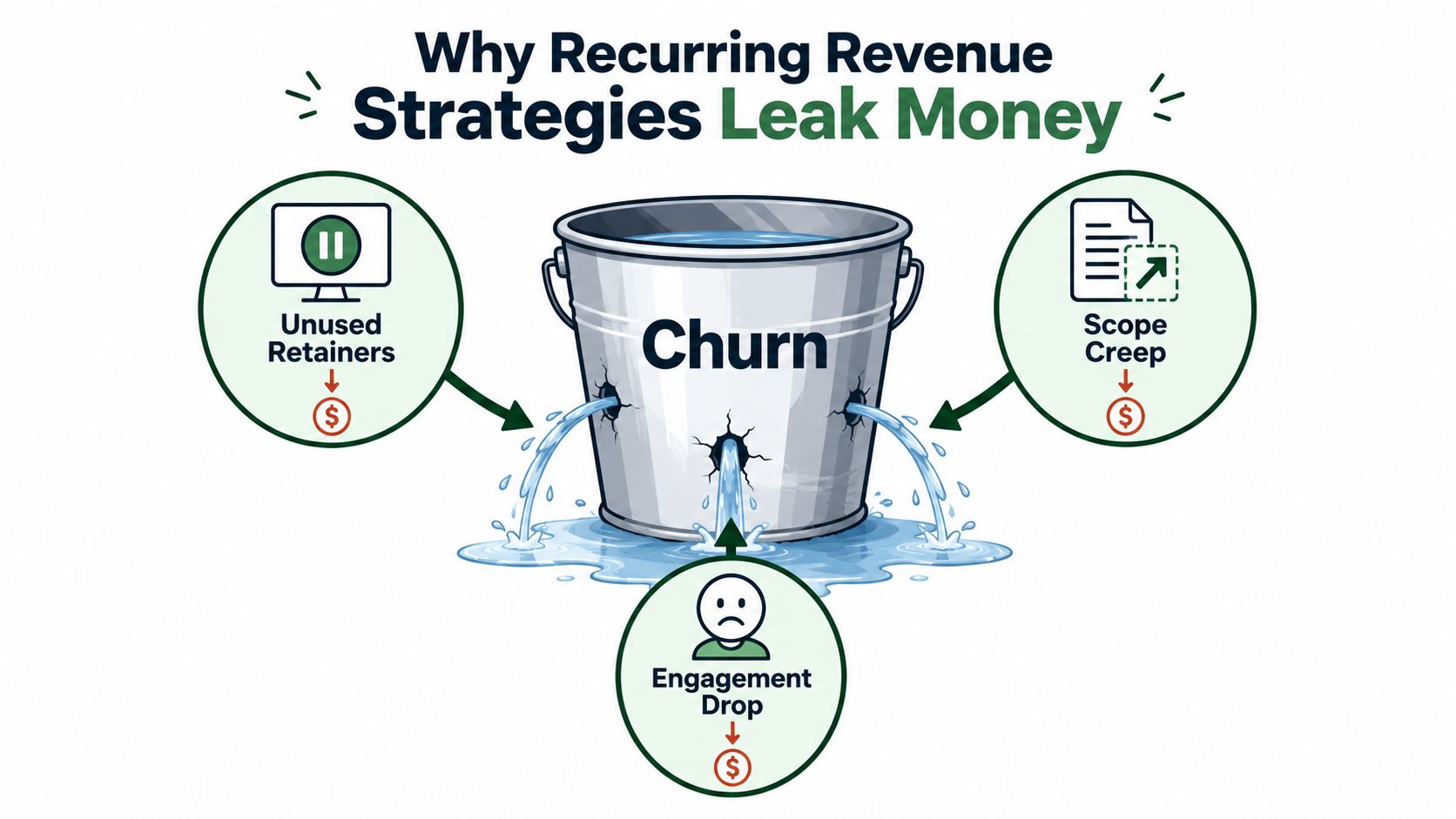
Three leaks deserve a contract-level review
Deliverable fatigue appears when the agency repeats the same format without showing what changed for the client. The service may still be delivered, but perceived value declines.
Silent downgrades happen when a client renews but gradually uses less, requests fewer strategic interactions, or stops adopting the included service. The contract remains active while its practical value shrinks.
Pricing inertia survives when the agency renews an old agreement without reviewing complexity, urgency, staffing, or client growth. The invoice repeats, but the economics deteriorate.
Hybrid monetization addresses some of this leakage. A base subscription or retainer can provide continuity, while usage, project, or performance layers charge for variable demand. Zuora's 2025 Subscription Economy Index highlights hybrid combinations of subscriptions, usage-based pricing, and one-time purchases as an important direction for recurring businesses.
Ask each account: What did the client pay for, what did they use, what did we deliver outside scope, and what payment or pricing issue can we correct within the next 30 days? That question turns a vague retention concern into a recoverability review. For a broader margin perspective, see this guide on how to improve profit margins.
Your 90 Day Recurring Revenue Checklist
A 90-day plan works when every decision has an owner and a visible output. Don't begin by purchasing billing software. Begin by understanding which clients already have a reason to continue.

Days 1 to 30, establish the foundation
The owner and finance lead should define what counts as recurring revenue, separate retainers from projects, and choose the initial pricing structure. Review the client base for repeated work, dependency on agency expertise, renewal potential, and delivery burden.
By the end of this block, you should have:
- A client audit: Record current contracts, recurring services, project work, renewal dates, payment status, and delivery owners.
- A conversion list: Identify the five strongest candidates for a recurring offer and write the reason each client needs continuity.
- A measurement baseline: Calculate current MRR and ARR where applicable, then document churn, contraction, expansion, margin, and concentration.
- A packaging decision: Choose whether each candidate fits a subscription, retainer, usage model, or hybrid structure.
Days 31 to 60, package and onboard
The commercial lead should build three tiered offers with clear scope, renewal language, response expectations, exclusions, and add-on rules. The delivery lead should test each package against real team capacity before proposals reach clients.
Create a 14-day onboarding workflow with a kickoff, access checklist, success milestones, communication cadence, and first-value checkpoint. Select the billing and automation stack only after the process is clear. Tools should support the workflow, not hide gaps in it.
Your milestone list for this block:
- Proposal templates: Write one version for each tier, including the recurring promise and boundaries.
- Renewal clause: Define notice periods, price review rules, cancellation terms, and treatment of unused capacity.
- Onboarding runbook: Assign an owner for kickoff, setup, delivery coordination, and the first adoption review.
- Billing workflow: Map invoice creation, failed-payment follow-up, receipts, reporting, and escalation.
Days 61 to 90, launch and review
Offer the packages to the conversion list rather than sending a generic announcement to every client. Use the conversations to test language, objections, scope, and willingness to pay. The owner should approve changes, while the account and delivery leads document what clients ask for.
Instrument the dashboard before the first renewal arrives. Review usage, engagement, payment status, margin, expansion opportunities, and delivery exceptions. At the 30-day retention review, adjust pricing or scope where the data shows a mismatch.
Keep this final checklist visible:
- Launch: Present the recurring offer to the selected conversion candidates.
- Track: Monitor MRR, ARR, new revenue, expansion, contraction, churn, margin, and payment recovery.
- Review: Hold a client health review after the first delivery cycle.
- Adjust: Change packaging, staffing, pricing, or add-on rules based on observed demand.
- Repeat: Document the process so another team member can run it without the founder.
A recurring revenue model becomes useful when it produces better decisions, not just a more attractive forecast. Start Monday by auditing five client relationships, assigning owners, and writing the first package boundaries. Then use the next 90 days to prove that the offer can renew profitably.
Earlybird AI can help agencies keep the top of the funnel active by connecting to Upwork, learning which projects fit, drafting personalized proposals, and replying to client messages automatically. Visit Earlybird AI to see how a steadier sales workflow can support the recurring revenue base you're building.