
← Back To Blog
Scope Creep Prevention: A Practical Guide for 2026

A client asks for one extra page during a design review. Then someone adds a second audience, another stakeholder requests a new approval route, and the team agrees to “handle it quickly.” Nothing looks serious in isolation. A few weeks later, the project has expanded, the deadline hasn't moved, and the original margin has disappeared.
That's scope creep. It rarely arrives as a dramatic renegotiation. It enters through informal messages, unrecorded decisions, vague acceptance criteria, and small requests that nobody wants to challenge. Scope creep prevention works when you treat scope as a live operating system, not a document you file away after kickoff.
Why Scope Creep Keeps Winning and What Prevention Means
Teams rarely lose control because a contract is missing. They lose it because nobody turns the contract into daily operating behavior. A detailed statement of work can sit untouched while a client asks a developer for a feature, a designer accepts another revision, or an account lead promises an addition without checking capacity.
PMI's 2018 Pulse of the Profession found that 52% of projects completed in the prior 12 months experienced scope creep or uncontrolled scope changes, up from 43% five years earlier (PMI's scope-creep analysis). The figure shows that uncontrolled change was a recurring delivery risk in that historical PMI sample, not an unusual edge case.
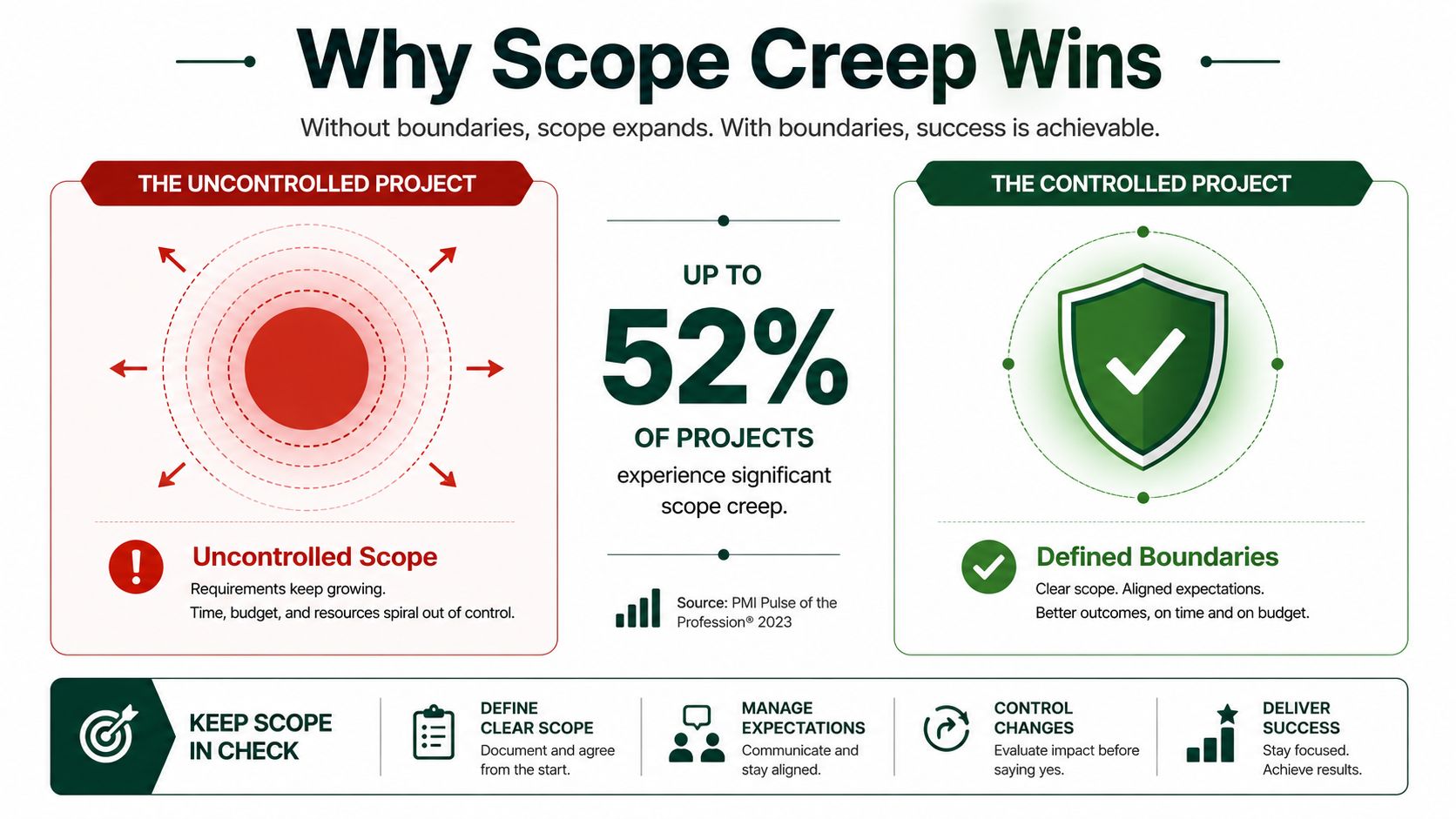
The cost reaches beyond an awkward client conversation. PMI material links poor project performance to an estimated $109 million lost for every $1 billion invested. Separate project-management literature reports losses of about $97 million per $1 billion invested from uncontrolled scope changes, while projects with significant scope creep were reported to exceed budgets by 189% (the project-management literature review). The estimates use different contexts, but the operating lesson is consistent: small additions consume capacity, weaken margin, and create pressure on delivery.
Prevention is governance, not paperwork
A scope system needs four working parts:
- A locked baseline: Everyone can see what the project includes, excludes, and must accomplish.
- An explicit change path: Every new request is recorded before anyone starts work.
- One decision owner: A named person approves, defers, swaps, or rejects the request.
- A social script: The team can protect the boundary without making the client feel punished.
The social script often determines whether the controls survive contact with the project. Teams may understand that a request affects time and cost, yet still agree because challenging the client feels risky. Use neutral language that puts the trade-off in front of both sides: “We can add that. It changes the current plan, so we'll confirm which existing item moves, whether the deadline changes, or whether we should price it separately.”
Scope should also have a visible change budget. Reserve a defined amount of flexibility for legitimate adjustments, then require a decision when requests exceed it. Review the request every week, not only when the deadline is already threatened. That rhythm turns scope from a static document into a live operating system.
The goal is not to eliminate every change. Good changes can improve the result. The goal is to make each change intentional, visible, owned, and resourced.
Operating principle: Scope is protected by making every yes carry a visible trade-off.
Locking the Baseline with a Bulletproof Scope Statement
A scope statement should be short enough to use during a live client call and precise enough to settle a disagreement. The strongest version usually fits on one page and answers three questions: What are we delivering? What are we not delivering? How will the client accept the work?
PMI guidance states that no request for work should be accepted without a clear in-scope or out-of-scope agreement, which makes a scope statement a decision rule rather than a description (PMI's guidance on preventing scope creep).

Start with deliverables, not activities
Clients buy outcomes, while teams often write task lists. “Design support” is ambiguous. “Approved desktop and mobile designs for the homepage, services page, contact page, and one reusable interior-page template” is testable.
For an agency website project, define:
- Deliverables: Sitemap, approved wireframes, visual design files, responsive layouts for named pages, and developer handoff notes.
- Exclusions: Copywriting, new photography, custom application functionality, third-party integrations, search-engine optimization, and post-launch maintenance.
- Acceptance criteria: The client reviews each milestone against the agreed brief, consolidates feedback through the designated approver, and accepts the deliverable when it matches the documented requirements.
The exclusions deserve as much attention as the deliverables. A scope statement can list every page in detail and still fail if “minor edits” or “support” remains undefined. Replace soft language with boundaries that a new team member can interpret without asking for permission.
Use clause language that creates a decision rule
A useful statement of work can include language such as:
“The services are limited to the deliverables expressly listed in this statement of work. Requests for additional deliverables, formats, integrations, revisions beyond the stated review process, or new stakeholder requirements are outside the current scope and require written approval of the resulting time, fee, or schedule adjustment before work begins.”
For a freelance content engagement, the same pattern might define a named set of briefs, drafts, revision rounds, publishing formats, and research responsibilities. It should also state what isn't included, such as additional channels, unplanned interviews, new content types, or revisions based on feedback from an approver who wasn't part of the agreed review process.
You can reinforce the relationship between the master agreement and project-specific work through a clear master service agreement versus statement of work structure. The master agreement establishes the broader relationship, while the statement of work gives each engagement its enforceable operating boundary.
Make acceptance measurable
Acceptance criteria don't need technical jargon. They need observable conditions. “Looks good” invites debate. “Uses the approved brand system, includes the agreed content blocks, works in the specified formats, and has no unresolved feedback from the named approver” gives the team a usable standard.
The final test is simple: when a new request arrives, can you compare it with one approved page and answer “in scope,” “out of scope,” or “requires a change decision”? If not, the baseline isn't finished.
The Change Request Workflow That Actually Stops Drift
A change request workflow protects the baseline without pretending that the original plan can predict everything. Atlassian's guidance recommends submitting the request, assessing schedule and budget impact, choosing a trade-off, recording the decision, and updating the baseline when the request is accepted (Atlassian's scope-creep guidance).

Use four steps every time
Submit. The requester describes what they want and why. A message such as “Can you add a pricing page?” becomes a recorded request rather than an immediate task.
Assess. The delivery lead estimates the effect on work already planned. Review design, production, dependencies, testing, approvals, deadline, and fee. The assessment doesn't need false precision. It needs enough clarity for a responsible decision.
Decide. Stop treating approval as the only positive outcome. Use four choices:
- Approve: The request supports the objective, and the client accepts the impact.
- Defer: The request matters, but it belongs in a later phase or future sprint.
- Swap: The request enters only if an existing item leaves.
- Reject: The request doesn't justify the disruption or doesn't fit the project objective.
Update. If approved, change the baseline, schedule, task list, and commercial record. An approval that exists only in chat is not a controlled change.
A useful change request form can be copied into a project board:
- Requester: Name and role
- Request: Clear description of the proposed change
- Business reason: What outcome the request supports
- Time impact: Effect on current milestones
- Cost impact: Effect on fee or internal capacity
- Dependencies: People, assets, approvals, or systems affected
- Decision: Approve, defer, swap, or reject
- Decision owner: Person authorized to decide
- Decision date: When the decision became active
- Baseline update: Document or plan changed after approval
Reserve capacity without creating a free-for-all
Fast-moving teams often need room for legitimate adjustments. Newer practitioner guidance recommends reserving an explicit 10% to 15% change budget of sprint capacity (practitioner guidance on managing scope creep). Treat that allowance as controlled capacity, not free work. Track requests against it in a visible register, and stop accepting “small” additions once the allowance is consumed.
If a request uses the change budget, explain that plainly: “We've reserved a limited portion of this cycle for changes. This request can fit there, but it will use most of that allowance. If another change arrives, we'll need to defer it, swap out planned work, or revise the schedule.”
For teams building a more formal process, Pebb's change management guide offers useful context on making change visible and accountable.
A log entry is complete only when another person can understand what changed, why it changed, who approved it, and what the team did with the baseline. That record turns scope control from a personal negotiation into a repeatable operating habit.
Client Communication Scripts That Protect the Relationship
Scope creep prevention fails in the moment someone feels pressure to be agreeable. The client isn't always acting badly. They may be responding to a new stakeholder, noticing an opportunity late, or assuming that a small request has little effect. Your job is to make the consequence visible without turning the conversation into a confrontation.
At kickoff, define how requests will travel
The weak version is: “Please try not to add things later.”
The stronger version is:
“We'll keep a shared request log during the project. If a new idea comes up, send it there or raise it in our review. We'll assess whether it fits the agreed scope, uses the reserved change capacity, replaces another item, or needs a separate change approval. That lets us stay flexible without quietly moving the deadline.”
This works because it establishes a process before anyone feels singled out. For multi-stakeholder clients, add: “To avoid conflicting instructions, [client name] will be the decision owner. Other stakeholders can submit requests, but the project team won't begin that work until the decision owner confirms the trade-off.”
A shared record matters when work, messages, and approvals move across channels. Teams that manage many relationships can also benefit from a CRM for consulting firms when they need clearer ownership around client communication.
When someone says “just add this page”
Don't reply, “That's out of scope,” and stop there. That sounds like a refusal even when you're willing to help.
Send this instead:
“We can add the page. The current scope covers the approved page set, so I'll log this as a change and confirm the effect on the delivery date and remaining work. If you'd like to keep the current deadline, we can swap it for one of the planned pages. Which option should we use?”
The message acknowledges the request, names the boundary, and offers decisions. It also prevents the client from mistaking politeness for approval.
When the request is “one more revision”
Repeated small revisions are dangerous because each one feels too minor to price. Use a calm reset:
“I'm happy to review this. We've used the revisions included in the current scope, so this next round is either a change request or a chance to replace another planned task. I'll outline both options so you can choose what protects the launch.”
If guilt appears, don't defend your character or apologize for the boundary. Say:
“I understand it feels like a quick tweak. The issue is the review, production, and rechecking around it. I want to handle it properly rather than promise a quick addition that puts the agreed delivery at risk.”
For practical guidance on keeping expectations clear across client conversations, use these client communication best practices. The relationship usually survives a clear trade-off. It suffers when the team agrees casually, misses the deadline, and raises the cost after trust has already eroded.
Weekly Scope Reviews and Escalation Thresholds
A baseline is only useful if someone compares real work against it. The weekly scope review is a short operating ritual, not another status meeting. Its purpose is to find undocumented work while the correction is still easy.
The review should include the delivery lead, the decision owner, and anyone who can introduce or accept work. Compare the work-in-flight with the approved deliverables, scan the change log, identify requests waiting for a decision, and check whether the current plan still reflects approved changes.

Give one person the decision
Committees create delay and encourage people to work around the process. Assign one decision owner who can approve, defer, swap, or reject requests. The owner doesn't need to make every delivery estimate, but they must own the decision and ensure the record is updated.
A 2026 peer-reviewed study found a strong negative relationship between scope creep and project performance, with a path coefficient of -1.076 and a critical ratio of -11.432. The same study reported that strategic best practices improved performance, with a root coefficient of 0.620 and a critical ratio of 19.801, while best practices partially offset scope-creep damage with a path coefficient of 0.196 (the 2026 peer-reviewed study). The practical lesson is that documentation alone won't carry the system. People need decision ownership and visible rules.
Use three escalation tiers:
- Routine drift: The work fits inside the approved change budget and doesn't affect a committed milestone. The delivery lead records it and handles it in flow.
- Material drift: The request consumes meaningful capacity, affects sequencing, or changes a client-visible commitment. Obtain written acknowledgment from the client decision owner.
- Major drift: The request changes core deliverables, commercial terms, or the contractual deadline. Stop affected work and issue a formal amendment or change order.
A shared board can show baseline items, approved changes, pending requests, and rejected work. This practical visual workflow guide can help teams choose a format that makes status visible without creating administrative weight. Agencies that need broader operational visibility may also evaluate marketing agency management software to connect project status with client and resource information.
Track decision cycle time, the share of requests handled within the change budget, and margin per project. These measures tell you whether the system is working. If decisions take too long, clients will bypass the process. If every request is absorbed inside capacity, your estimate or boundary may be wrong. If margin falls while scope appears controlled, the team may be doing unrecorded rework.
Your 30-Day Scope Creep Prevention Rollout
You don't need a new department to install scope discipline. Start with the project type your team delivers most often, then make the controls visible in active work.
| Week | Primary Action | Key Deliverable | Done When |
|---|---|---|---|
| Week one | Rebuild the standard scope template | One-page scope statement with deliverables, exclusions, acceptance criteria, and decision owner | A new project can be evaluated against the template without interpretation |
| Week two | Retrofit active work | Change request form, shared change log, and named decision owner for two active projects | Every open request has an owner, impact note, and decision status |
| Week three | Install the communication rhythm | Kickoff script, request-response scripts, and weekly scope review agenda | The team has completed its first review and recorded undocumented work |
| Week four | Instrument and improve | Change-budget tracker, escalation matrix, and retrospective notes | The team has reviewed decision speed, budget usage, and project margin |
Keep four reusable artifacts in one operating folder:
- Scope statement one-pager: The approved baseline.
- Change request form: The intake and impact record.
- Weekly review agenda: The recurring control point.
- Escalation matrix: The rule for deciding when routine handling stops.
A useful retrospective question is not “Who allowed this?” Ask instead, “Which request entered without a decision, and what would have made the trade-off visible sooner?” That question improves the system without turning scope control into blame.
Scope discipline means every addition is a decision, every decision has an owner, and every approved change updates the plan.
Earlybird AI helps freelancers and agencies manage the front end of client acquisition with automated Upwork search, personalized proposals, replies, analytics, and multi-user workflows. If stronger project boundaries give you the capacity to handle more work profitably, visit Earlybird AI to see how its outreach automation can support a more disciplined agency operation.