← Back To Blog
Team Productivity Improvement: A Practical Playbook

Your 12-person agency is busy, but the work still feels stuck. Two project leads are triaging Slack, three bidders are rewriting Upwork proposals, a designer is waiting for client assets, and the founder is asking why output has slipped even though everyone's working longer hours. The problem usually isn't effort. It's the coordination tax between effort and shipped work.
Team productivity improvement starts when you treat lead sourcing, bidding, onboarding, production, quality assurance, delivery, and retention as one connected system. Productivity is the value your team ships relative to the time, money, and stress required to ship it. Adding more apps or asking people to move faster won't fix a workflow that loses decisions in chat, repeats reviews, or leaves ownership unclear.
Small agencies and multi-bidder Upwork teams feel this sharply because the same people often run the entire pipeline. A delay in job filtering affects bidding. A weak proposal handoff affects the kickoff. A missing client asset blocks delivery. Each bottleneck travels downstream.
The practical approach is straightforward: diagnose the system, redesign the workflow, automate selectively, measure output, coach the habits, and run the changes through a focused 30-day plan.
What Team Productivity Improvement Actually Looks Like in 2026
A productive agency doesn't merely keep people occupied. It moves qualified opportunities from discovery to proposal, converts the right projects, starts client work cleanly, and delivers without forcing the founder to intervene at every stage.
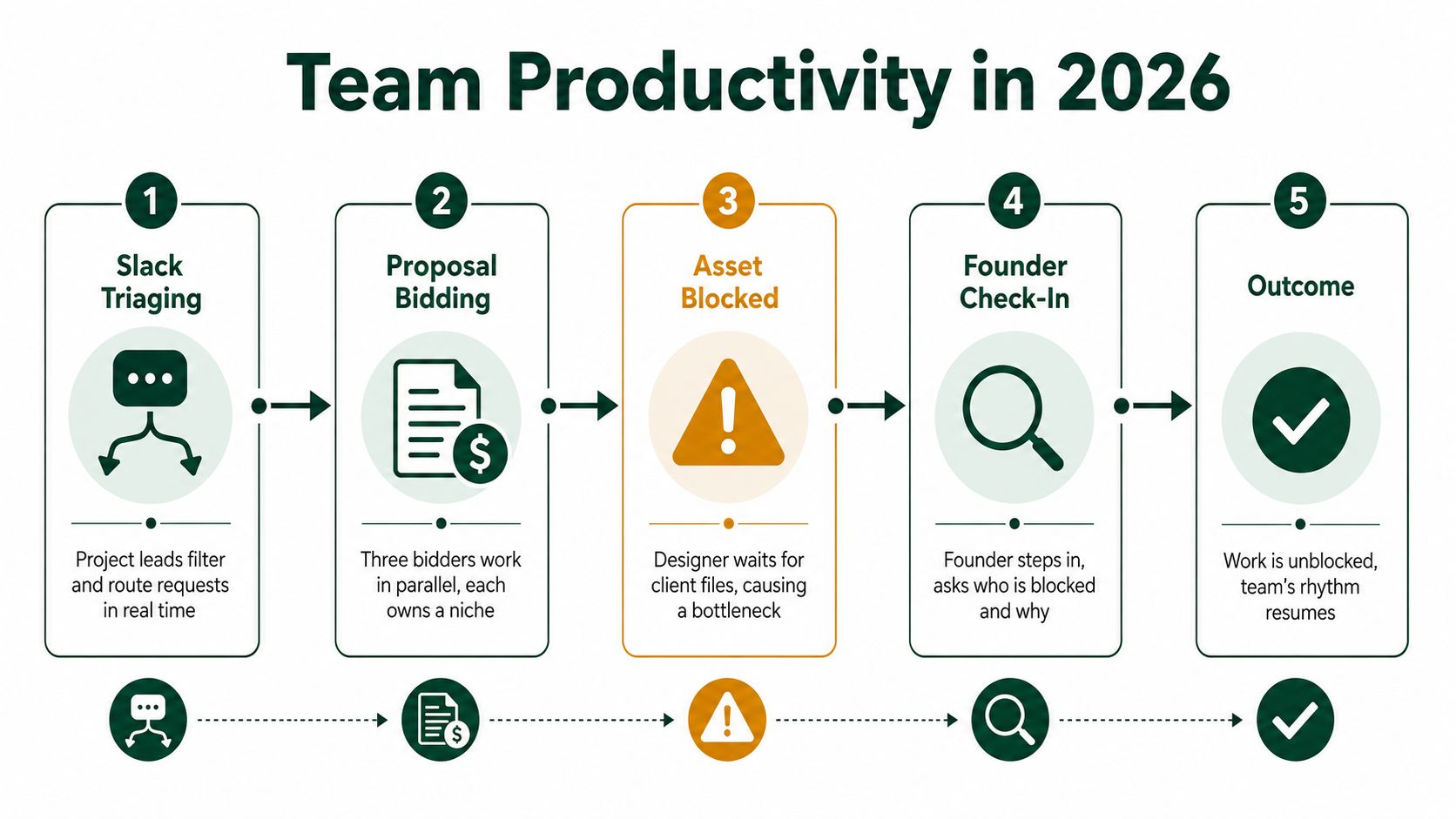
In a 12-person agency, the visible problem might be “too many Slack messages.” The underlying problem could be that no one owns intake, bidders don't share a qualification rule, and delivery teams receive incomplete context. Fixing Slack alone would leave the pipeline unchanged.
Practical rule: Don't optimize a task before you understand the handoff before it and the consequence after it.
The cost of coordination is measurable. A Zoom workplace collaboration report summarized by ActivTrak says over one-third of leaders spend an hour or more each day resolving collaboration problems. It estimates that one hour can cost $16,491 per manager per year in wasted productivity, and that the cost can exceed $874,000 annually for just one-third of managers in a 1,000-person enterprise. The same report says teams using more than 10 apps are twice as likely to spend an hour or more resolving collaboration issues as teams using fewer than five apps.
That evidence points to a useful reframing. Productivity improvement is often the removal of friction, not the addition of working hours. Standardized channels, clear decision rights, complete handoffs, and fewer unnecessary tools can create more capacity than another push for individual speed.
For an Upwork agency, the system should connect:
- Lead sourcing: Find opportunities that match your actual capabilities.
- Bidding: Filter, personalize, review, and submit without duplicated effort.
- Onboarding: Turn a won project into a complete delivery brief.
- Production: Give specialists the inputs they need before work begins.
- Retention: Capture results, follow-ups, and future opportunities in one place.
The rest of the playbook applies that logic in sequence. Diagnose first, redesign one workflow, protect judgment-heavy work, instrument outcomes, reinforce better habits, and review the system before buying another tool.
Diagnosing the Real Bottlenecks in Your Workflow
Start with evidence, not the loudest complaint. A team that says bidding takes too long may be losing more capacity during kickoff, where missing requirements create repeated questions and rework.
Run an afternoon diagnostic
Pull two weeks of work artifacts into one review folder. Include tickets, proposals, client messages, chat threads, delivery files, QA comments, and any timesheets your team already keeps. Don't ask people to reconstruct their memory if the workflow has already left a trail.
Tag every item by stage:
- Bidding
- Onboarding
- Production
- Quality assurance
- Delivery
- Follow-up
Then measure elapsed time from one stage to the next. Include waiting. A proposal may take minutes to draft but sit in review for hours. A design task may require a short production window but remain blocked while someone searches for brand assets.
Interview three people from different roles. Ask two direct questions: “What did you wait on most last week?” and “Where did you redo work that someone else had already started?” Their answers won't prove the cause, but they'll help you find the records that can.
Designing Workflows That Compound Instead of Collide
A workflow compounds when each completed stage gives the next person enough information to act without restarting the investigation. It collides when several people touch the same item, make different assumptions, and send questions backward through Slack.
Take the bidding-to-delivery pipeline and define one owner for every stage:
- Feed: The sourcing owner collects eligible jobs.
- Filter: The qualification owner applies the shared fit rule.
- Bid: The assigned bidder creates the proposal.
- Interview: The sales owner handles the call and records the outcome.
- Kickoff: The project lead confirms scope, files, milestones, and risks.
- Deliver: The delivery owner ships against the agreed acceptance criteria.
Each stage needs a trigger and a measurable exit. A shortlisted proposal might route automatically to a reviewer within the team's agreed review window. The exit isn't “proposal drafted.” It's “proposal reviewed, personalized, approved, and submitted.”
Make handoffs impossible to misunderstand
Write the input and output beside every stage. The bid stage receives the job URL, qualification notes, relevant proof, and pricing boundaries. It outputs a submitted proposal, a recorded rationale, and a next-action date.
That output should be a file plus a checklist, not a message such as “looks good.” A kickoff should include the approved scope, client objective, source assets, decision-maker, delivery date, and known assumptions. If any required input is absent, the work returns to the owner responsible for supplying it.
Set SLAs for the points where delay becomes expensive:
- Job post to submitted bid
- Draft to internal review
- Client message to response
- Won project to complete kickoff
- Deliverable submission to QA
- QA approval to client delivery
Do not create an SLA for every activity. Choose the few transitions that repeatedly slow the pipeline, then assign one person to monitor each.
The human decisions should remain visible. A person must approve unusual scope, pricing exceptions, sensitive client replies, and any proposal where the standard proof doesn't fit. Templates can carry routine information, but they shouldn't conceal judgment.
For another perspective on using AI in project operations, see this guide to AI project management workflows. The principle is simple: automate movement, not accountability.
Choosing What to Automate and What to Protect
Automation should earn its place by removing repeatable coordination work. A task is a strong candidate only when it repeats regularly, produces an output that can be checked against a fixed rule, and carries a mistake cost lower than the time saved.
That test separates useful automation from theatre. Lead scraping, follow-up reminders, CRM tagging, weekly reporting rollups, and proposal assembly from approved blocks usually pass. First-project scoping, difficult client replies, scope negotiation, and final portfolio tone review usually don't.
Use the test on the bidding pipeline
Job filtering can be automated when the team has a clear service list, excluded categories, budget boundary, and client-fit rule. Proposal assembly can pull approved proof points and structure, but a bidder should still make the final edit. Follow-up reminders can run without human attention until a client responds or the conversation reaches a sensitive point.
The same distinction applies to reporting. A system can collect submitted bids, interviews, response times, and project statuses. A manager still needs to interpret why the numbers changed and decide what the team should alter.
A practical time-saving automation guide for coaches reinforces a useful operational idea: start with recurring work that has a defined process, then improve the process before expanding automation.
Earlybird AI is one option for the Upwork portion of that system. It searches for jobs, drafts and submits proposals, replies to client messages, follows up, and provides analytics and multi-user workflows. Use it only with review rules that preserve human control over fit, tone, pricing, and scope.
For broader workflow examples, see how to automate repetitive tasks. After each automation ships, record the hours freed, errors introduced, and downstream work created. A tool installed isn't a productivity gain.
Metrics and SLAs That Measure Output, Not Hours
Hours logged tell you that someone was present in a system. They don't tell you whether the agency found the right opportunities, submitted strong proposals, delivered on time, or created work that clients can use.
A useful dashboard follows the pipeline's economic outcomes:
- Proposals sent per bidder: Shows throughput, but only alongside quality measures.
- Proposal-to-interview rate: Tests whether filtering and personalization work.
- Interview-to-hire rate: Shows whether positioning and qualification survive the call.
- Job post to submitted bid: Measures bidding responsiveness.
- Deliverable turnaround against promise: Connects production speed to client commitments.
- Revenue per team member: Connects capacity to business value.
The TimeTackle guide to ways to measure team output provides useful framing for moving away from presence-based measurement. The key is to choose metrics that describe the work your team is accountable for, not metrics that merely look busy.
Build a small operating dashboard
A Notion database, Looker dashboard, or shared sheet is enough if the fields are consistent. Every record should have an owner, stage, entered date, exit date, status, and rework flag. Keep the dashboard readable enough that a bidder and a project lead can interpret it without a meeting.
Attach an SLA to each important transition. For example, bids that remain in review beyond the agreed threshold should be reassigned by the named operations owner at the next review. The exact threshold should come from your diagnostic, not from a generic benchmark.
Review only three numbers each week:
- Throughput: How much completed work moved through the stage?
- Cycle time: How long did items take from start to exit?
- Rework rate: How often did work return because the handoff or output failed?
Don't use these metrics as an individual surveillance system. If people believe every variation will be used against them, they'll optimize the dashboard, hide blockers, and avoid difficult work. Use the data to improve workload allocation, clarify standards, and identify where the process needs support.
For dashboard design ideas, performance dashboard examples can help you structure the view without turning it into a wall of charts.
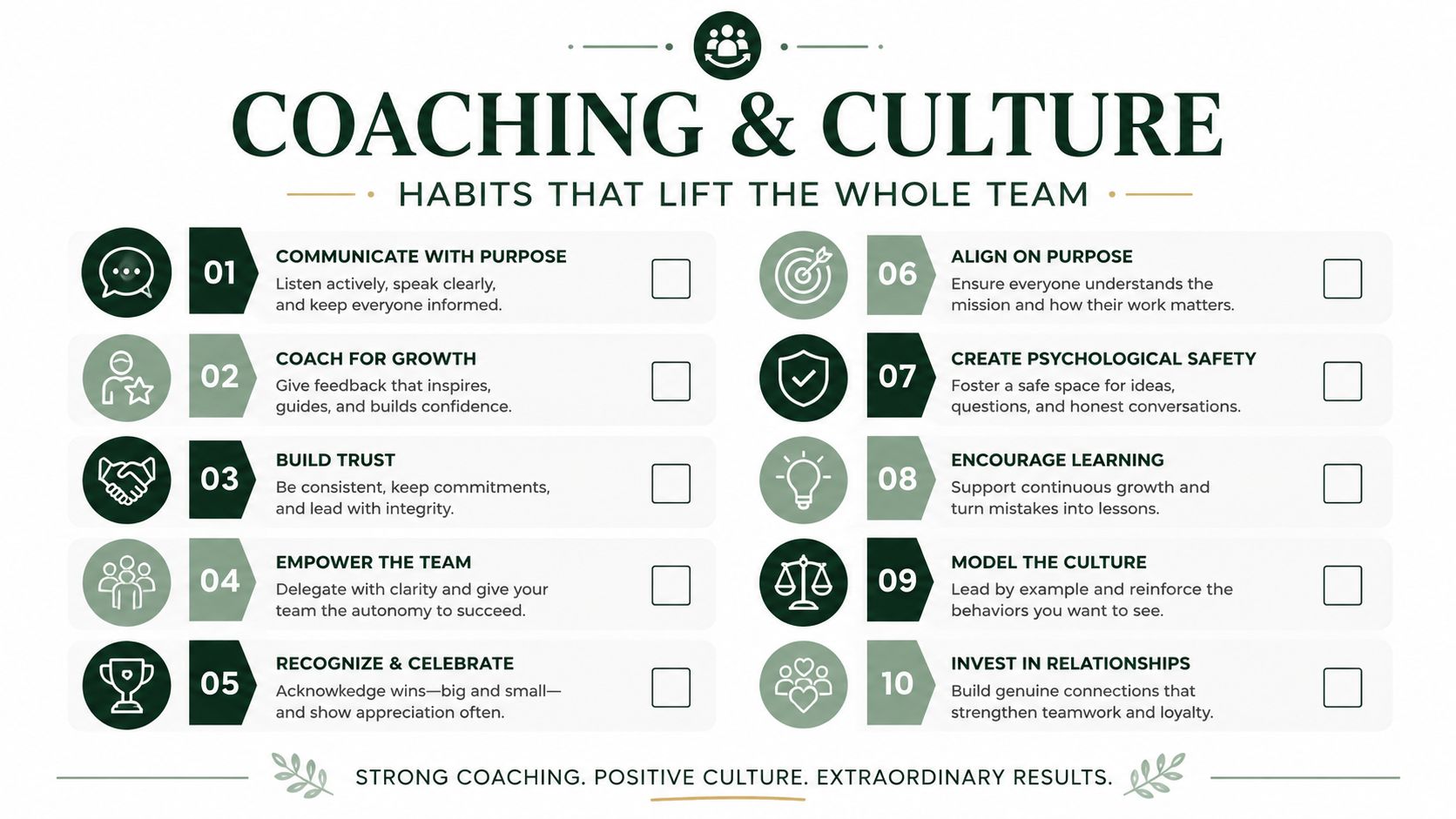
Coaching and Culture Habits That Lift the Whole Team
Tools set the floor. Managers set the ceiling.
A causal manager-effect study found that good managers have roughly twice the impact on team performance as good workers, using a method that isolates team output, controls for worker quality, and estimates the manager's causal contribution rather than relying on satisfaction scores (the manager-effect research paper). Independent reporting on the same research argues that leadership ability can matter to company performance as much as the combined productive capacity of employees (reporting on manager leadership and team output). The operational implication is uncomfortable but useful: adding another bidder won't compensate for a manager who allows unclear priorities and broken handoffs to persist.
Use rituals that expose friction early
A weekly one-on-one should ask, “Where did you get stuck?” before asking, “What did you ship?” The first question surfaces blocked assets, unclear approvals, and conflicting instructions while the problem is still cheap to fix.
Written handoff notes should accompany every meaningful deliverable. The next person shouldn't start by searching old messages for context. Include the objective, completed work, open questions, source files, acceptance criteria, and the next decision.
On Monday morning, replace the long status meeting with a short pipeline review. Everyone sees the same measures, the owner of the slowest stage names the constraint, and the group agrees on one action that will move it.
Make learning part of the operating system
Default to async written updates for routine status. Reserve meetings for decisions, sensitive conversations, and work that benefits from live collaboration. Poor collaboration costs employees at least three hours of productivity per week according to a collaboration survey, while one-fifth reported waste of as many as six hours weekly (collaboration productivity survey).
Keep a public lessons-learned document. When a proposal misses because the proof was weak, or a delivery slips because the kickoff omitted a dependency, record the lesson and update the checklist. A recovered mistake becomes valuable only when the next person can avoid repeating it.
A 30-Day Productivity Plan You Can Run on Monday
Run the plan on one workflow, preferably bidding through delivery. A narrow implementation gives you a clean baseline and prevents the team from changing every process at once.
Week 1
Pull two weeks of artifacts and map each item through bidding, onboarding, production, QA, delivery, and follow-up. Interview three people from different roles, then select the stage with the worst combination of waiting and rework. Write down the current workflow before changing it.
Week 2
Assign one owner to each stage. Define the trigger, required inputs, output checklist, exit condition, and SLA for every handoff. Apply the automate-versus-protect test and choose only the first two to four tasks that are repetitive, rule-based, and low-risk enough to automate.
Week 3
Ship the selected automations and create a lightweight dashboard. Track throughput, cycle time, rework rate, proposal-to-interview rate, and delivery turnaround against the promised date. Replace the long Monday meeting with a short review focused on bottlenecks, wins, and one corrective action.
Week 4
Coach the rituals deliberately. Run the one-on-ones, enforce written handoffs, update the lessons-learned document, and review whether the automation created new downstream work. Compare the new workflow with the baseline, but don't declare victory because one week looked better.
Keep this checklist visible:
- Diagnostic: Where does work wait, return, or change owners?
- Workflow: Who owns each stage, and what exact event moves work forward?
- Handoff: What inputs and outputs must be present before the next person starts?
- Automation: Does the task repeat, follow a rule, and carry an acceptable error cost?
- Metrics: Are you tracking throughput, cycle time, rework, conversion, and promised-date delivery?
- Coaching: Are blockers discussed, handoffs documented, and lessons shared?
- Review: Does the weekly meeting produce a decision and an owner?
Look for leading indicators rather than waiting for revenue data. Bid cycle time should fall, handoff defects should decline, context-switching complaints should become less frequent, and more capacity should move toward revenue work while manual bidding administration shrinks.
Historical productivity data supports the broader principle that better systems don't require longer days. A workplace productivity benchmark summary reports 2.7% U.S. labor productivity growth in 2023 and says productivity remained 2.1% above pre-pandemic levels in 2025. It also reports a workday that was 36 minutes shorter while productive time increased by 2%, a useful reminder that process design can outperform endurance.
Earlybird AI helps Upwork teams automate job search, proposal creation, client replies, follow-ups, analytics, and multi-user outreach workflows, so you can remove repetitive coordination work without handing over decisions about fit, tone, or scope. Visit Earlybird AI to see how it can support a cleaner bidding-to-delivery pipeline for your agency.