
← Back To Blog
8 Types of Sales Funnel Agencies Should Use in 2026

Most agencies don't have a funnel problem. They have a funnel mismatch problem. They use a lead magnet when buyers are ready to discuss a project, force a discovery call on prospects who still need proof, or automate outreach before they've defined who they want to reach.
The right choice depends on three things: sales motion, audience temperature, and revenue goal. A freelancer responding to fresh Upwork posts needs a different system from an agency selling a complex retainer through referrals. A short-cycle service needs speed and qualification. A trust-heavy service needs education and repeated contact. A scalable product needs activation and automated follow-up.
The modern funnel evolved from Elias St. Elmo Lewis's 1898 AIDA model, which described Awareness, Interest, Desire, and Action. Later frameworks added Consideration, Conversion, Loyalty, and Advocacy, turning the funnel into a lifecycle model rather than a single path to purchase. Marketful's overview of funnel evolution also highlights why stage-by-stage diagnosis matters. A widely cited B2B benchmark places visitor-to-lead conversion at about 2.3%, with above 10% considered a green-zone target and below 1% a red zone.
Before you build more pages, analyze conversion funnel drop-offs. Then choose the type of sales funnel that fixes your most important commercial constraint.
1. Lead Magnet Funnel
A lead magnet funnel earns permission to continue the conversation. You offer a focused resource, capture contact information, and use relevant follow-up to move a prospect toward a paid service. It's the right starting point when your buyers need trust before they'll discuss a project.
For an Upwork-focused freelancer, that resource could be an Upwork profile audit, an optimization checklist, or a proposal review guide. An agency could offer a client discovery template, a campaign planning worksheet, or an assessment that reveals a common operational gap. A rate-setting calculator can attract service providers while qualifying them by niche, experience, and commercial ambition.

Build the asset around the paid service
The lead magnet must solve a small, urgent problem that naturally leads to your core offer. If you sell conversion copywriting, a generic marketing ebook attracts too many people who'll never hire you. A landing-page diagnosis checklist attracts prospects already thinking about the problem you solve.
Keep the opt-in page narrow. Use one promise, one form, and one next step. After delivery, send an automated sequence that teaches the prospect how to use the resource, points out related problems, and only then introduces your paid solution. These conversion testing methods can help you compare headlines, form placement, and calls to action without changing the entire system at once.
Track the conversion from lead magnet signup to qualified conversation and paid customer, not just the form completion rate. A large list of poorly matched contacts creates activity without pipeline.
Practical rule: Make the resource specific enough that an unsuitable prospect rejects it before they enter your database.
2. Content Marketing Funnel
Content marketing works when the buyer isn't ready to reply to a proposal but is actively trying to understand a problem. Your articles, videos, webinars, and guides answer increasingly specific questions, establish expertise, and direct qualified readers toward a relevant next step.
An agency serving Upwork freelancers might publish guidance on optimizing a profile for higher conversion rates, writing better proposals, or improving client communication. A larger agency could publish a webinar about scaling Upwork delivery without hiring full-time staff, then invite qualified viewers to a strategy call. Video tutorials can demonstrate proposal writing, reporting workflows, or handoff systems more clearly than a long sales page.

Turn expertise into a route to revenue
Start with a few content pillars tied directly to your service lines. For example, an agency might own lead generation, proposal quality, delivery systems, and retention. Each pillar should contain broad educational content, practical implementation advice, and a commercial next step.
Repurpose one strong idea into a blog post, LinkedIn post, short video, email, and webinar segment. Use analytics to identify the topics that attract the right prospects, then expand those topics instead of chasing every trending subject. Search optimization matters, but ranking for irrelevant traffic won't fill your pipeline.
A content funnel also needs a deliberate handoff. A post about proposal structure should lead to a proposal audit or template. A post about agency growth should lead to a diagnostic call. For a practical approach to generating demand without relying on phone-based prospecting, learn how to generate leads without cold calling.
Don't judge this funnel only by page views. Watch qualified replies, booked calls, assisted opportunities, and revenue influenced by content. Content is a poor choice when you need immediate project volume and have no distribution advantage.
3. Proposal-Based Funnel
For freelancers and agencies selling through Upwork, the proposal funnel is usually the fastest route from an active need to a sales conversation. The prospect has already described a problem. Your proposal must prove that you understand it, can produce the outcome, and present less delivery risk than competing applicants.
The process starts with opportunity selection, then moves through research, submission, replies, clarification, negotiation, and close. A proposal is a compact sales argument built around the client's situation, not a biography. Treat each stage as a decision point, because weak qualification wastes more time than weak copy.
Write for the decision the client needs to make
Lead with the client's likely priority, such as speed, reliability, quality control, or a specific business outcome. Explain your approach, define deliverables, give a credible timeline, and name the next conversation. Use concrete evidence where available. Never invent performance claims or promise results outside your control.
Agency proposals should make scope easy to scan. Separate outcomes from deliverables, state what you need from the client, and flag assumptions before they become objections. Follow-up should contribute something useful. Send a relevant observation, an unanswered question, or a practical recommendation instead of asking whether the prospect reviewed your proposal.
Use proposal software that shows engagement where appropriate, then record each stage in a CRM or pipeline. Track qualified proposals submitted, replies, discovery calls, opportunities, closed work, and the reasons deals stall. These measures show whether the problem sits in targeting, positioning, qualification, or closing.
For reusable structures, review these agency proposal templates. Adapt them to the service, buyer, and project type rather than sending the same document to every prospect.
B2B benchmarks show why proposal quality alone cannot carry the funnel. One 2026 benchmark places SQL-to-opportunity conversion at 40% to 48% and opportunity-to-customer conversion at 31% to 39%, while noting that most B2B companies close only 2% to 5% of leads overall. The full B2B benchmark breakdown supports measuring every transition instead of celebrating one total rate.
4. Consultation and Discovery Call Funnel
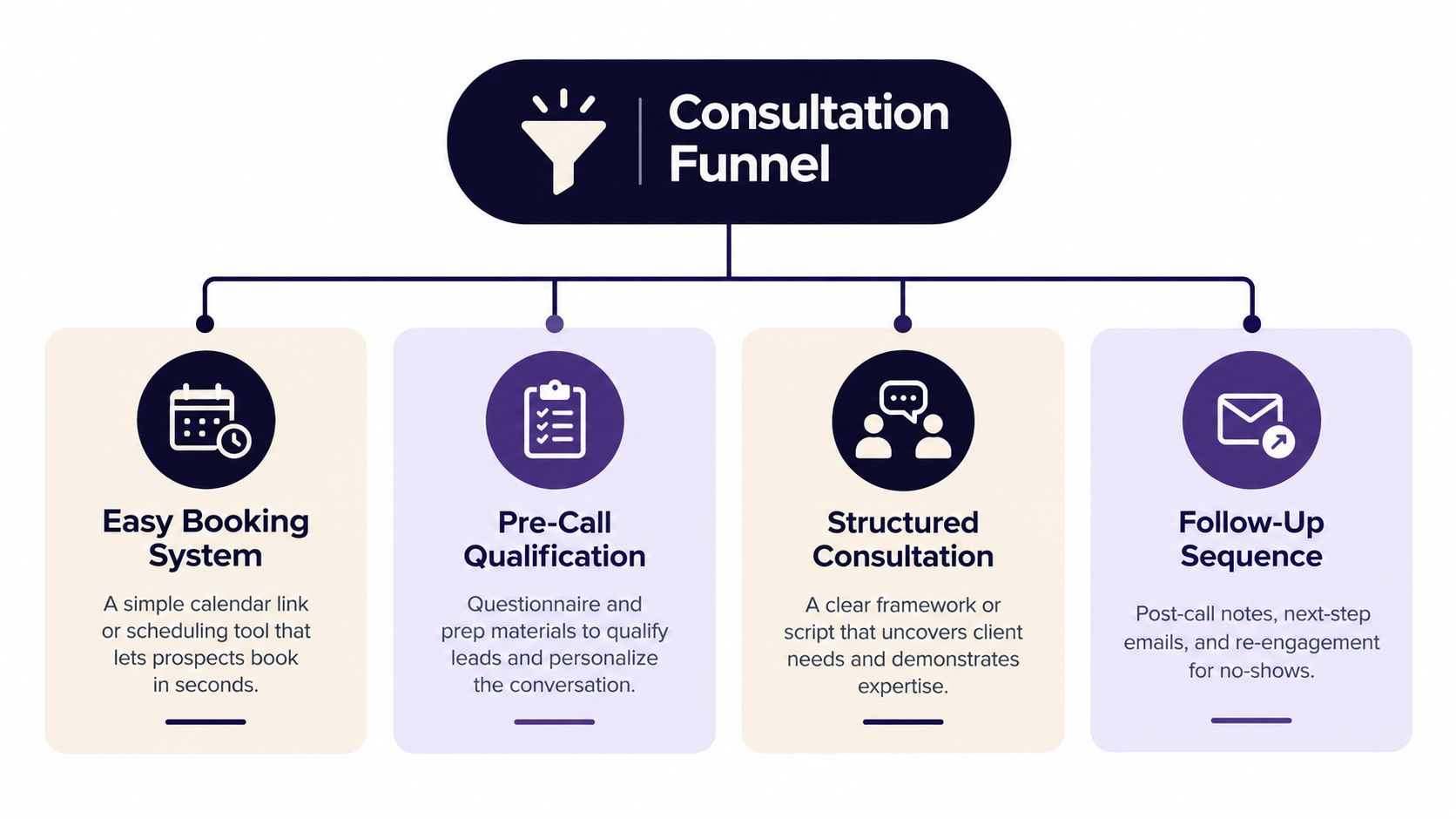
Choose a consultation funnel when the service is difficult to scope in writing, the buyer has multiple stakeholders, or trust must be established before a proposal can make sense. The call is not a casual chat. It's a structured qualification and diagnosis session that determines whether both sides should proceed.
A freelancer might offer a project-fit assessment to an Upwork prospect. An agency could book a strategy session with an owner considering a retainer, or use a discovery call to uncover dependencies that a job post didn't mention. The best calls create clarity even when they don't produce a sale.
Qualify before you protect the calendar
Use a pre-call questionnaire to collect the current situation, desired outcome, timeline, decision process, and relevant constraints. It should reduce repetitive questioning and expose poor-fit leads before they occupy your calendar.
Send an agenda and useful pre-read material before the meeting. During the call, follow a repeatable sequence:
- Diagnose the current state: Ask what's happening now and why it matters.
- Define the desired outcome: Clarify what success needs to look like.
- Test feasibility: Confirm resources, timing, authority, and scope.
- Recommend a next step: Explain whether that's a proposal, paid audit, referral, or no engagement.
Use calendar software with reminders, and record the conversation only with permission. End every call with a clear owner and next action. Follow up within 24 hours with notes, decisions, open questions, and the proposed path forward.
Consultation funnels are especially useful for services where the proposal close is the key commitment. A benchmark for consultation and services funnels places proposal close rates at 25% to 35%, according to First Page Sage's funnel benchmark report. The number isn't a promise. It's a reminder to judge this funnel by booked, qualified conversations and proposal outcomes, not traffic.
5. Value Stack Funnel
A value stack funnel makes the buying decision easier by organizing the full value of an offer. It starts with a core service and adds legitimate components that remove risk, improve implementation, or help the client reach the desired result faster.
For an Upwork service, the stack might combine project bidding, proposal optimization, profile refinement, client communication templates, follow-up sequences, and an analytics dashboard. An agency could add monthly strategy calls, performance reviews, documentation, or team training. Each addition must solve a real problem. Bonuses that exist only to make the offer look bigger weaken trust.
Stack usefulness, not clutter
List every meaningful component of delivery, then rank those components by importance to your ideal buyer. Present the core outcome first. Follow with the elements that support that outcome, such as onboarding, reporting, quality assurance, or implementation support.
Social proof should match the value component it validates. A testimonial about communication doesn't prove strategic expertise. A case study about delivery speed doesn't automatically prove revenue impact. Use only results you can substantiate, and don't calculate a fictional total value.
This funnel works best when the buyer understands the problem but is comparing alternatives. It helps an agency distinguish a structured service from a cheaper collection of tasks. It doesn't rescue a vague offer. If you can't explain what changes for the client, adding more deliverables will only create scope confusion.
Build the stack in buyer order: outcome first, risk reduction second, convenience third, extras last.
Test different stacks against clearly defined audience segments. Track proposal acceptance, average project scope, objection frequency, delivery margin, and retention. A value stack that wins more deals but destroys margin isn't a successful funnel.
6. Community and Network Funnel
A community funnel is a long-game choice. It fits agencies whose buyers benefit from peer interaction, shared learning, and repeated exposure to the operator's expertise. The community becomes a trust environment where members exchange advice, share wins, and influence each other's decisions.
A private Slack group for Upwork freelancers could cover client acquisition, delivery challenges, and proposal feedback. An agency might run a members-only forum for scaling operators, host virtual meetups, or organize focused challenges around sales operations. These activities create more opportunities for prospects to observe your thinking before they consider a paid service.
Lead the room instead of renting out software
A community needs a clear mission and a defined member profile. “A group for everyone in business” won't create useful discussion. “A peer group for small agencies managing multiple Upwork bidders” gives the right people a reason to join and participate.
The operator must be visible. Answer questions, connect members to each other, celebrate useful contributions, and publish lessons from recurring problems. Peer-to-peer introductions matter as much as leader-to-member interaction. A silent group with occasional promotional posts isn't a funnel. It's an abandoned channel.
Create natural progression from free participation to paid membership, workshops, audits, or agency services. Don't pressure members after every discussion. Use community feedback to refine offers and identify repeated problems that deserve a productized solution.
This funnel is a poor choice if you need immediate revenue or dislike ongoing moderation. It demands consistent presence, thoughtful programming, and a willingness to build trust before asking for a commercial commitment. Track active participation, qualified introductions, event attendance, member-to-opportunity movement, and revenue by community source.
7. Automated Outreach and Messaging Funnel
Automated outreach is the best operational funnel for agencies that already know their ideal project and need more consistent coverage. On Upwork, speed matters because several qualified sellers may respond to the same posting. Automation can search for relevant work, assemble personalized proposals, send follow-ups, and route interested prospects toward a call.
The system must still sound like a person who read the brief. Reference the project's actual requirements, identify a relevant risk, and explain the first practical step. A generic template sent quickly is still generic.
Automate repetition, not judgment
Create separate sequences for different project types, buyer readiness levels, and service lines. A new lead may receive an initial proposal, a useful follow-up, and a final close-the-loop message. A prospect who replies should leave the automated sequence and enter a human-managed conversation.
Respect Upwork rules and anti-spam requirements. Include clear opt-out handling where email is involved, protect account access, and review messages regularly. Monitor response rates, qualified replies, booked calls, and closed revenue by sequence. If a sequence generates replies from poor-fit prospects, improve targeting before increasing volume.
Lead nurturing is a core part of this funnel, not an optional add-on. One 2026 summary reports that nurtured leads make 47% larger purchases and convert 23% faster than non-nurtured leads, according to the cited sales funnel statistics summary. Treat that figure as benchmark context, then measure your own cohorts.
For agencies comparing workflow options, explore sales outreach automation. The right setup gives the operator more time for discovery, negotiation, and delivery rather than repetitive searching and messaging.
8. Referral and Strategic Partnership Funnel
Referral funnels convert trust you've already earned into new opportunities. They're the strongest choice once you have satisfied clients, complementary providers, or agency relationships that regularly encounter the same buyers.
Make the referral path simple. A current Upwork client might introduce another business that needs similar help. A copywriter can refer design work, while a developer can refer conversion strategy. Agencies can create co-marketing partnerships with providers serving the same audience without competing for the same project.
Design the handoff before asking for referrals
Explain your service in language a partner can repeat accurately. Provide a short description, ideal-client profile, qualifying signals, and a direct introduction template. If the referrer has to explain your entire business from scratch, they won't send many introductions.
Reward referrals only in ways that fit your contracts, platform rules, and local requirements. A credit, reciprocal referral, or agreed partnership arrangement may be more useful than a complicated program. The incentive should never be the only reason someone recommends you. Poor-fit referrals damage the source's reputation too.
Track the original source, contact date, qualification result, proposal stage, and final outcome. Close the loop with the person who referred the opportunity, even when the lead doesn't become a customer. That courtesy builds confidence and encourages future introductions.
Referral opportunities can outperform many outbound channels, but channel comparisons must use the same stage definition. One dataset reports referral lead-to-opportunity conversion at 10.99%, compared with 0.55% for email and 0.90% for sales prospecting, as summarized by this sales funnel benchmark source. Use the comparison as directional context, then judge partnerships by qualified opportunities, margin, and strategic fit.
Pick One Funnel, Run It Clean, Then Stack the Next
Don't build all eight funnels. Pick the one that matches the revenue problem in front of you.
If you need project volume now and sell through Upwork, start with a proposal-based funnel supported by automated outreach. Your immediate metrics are qualified opportunities found, proposals submitted, replies, calls booked, proposals sent, and closed work. If you already have a reliable client base, add a referral funnel before investing heavily in content or community. Trust already exists, so the path to another opportunity is shorter.
If prospects need education before they'll buy, choose a content funnel or lead magnet funnel. If the service requires diagnosis, use a consultation funnel. If buyers compare similar offers, sharpen the value stack. Community is the right move when you want durable authority and peer-driven demand, but it shouldn't be your first system if the business still lacks a repeatable sales motion.
Run the first funnel for 90 days using a consistent cohort definition. Monthly snapshots can distort long-cycle B2B performance, so the B2B benchmark guidance recommends 90-day cohorts for more useful analysis. Measure every transition with the same formula: later-stage contacts divided by earlier-stage contacts, multiplied by 100, as explained by HiBob's guide to sales funnel conversion rates.
Find the leak before adding complexity
A funnel with strong lead volume but weak qualification needs better targeting. A funnel with qualified calls but weak proposals needs stronger diagnosis, positioning, or proof. A funnel with accepted proposals but poor retention needs delivery and expectation management, not more top-of-funnel traffic.
The benchmark ranges are stage-specific. One 2026 source places visitor-to-lead conversion at 1% to 5%, lead-to-MQL at 25% to 35%, MQL-to-SQL at 13% to 26%, SQL-to-opportunity at 50% to 62%, and opportunity-to-closed-won at 15% to 30%. The named transition benchmarks are useful for locating pressure points, but your own service, platform, audience, and sales cycle determine what healthy looks like.
Early-stage agencies should usually begin with proposal-based and automated outreach on platforms such as Upwork. Earlybird AI connects to an Upwork account, learns preferred projects through thumbs-up and thumbs-down feedback, searches for matching jobs, drafts personalized proposals, and replies to client messages. Its publisher describes proposals submitted within about 10 minutes of posting and replies in under 5 minutes, with analytics, profile optimization, and multi-user workflows also available.
Stack a second funnel only after the first one is profitable and operationally stable. Then choose the layer that addresses the next constraint, usually lead nurturing, referrals, content, or consultation.
Take three actions this week. Audit the funnel you already run, from first contact to closed work. Define the single metric that proves the system works, such as qualified calls booked or profitable projects closed. Then choose the second funnel to add next quarter, based on the stage where your current process loses the most value. If video will support your education or outreach system, you can begin creating AI videos as part of that content layer.
Earlybird AI helps freelancers and agencies automate Upwork job discovery, personalized proposals, client replies, follow-up, analytics, and team workflows. Visit Earlybird AI to connect your outreach motion to a more consistent sales funnel and spend more time on qualified conversations and closing.


