
← Back To Blog
Upwork Application Letter: A Complete Guide to Writing One
You've sent ten proposals this week. Maybe twenty. You've checked your messages, refreshed the page, and heard nothing back. That silence doesn't always mean your skills aren't good enough. Often it means your Upwork application letter never earned enough attention to get a fair read.
Why Your Upwork Application Letter Matters
You find a job that fits. You rewrite your opening, attach a sample, double check your rate, and hit submit. Then you wait while the client reviews a stack of other freelancers who did exactly the same thing.
That stack is the problem. Upwork isn't a quiet job board where a polite cover letter gets a careful read. It's a crowded marketplace where clients scan quickly, discard freely, and only reply to a small shortlist. The scale makes this clear. According to Upwork's historical record on Wikipedia, Upwork reported 12 million registered freelancers in 2017, although only about 3% completed a project during that year, highlighting the difference between platform registration and commercially active participation.
That gap should change how you think about applying. Registration doesn't equal revenue. Most freelancers who sign up never turn activity into paid work, and weak proposals are one reason they stall early.
A Sales Pitch, Not a Formality
Treat your letter as a conversion instrument, not an introduction for its own sake. A traditional cover letter explains your background and hopes someone connects the dots. An effective Upwork application letter does the connecting for the client. It names their problem, shows relevant proof, removes obvious risk, and makes replying feel like the obvious next step.
That shift sounds small, but it affects every sentence. You stop opening with your biography. You stop listing every skill you own. You start asking a harder question before you submit. Would a busy client, reading this between other proposals, understand in seconds why you're worth a conversation?
If your letter could be sent unchanged to ten different clients, it's probably not specific enough to win any of them.
You're also competing for repeat buyers, not just one off gigs. Clients with established hiring patterns know what a serious proposal looks like because they've seen hundreds of weak ones. They reward clarity and evidence. They punish vagueness fast.
That's why this guide focuses on measurable attention, not taste. You can't improve what you treat as a writing exercise. You can improve a letter when you know whether it was opened, shortlisted, answered, or ignored, and you fix the stage where it failed.
What Makes an Application Letter Get Opened and Read
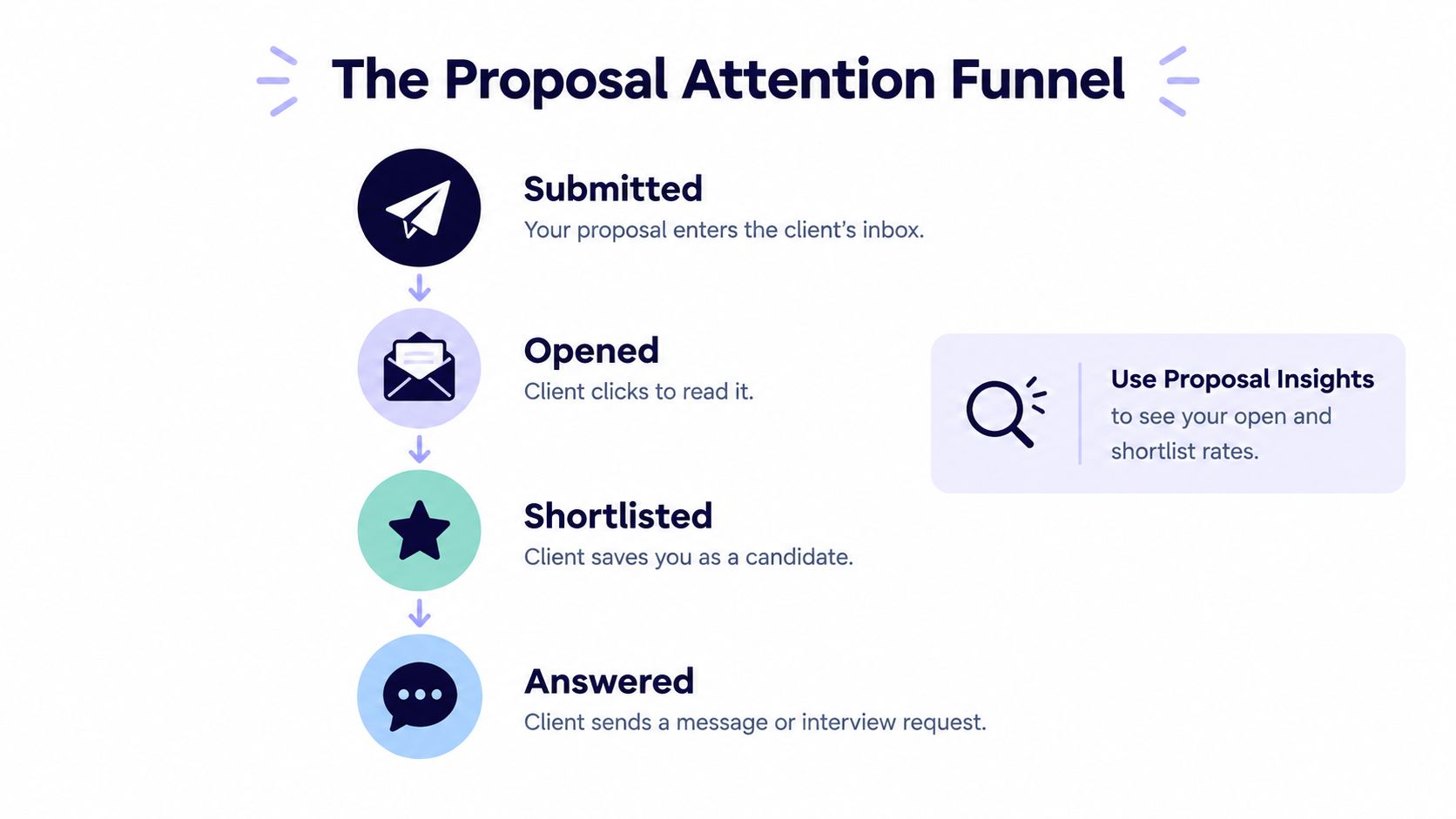
Every proposal passes through the same funnel, whether you track it or not. You're submitted, then opened, then shortlisted, then answered with a message. Most freelancers only notice the final stage. When no message arrives, they rewrite everything at once and learn nothing.
Upwork gives you better data than that. As described in Upwork's 2025 impact report, Proposal Insights reports the total number of proposals submitted for a job and breaks client engagement into proposals opened, shortlisted, and answered with a message, updating hourly. It also surfaces average bid amounts and comparative information on competing applicants, so you can separate a writing problem from a pricing or positioning problem.
Where Letters Die
A low open rate usually points to your first lines, your timing, or how your profile looks at a glance. Clients preview proposals before they commit to reading them. If your opening is generic, self focused, or disconnected from the job post, they have no reason to click.
A strong open rate with few shortlists tells a different story. The hook worked, but the proof didn't. Your examples may be irrelevant, your claims may sound inflated, or you may not have answered the client's screening questions directly.
Shortlists without replies point further down the page. Pricing may be unclear. Scope may feel risky. You may have left the client unsure about availability, process, or what happens next. That's a communication failure, and it's fixable with the kind of direct, low friction messaging covered in practical client communication best practices.
- Not opened: Fix the opening sentence and check whether you applied after the client had already moved on.
- Opened, not shortlisted: Tighten proof, relevance, and answers to specific requirements.
- Shortlisted, not answered: Clarify price, timeline, next step, and any obvious risk.
This funnel matters more as competition spreads beyond software into design, marketing, translation, and other creative work. You don't need a prettier letter. You need to know which stage is leaking, then repair that stage instead of guessing.
Structuring Your Application Letter for Maximum Impact
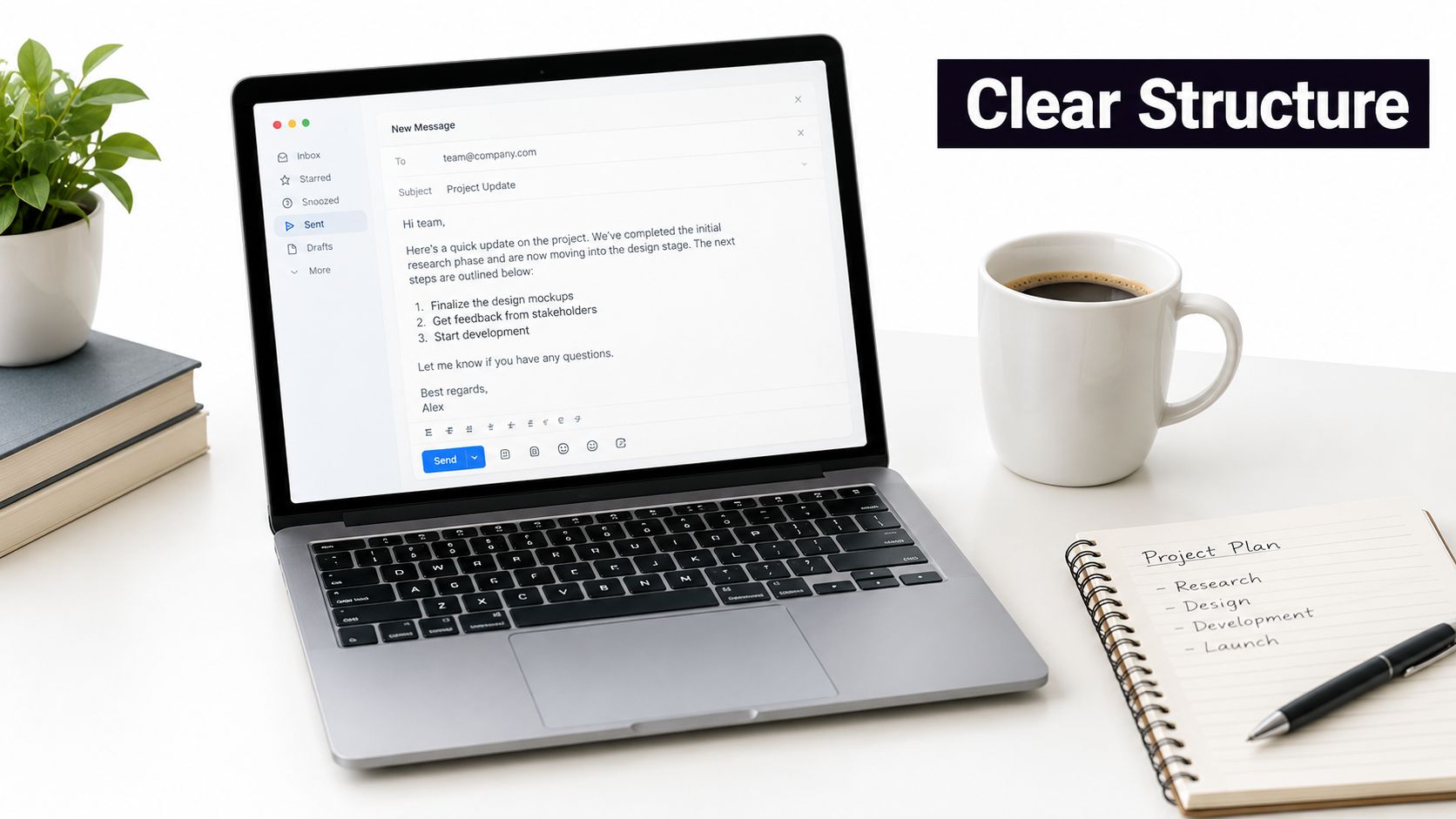
A strong Upwork application letter has a boring skeleton. That's a compliment. Clients shouldn't have to work to find your point, and you shouldn't have to invent a new format for every job.
Upwork's own guidance keeps it tight. In Upwork's cover letter tips, the platform recommends keeping an application letter to 200–300 words or fewer, depending on the project, with a professional greeting, a concise introduction tied to the client's needs, a body explaining relevant experience, and a closing call to action.
The Four Part Skeleton
Start with a simple professional greeting. Use a name only if you're certain it's correct. A wrong name is worse than no name.
Your introduction should do one job. Connect your capability to the client's stated need in two or three sentences. Don't open with how long you've been freelancing. Open with the problem they posted about and the specific outcome you can help them reach.
The body is where proof lives. Pick your most relevant experience, not your most impressive unrelated win. Name the type of project, what you did, and what changed for that client. Link one or two samples that match the brief. Three relevant lines beat a paragraph of broad claims.
Close with a clear call to action. Propose a short call, offer to outline first steps, or ask one useful question that moves the project forward. A vague sign off like hoping to hear from them gives the client nothing to act on.
Practical rule: every paragraph should either prove relevance, reduce risk, or move the client toward a reply. Cut anything else.
Adjusting for Project Size
For a short design task, compress further. A tight opening, one matching sample, a delivery note, and a question about files or dimensions may be enough. For a complex development build, keep the same order but add brief process detail. Explain discovery, milestones, and how you'll handle testing or handoff, without turning the letter into a full proposal document.
Brevity isn't a constraint here. It's a competitive advantage because it respects scanning behavior. A concise letter signals that you'll communicate clearly during the project too. If you want a broader look at cover letter structure beyond Upwork, Eztrackr's guide to landing more interviews is worth comparing against this tighter, client first format.
Personalization Techniques That Stand Out
Personalization isn't inserting a first name into a template. Clients spot that instantly. Real personalization proves you read the post, understood the constraints, and thought about their situation before asking for money.
Start by mining the job post itself. Pull out the exact deliverable, the deadline pressure, any tools they mention, and the words they use to describe success. Then mirror that language naturally in your opening. You're not copying for flattery. You're showing alignment.
Research Without Burning an Hour
Check the client's history before you write a word. Look at past job titles, reviews from other freelancers, and whether the listing already shows interviews or a hire. Upwork advises checking job activity and client reviews before spending Connects, because a polished letter for a dead listing is still wasted effort.
That quick screen also tells you how to pitch. A client who repeatedly hires for landing pages likely values speed and conversion thinking. A first time client with a vague post likely needs reassurance and a clearer process. Same skill from you, different emphasis in the letter.
- Reference a specific detail: Mention their product, audience, existing asset, or stated bottleneck, not just the job title.
- Connect past work directly: Explain why a previous project is similar in scope, industry, or challenge.
- Name the trade off: If there's a tight timeline or limited budget, acknowledge it and explain how you'd prioritize.
- Ask one sharp question: A thoughtful question about source files, access, or approval process signals you've already started planning.
This is also where positioning matters. The thinking behind strong unique value proposition examples applies directly here. You aren't the best designer or developer in abstract terms. You're the right fit for this client because of a specific match between their need and your evidence.
Balance matters. Build reusable proof blocks for common project types, then customize the opening, the example you lead with, and the closing question for each post. That gives you speed without sounding templated. If you're selling services beyond a single platform, AmaJova's perspective on how to sell services as a creator reinforces the same principle. Buyers respond to specific outcomes, not generic capability lists.
Don't personalize every opportunity equally. Spend your best effort where fit is strong, the client looks active, and the budget supports your rate. That's not laziness. That's allocation.
Common Mistakes That Kill Your Chances
Most proposals don't fail because the freelancer lacks skill. They fail in the first thirty seconds, for reasons the client can see and the freelancer often can't.
The biggest misconception is that volume fixes quality. It doesn't, especially when every submission costs you. As explained in Upwork's guide to creating a winning proposal, every Upwork proposal requires Connects, which cost $0.15 each in U.S. dollars and are sold in bundles, meaning each application letter has a measurable acquisition cost.
The Fatal Five
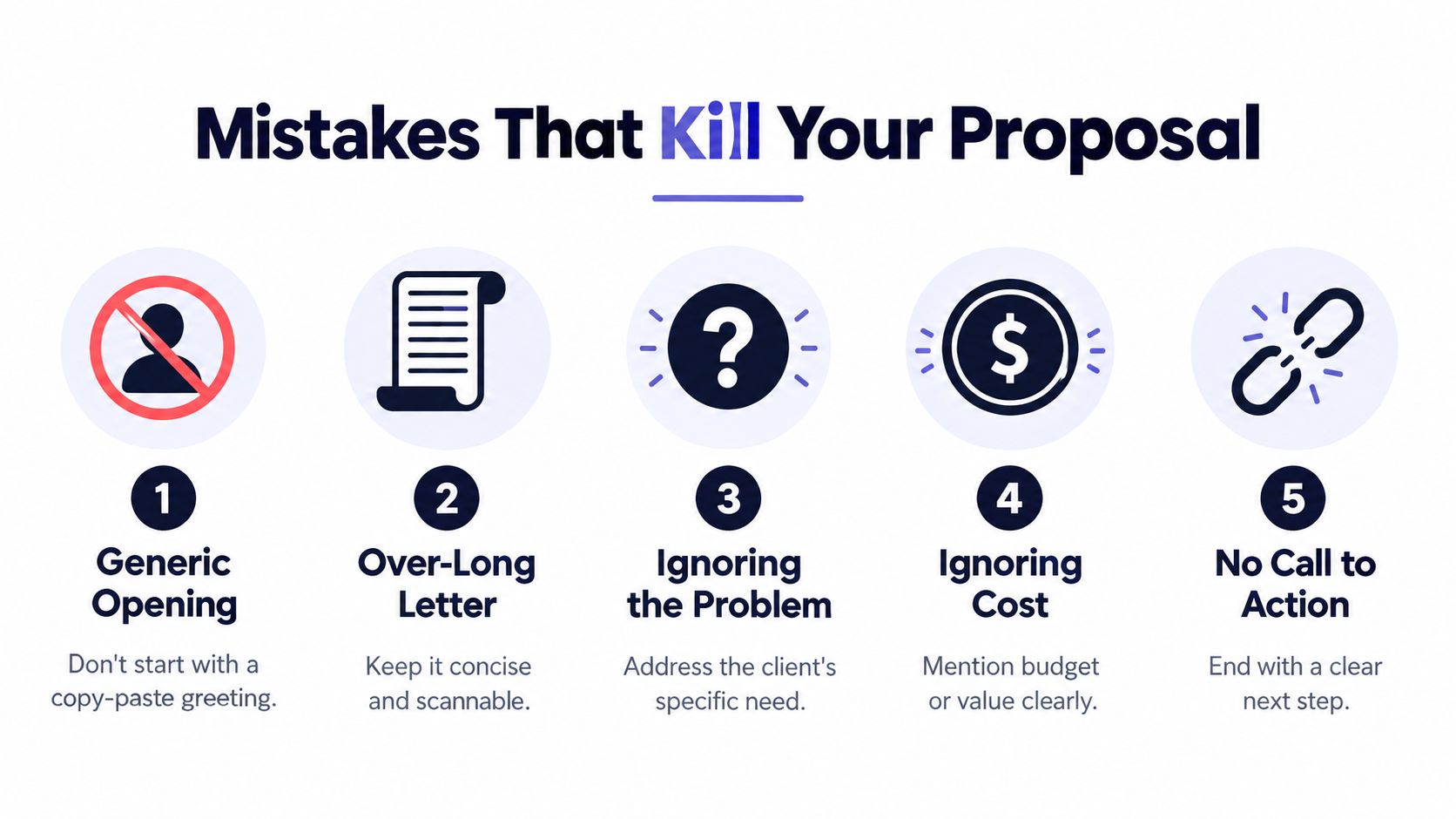
Generic openings kill opens. Starting with a copy paste greeting and your years of experience tells the client you wrote this for everyone. They'll treat it accordingly.
Over long letters kill shortlists. Walls of text force clients to hunt for relevance. Most won't bother. If your proof is buried in paragraph four, it may as well not exist.
Ignoring the client's problem kills trust. Listing tools and services without connecting them to the posted need makes you sound like a catalogue, not a solver. Clients hire outcomes. They don't hire feature lists.
Ignoring cost and value creates friction. You don't need to negotiate against yourself, but you do need to make pricing, scope boundaries, or value easy to understand. Confusion about what they're buying pushes clients toward clearer competitors.
No call to action kills replies. Ending passively leaves the client to invent the next step. Offer a brief call, a small first milestone, or a direct question they can answer quickly.
There's also a quieter mistake behind all of these. Applying to poorly matched jobs because submitting feels productive. It isn't. Each weak fit application burns paid Connects, dilutes your focus, and produces data that tells you nothing useful about your letter.
Audit before you spend. Read your draft as a client would, on a phone, between meetings, with twenty tabs open. If the value isn't obvious immediately, it isn't obvious enough.
Application Letter Examples You Can Adapt
Examples help only if you understand why each line is there. Copy either letter below word for word and you'll sound like everyone else who found it online. Adapt the logic, and you'll have something usable.
Design Project Example
Hi there. Your landing page needs to do more than look polished. It needs to explain the offer fast and guide visitors toward booking a demo, which is exactly how I approached a recent SaaS homepage redesign. I rebuilt the hero, simplified the feature sections, and tightened the calls to action around one clear next step.
I can share that project and one similar page in your industry. For your page, I'd start with the headline hierarchy and primary call to action before moving into visual polish, so structure drives the design rather than decoration.
Could you share your current page and any brand files? I can then confirm scope and a delivery timeline.
Notice what earns its place. The opening names the business goal, not the freelancer's biography. The proof is relevant and specific. The process is brief. The closing asks for exactly what's needed to move forward.
Development Project Example
Hi. It sounds like your checkout issue is costing sales, not just creating a technical annoyance. I've debugged similar payment flow problems in custom storefronts by tracing the failure point first, then fixing the smallest piece that restores checkout before refactoring anything wider.
I'd begin with a short diagnostic, report what I find in plain language, and agree on the fix before deeper work starts. That keeps cost controlled and avoids surprises.
Would a brief call tomorrow help? I can review access needs and confirm the first diagnostic step.
Here the letter reduces risk. It proposes diagnosis before a large commitment and promises plain language updates, which matters to non technical clients.
Where AI Helps and Where It Must Stop
Use AI for grammar cleanup, structure checks, summarizing a long job post, or generating questions you might ask. Verify personally every portfolio claim, technical recommendation, delivery estimate, and statement about past results. According to Upwork's Terms of Service, generative AI use is not categorically banned, but it prohibits substantially bolstering proposals when the client restricts AI use, when third-party rights are violated, or when AI-generated material is passed off improperly as the freelancer's own.
A short, verifiable proposal is safer and more persuasive than polished generic copy you can't fully stand behind.
Before submitting, run a quick fact check. Did the client restrict AI use? Is every claim true? Could you defend each sentence on a call? If not, rewrite it yourself.
How to Measure and Improve Your Results
Treat each batch of applications as a test, not a verdict on your talent. Review Proposal Insights after you apply and link each metric to one specific revision, using the funnel logic covered earlier. Change one variable at a time, or you won't know what helped.
The image below captures the habit you're building. Regular review, not occasional guessing.

Track your own notes alongside the platform data. Record the opening line you used, the proof you led with, your bid relative to the job, and how active the client looked. Over time you'll see patterns in meaningful client engagement metrics that a single rejection can't reveal. You'll also learn to separate a fixable letter problem from market conditions, such as a client who never hires or a flood of lower priced bids.
Boosting adds another decision. As detailed in Upwork's support guide on boosting proposals, the system lets eligible freelancers bid additional Connects for one of the top four boosted positions in the client's proposal list, with the bid added to the normal submission cost. Boost only when fit is excellent and your letter is already strong. Paying for visibility on a weak pitch just helps more clients ignore you faster.
Tools can support this loop. Earlybird AI, for example, connects to your Upwork account, learns your preferred projects from your feedback, and drafts personalized proposals automatically. Whether you use a tool or work manually, the discipline stays the same. Measure, revise one thing, measure again.
The walkthrough below shows this review mindset in practice.
If you're tired of writing strong letters too slowly while good jobs fill with proposals, Earlybird AI can act as your always on sales team by finding matching Upwork jobs, submitting personalized proposals quickly after posting, and replying to clients so conversations move toward booked calls. Visit the site to see how its analytics, profile optimization, and automated follow up can help you turn your improved application letters into more interviews with less manual work.


