
← Back To Blog
Upwork for Agencies: The Complete Operating Playbook
A four-person agency can have the right specialists, a credible portfolio, and a strong offer, yet still watch qualified Upwork leads disappear to slower bidders. The owner sees a promising post, sends it after lunch, and discovers that the client has already shortlisted other teams. The problem usually isn't writing ability. It's the absence of a sales operation.
Upwork for agencies works best when you treat every job post as an outbound opportunity with a short response window. Your team needs a clear ideal-client profile, a fast qualification process, controlled proposal ownership, and feedback loops that show which signals produce replies. More applications won't fix a slow or unfocused pipeline.
Why Upwork for Agencies Is a Sales Problem, Not a Job Board
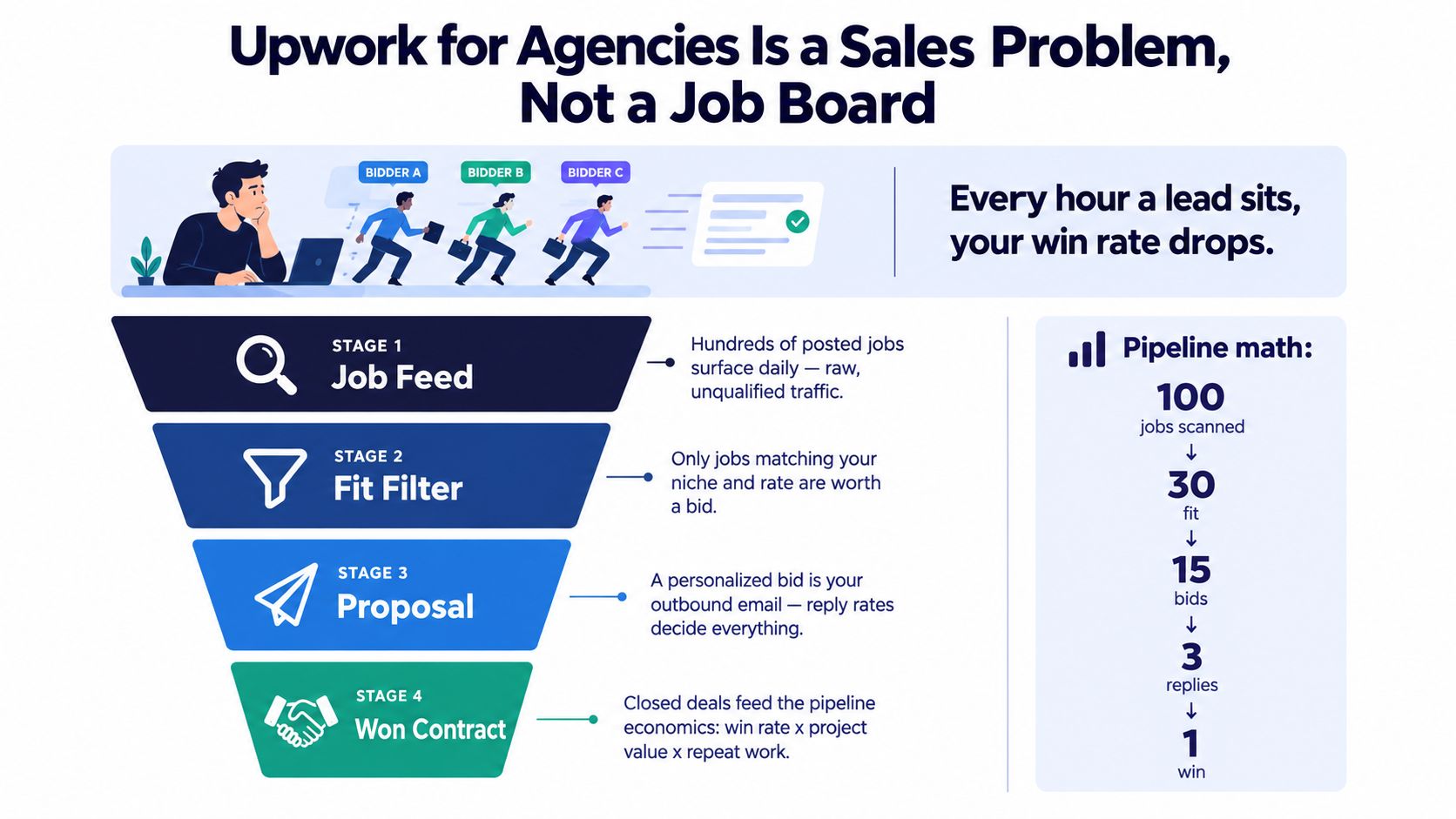
An agency owner who opens Upwork casually tends to follow the same pattern: scan the feed, open anything that looks vaguely relevant, ask a specialist to draft a proposal, then submit whenever the draft is ready. That workflow feels productive because the team stays busy. It fails because the agency competes after the buyer's attention has already moved elsewhere.
Upwork is a global marketplace with customers in more than 180 countries. The platform enabled $4.0 billion in gross services volume in 2025, and reported 785,000 active clients at year-end, according to Upwork's 2025 annual report. That scale creates opportunity, but it also creates noise. Agencies need a system for deciding which opportunities deserve attention before they spend time drafting.
The useful metrics are operational
The metrics that matter aren't the number of jobs viewed or proposals submitted. Track reply rate, time from posting to submission, interview conversion, hire rate, and revenue per Connects spent. These numbers tell you whether the agency is reaching suitable buyers quickly and presenting enough evidence to earn the next conversation.
A proposal is a cold email with a platform-native format. It should target a defined client profile, address a recognizable problem, make the agency's role clear, and give the buyer a reason to reply now. Generic introductions, long service lists, and copied portfolio paragraphs consume team time without creating a strong buying signal.
Practical rule: Reduce the time between job discovery and human-reviewed submission before you invest in more elaborate proposal copy.
Reply-rate decay is the central operating constraint. As a job collects applications, later proposals have to overcome more competition and less available buyer attention. The agency that responds quickly with a specific, credible message often beats the agency that submits a more polished but delayed proposal.
Owners who want a broader framework for structuring this work can use this guide to build a sales pipeline. The important shift is simple: stop asking whether your team is bidding enough. Ask whether the right person is finding the right jobs, qualifying them quickly, and sending a useful signal while the opportunity is still fresh.
How an Upwork Agency Account Actually Works
An Upwork agency account isn't just a freelancer profile with extra names attached. It represents a team that can work under one brand, with shared management, pooled Connects, and agency-level delivery responsibility. When a client hires an agency member, the client is hiring the agency, and payments on agency contracts go to the agency before the agency pays its members under its internal arrangement, as Upwork's agency and freelancer guidance explains.
Start by deciding whether the agency model matches your delivery reality. If one person sells, manages, and delivers every project, a freelancer account may remain simpler. If multiple specialists contribute to fulfilment or one sales operator manages proposals for several people, the agency structure gives you the control layer you need.
Assign ownership before bidding starts
The owner should control the commercial relationship and account-level decisions. Managers can coordinate proposals and team activity, while members contribute specialist delivery and may support client conversations. Don't let every specialist decide independently which jobs to pursue. That creates duplicated bids, inconsistent pricing, and unclear accountability.
Upwork's agency guide says owners can add unlimited team members and share Connects across the team. Agency business managers can submit, edit, or withdraw proposals and handle offers on behalf of team members, which supports centralized bidding and reduces the temptation to share credentials. Review Upwork's agency operating model before assigning permissions.
CapabilityAgency AccountFreelancer AccountBrand presentationShared agency identity with team membersIndividual professional identityProposal managementAgency managers can coordinate submissions for membersFreelancer controls personal proposalsConnectsCan be pooled across the agencyManaged by the individual accountContract ownershipAgency receives payment on agency contractsFreelancer receives payment on personal contractsDelivery modelWork can be distributed across assigned membersWork is delivered by the individualReputation signalAgency-level performance can reflect team deliveryPerformance centers on the individual
Make the bid queue a managed resource
Shared Connects don't mean unlimited bidding. They create a budget that needs rules. Define who can spend them, what fit criteria justify a proposal, and when a specialist needs approval before entering a competitive job.
The clean operating question is: who owns the bid queue, who reviews the message, and who owns the client after a reply? If those answers change from job to job, your agency won't know whether a weak result came from poor fit, poor timing, weak positioning, or poor follow-up. Document the workflow in one place, then use this Upwork agency tool guide to evaluate supporting processes.
Building an Agency Profile That Wins Shortlists
Clients don't shortlist an agency because it claims to do everything. They shortlist the team that makes the buyer's problem feel understood and solvable. A profile titled “full-service digital agency” gives the client no reason to choose you over dozens of similar profiles.
Use a positioning formula built around niche, outcome, and proof. For example, a technical SEO agency might lead with ecommerce migration recovery, then explain the commercial outcome it targets, followed by a concise proof point from approved client work. The profile title and opening lines should tell a buyer who you help and what kind of result your team is built to produce.
Turn portfolio items into buying evidence
A portfolio item should answer three questions:
- Client problem: What situation required outside help?
- Agency role: Which part did your team own?
- Result: What changed, using a verified business or marketing measure where permission exists?
Don't present a gallery of disconnected deliverables. A collection of attractive screenshots can demonstrate taste, but it doesn't prove that the agency can manage scope, communicate with stakeholders, or solve a business problem. Group related work by service and buyer type so the client can recognize their own situation.
Your service descriptions should function as conversion copy. Explain the situations that trigger an engagement, the work the agency performs, and the decisions the client can expect from your team. Specialty tags should reinforce the same positioning rather than introduce unrelated capabilities because they might attract more searches.
Make the team page reinforce the brand
Every member bio needs a role in the agency story. The lead strategist should establish authority, the developer should clarify technical ownership, and the project manager should reduce delivery risk. Avoid five biographies that all say the same person is passionate, detail-oriented, and results-driven.
Use approved certifications, recognizable client logos, and verified outcomes where available. Don't imply work your agency didn't perform, and don't use a logo without permission. Upwork's agency-level Job Success Score reflects client satisfaction across agency contracts, including work by exclusive and non-exclusive members, so delivery quality must match the promise made by the profile.
A strong agency profile doesn't describe your capabilities. It helps the right buyer self-qualify.
Rewrite the profile as your proof improves. New wins should change the order of your evidence, not merely add another paragraph at the bottom. A quarterly review keeps the positioning aligned with the type of work your pipeline can deliver profitably.
Proposal Timing and the Reply-Rate Decay Curve
Proposal quality matters, but timing usually matters more than another round of copy edits. Independent pipeline data based on 133,872 proposals found reply rates of 8.99% at four minutes, 6.47% at seven minutes, and 5.34% at thirty minutes after a job was posted.
The first proposals also receive disproportionate attention compared with submissions made after the first hour, according to the same analysis. Treat the numbers as directional rather than as a promise for every category. The operating conclusion remains firm: posting-to-send latency belongs on the agency dashboard.
Build for freshness, not frantic volume
Set alerts around tightly defined niches, budgets, client histories, and services your team can deliver. A scout should review fresh posts first, reject weak-fit jobs quickly, and send high-fit opportunities into a queue that a drafter can act on without further research.
Use templates as structured starting points, not automated cover letters. Each template should contain a problem-led opening, a relevant proof section, a delivery approach, and a single clear next step. The sender then personalizes the message using the buyer's language and submits it while the job is still fresh.
For practical guidance on organizing responses to formal opportunities, BoloSign RFP response tips offers useful principles around relevance, requirements, and response discipline. Those principles apply to Upwork proposals, even though the platform's format is shorter and more conversational.
A tool such as quicker job alerts can support faster discovery, but alerts alone won't produce a pipeline. The agency still needs a fit score, a responsible bidder, and a review step that prevents speed from turning into irrelevant applications.
Consider two agencies pursuing the same technical audit. Agency A identifies the post soon after publication, checks fit, personalizes a focused message, and submits while the client is still reviewing initial responses. Agency B waits two hours for a senior specialist to rewrite a generic draft. Even if Agency B's prose is smoother, its proposal enters a more crowded shortlist with less opportunity to shape the buyer's first impression.
Designing a Bidding Workflow for Multiple Bidders
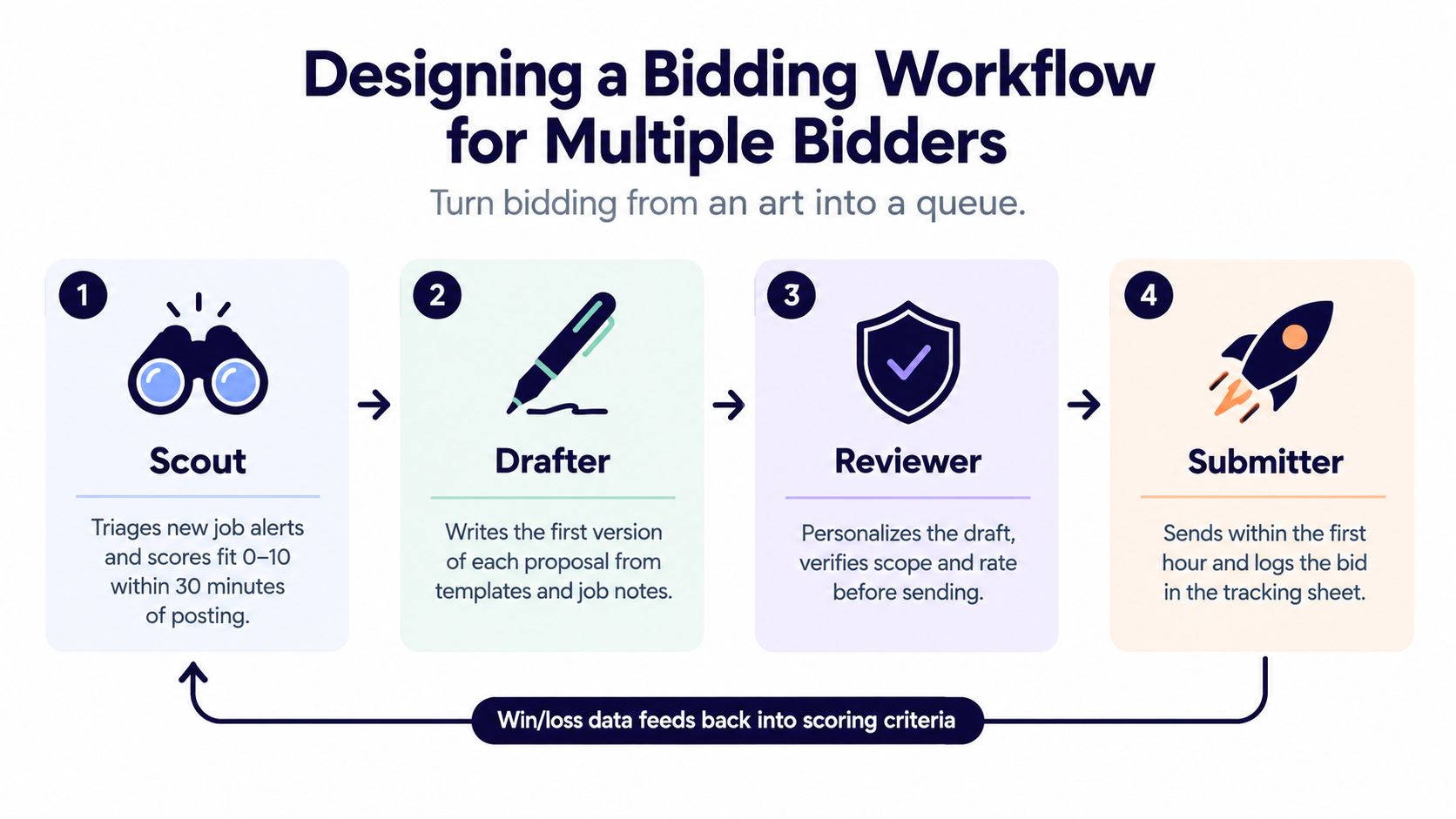
A multi-person bidding team needs a queue, not a group chat. Every new job should have one owner at each stage, a visible status, and a deadline for handoff. Without that structure, several people may research the same post while nobody submits a proposal.
Use four distinct roles
The scout triages alerts, scores fit, checks client quality, and records the opportunity in a shared sheet or lightweight CRM. The scout shouldn't write proposals. Their job is to protect specialist time.
The drafter turns the job notes into a first proposal using the relevant service and client-type template. The draft should contain a specific observation, a relevant example, and a sensible next step.
The reviewer checks scope, tone, rate, proof, and risk. They remove unsupported claims and flag jobs where the brief is vague, the timeline is unrealistic, or the requested work doesn't fit the agency's delivery capacity.
The sender adds final personalization and submits the proposal. This role needs authority to make small edits without reopening the entire approval cycle.
Set internal service levels that protect speed. A practical starting point is triage within 15 minutes, drafting within one hour, review within 30 minutes, and submission before the two-hour mark. These are operating targets, not platform guarantees, and high-fit jobs should move faster whenever the team can support it.
Keep the queue visible
Your tracker should show the job URL, service category, fit score, assigned roles, proposal status, Connects used, client response, and eventual outcome. A template library should be segmented by service and buyer type, not by vague labels such as “general proposal.”
On a busy Monday, a four-person agency might receive twenty alerts. The scout rejects poor-fit posts and assigns the strongest opportunities. Two drafters work from separate service libraries, the reviewer handles proposals in a fixed order, and the sender submits the approved messages while they remain current. Everyone sees which opportunities are waiting, blocked, sent, or closed.
Queue rule: If a proposal has no named sender and no submission deadline, it isn't in production. It's only an intention.
Feed win and loss data back into the fit criteria. If a particular client type replies but never hires, change the qualification score. If a service repeatedly produces interviews but strains delivery, change the rate floor or narrow the scope before increasing volume.
Compliance, Account Safety, and Staying on the Right Side of Upwork
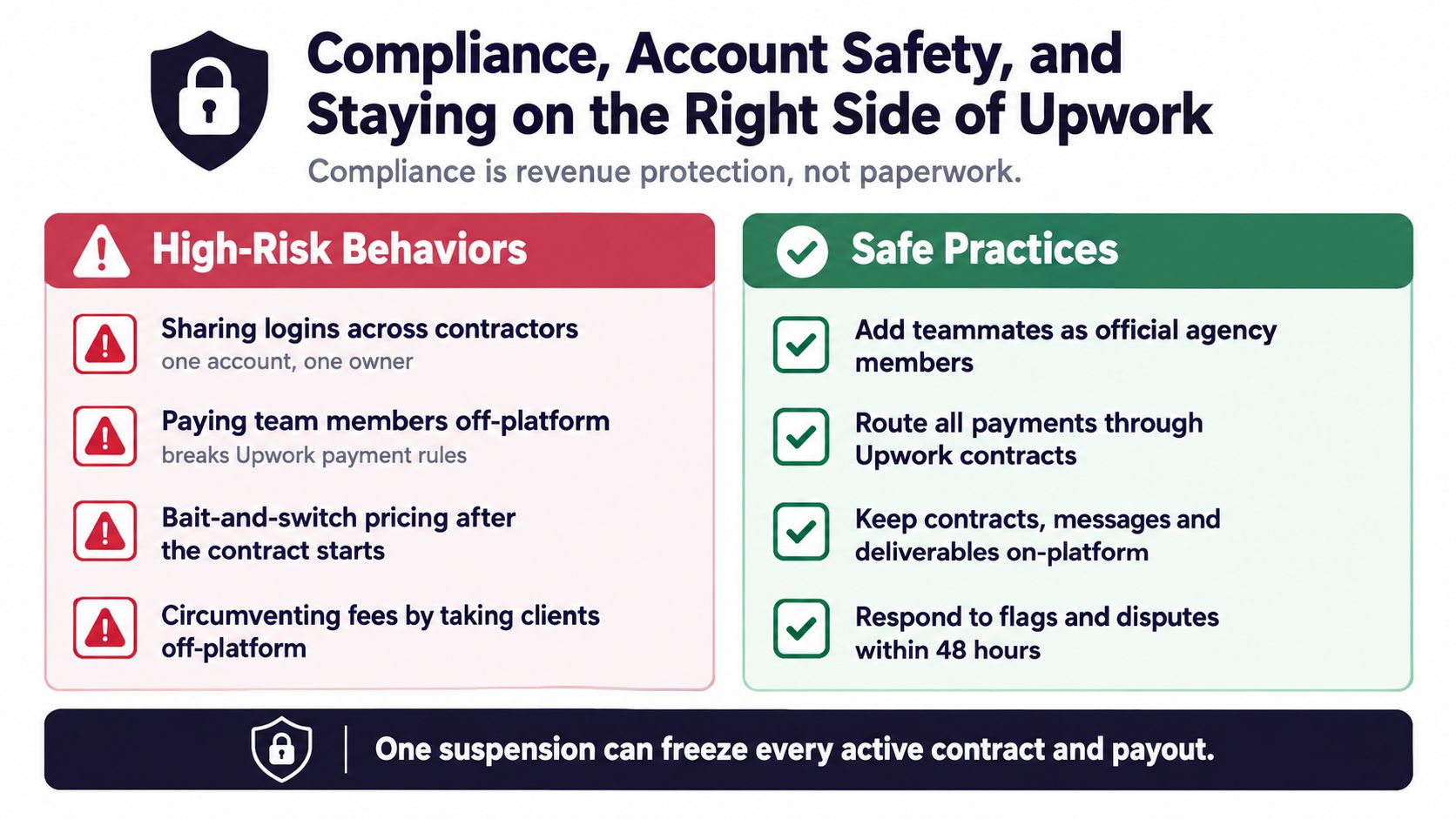
Compliance protects revenue. An agency account concentrates client relationships, contracts, payments, and reputation in one operating structure, so a shortcut taken by one contractor can affect the entire team.
Keep every person involved in delivery assigned through the official agency structure. Don't share account credentials across contractors, create overlapping identities that confuse ownership, use regional workarounds to misrepresent location, or move a client relationship outside Upwork to avoid platform rules. Those practices may look efficient until they trigger a review, payment interruption, or loss of access.
Separate speed from shortcuts
A business manager or agency manager should operate through the permissions Upwork provides, not through shared logins. Route payments through the relevant Upwork contracts, keep important scope decisions and deliverables in the platform, and make sure the person communicating with the client matches the role represented in the proposal.
Don't promise one specialist and substitute another without client alignment. Don't present a portfolio item as agency work if the agency didn't own the engagement. Clean records make it easier to explain who did what when a client raises a question or a dispute begins.
Run a weekly hygiene check:
- Access review: Confirm that current team members have the appropriate agency permissions.
- Contract review: Check active work for scope expansion, missing milestones, and unclear acceptance criteria.
- Payment review: Confirm that payment methods and entity details match the verified agency structure.
- Message review: Look for important decisions that happened outside the platform and record the necessary context appropriately.
- Risk review: Address flags, disputes, and client complaints promptly instead of leaving them to the account owner alone.
Hourly contracts have a $3 USD per hour minimum, while fixed-price contracts have a $5 USD minimum per project or milestone, according to Upwork's contract-type guidance. For hourly disputes, clients can challenge hours within five days after the billing period ends, the freelancer has three business days to respond, and Upwork says it resolves the case within seven days after reviewing the work diary, as described in Upwork's hourly dispute process. Know these rules before a dispute arrives.
Billing, Pricing, and the Real Economics of Agency Work
Agency pricing on Upwork should start with delivery economics, not with whatever rate appears beside a competitor's profile. Your floor must cover specialist compensation, management time, revisions, sales administration, Connects, platform charges, taxes, and the risk of unplanned work. If the floor isn't clear, the agency will accept work that creates activity but weakens cash flow.
Upwork's Agency Plus membership costs $19.99 per month, and Connects purchased through the membership cost $0.15 each and expire after one year, according to Upwork's Agency Plus help page. Treat Connects as acquisition spend. Track them against replies, interviews, hires, and realized revenue rather than hiding them as a minor administrative expense.
Choose the billing model by delivery risk
A fixed-price project suits a defined deliverable with a stable acceptance standard. Milestones work better when the project has clear stages and the client needs visible checkpoints. Hourly work is more appropriate when discovery will change the scope or the agency is providing ongoing specialist access.
Don't use hourly billing to conceal poor scoping, and don't force a fixed fee onto work where the client hasn't defined success. The contract structure should make responsibilities, review points, and change requests easier to manage.
Agency ProfileMonthly RevenuePlatform FeesTeam CostNet MarginBoutique agencyTrack actual booked revenueRecord actual charges by contract and ConnectsInclude delivery and management costCalculate after every direct and platform costLarger agencyTrack revenue by service podSeparate recurring account costs from variable bidding spendInclude payroll, contractors, and coordinationCompare by client and delivery teamSpecialist agencyTrack revenue by nicheAttribute proposal spend to the relevant nicheInclude specialist and account-management timeProtect the rate floor before accepting scope
A simple model exposes bad deals quickly. If a contractor needs a certain internal rate and an account manager must supervise delivery, the client-facing price has to leave room for both. A project that looks attractive at the proposal stage can become unprofitable after revisions, client calls, and non-billable coordination.
Raise prices by improving the evidence around the offer, not by adding margin to an unchanged profile. Lead with a narrower outcome, show relevant work, define the process, and remove low-value inclusions. Walk away when the buyer's scope, response expectations, and budget cannot support reliable delivery.
Scaling Your Agency From First Wins to Predictable Revenue
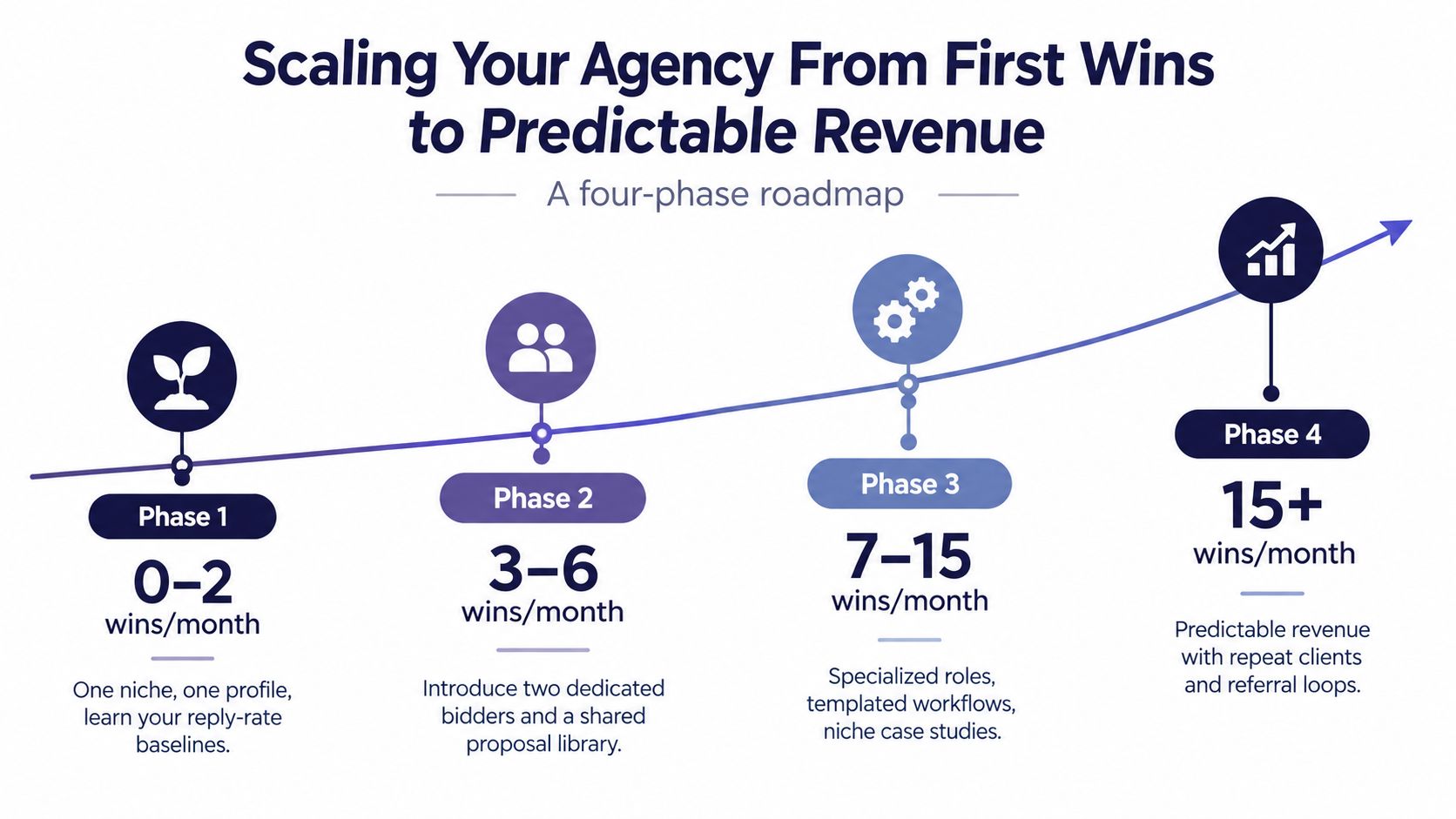
Scaling Upwork for agencies isn't a contest to submit more proposals. It means adding process only when the current process produces enough signal to justify another layer of specialization. The Upwork agency scaling roadmap illustrates the progression from early wins toward repeatable revenue.
Phase one focuses on learning
At 0 to 2 wins per month, keep one niche, one primary profile, and one clear delivery offer. Your trigger for moving forward isn't optimism. It's a repeatable pattern in reply rate, interviews, and client fit. If you can't explain why the last proposal earned a response, more bidding volume will only produce more uncertainty.
Phase two adds specialized capacity
At 3 to 6 wins per month, introduce specialized profiles, a dedicated bidder, and a vetted contractor bench. Graduate when the owner is spending too much time qualifying jobs or when good opportunities wait for a specialist who is already delivering client work.
Phase three systematizes expansion
At 7 to 20 wins per month, install repeat-client workflows, structured upsells, and a sales lead who runs discovery calls. Add a case-study process so completed work improves the profile and proposal library. The graduation trigger is delivery friction, not merely a higher application count.
At 20 or more wins per month, pursue larger client relationships, build subcontractor pipelines, and organize delivery pods around repeatable services. A larger queue requires stricter access control, clearer quality review, and more disciplined capacity planning.
Before increasing bids, check capacity:
- Delivery coverage: Every promised service has an available owner.
- Review ownership: Someone can check quality without delaying client work.
- Onboarding process: New contractors understand tools, standards, and communication rules.
- Margin visibility: Each offer has a known rate floor.
- Client concentration: One difficult account can't destabilize the whole team.
- Pipeline measurement: Reply rate, interview rate, hire rate, and revenue per Connects spent are tracked by niche and bidder.
The platform remained near $4.0 billion in annual GSV in 2024 and 2025, after $4.1 billion in 2023, while Upwork reported $787.8 million in 2025 revenue and $682.9 million in marketplace revenue, according to the company's 2025 investor filing. The opportunity is large, but agencies still need a controlled operating model to turn marketplace access into dependable revenue.
Earlybird AI helps agencies find relevant Upwork jobs, prepare personalized proposals, manage lead replies, and coordinate multi-user outreach from the agency's account. If your team needs to reduce posting-to-send time and make bidder ownership visible, visit Earlybird AI to see how the workflow fits your pipeline.


