
← Back To Blog
Upwork Free Connects: The 2026 Agency Guide
The most popular advice about Upwork free Connects is also the least useful: collect every bonus, avoid buying credits, and treat proposals as free activity. That approach confuses a platform incentive with a sales strategy. Free Connects can reduce your initial cost, but they don't create a dependable pipeline, qualify opportunities, or improve a weak proposal.
For a freelancer, that distinction matters. For an agency, it determines whether Upwork becomes a measurable acquisition channel or an expensive source of manual work. The right question isn't “How do I get the most free Connects?” It's “Which applications deserve a Connect, and how can my team process those opportunities efficiently?”
The Reality of Upwork Free Connects
Free Connects aren't a loophole around Upwork's commercial model. They're part of the model. Upwork gives credits through membership plans, onboarding, reputation milestones, interviews, and selected activity rewards, then ties proposal capacity to those events. The result is a system that encourages continued participation, rather than a permanent pool of free applications for every seller.
That makes the common “just use the free quota” strategy unreliable. Basic members may receive a monthly allocation, but that balance can disappear quickly when a team applies selectively to serious opportunities. Promotional grants and achievement rewards can help, yet they arrive irregularly and often depend on behavior that already-active freelancers are more likely to produce. Upwork's own documentation describes these different routes in its guidance on whether Upwork is free for freelancers.
Commercial reality: Free Connects lower the entry barrier. They don't remove the cost of selling.
The problem becomes sharper for agencies serving lower-budget markets. The platform still requires application credits, while the expected project value may leave little room for manual research, proposal writing, follow-up, and account management. A team can technically apply without purchasing credits and still lose money through labor.
Treat Connects as a sales expense, whether Upwork grants them or you purchase them. Their economic cost includes the opportunity cost of the person searching for jobs, reviewing clients, customizing proposals, and tracking replies. If a free application consumes substantial staff time and targets a poor-fit project, it isn't free in any meaningful business sense.
The practical conclusion is straightforward. Use free Connects as a controlled test budget, not as the foundation of your acquisition plan. A reliable Upwork operation needs clear targeting, a disciplined application threshold, and a workflow that prevents sellers from spending credits on jobs they shouldn't pursue.
Understanding the Core Concept of Allocations
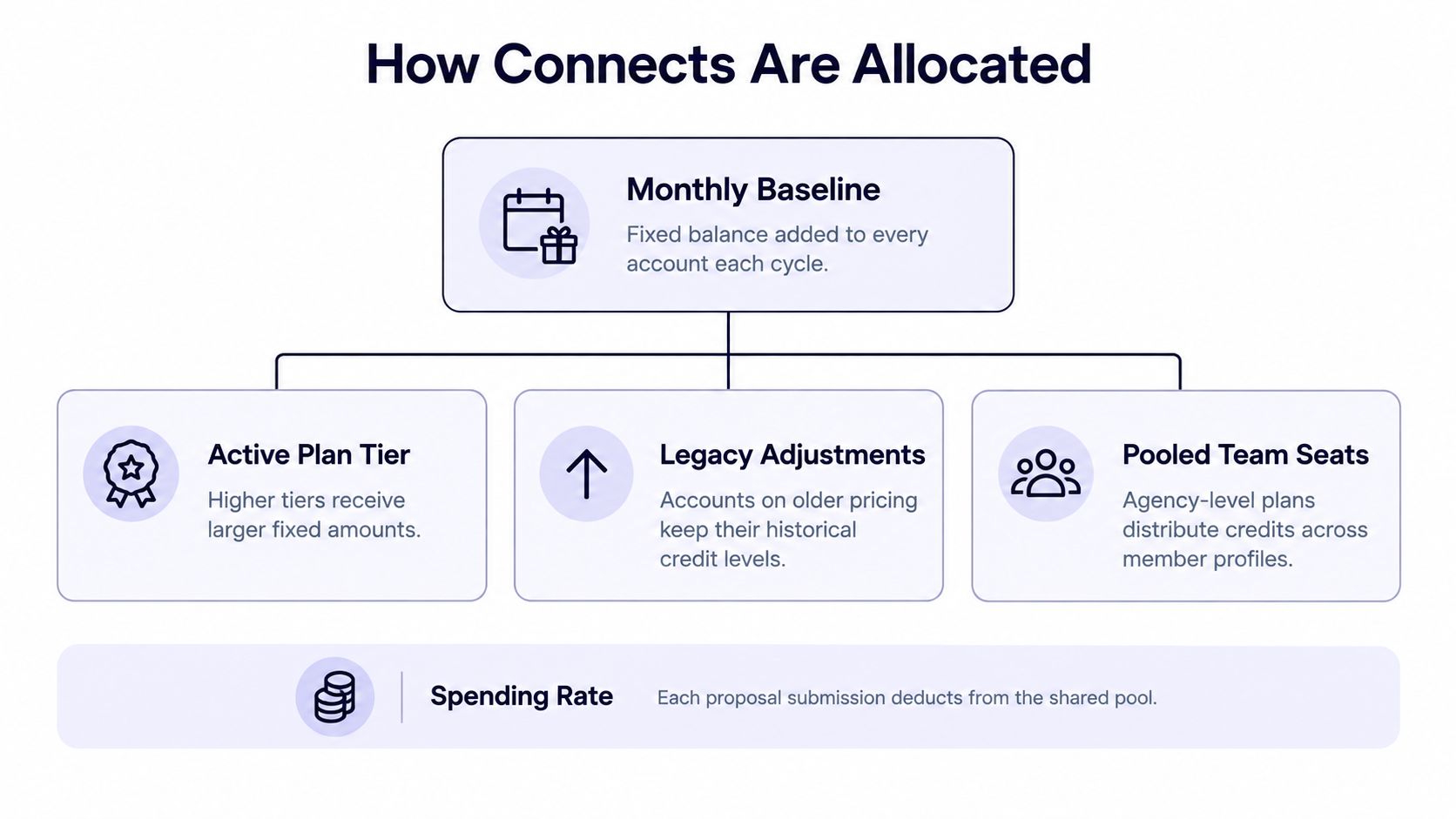
Upwork Connects are distributed through a combination of membership status and event-based rewards. That means two freelancers can have very different application capacity even when they operate in the same category. Your planning starts with the account's plan, billing cycle, credit history, and eligibility for platform incentives.
Basic members receive 10 free Connects per month, while Freelancer Plus members receive 100 per month, according to Upwork's published explanation of how to get free Connects. Upwork says the monthly credits are added on the first day of the billing cycle, so the timing isn't necessarily the first day of the calendar month.
A new freelancer may also receive a one-time bonus of 50 Connects when joining, subject to Upwork's stated conditions. Earning the Rising Talent badge can provide 30 free Connects, and interviews with established clients may generate additional credits. These aren't guaranteed monthly capacity. They're event-triggered additions, which makes them useful for planning upside but unsafe as a baseline forecast.
Audit usage instead of watching the balance
A balance tells you what remains. It doesn't tell you whether your targeting is improving. Upwork says freelancers can review Connects history across the past 7, 30, and 90 days, which gives you enough context to compare recent activity with a broader operating pattern. Use those views to identify which categories, clients, and proposal types consume credits without producing conversations.
Your audit should answer four questions:
- Application volume: How many proposals did the account submit during each review window?
- Concentration: Which job types consumed most of the credits?
- Outcome quality: Which applications produced interviews, replies, or contracts?
- Expiry exposure: Are older awarded or purchased credits approaching their expiration period?
Some credits can expire after one year, as Upwork explains in its Connects guidance. Don't hoard a large balance without a deployment plan. Credits that sit unused can become a misleading asset, particularly when the team has no agreed definition of a qualified opportunity.
For an agency, allocate Connects by account and market rather than treating every profile as interchangeable. Track the balance, source, and usage reason for each freelancer profile. That turns a vague “free credits” discussion into a manageable operating budget.
Key Aspects of Earning Bonus Credits
Bonus Connects are useful when they result from healthy marketplace behavior. They're dangerous when they encourage your team to chase low-value activity only to trigger a reward. The correct approach is to treat each pathway as a by-product of building a credible profile and pursuing relevant work.
Start with legitimate platform events
Upwork identifies several ways freelancers may receive additional free Connects. The most concrete routes include:
- New-account onboarding: Eligible new freelancers may receive a one-time 50-Connect bonus, subject to Upwork's conditions. This is launch capital, not a recurring acquisition budget.
- Rising Talent recognition: Earning the Rising Talent badge can provide 30 free Connects. The reward is attached to a reputation milestone, so it shouldn't be pursued through random applications.
- Established-client interviews: Upwork may award credits after an interview with an established client. The amount and eligibility can vary, and not every interview qualifies.
- Activity rewards: Submit at least three proposals while spending at least 54 Connects, and Upwork says it grants 18 free Connects. This reward can be earned up to twice per calendar month, according to its Connects frequently asked questions.
- Promotions: Upwork may issue promotional credits to selected users. Promotions aren't a dependable forecast item because availability and eligibility can change.
The activity reward deserves careful handling. It can offset part of an intentional proposal budget, but it shouldn't justify spending 54 Connects on weak opportunities. If the jobs aren't commercially viable, the rebate doesn't rescue the economics.
Build the behavior, not the bonus
A strong profile, clear positioning, relevant work samples, and prompt client communication improve the quality of your sales process regardless of whether Upwork awards credits. Reputation milestones should emerge from delivery quality and focused participation.
Agency rule: Never submit a poor-fit proposal to unlock a credit reward. The reward is smaller than the cost of bad targeting.
Review your account's current terms before relying on a particular incentive. Upwork's support materials state that some freelancers may receive monthly or promotional credits only under specific conditions. The practical checklist is simple: verify the billing cycle, confirm the plan, inspect the Connects history, and record the source of every bonus.
Don't build a forecast around interviews either. Interviews are an outcome, not a guaranteed credit-generation tactic. Your team should pursue conversations because the project fits, the client is credible, and the offer is commercially sound. Any Connects awarded afterward are a secondary benefit.
Strategic Bidding and Refund Mechanics
Spending Connects and spending them well are different activities. The clearest example is Upwork's proposal-boosting auction. A freelancer chooses how many additional Connects to bid for visibility, but Upwork charges those boost Connects only after the auction ends. The mechanics are explained in Upwork's proposal-boosting guidance.
If the proposal doesn't finish among the top four bidders, or the client doesn't engage with the boosted proposal, the boost Connects are refunded after the auction closes. That refund changes the decision from “never boost” to “boost only when the expected value justifies the temporary exposure of credits.”
Compare standard and boosted applications
A standard proposal is appropriate when the job strongly matches your positioning and the client is likely to read carefully. A boost may make sense when the opportunity is unusually valuable, the brief is specific, the client shows credible hiring intent, and your proposal can compete on proof rather than price.
Don't boost because a job is crowded. Crowding alone doesn't make a bid profitable. Boost when your agency has a differentiated case, a relevant portfolio example, and a clear next step for the client.
Use a decision filter before committing extra credits:
- Fit: Does the brief match a service you can deliver repeatedly?
- Client quality: Does the client history indicate serious hiring intent?
- Commercial value: Can the expected project support the proposal and delivery effort?
- Proof: Can you show a directly relevant outcome or work sample?
- Timing: Can you respond quickly enough for the proposal to matter?
A refund isn't a profit. It returns the boost portion under Upwork's stated conditions. Your original proposal Connects still represent an acquisition cost, and your team's labor remains real.
Fraudulent or guideline-violating jobs create a different protection. Upwork says proposal Connects may be credited back when a client cancels before a contract is made or when the proposal is connected to a fraudulent or guideline-violating job. That safeguard is valuable, but it shouldn't replace client screening.
For more detail on the commercial logic behind selective bidding, use this practical guide to bidding on Upwork. The central discipline is simple: set a maximum acquisition cost before submitting, then refuse to let auction pressure override it.
Scaling Agency Outreach with Automation
Manual Upwork prospecting creates two avoidable losses. Sellers waste Connects on marginal jobs, and they spend valuable hours writing proposals after the opportunity has already attracted competing applicants. Agencies don't solve that problem by bidding on more listings. They solve it by improving selection speed and proposal consistency.
Automation should perform the repetitive work while your team controls positioning, approval rules, and client judgment. A system can monitor relevant opportunities, filter them against predefined criteria, draft a personalized proposal, and route the application through an accountable workflow. Earlybird AI is one example. It connects to an Upwork account, learns preferred project patterns through feedback, drafts proposals, and automates replies and follow-ups.
Automate qualification before submission
The most valuable automation decision happens before the proposal is written. Define a narrow ideal-project profile using service type, client requirements, budget suitability, geography where relevant, and delivery capacity. Then give the system clear positive and negative examples through feedback.
That approach protects Connects in two ways. It reduces applications to jobs that never had a realistic chance, and it gives the writer more context for producing a proposal that addresses the client's actual problem. Speed matters because early submissions get more opportunity to be noticed, but speed without qualification only accelerates waste.
A proposal workflow should also include:
- Account-level controls: Keep each freelancer profile aligned with its own expertise and availability.
- Human review rules: Require approval for unusual scopes, sensitive clients, or high-value opportunities.
- Message handling: Route replies to the right operator instead of leaving conversations in a shared inbox.
- Follow-up timing: Use relevant, non-repetitive follow-ups rather than sending generic reminders.
- Outcome tracking: Connect every proposal to a reply, interview, contract, or rejection reason.
Teams building a broader outbound system can also consult Fypion Marketing's cold outreach guide for ideas on targeting, personalization, and follow-up discipline outside Upwork. The principle transfers well: automation should enforce a sales process, not replace strategic judgment.
Use the detailed workflow described in this guide to automating Upwork proposals as a reference point, then adapt the controls to your agency's risk tolerance. The goal isn't to imitate spam. It's to make selective, relevant outreach happen consistently while protecting the accounts and people responsible for revenue.
Building a Sustainable Proposal Strategy
A sustainable Upwork operation measures more than the remaining Connects balance. Track qualified applications, client replies, interviews, contracts, revenue by profile, and the labor required to produce each opportunity. Those metrics show whether your team is buying access to the right market or merely consuming credits.
Set a clear application policy for every freelancer account. Define which jobs qualify, when a proposal can be boosted, who approves exceptions, and how the team pauses an account when delivery capacity is full. Multi-user workflows should preserve profile-specific expertise instead of sending identical pitches from several bidders.
Operating principle: A free Connect should meet the same quality standard as a purchased Connect.
Use real-time reporting to identify patterns. If one service line receives replies while another consumes credits without conversations, change the targeting or positioning. If proposals perform better when submitted quickly, automate discovery and drafting while keeping human review where the risk warrants it.
Calendar discipline also matters. Agencies need protected blocks for client calls, proposal review, delivery, and follow-up. A practical resource on how freelancers sync calendars can help distributed teams coordinate availability without turning every opportunity into an interruption.
Stop treating Upwork like a lottery. Free Connects are a useful subsidy, but predictable growth comes from disciplined qualification, measurable conversion tracking, profile-level accountability, and automation that removes repetitive sales work. Whether credits are awarded or purchased, each proposal should serve a defined business objective.
Earlybird AI helps Upwork freelancers and agencies find matching jobs, draft personalized proposals, automate replies and follow-ups, and manage outreach across multiple users. Visit Earlybird AI to evaluate whether a faster, more controlled proposal workflow fits your agency's sales process.


