
← Back To Blog
Upwork Graphic Design: How to Win and Scale Projects Fast
Graphic design is the single largest skill tag in a 2026 analysis of 536,973 Upwork jobs. The dataset counted 81,301 Graphic Design jobs, or 15.1% of all jobs reviewed, which changes the way serious freelancers and agencies should view Upwork graphic design. The opportunity is substantial, but so is the competition. A general profile offering logos, flyers, social posts, and “anything creative” gets compared with hundreds of similar profiles. A specialist who connects design decisions to brand recognition, sales conversations, product adoption, or executive communication competes in a different category.
The practical shift is from selling production hours to selling a clearer business outcome. Smart automation can help you find and respond to suitable projects consistently, but it can't rescue weak positioning, irrelevant samples, or vague scopes. The designers who scale treat Upwork as a managed sales channel, not a slot machine.
Why Upwork Graphic Design Demand Actually Matters
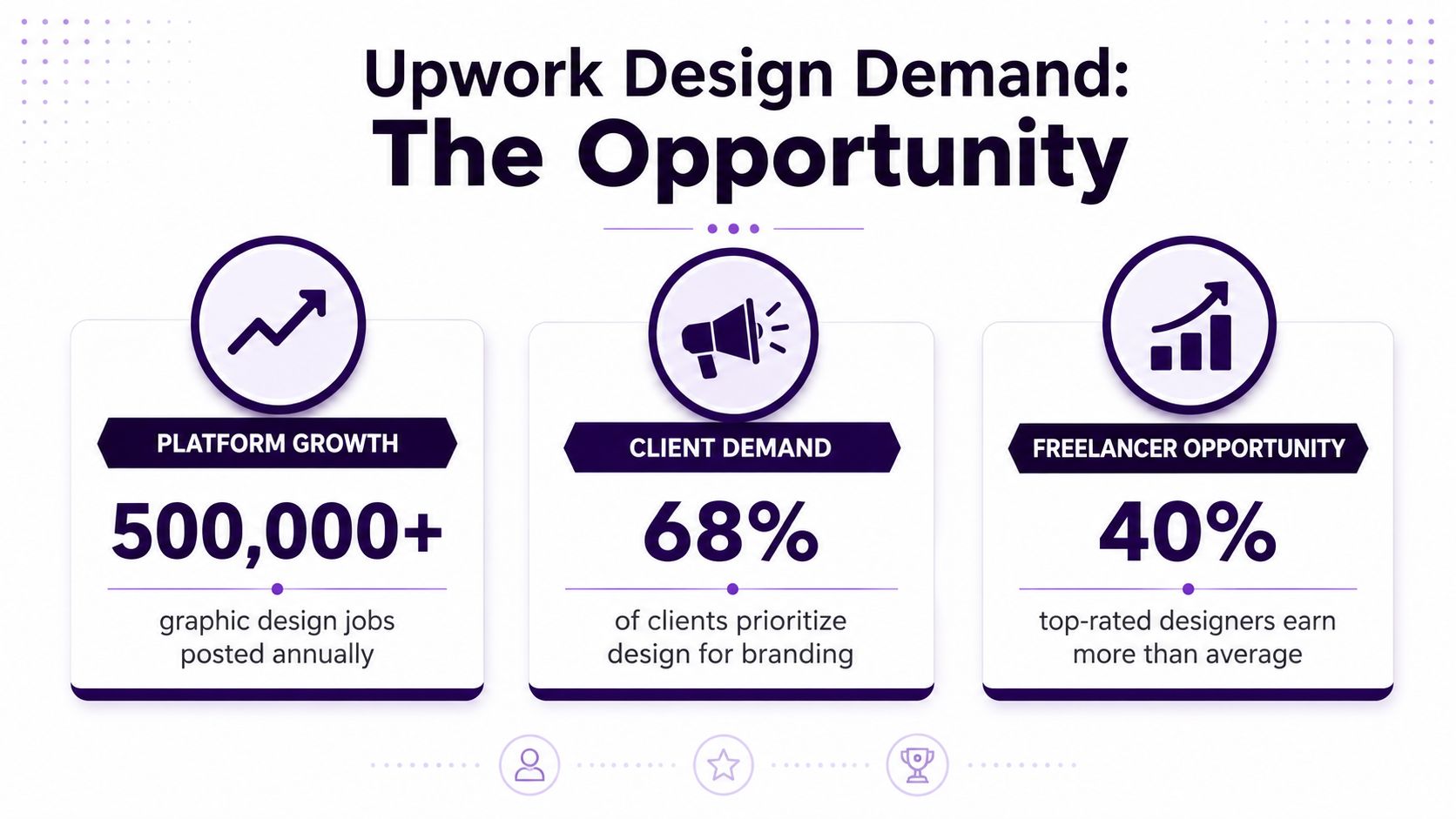
The scale of the marketplace is the first important signal. The 2026 analysis found 81,301 jobs tagged with Graphic Design, representing 15.1% of the sample and the largest single skill tag in that dataset. The broader Graphic Design category appeared at roughly 81,307 jobs, reinforcing how heavily buyer activity clusters around visual work such as branding, layouts, and presentations.
That volume creates a useful contradiction. There are enough buyers to support a serious practice, yet the same concentration attracts a large supply of generalists. If your profile says you handle every design task, clients have little reason to remember you. They can compare you on price, availability, and surface-level portfolio polish.
Demand is broad, but value isn't distributed evenly
Upwork's own pricing information shows graphic designers charging between $15 and $150 per hour, with an average of about $25 per hour.
The spread matters more than the average. A client seeking ten resized social graphics is buying output. A client trying to reposition a software company needs a visual system, decision-making, and repeatable rules that other people can use. Those projects require more discovery and carry more responsibility, so they shouldn't be framed as interchangeable production tasks.
Choose a market position before you chase volume
Good starting positions include brand identity systems, pitch decks and presentation design, product visuals, marketing design systems, and motion-led brand assets. The right choice depends on the work you can prove and the problems you understand, not on whichever keyword appears most often in job searches.
A durable Upwork presence also benefits from activity outside the platform. Designers who want a consistent client pipeline building process should connect marketplace outreach with referrals, portfolio publishing, and direct relationship development. Upwork can supply demand, but specialization determines whether that demand becomes profitable work.
Building a Specialized Upwork Designer Profile
A strong profile answers one question quickly: why are you the safe choice for this particular design problem? Listing every capability signals availability, not expertise. Clients need to see that you understand their business context and can turn design decisions into a usable system.
Upwork lets freelancers create targeted specialized profiles by choosing a specialty, selecting relevant skills, writing a title and overview, and featuring selected work history or portfolio items. Upwork's profile guidance confirms that a saved specialized profile becomes visible to clients. Treat that profile as a market position, not a second résumé.
Start with a commercially meaningful specialty
“Graphic designer” describes a category. “Brand identity designer for early-stage technology companies” establishes a position. “Presentation designer who turns complex B2B material into investor-ready narratives” goes further by naming the deliverable and the decision-maker's problem.
Build the profile around one primary service, then add adjacent capabilities that support the same buying decision:
- Brand identity systems: Explain how logos, typography, color rules, templates, and usage guidance work together as one system.
- Presentation design: Show your approach to information hierarchy, narrative flow, editable master slides, and executive readability.
- Product visuals: Connect interface visuals, launch assets, and marketing pages instead of presenting them as unrelated samples.
- Social design systems: Focus on repeatable templates and content rules rather than isolated posts. A team that can find social media design templates in your portfolio will immediately recognize the production rigor behind your work.
This positioning also moves the offer beyond commodity production. Automation can help organize case-study tags, refresh selected portfolio items, and schedule profile updates, but it should never replace the judgment shown in the work. Keep the visible portfolio narrow enough that a client can understand your specialty quickly.
Replace software lists with business outcomes
Clients rarely hire a designer because the designer knows Figma, Illustrator, or Photoshop. They hire someone who can make a product look credible, help a sales team present clearly, or give a marketing team a system it can maintain.
Use an overview structure that moves from problem to process to proof:
- Name the client type and design challenge.
- Explain the decisions you make before opening the design file.
- Describe deliverables in operational terms.
- Show the kind of result the client can expect without inventing performance claims.
- End with a focused next step, such as reviewing the current brand or discussing the deck's audience.
Your portfolio should reinforce the same position. Feature fewer, more relevant projects, and annotate each with the brief, constraints, decisions, and final system. A practical guide to building an Upwork portfolio can help organize the presentation, but the editorial standard remains yours: every item should make the chosen specialty more believable.
Crafting Proposals That Get Noticed
Most weak proposals fail before the client reaches the portfolio link. They open with a biography, list software, repeat the job description, and finish with “I'm available.” That format makes the client do all the work of deciding whether you understand the assignment.
A stronger proposal starts with an observation about the brief. If the client needs a pitch deck, mention the audience, decision point, or content problem. If the client needs a brand refresh, identify whether the brief suggests inconsistency, weak differentiation, or a lack of usable templates. You don't need to solve the entire project in the first message. You do need to demonstrate that you've read it.
Proof beats promises
A benchmark analysis covering 150,000 proposals reported that relevant attachments raised average response rates from 8.2% to 11.5%, while graphic-design proposals with portfolio attachments reached 15.7%. The same analysis found that irrelevant attachments could reduce response rates to 5.3%.
The comparison is straightforward:
- Text-heavy proposal: Easy to write, but it asks the client to trust your claims.
- Portfolio dump: Contains proof, but forces the client to search for relevance.
- Focused proposal with one matching sample: Connects the brief to a visible example and reduces evaluation effort.
Use a compact structure
A practical proposal can follow this sequence:
- Brief diagnosis: “Your deck needs to make the product understandable to a non-technical buyer before the pricing discussion.”
- Relevant proof: “I've attached a presentation project showing how I handled dense information and created an editable slide system.”
- Working method: Mention discovery, first direction, revision handling, and final handoff.
- Clarifying question: Ask about the audience, source files, approval process, or launch date.
- Next step: Offer a short conversation or request the material needed to scope accurately.
Keep the opening specific and the middle useful. Don't promise results you can't control, and don't claim experience that isn't represented in your work. If you need help tightening the language, you can browse Writingmate free tools, then edit every generated draft against the actual brief.
A proposal template should reduce repetition, not remove judgment. This Upwork proposal example is useful as a reference for structure, but the winning version always includes a job-specific diagnosis and a job-specific attachment.
Pricing Upwork Graphic Design Projects for Sustainable Growth
Price production, design direction, and system creation separately. A banner with fixed dimensions and supplied assets is a production task. A visual identity with templates for an internal team requires decisions that continue after the first files are delivered. Quoting both as “graphic design hours” makes strategic work look expensive and hides the risk inside simple production requests.
Upwork's published range of $15 to $150 per hour, with an average of about $25 per hour, shows how widely rates vary on the platform. Your quote should cover judgment, client communication, revisions, project management, and work that never appears in the exported file. Higher-value strategic design earns its price by reducing ambiguity and creating systems the client can reuse.
Read the job post for buying intent
A production-led post usually lists dimensions, existing brand assets, file formats, and defined deliverables. A strategy-led post mentions inconsistent branding, a new market position, unclear messaging, multiple stakeholders, or a system that must scale. The second type requires discovery and decision-making before execution, so scope it around outcomes and approvals rather than file count alone.
Use a written scope that names:
- Deliverables: Specify each file, format, variation, and included template.
- Inputs: List the copy, brand assets, references, product access, and source material the client supplies.
- Review rounds: Define how feedback is collected and what qualifies as a revision.
- Schedule: Tie dates to client approvals, not only your production time.
- Exclusions: State whether copywriting, stock licensing, illustration, animation, and extra formats are excluded.
- Change process: Explain how new requirements receive a separate estimate.
This document protects margin and gives the client a clear buying decision.
Choose hourly or fixed price deliberately
Hourly work fits evolving briefs, open-ended art direction, and ongoing support. Log time carefully and explain what it includes. Fixed pricing fits defined deliverables, supplied assets, and milestone approvals, provided the scope has clear boundaries. For strategic projects, a discovery phase can separate diagnosis from execution and prevent an underpriced identity or template system.
Upwork's freelancer fee ranges from 0% to 15% per contract across hourly, fixed-price, and Project Catalog work. Upwork's fee and protection information explains the platform's payment protection, fraud prevention, and dispute-resolution provisions. Include that cost in your commercial calculation before submitting a quote.
For fixed-price work, use pre-funded milestones and submit completed work through Upwork. Payment protection covers eligible hourly work logged through the desktop app with the required activity and memos, along with pre-funded fixed-price milestones submitted through the platform. Upwork's payment protection guidance states that eligible communication and work must remain on Upwork, and freelancers must use the Submit Work for Payment flow. These requirements affect how you collect assets, record decisions, and manage approvals, so set that process at kickoff.
Using Automation to Scale Upwork Outreach Safely
Manual proposal writing creates a capacity problem. A freelancer can spend too long searching, drafting, attaching samples, and checking replies, while an agency can lose consistency across several bidders. Automation helps with repetition, but it should never replace selection, relevance, or human review.
The safe model is a controlled workflow:
- Define the project types you want.
- Filter out poor-fit briefs.
- Draft a proposal from the job's actual language.
- Match one portfolio artifact.
- Review the message before submission when judgment is needed.
- Track replies, interviews, and booked conversations.
- Adjust the targeting rules based on qualified outcomes.
Automate workflow friction, not creative judgment
A useful automation system can monitor suitable jobs, prepare first drafts, organize follow-ups, and show which categories generate meaningful replies. It shouldn't send generic messages to every client, attach unrelated work, or make unsupported promises. The more specialized your profile and portfolio are, the more useful automation becomes because the system has a clear definition of relevance.
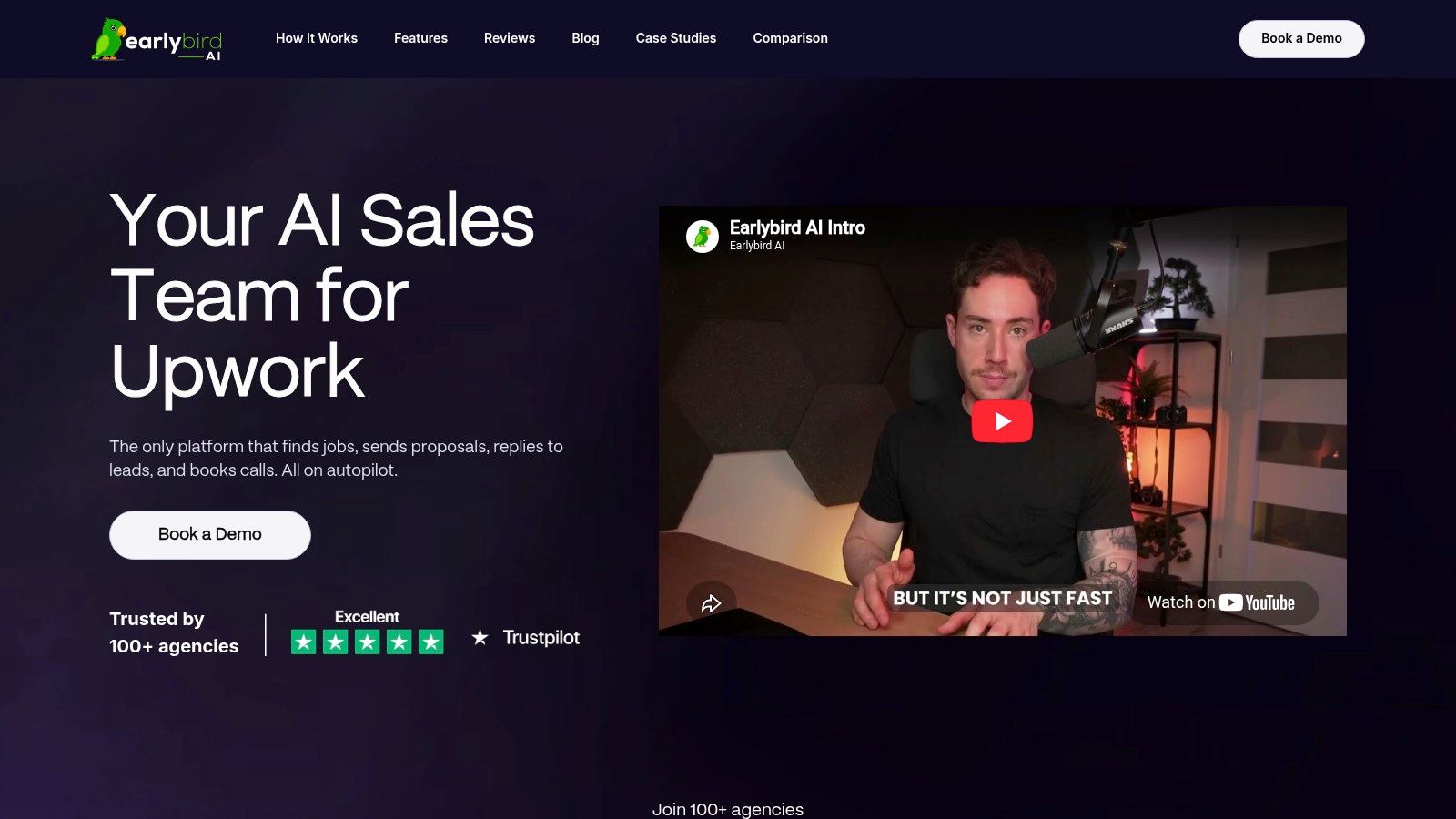
Earlybird AI is one option for this workflow. It connects to an Upwork account, learns preferred projects through thumbs-up and thumbs-down feedback, searches for matching jobs, drafts personalized proposals, handles client replies and follow-ups, and supports call booking. It also provides real-time analytics, profile optimization tools, and multi-user workflows for agencies. Its stated safety approach includes human-like activity patterns, clean regional IPs, and no password storage.
A guide to automating Upwork proposals is most useful when treated as an operating design exercise. Decide which tasks can be automated, which require approval, and which signals should stop the workflow.
Practical rule: Automation should make a good decision faster. It shouldn't make a bad decision more often.
Keep account safety and quality in the same conversation
Don't hand sensitive credentials to unverified tools, and don't let a system operate without clear targeting boundaries. Review how it connects to the account, what it stores, how users can revoke access, and whether agency permissions are separated.
Quality control needs its own checklist. Before a proposal goes out, confirm that the job is relevant, the sample matches the subtype, the promised deliverables fit the scope, and the tone sounds like a professional designer rather than a generated sales script. Follow-ups should add context or ask a useful question, not repeat “just checking in.”
This video provides a visual look at the product workflow. Review it after considering your own approval rules, portfolio library, and account permissions.
Automation also has a financial operating cost. Upwork Connects cost $0.15 each, are available in bundles or custom amounts with a 10-Connect minimum, and are used to submit proposals, although some jobs require no Connects and others require different amounts. Upwork's Connects calculator explains the mechanics. Track Connects alongside qualified replies and booked calls, not as a vanity activity metric.
Turning Upwork Success Into a Repeatable Agency Workflow
A small agency usually doesn't fail because its designers lack talent. It fails because every bidder searches differently, every proposal uses a different standard, and nobody knows which work is producing qualified conversations.
Create one operating rhythm. Review the target specialties regularly, maintain a portfolio library organized by job subtype, and keep proposal templates modular. A template should contain reusable sections for process and handoff, while the opening, proof sample, and question should change for every serious opportunity.
Separate the work into operating lanes
The owner or sales lead can define target categories and disqualifiers. A designer can select the strongest visual proof and flag technical questions. An account manager can monitor replies, schedule calls, and make sure scope notes reach the person responsible for delivery.
For each opportunity, record:
- Fit: Which specialty and client problem does the job match?
- Proof: Which portfolio item demonstrates the closest experience?
- Commercial shape: Is the project hourly, fixed-price, milestone-based, or likely to become ongoing support?
- Signal: Did the client reply, request an interview, ask for a call, or disappear?
- Lesson: What should change in the profile, targeting, proposal, or scope?
Upwork's specialized profiles are especially useful for this setup because each version can present a different specialty, overview, skill set, and selected work history. The agency can align each bidder with a narrower service position instead of making every account compete as a generalist.
Measure qualified movement, not raw activity
A high number of proposals means little if the work attracts poor budgets or unclear briefs. Review which design subfields produce serious conversations, which samples get selected, where scope breaks down, and which clients return with related work.
The agency scenario is simple. One bidder focuses on brand systems, another on presentations, and a third on product visuals. Automation handles repetitive discovery and draft preparation, while people approve fit, proof, and commercial terms. Over time, the team gains a clearer picture of where Upwork graphic design supports strategic growth and where it only creates low-margin production pressure.
Run that review on a fixed cadence, update weak portfolio entries, remove services that attract bad-fit work, and rewrite proposals when clients repeatedly ask the same unanswered question. A repeatable system doesn't eliminate judgment. It gives judgment a reliable place in the process.
Earlybird AI helps freelancers and agencies automate Upwork job discovery, personalized proposal drafting, client replies, follow-ups, and call booking while providing analytics and multi-user workflow support. If your design pipeline is being slowed by repetitive outreach, visit Earlybird AI to evaluate whether its workflow fits your targeting and quality-control process.