
← Back To Blog
Upwork Project Catalog: A Guide for Agencies
You've spent another morning sending proposals, rewriting the same introduction, and waiting for replies that may never arrive. Meanwhile, your delivery team has the skills to complete repeatable work, but every new client still starts with a blank page, a custom scope, and another round of negotiation.
Upwork Project Catalog changes that operating model. Instead of treating Upwork only as a place to hunt for jobs, an agency can publish defined services that clients can inspect and purchase directly. The opportunity is attractive, but the core challenge isn't visibility. It's preventing demand from exceeding the team's ability to deliver profitably.
Introduction - Scaling Your Agency Beyond Manual Bidding
An agency owner I've worked with described the familiar cycle clearly. Monday began with proposal research, Tuesday with follow-ups, and the rest of the week with custom discovery calls for projects that had no consistent scope. The agency had capable specialists, yet revenue depended on someone continually searching, pitching, and negotiating.
A catalog offer creates a different starting point. The buyer sees a defined outcome, a delivery schedule, a price, and the information required to begin. That structure doesn't remove sales work, but it moves part of the sales process into the listing itself. The client can qualify the service before a long conversation, while the agency can qualify the buyer through the requirements and package selected.
This is why I view the Upwork Project Catalog as a productized inbound channel rather than another profile feature. A well-built listing gives the market a clear answer to three questions: what do you deliver, what does the client need to provide, and what happens next?
That model also fits agencies expanding through partners or specialist teams. If you're evaluating white label SEO for agencies, the same discipline applies: standardize the service before you scale the sales channel. A catalog can expose inconsistent fulfillment just as quickly as it exposes demand.
For a broader look at how agencies can structure their presence on the platform, see this guide to agencies on Upwork. The central lesson is practical: catalog growth only matters when your delivery system can absorb it without weakening quality, response times, or margins.
What Is the Upwork Project Catalog?
An agency can receive a purchase without starting with a proposal, discovery call, or custom quote. Upwork Project Catalog packages a defined service into a buyer-ready offer with a fixed scope, delivery schedule, price, requirements, and optional upgrades. Clients can purchase directly instead of publishing a job and comparing individual proposals. The official Upwork project creation guidance sets out the framework and publishing limits.
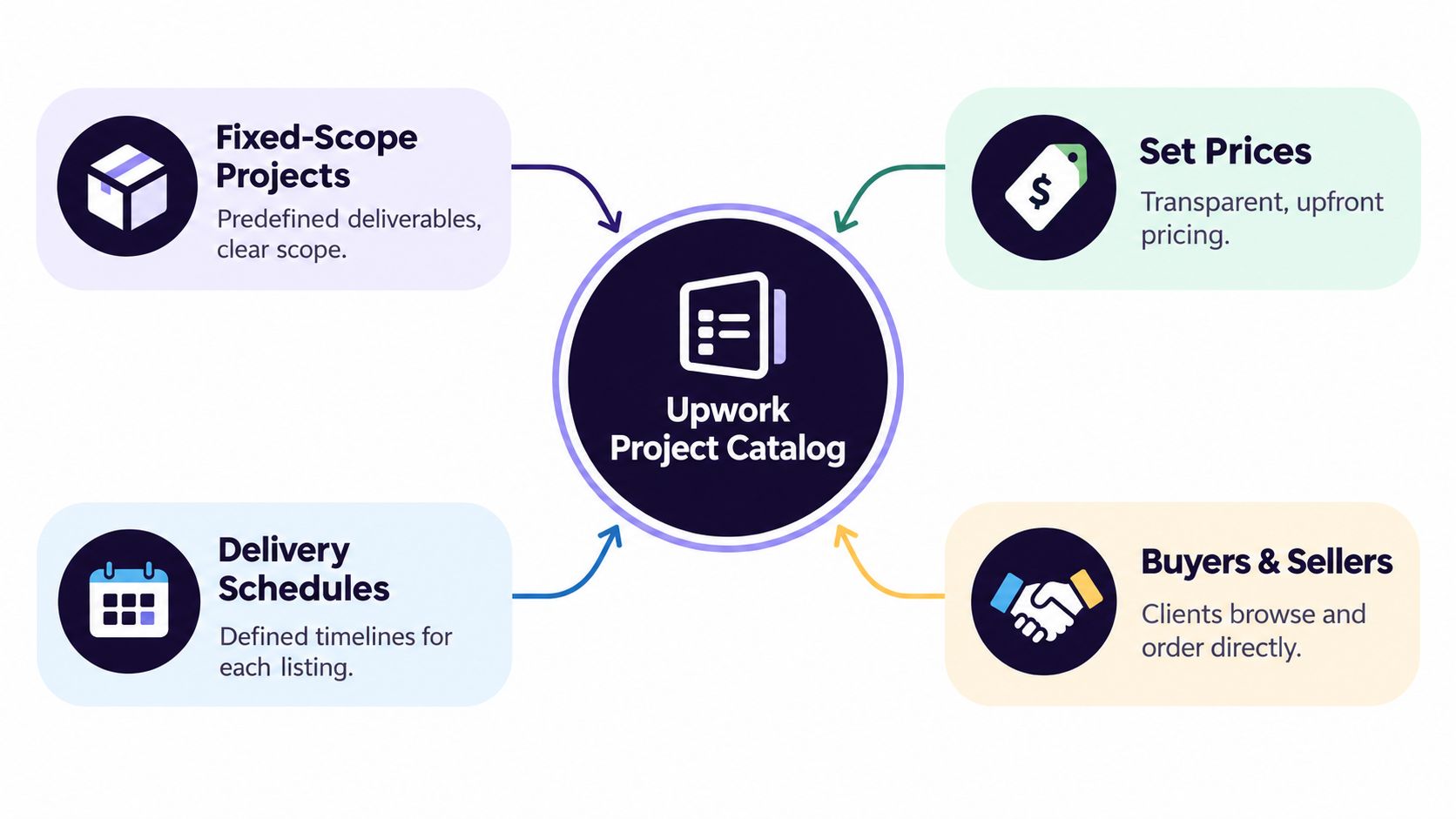
A seller may maintain up to 20 published projects and up to 20 additional projects under review. Each project can include as many as three package tiers, with separate titles, deliverables, turnaround times, revision allowances, and prices. The permitted price range is $5 to $500,000. Those limits describe what the platform allows, not what an agency should offer. Pricing still needs to cover production time, account management, revisions, overhead, and a workable profit margin.
Treat each listing as a sales object
A proposal argues that your agency is suitable. A catalog listing defines the specific result a buyer can purchase. That difference links positioning directly to fulfillment capacity.
Build the offer around a narrow, recognizable outcome. Define:
- Scope: State what the package includes and excludes.
- Schedule: Set a clear delivery expectation.
- Requirements: Collect every input needed before production starts.
- Revisions: Specify the changes included in each package.
- Upgrades: Keep expanded research, extra assets, or faster delivery as paid options.
Fixed scope reduces negotiation only when the boundaries hold. A title such as “complete SEO” invites open-ended expectations. A defined technical review with documented outputs gives the client a clearer purchase and gives the delivery team a repeatable process.
Capacity should shape the listing before it goes live. A package that appears attractive at a low price can become unprofitable if it requires senior strategy time, several revision rounds, or work from specialists with limited availability. Review order volume by tier, revision pressure, delivery strain, and add-on value. Those signals show whether demand is supporting healthy margins or exposing a fulfillment bottleneck.
Steps to Create High-Converting Project Listings
A listing should attract qualified buyers and filter out poor-fit orders. A buyer must recognize the service, understand the expected result, and know what information the team needs before work can begin.

Build the listing around a defined result
Select the category that matches the actual work, then write a title around the client's outcome. “SEO consulting” is broad. “Technical SEO review with prioritized implementation brief” gives the buyer a clearer reason to click and sets a more manageable delivery expectation.
Use the description to establish boundaries early. Explain the starting condition, deliverables, required client inputs, turnaround, and situations that call for a custom engagement. Buyers need confidence that the package fits their problem and that the agency can deliver it without expanding the work informally.
Your media should make the deliverable tangible. Show a redacted audit, reporting view, content brief, or another artifact that represents the purchased output. Decorative visuals add little value. A useful preview also helps the delivery team align its work with the promise made on the listing.
Make requirements machine-checkable
Collect required inputs before production starts. Upwork's project setup process prevents work from beginning until the buyer submits the specified requirements. Treat that rule as a production control, not an administrative detail.
A practical requirement set might include:
- Brief: The business objective, problem statement, and desired outcome.
- Source files: Existing copy, designs, exports, or documentation.
- Access credentials: The systems required for the agreed work.
- Target audience: The people the deliverable must address.
- Acceptance criteria: The conditions that define an acceptable result.
Map each requirement to a production step. If analytics access is needed for diagnosis, state that before purchase. If the buyer has not supplied it, the order should remain pending rather than consume active delivery capacity.
Use package tiers to separate operational complexity. The entry level should solve a contained problem. The middle tier can add analysis or implementation guidance. The highest tier should expand the scope deliberately, not add vague “premium support.”
A short demonstration of the buyer journey can help the team align its listing with the workroom process:
Practical rule: If a requirement cannot be checked before production starts, the offer is not defined clearly enough.
Pricing Strategies and Package Tiers
A service can sell well and still weaken an agency's margins. Each additional listing creates another fulfillment path, with its own delivery exceptions, client questions, review cycles, and revision demands. A focused catalog of repeatable offers usually gives an agency better control than a large set of loosely defined services.
The platform's price boundary, covered earlier, is a ceiling, not a strategy. Upwork allows a project price from $5 to $500,000 under its project creation rules, but your price should come from the work required to deliver profitably. Account for production time, senior review, project management, expected revisions, and the customization each package permits. The Project Catalog purchasing and contract guidance also helps frame how buyers purchase and engage with these offers.
Design tiers around operational differences
A practical three-tier structure could be:
- Entry tier: One focused deliverable, limited inputs, and a defined revision allowance.
- Core tier: Broader analysis or a larger deliverable set, requiring more review and coordination.
- Expanded tier: Additional implementation, strategic interpretation, or a wider business context.
Make the differences visible before purchase. If every tier requires the same research, meetings, and senior involvement, the entry package may consume nearly the same capacity as the highest tier. You then offer a discount without removing the underlying cost.
Calculate net contribution
The listed price is not the agency's margin. Upwork states that Project Catalog listings incur a 10% freelancer service fee, so calculate the seller's net after that fee and expected revision labor.
For internal planning, review each tier in sequence:
- Start with the listed price.
- Subtract the applicable platform fee.
- Estimate production and project-management labor.
- Reserve time for included revisions.
- Allow for clarification and approval work.
- Compare the remaining contribution with the agency's target.
This calculation may rule out an extremely cheap entry offer. That can protect profitability when a low price attracts orders requiring senior capacity. A lower barrier may increase clicks while reducing the contribution from every accepted order.
Capacity Management and Fulfillment Control
Visibility becomes a liability when the delivery queue grows faster than the team can process it. Agencies should set capacity before publishing, not after the first operational crisis.
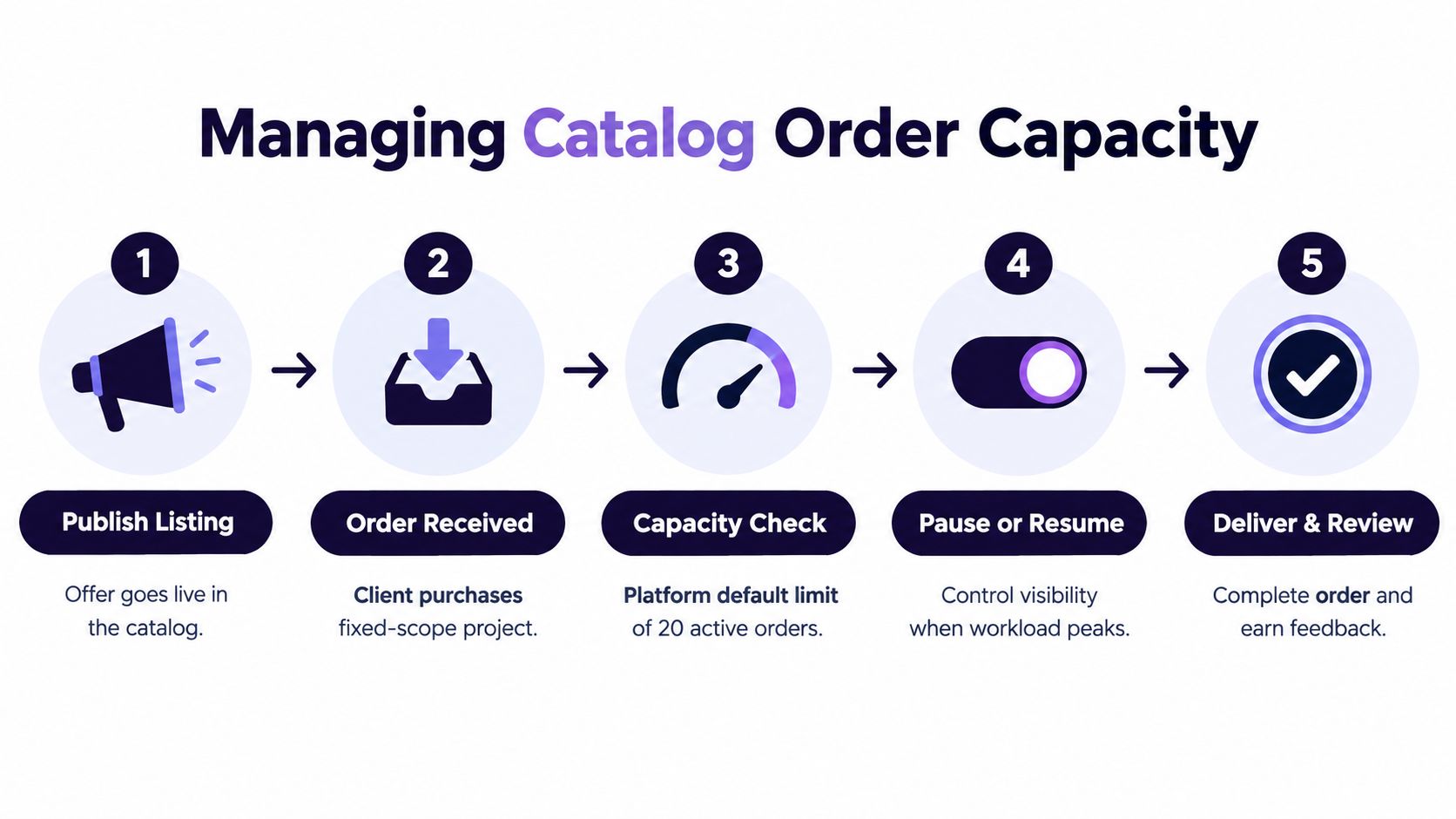
Upwork states that each project has a default limit of 20 active orders. Sellers can change the limit, turn listings on or off, and update scope. An overloaded seller may cancel a purchase within 24 hours without affecting the Job Success Score, according to Upwork's project management guidance.
Set limits by service complexity
Don't use one order limit for every offer. A templated deliverable may tolerate a higher queue than a strategic audit requiring senior review. Keep capacity for revisions, client messages, internal quality checks, and unexpected access problems.
Define pause rules in advance:
- Queue pressure: Pause when active work consumes the team's planned production capacity.
- Revision load: Pause a package when included revisions begin delaying new submissions.
- Response risk: Pause when client communication starts competing with delivery work.
- Margin erosion: Review or disable a listing when customization repeatedly exceeds its scope.
The best-performing offer may be the narrowest package your team can deliver consistently. More orders don't compensate for late work, avoidable cancellations, or poor reviews.
Use the listing controls deliberately
Check active orders as part of the agency's regular operations review. Resume a listing when capacity returns, and update the scope when recurring exceptions show that the original package no longer matches the work. A catalog should behave like an inventory system, not a permanently open inbox.
Navigating the Project Catalog Workroom Workflow
The workroom turns a catalog purchase into a sequence of controlled states: purchase, requirement submission, production, work submission, revision handling, and approval. Upwork describes a shared workspace containing a timeline, task checklists, attachments, submitted requirements, work submissions, and revision tracking in its Project Catalog contract workroom guidance.
Clients must submit the required information or materials within 48 hours of purchase. If they don't, the order will be canceled. That deadline affects how you write the listing because missing inputs aren't a minor inconvenience. They can stop the engagement before production begins.
Convert requirements into a production gate
The team should review the submitted requirements against a checklist before assigning the order. A content project might require the approved brief, source material, brand guidance, target audience, and acceptance criteria. A technical service might require access, environment details, and a description of the issue.
Don't rely on a long chat thread to reconstruct the order. Store the accepted inputs in the workroom, connect them to tasks, and record what the team will deliver. This makes the engagement auditable at the item level.
A fixed-price service becomes scalable when every order follows the same path, not when every client receives the same conversation.
After submission, the client can approve the work or request revisions in the workroom. The individual project defines the revision allowance, so the listing should make that allowance explicit and encourage consolidated feedback. Otherwise, “one revision” can become several disconnected rounds of change.
Measure the state transitions
Track time to requirements, time to first submission, revision count, approval latency, and cancellation or refund incidence by tier. These measures help identify whether the package is underscoped, whether the requirements are incomplete, or whether the delivery promise is unrealistic.
For agencies building a multi-user operating model, this Upwork agency account guide provides useful context. The catalog can also qualify buyers for a larger engagement. A client who completes a structured purchase, supplies usable inputs, and gives coherent feedback has demonstrated a stronger fit for custom work than a lead who only asks for the lowest possible price.
Integrating Catalogs Into Agency Outreach
A catalog listing shouldn't operate in isolation from outreach. It can serve as the concrete next step when a prospect has a defined need but isn't ready to discuss a broad retainer or custom project.
Start by mapping each outreach message to one relevant offer. Don't send a general catalog link after every conversation. If the prospect needs a technical diagnosis, direct them to the diagnostic package. If they need a content brief, show the offer that produces that specific artifact.

Use the first order as qualification
The catalog purchase reveals useful information. The selected tier shows the buyer's initial scope preference. Their submitted requirements show whether they can provide the inputs needed for progress. Their feedback and approval behavior indicate how they may handle a larger engagement.
Track operational signals rather than vanity activity:
- Time to requirements: Shows how quickly the buyer can mobilize.
- Time to first submission: Shows whether the package is ready for production.
- Revision count: Reveals expectation or scope problems.
- Approval latency: Highlights decision-making friction.
- Expansion requests: Indicates where a custom service may fit.
Your outreach workflow should preserve the same positioning as the listing. A message that promises a focused outcome should lead to a package with matching deliverables. For agencies coordinating multiple bidders or specialists, Upwork lead automation can provide context on connecting outreach activity with a more organized sales process.
Earlybird AI is one tool agencies may evaluate for this layer. It connects to an Upwork account, uses feedback to learn preferred projects, searches for opportunities, drafts personalized proposals, and replies to client messages automatically. It also includes analytics, profile optimization tools, and multi-user workflows. Automation can increase the flow of conversations, but the catalog still determines whether those conversations lead to work the delivery team can fulfill.
Building a Sustainable Productized Service Ecosystem
A sustainable catalog has three connected parts: a clear offer, a controlled fulfillment process, and a review loop. If one part weakens, the listing becomes harder to scale.
Review each package after completed orders. Look for repeated clarification requests, frequent exclusions, revision pressure, and work that consistently falls outside the promised scope. Then adjust the package, requirements, delivery schedule, or order limit rather than asking the team to absorb the problem indefinitely.
Keep the operating checklist simple:
- Offer quality: Does the package describe one recognizable buyer problem?
- Input quality: Can the team verify requirements before production?
- Capacity quality: Is the order limit appropriate for the service complexity?
- Margin quality: Does net contribution justify the labor and revision exposure?
- Expansion quality: Does the completed order create a credible path to custom work?
The strongest agency catalog isn't the largest one. It's a portfolio of offers the team can deliver repeatedly, price transparently, and improve through evidence from real workroom activity. That turns Project Catalog from a passive storefront into a managed productized-service ecosystem.
Earlybird AI helps agencies automate Upwork prospecting, personalize proposals, manage replies, and coordinate multi-user sales workflows while your team focuses on delivering catalog orders well. Visit Earlybird AI to connect a more consistent outreach process with a capacity-controlled Project Catalog operation.


