
← Back To Blog
Upwork Projects Catalog Guide for Agencies
You've spent the evening tailoring another proposal for a project that may never receive a reply. The scope is familiar, your team has delivered it before, and yet the sales process starts from zero every time. That pattern drains agency capacity because skilled people spend hours proving they can do work instead of delivering it.
Upwork Projects Catalog changes that starting point. It turns repeatable services into defined products that buyers can browse, compare, and purchase through an e-commerce-style workflow. For an agency, the opportunity isn't just to add another tab to a profile. It's to build a controlled inventory of entry services, connect each offer to a delivery process, and use custom proposals for the work that truly needs bespoke scoping.
The Shift From Proposals To Productized Services
Proposal-led selling makes every opportunity feel custom, even when the underlying work is almost identical. An agency might write separate pitches for a technical SEO audit, a landing page redesign, or an analytics cleanup, then repeat the same discovery questions after the buyer responds. The work is standardized, but the buying process isn't.
Project Catalog was developed and launched in stages during 2020 and 2021, moving Upwork beyond its traditional proposal-driven marketplace. Upwork approved the initiative at the end of July 2020, introduced a beta to independent professionals in mid-September, released it to a limited group of customers on October 27, 2020, and announced an early global launch on January 14, 2021. Upwork later described the product as launched in the first quarter of 2021, as detailed in Upwork's account of the Project Catalog launch.

The strategic shift is straightforward. Instead of asking, “How do we win this individual job post?” an agency asks, “Which repeatable outcome can a buyer purchase without a discovery call?” That outcome might be an indexation review, a content brief, a conversion audit, a dashboard prototype, or a narrowly scoped automation implementation.
Productize the first mile
The best Catalog offer usually isn't the largest engagement an agency can deliver. It's the first-mile service that reduces buyer risk and creates a clear next step. A fixed audit can lead to implementation. A landing page diagnostic can lead to a redesign. A content strategy package can lead to an ongoing editorial engagement.
This model also supports a healthier division of labor. The Catalog handles clearly bounded work, while senior staff reserve custom proposals for complex integrations, multi-team programs, and enterprise requirements. Agencies moving in this direction can also benefit from actionable advice from Outrank when refining specialist SEO services and making the deliverable understandable to a buyer.
The transition requires more than rewriting service descriptions. It requires acceptance criteria, production checklists, intake fields, revision rules, and a realistic view of team capacity. A package that sells well but creates constant clarification work is not a successful product. It's an expensive lead magnet.
Treat the listing as inventory
An Upwork listing should have a clear place in the agency's service system. Give it an internal owner, a delivery checklist, an escalation route, and a definition of completion. The agency business model matters here because Catalog services work best when they fit a broader path from low-risk purchase to deeper engagement.
Operator's rule: If a teammate can't deliver the package from the listing, intake form, and checklist, the package isn't productized yet.
Upwork sits inside a substantial marketplace. For context, the company reported $4.028 billion in gross services volume for full-year 2025, $787.8 million in revenue, and 785,000 active clients as of December 31, 2025. Those figures describe the wider marketplace, not Project Catalog sales, but they show why a well-designed product can reach buyers beyond an agency's existing network. The figures come from Upwork's full-year 2025 financial release.
Comparing Traditional Bidding With Catalog Listings
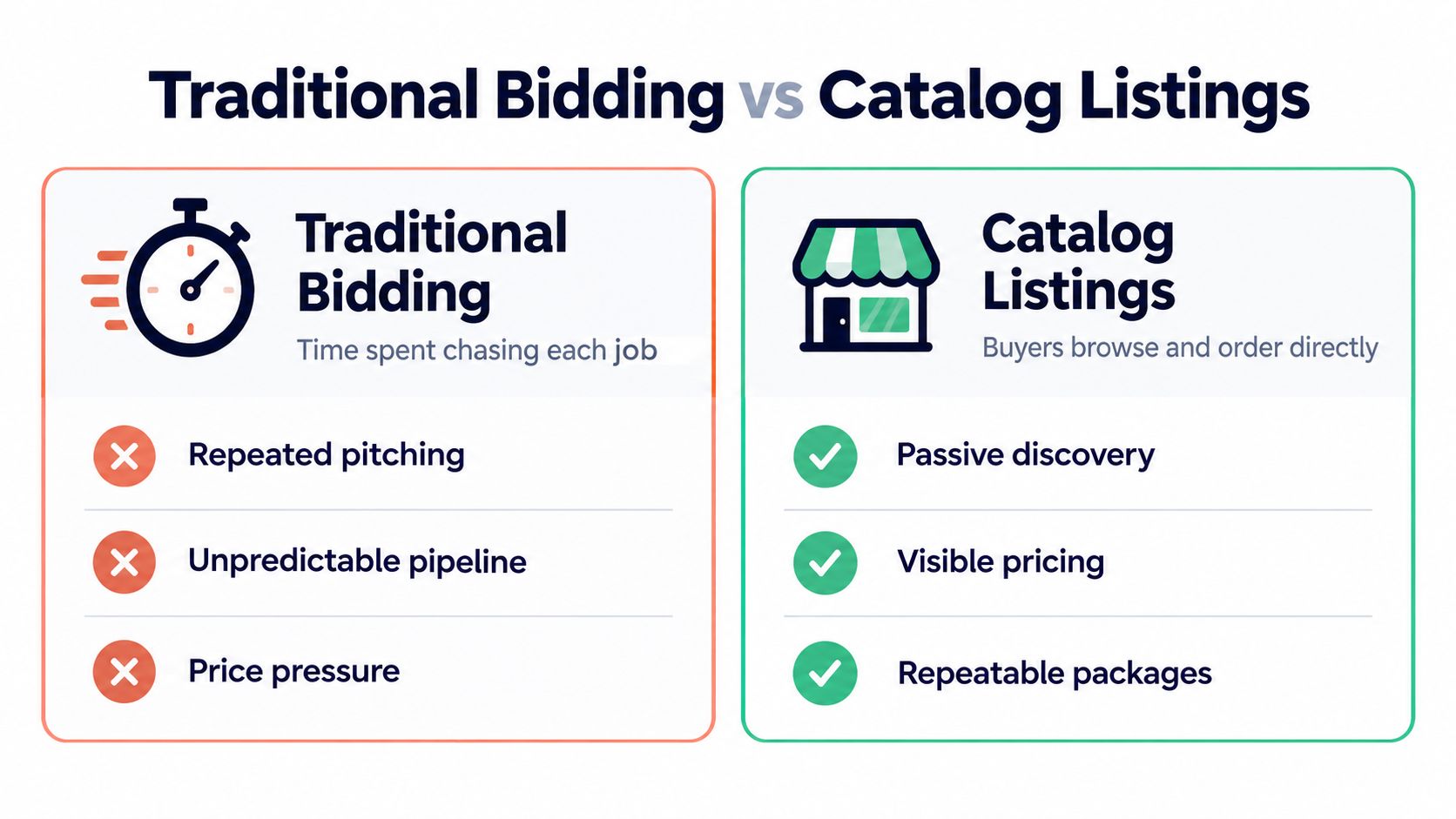
Traditional bidding and Catalog selling solve different parts of the acquisition problem. Bidding captures active demand from a buyer who has already published a job. A Catalog listing captures demand from someone browsing possible solutions and deciding whether one of them fits.
In a proposal workflow, the agency usually controls the pitch but not the scope. The buyer describes a problem in their own language, and the agency translates it into an offer. That creates room for expertise, but it also creates repeated research, inconsistent qualification, and price negotiations before the buyer understands what they'll receive.
Catalog reverses the sequence. The agency defines the scope first, publishes the price and delivery terms, and gives the buyer enough information to self-select. Upwork describes Project Catalog as a collection of pre-scoped services that clients can purchase through a “click and buy” process, rather than creating a job and reviewing proposals. The result feels closer to a storefront than a conventional freelancer profile.
Map services into purchasable units
Start with work the agency already performs repeatedly. Don't begin with a vague capability such as “full-service marketing.” Convert that capability into a buyer-recognizable result, such as:
- Technical SEO diagnosis: A prioritized issue list, evidence, and implementation guidance for a defined website area.
- Content production: A brief, draft, optimization pass, and handoff notes for a specific content type.
- Analytics cleanup: A review of selected events, tracking gaps, and a documented correction plan.
- Design validation: A defined number of screens, flows, or review rounds with explicit handoff artifacts.
Upwork allows a freelancer to publish up to 20 projects, and each project can contain as many as three tiers, according to Upwork's Project Catalog creation guidance. Those limits favor a curated inventory. An agency shouldn't fill every available slot with near-duplicates. Each listing should target a distinct buyer problem or a meaningfully different scope.
Align search language with buyer intent
A buyer searching for “technical SEO audit” has a different intent from one searching for “link building” or “content strategy.” Use the phrase the buyer is likely to type, then make the outcome and boundaries clear in the title and opening copy. Upwork recommends using up to five relevant search tags, so choose tags that match the actual package rather than broad terms that attract poor-fit traffic.
Visible pricing also changes the conversation. It can filter out buyers whose expectations don't fit the agency's minimum engagement, but that's useful information. A Catalog listing shouldn't hide every constraint in a call. It should make the right buyer feel confident enough to purchase and make the wrong buyer recognize the mismatch early.
For agencies working on marketplace or commerce projects, browsing a RapidNative commerce category can provide useful context for how specialized digital services are grouped and presented. The lesson is not to imitate another marketplace. It's to make each service legible as a distinct product.
Designing Tiers And Intake Requirements For Scale
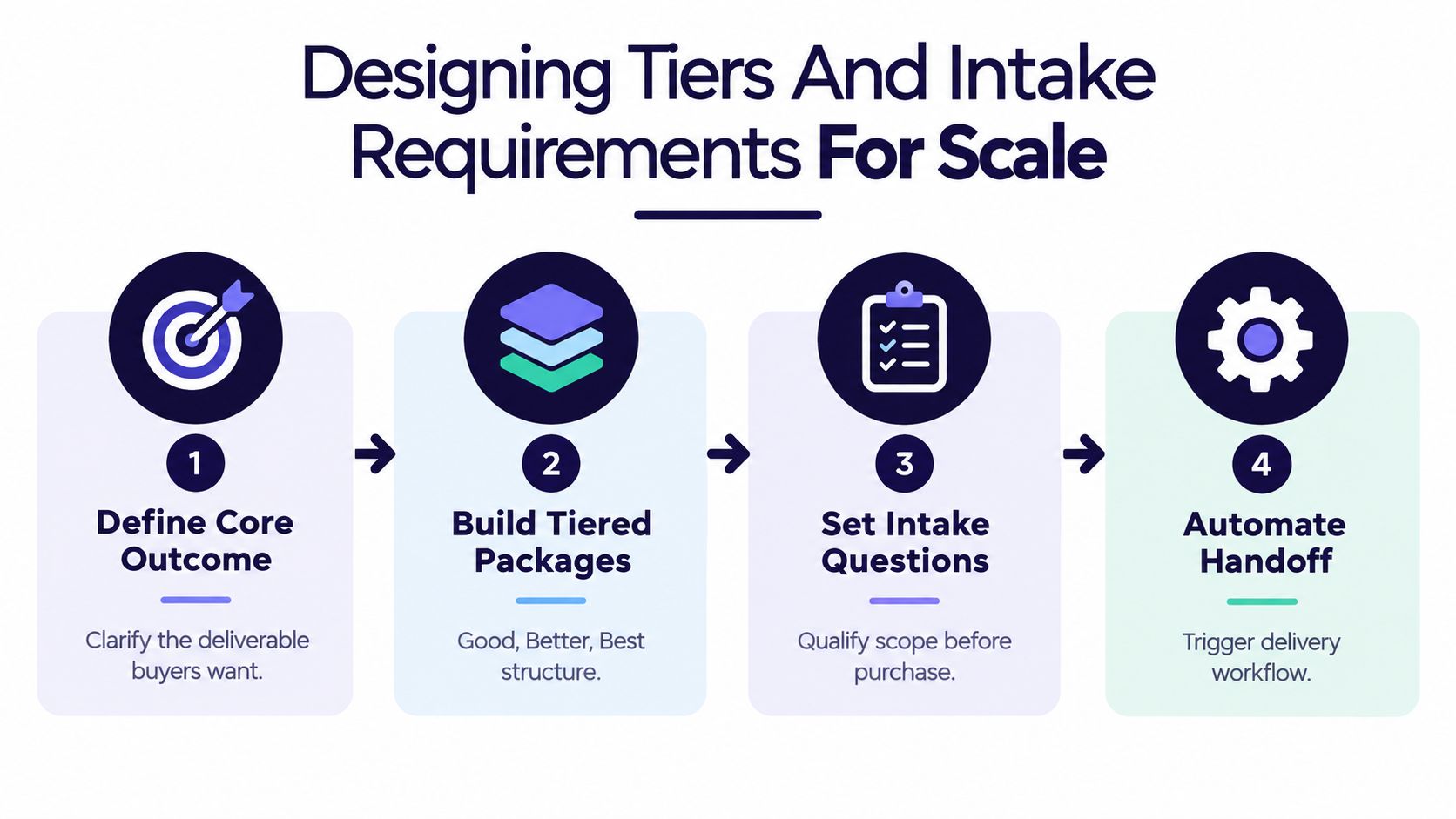
A Catalog package becomes operationally dangerous when its promise is broader than its production system. Buyers interpret “SEO optimization” or “website redesign” expansively, while the agency may have intended a small diagnostic. The listing must close that gap before purchase.
Start by defining the core outcome. Describe what the buyer can use at the end, not the hours your team will spend. “Prioritized indexation action plan for the supplied templates” is more controllable than “complete SEO support.” The first phrase points toward a deliverable. The second invites an open-ended engagement.
Build three versions of one outcome
Each project can offer as many as three tiers, with different deliverables, delivery times, prices, and revision allowances. The tiers should not represent three unrelated services. They should provide three sensible levels of depth around the same buyer problem.
- Entry tier: Solve the narrowest version of the problem with a short, clearly bounded deliverable.
- Core tier: Add validation, additional coverage, or a stronger handoff so this becomes the natural choice for most qualified buyers.
- Advanced tier: Include broader scope, deeper analysis, additional stakeholders, or implementation support, but only where the agency can deliver consistently.
A technical SEO package might begin with a crawl interpretation and prioritized findings, move to template-level recommendations and an implementation checklist, then add a developer working session and validation review. A content package might vary the depth of research, the number of content assets, and the level of editorial review. The distinction must be visible in the deliverables, not buried in marketing language.
Add-ons should handle predictable variations. Extra templates, an additional review, a faster delivery option, or a handoff session can work well when the agency has already defined the effort and dependencies. Anything that changes the nature of the work belongs in a separate project or a custom engagement.
Design intake around the delivery clock
Project Catalog orders have a strict dependency workflow. Clients have 48 hours after purchase to submit mandatory requirements. If they don't provide those materials within that window, Upwork automatically cancels and refunds the order. The delivery clock begins when the required information is submitted, not when the purchase is made, as explained in Upwork's Project Catalog workflow guidance.
That makes the intake form part of the product itself. Ask for only what enables the work, but make each question specific enough to prevent a second discovery process.
- Access and location: Request the exact URL, repository area, account access method, or file location required for the package.
- Business context: Ask which audience, product, market, or business goal the deliverable must support.
- Constraints: Capture brand rules, technical limitations, compliance requirements, and prohibited tools.
- Approval path: Identify the person who can approve the work and the format they prefer for review.
- Definition of success: Ask the buyer to state the outcome in practical terms, then match it to the package's acceptance criteria.
Practical rule: Every promised deliverable should have a corresponding intake field, file request, or explicit assumption.
Avoid requesting a long questionnaire just because the agency wants more background. Excessive requirements create friction and increase the chance that a buyer delays submission. Precise requirements, supported file formats, and examples of acceptable inputs make the order easier to start and easier to fulfill.
A useful scale operations playbook can help agencies connect these package decisions to staffing, handoffs, and quality control. The Catalog listing is only stable when the internal operation behind it is stable.
Managing Capacity And The Post-Purchase Workflow
A Catalog order enters an agency's production system the moment the buyer purchases it. If the team treats the sale as a simple notification rather than a workflow event, the agency can oversell a service, miss an input dependency, or let revisions consume the available margin.
Upwork provides a capacity control for each project. The default maximum is 20 active orders per project, and sellers can change the limit to match their actual production bandwidth. Once the limit is reached, the listing becomes unavailable until an active order is completed, according to Upwork's project management guidance.
Read the order as a funnel
The useful unit of analysis isn't only views or purchases. It's the complete sequence:
- Purchase: The buyer selects a tier and pays.
- Requirements received: The agency confirms that the required files, access, and context are complete.
- Work delivered: The team submits the promised artifacts through the workroom.
- Revisions handled: The agency records what changed and whether the request fits the package.
- Approval and payment: The buyer approves the work, or the platform releases funds after the applicable waiting period.
The workroom includes a shared timeline, task checklist, attachments, submissions, and revision tracking. That creates operational signals an agency can monitor without building a separate system. Long delays before requirements arrive point to unclear intake. Repeated revision requests point to weak acceptance criteria or an overly broad tier. Slow approvals may indicate that the buyer's approval path wasn't identified during intake.
The payment mechanics matter for cash planning. Client approval controls payment release, and if the client neither approves nor requests changes, funds are released after 14 days, according to Upwork's workflow documentation. The agency should therefore track approval delay separately from production time rather than treating the entire period as delivery effort.
Protect the production floor
Capacity limits work only when they reflect reality. Count reviewer time, project management, quality assurance, and communication, not just the person creating the deliverable. A package that takes a specialist one afternoon may require several days of calendar capacity when access arrives late or an approver is unavailable.
Use a simple internal status system such as “awaiting requirements,” “in production,” “in review,” and “revision requested.” Connect each status to an owner and a next action. Agencies that want a deeper treatment of event-based handoffs can use this workflow orchestration guide as a reference point for designing the operational layer around Catalog orders.
Aligning Packages With Emerging Market Demand
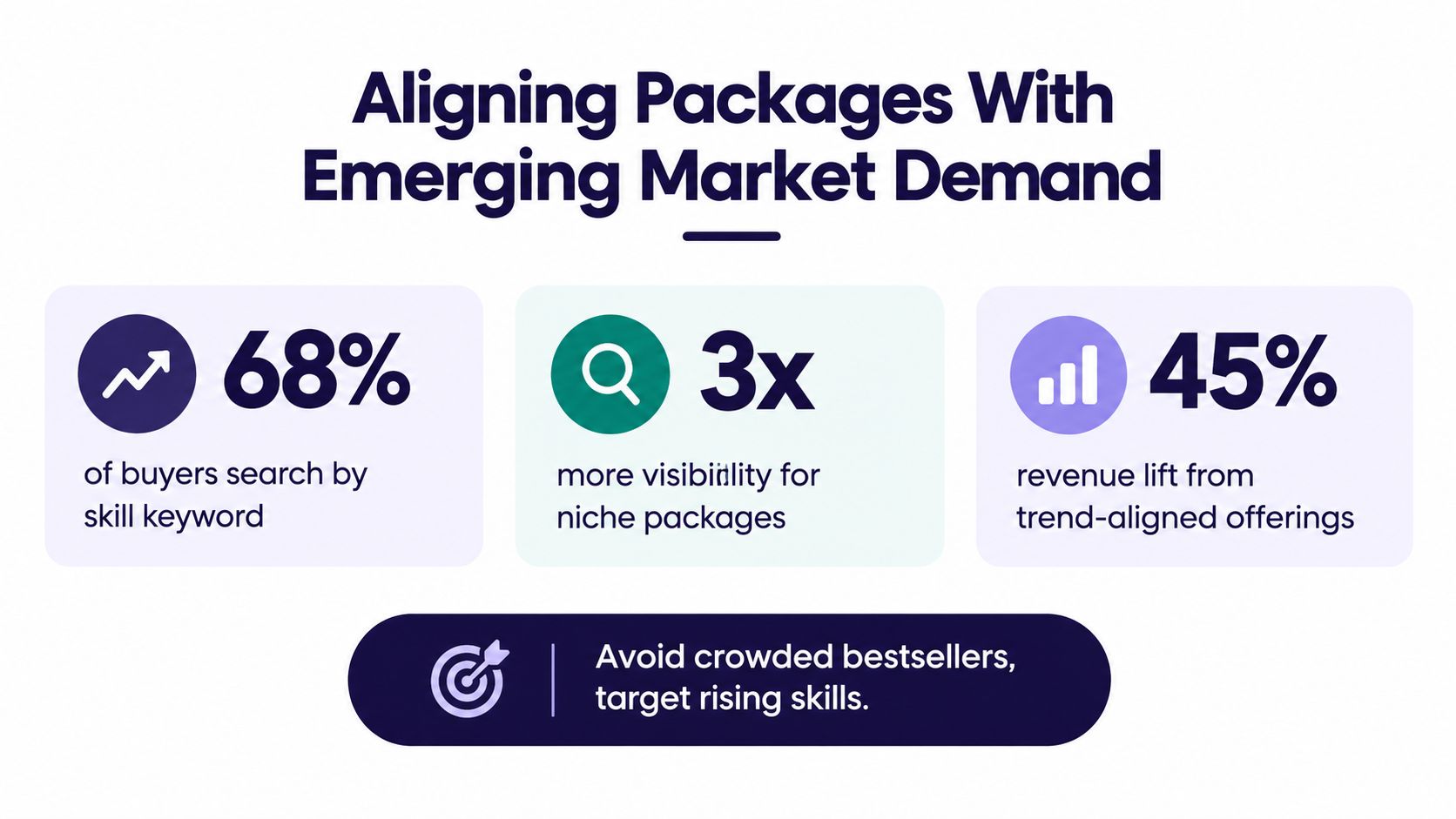
A crowded category doesn't become attractive merely because buyers are searching it. Fast-growing demand can bring more competition, less differentiation, and stronger buyer expectations. Agencies should use demand signals to choose a problem worth testing, then narrow the offer until the result is specific enough to deliver reliably.
Upwork reported that in September 2025, project-management demand rose 17% overall and 102% among SMBs, while translation and localization grew 29%, digital marketing 9%, and QA testing 9%. In November 2025, demand increased 19% for QA testing and 7% for AI and application integration. These figures come from Upwork's guidance on creating Project Catalog projects, which also reported that 38% of businesses sought strategic thinkers and 36% valued interpersonal skills. The figures indicate marketplace signals, not a guarantee that any individual Catalog listing will sell.
Turn a trend into a buyer outcome
The wrong response is a generic package called “AI services” or “strategic consulting.” Those labels describe a capability, not a purchase decision. A better process has four questions:
- Who is buying? An SMB operations lead, a product manager, and an agency founder will describe the same problem differently.
- What changed? Identify the specific pressure behind the demand, such as integration complexity, testing needs, localization volume, or project coordination.
- What can be completed in a fixed scope? Remove the parts that require prolonged discovery or uncertain implementation.
- What human judgment makes the offer safer? Add review, prioritization, communication, QA, or implementation guidance where automation alone would leave risk.
For example, an agency could test a narrowly scoped integration audit for a defined application workflow rather than offering open-ended AI consulting. A QA specialist could package a release-readiness review for a specified surface rather than promising quality assurance. A project-management offer might focus on creating a delivery recovery plan for a defined initiative, with a documented set of decisions and next actions.
Validate before expanding the inventory
Start with the smallest package that can prove whether the buyer problem is real. Use the title, tags, category, and first description lines to match the language of the intended customer. Then review buyer questions, cancellations, requirement delays, and revision patterns. A listing that attracts attention but produces confused intake is not ready for expansion.
The combination of technical specialization and human reliability is especially important in emerging categories. Buyers may want the speed of a modern tool, but they still need someone to interpret outputs, challenge weak assumptions, document decisions, and communicate limitations. That is where an agency can differentiate without making unsupported promises about demand or performance.
Integrating Catalog Listings With Automated Outreach
A Catalog listing can capture passive discovery, but it shouldn't be the agency's only sales channel. Buyers who publish jobs are already expressing an active need, and a well-written proposal can direct the right prospects toward a defined package without forcing the team to rebuild the scope from scratch.
The strongest system uses both paths for different purposes. Catalog listings provide structured inventory for repeatable outcomes. Outreach and proposals identify relevant job posts, start a conversation, and introduce the package when the buyer's problem matches it. The agency gets a clearer sales path without pretending that every project is identical.
Use proposals as routing, not reinvention
An agency can create a proposal library around its Catalog inventory, but the proposal still needs to respond to the buyer's specific situation. A useful message should identify the problem, state the relevant outcome, explain why the package fits, and flag the information required to confirm scope. It shouldn't paste a generic service description into every application.
A proposal for a technical audit might point to the defined audit package, while noting that the buyer's platform, access requirements, or number of templates could require a larger engagement. A proposal for an automation project might use a Catalog discovery product as the first step, then reserve implementation for a scoped follow-on. This structure gives the buyer a low-risk starting point while protecting the agency from promising unknown work.
Automation can support this process by filtering opportunities, drafting personalized proposals, organizing follow-ups, and surfacing client messages for response. It still needs clear rules. The system should reject poor-fit jobs, preserve human approval where scope or compliance is uncertain, and avoid sending volume for its own sake.
Connect acquisition to delivery
The operational advantage appears when outreach and Catalog inventory share the same underlying data. A service record can contain the offer name, buyer problem, qualification questions, price tier, intake requirements, owner, capacity status, and follow-on path. When a prospect responds, the team can move from conversation to the correct package without searching through scattered documents.
Upwork lead automation guidance offers a useful reference for thinking about this connection between opportunity discovery, proposal handling, and response workflows. The principle is simple: automate repetitive coordination, not professional judgment.
Earlybird AI helps agencies automate Upwork prospecting, personalized proposals, client replies, analytics, profile optimization, and multi-user workflows while keeping productized services connected to an always-on sales process. Visit Earlybird AI to see how the platform can support Catalog-led outreach without adding another full-time sales layer.


