← Back To Blog
Upwork Proposal Writer Guide to Win More Clients

You've sent a dozen Upwork proposals, each one custom-fit, and still watched the inbox stay quiet. The problem may not be your grammar or even your expertise. You may be treating proposals as cover letters when the job is to operate a funnel, decide which opportunities deserve Connects, earn a qualified reply, and move that reply toward a signed contract.
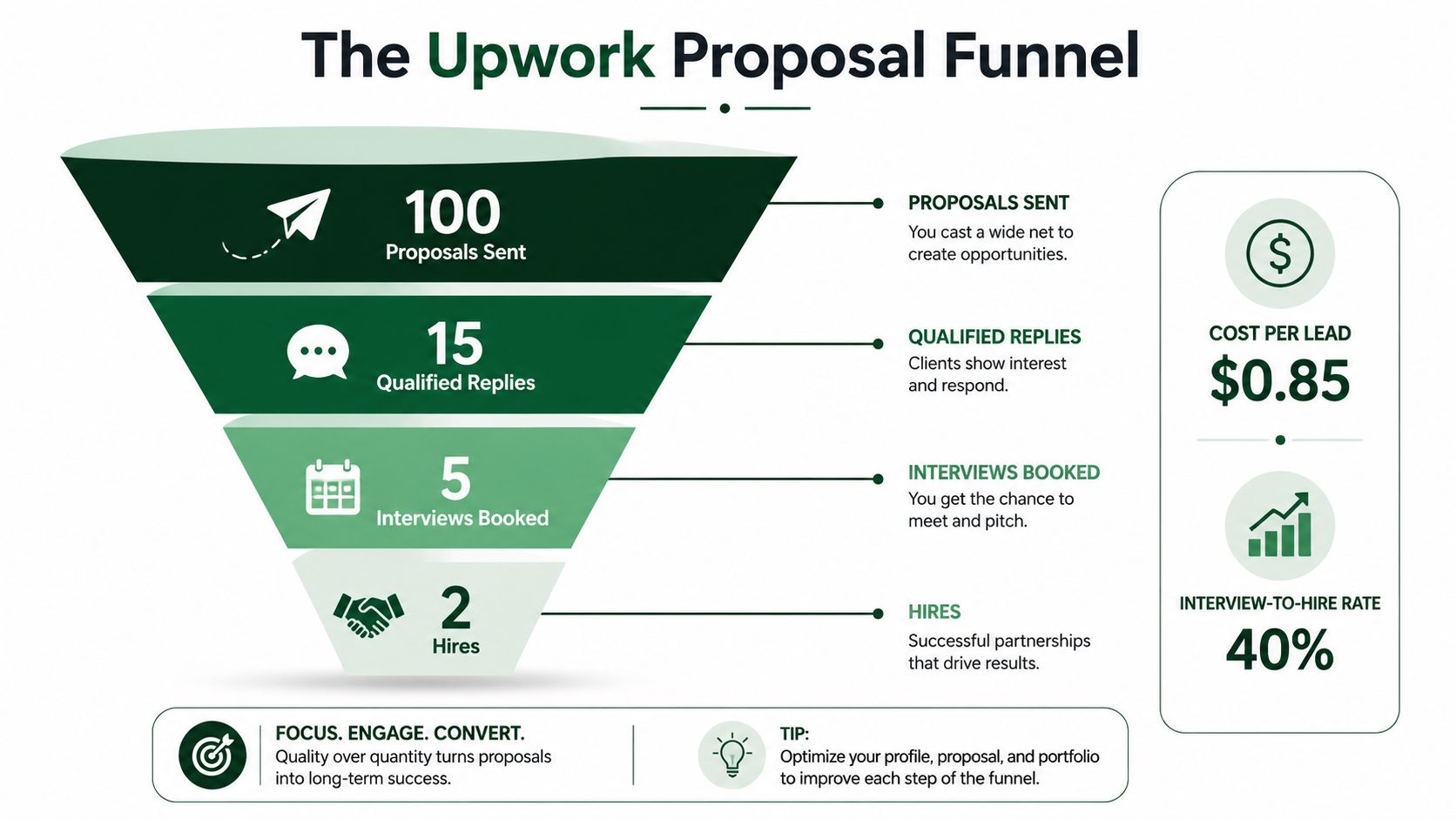
An effective Upwork proposal writer combines job qualification, concise positioning, proof, timing, follow-up, and measurement. Upwork makes that funnel visible: clients can see proposals submitted, opened, shortlisted, and messaged, while freelancers with Plus can access proposal insights updated hourly. Broader proposal statistics also include sent, viewed, interviews, and hires, as documented in this overview of proposal performance metrics.
What an Upwork Proposal Writer Does in 2026
A proposal writer manages the funnel from bid selection to signed contract. The work includes screening opportunities, identifying delivery risk, choosing evidence that addresses the client's concern, writing an opener that earns attention, and scheduling the next touch before submission.
The channel is competitive. Independent benchmark reporting based on 133,872 outbound proposals found an average reply rate of 7.45%, with the top quartile at 12.86% and the bottom quartile at 3.76%. The same Upwork bidding benchmark reports monthly reply rates between 5.9% and 9.0%, with timing differences across the dataset. Most submissions receive no reply, so mass sending turns Connects into an avoidable cost.
Three operating modes
A solo freelancer sending 5-10 bids a week can use a lightweight workflow. Scan jobs personally, maintain a small snippet library, attach proof selectively, and follow up within a day of a reply.
An agency operator running 50+ weekly proposals needs separate ownership for job research, writing, quality control, and account management. A multi-bidder team also needs version control and proposal QA before any message reaches a client. Automation can speed research and drafting, but a human must verify scope, technical assumptions, security concerns, and delivery promises before sending.
The inputs stay consistent:
Job selection: Is the scope clear, funded, and aligned with your delivery capability?
Opener quality: Does the first line identify the client's problem rather than introduce you?
Proof support: Does the work sample answer the client's specific concern?
Follow-up cadence: Does every touch add information or reduce uncertainty?
The outputs are qualified reply, discovery call, interview, and signed contract. Track reply rate, shortlist or interview rate, win rate, cost per lead, and Connects spent per hire. A proposal earns its place when it improves the next stage.
Qualifying Jobs Before You Spend a Single Connect
A client's post can look attractive and still be a poor funnel entry. Before drafting, score three areas: client signals, job signals, and delivery fit. The same practical logic used in broader lead qualification frameworks applies to Upwork, where every bid consumes Connects and attention.
Filter one, client signals
Check whether payment is verified, the client has feedback and completed hires, and the post explains the business need. A new client is not automatically risky. Treat limited history as uncertainty, then require clearer scope, decision ownership, or proof of seriousness before giving the job a high score.
Filter two, job signals
A bid-worthy post names deliverables, identifies the relevant tools, gives a budget or rate, and explains the current situation. An automation request that mentions Make.com, describes the existing lead-routing workflow, and specifies the desired handoff gives an Upwork proposal writer enough detail to diagnose the work before promising a solution.
A post that says, “I need a writer,” provides little to assess. A client hiring 30 freelancers at once may be testing volume rather than building a focused working relationship. That can still be legitimate, but lower its priority unless the scope, selection process, and expected output are unusually clear.
Filter three, fit signals
Compare the requested problem with your actual work, not just your category label. Confirm that the timeline matches your capacity and that you can access the systems, files, or stakeholders the project depends on. Treat “quick and easy” and “budget is flexible” without a stated range as prompts for clarification, not evidence of an easy win.
Use a simple A/B/C rubric:
A tier: Clear scope, credible client, strong portfolio fit, realistic delivery. Spend Connects.
B tier: Partial fit or incomplete client information. Pursue only with a sharp diagnostic angle.
C tier: Vague scope, weak fit, unclear budget, or operational red flags. Pass.
| Signal Type | Green-Light (Bid) | Skip (Pass) |
|---|---|---|
| Client | Payment verified, clear hiring history, specific feedback | No context, no hiring evidence, unclear decision-maker |
| Job | Named deliverables, stated budget or rate, relevant tools listed | Vague request, missing scope, “quick and easy” language |
| Fit | Matching work, realistic timeline, accessible inputs | No relevant proof, impossible deadline, unclear dependencies |
Upwork's official Connects pricing information states that each Connect costs $0.15, with purchases available in bundles or custom amounts and a minimum purchase of 10 Connects. Qualification therefore affects acquisition cost as well as writing time. A proposal writer should bid when the post supports a credible path from reply to paid work, then record which signals predicted that outcome.
The Anatomy of a Proposal That Gets Replies
A client searching for a Make.com expert to fix lead routing isn't asking for a biography. They're asking whether you understand the failure, can isolate the cause, and can repair the workflow without creating a second problem.
A generic proposal might open with enthusiasm, list every tool you know, paste a portfolio link, and end with “Let's discuss.” A structured proposal mirrors the client's buying process instead.
Six blocks that earn their place
Hook line: Name the specific business problem.
Observation line: Prove you noticed a detail in the post.
Proof line: Show relevant experience or a work sample.
Approach line: Outline the first practical steps.
Timeline and budget line: Set expectations without pretending certainty.
Close line: Ask for one specific next action.
For the automation job, the proposal might read:
Your lead-routing issue is probably less about the Make.com scenario itself and more about where duplicate or incomplete records enter the workflow.
You mentioned that leads are reaching the wrong owner. I'd first trace the webhook or form submission into the router, then test the filtering and handoff rules against recent failed records.
I've repaired comparable automation workflows involving form submissions, CRM assignment, and notification handoffs. I can share a relevant workflow example and document the changes so your team can maintain them.
My first step would be a short audit of the scenario, data fields, and current routing rules. After that, I'd propose the repair before changing production logic. Once I see the scenario complexity and available access, I can confirm the delivery estimate and fixed or hourly structure.
Can you share which CRM receives the leads and whether the incorrect assignments affect every source or only one form?
The first line frames the risk. The second shows attention. The proof establishes relevance without dumping credentials. The approach reduces implementation uncertainty, while the final question makes replying easy.

Why structure beats cleverness
Clients scan proposals. A polished sentence that doesn't answer the client's concern has less value than a plain sentence that identifies the dependency, next step, or risk. Templates can help with consistency, but they shouldn't replace judgment. RewriteBar's proposal templates can provide a starting structure, especially when you're building modular drafts for different services.
Keep the proposal focused on the decision in front of the client. Upwork's own guidance on submitting a proposal emphasizes relevance, concise communication, and a clear next step. The proposal should make the interview feel like the natural continuation of a useful first exchange.
Writing Openers That De-Risk the Project in Two Sentences
The first two sentences don't need to prove everything. They need to prove that you understand something the average bidder missed.
Most openers fail in predictable ways:
“I read your job post and love it.”
“I'm an expert with years of experience.”
A restatement of the entire project description.
A list of tools with no connection to the client's outcome.
A de-risking opener follows a different pattern. Name the likely outcome, identify a risk the client hasn't solved, and signal relevant experience without turning the sentence into a credential parade.
Before and after
Generic version:
Hi, I'm an expert in Zapier and automation. I'd love to help improve your workflows and can start immediately.
Stronger version:
If your Zapier bill is climbing faster than conversions, the real cost may be an unmaintained Zap pulling duplicate rows. I rebuilt that pattern for a Shopify brand last month, and I'd first check whether duplicate triggers or failed deduplication rules are affecting your workflow.
The metric belongs to the client's world. The diagnosis shows systems thinking. The prior experience supports credibility, but the writer doesn't claim a result that the client can't verify.
The same principle applies to cold outreach beyond Upwork. A practical cold calling guide is useful because it treats the opening as a reason to continue the conversation, not as a compressed résumé.
Three adaptable patterns
Automation: “You're trying to [business outcome], but [implementation risk] can undermine it. I'd check [specific dependency] before changing the live workflow.”
Development: “The visible bug is [symptom], but the cause may sit in [architecture or data layer]. I've worked on similar [system type], and I'd reproduce the issue before proposing a fix.”
Design: “Your [page, product, or campaign] needs to improve [user action], but [friction point] may be weakening the path. I'd review [specific screen or behavior] and return a focused direction before expanding the concept.”
These patterns work because they start with the client's exposure. They also invite correction. If your diagnosis is slightly wrong, the client can clarify it, which is far more useful than forcing them to respond to a generic introduction.
Timing, Attachments, and the Speed vs Relevance Trade-Off
Speed matters, but rushed relevance is still weak. Independent Upwork benchmark reporting connects timing with response probability, including a reported 9.49% reply rate for proposals sent within the first 5 minutes in one dataset, while another benchmark cited 24.3% for proposals sent 2-4 hours after posting. The conflicting results are a warning against treating speed as a universal rule. Timing interacts with job quality, message specificity, and competition.
Choose the right first move
For a simple, clearly scoped job, a fast and relevant proposal can win attention before the client's shortlist fills. For a technical or expensive project, spending more time identifying dependencies usually produces a stronger message.
Relevant attachments also change the buying conversation. One industry analysis reported response rates moving from 8.2% to 11.5% with relevant attachments, while irrelevant attachments reduced the reported rate to 5.3%. The source attributes the higher result to a 40% lift, but the practical lesson is more important than the label: attach evidence only when it answers the job.
A two or three-page case study can beat a portfolio homepage on a cold send. A short Loom audit can be more persuasive for a design job, while a bug report or focused repository link may matter more than a list of engineering credentials. Each asset has a cost. Case studies require preparation, and Loom audits don't scale across every low-value opportunity.
| Job Tier | Priority | First Move | Attachment | Best Window |
|---|---|---|---|---|
| Simple, clearly scoped | Speed with basic personalization | Submit after checking fit | Existing relevant sample | As soon as the diagnosis is clear |
| Mid-scope service | Balanced speed and relevance | Write a specific observation | Short case study or sample | During the client's active working hours |
| Technical or high-risk | Relevance first | Identify dependencies and failure points | Audit, bug report, or technical proof | When you can submit a defensible approach |
Upwork's Connects system creates a real cost for experimentation. Basic accounts include 10 Connects per month, Plus accounts include 100, and additional Connects cost $0.15 each. Start with a posting-window rule that your team can maintain, then adjust it from reply and interview data rather than folklore.
Follow-Up Sequences That Turn Silence Into Calls
Silence after a proposal has several causes. The client may be waiting for approval, comparing options, or discovering that the brief omitted a dependency. A follow-up earns attention only when it adds useful information. “Did you see my message?” creates pressure without reducing uncertainty.
A disciplined sequence also depends on sharp qualification. Review our lead qualification frameworks before scheduling touches, so you do not spend time reviving jobs that were poor fits from the start. For broader message structure, use this guide to follow up with clients.
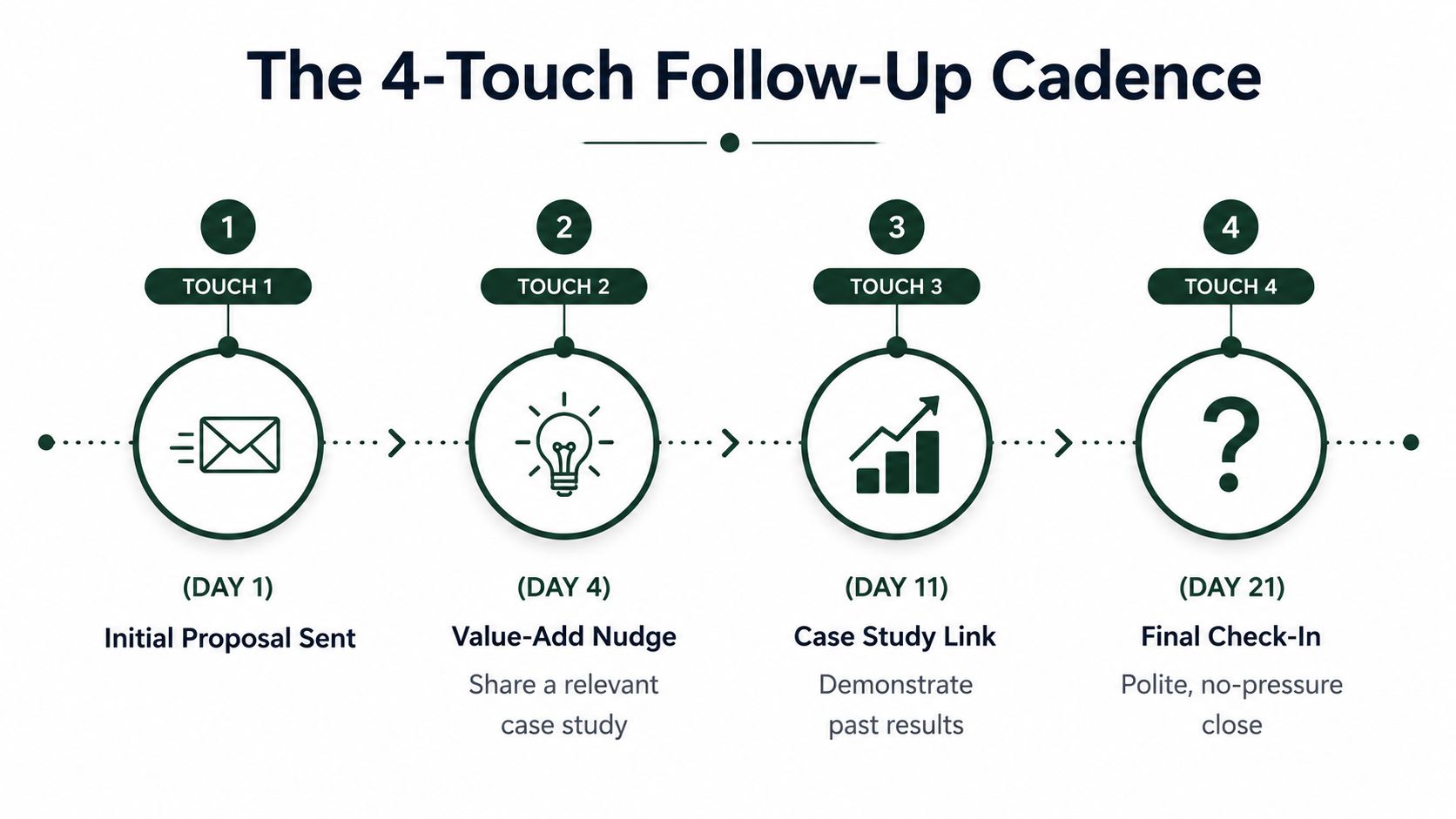
A four-touch sequence
At 72 hours, add a useful observation. Share a relevant resource, a short audit finding, or one question that narrows the problem. For an automation firm, a brief Loom showing the reported bug's failure path can demonstrate technical understanding without promising a fix before discovery.
At day 7, introduce new context. Refer to a detail in the client's stack or workflow that changes your proposed approach. A specific dependency, integration risk, or handoff issue gives the client a reason to reopen the conversation.
At day 14, make a future-oriented check-in. State that you remain available if the project returns to the top of the client's list. Keep the message open and useful, without asking for an immediate decision.
At day 21, close cleanly. Say that you will stop following up for now, then invite the client to reconnect if timing or scope changes. This protects your positioning and keeps pipeline reporting honest.
The no response email templates can help standardize language across a team. Replace generic wording with the client's actual constraint, workflow, or unanswered question.
Avoid sending a rapid series of identical bumps. Upwork guidance emphasizes prompt responses to messages and invites, ideally within two hours and no later than seven days, according to its Connects calculator and support guidance. For active contracts, the cited support guidance also identifies seven days as an important responsiveness benchmark under the Optional Service Contract Terms, as summarized in this Upwork fees guide.
Measure each touch by funnel stage. More replies matter only if qualified replies become interviews and interviews become hires. Rising replies with flat interviews points to weak targeting or proof. Interviews without contracts point to scope, pricing, or delivery-confidence problems.
Role-Based Workflows for Freelancers, Agencies, and Multi-Bidder Teams
A reusable proposal workflow should become more structured as proposal volume rises. The solo freelancer needs speed and memory support. An agency needs specialization. A multi-bidder team needs governance, because inconsistent claims and duplicated outreach can damage the account.

Solo freelancer workflow
Reserve a focused job-scanning block. Tag each prospect in a spreadsheet by niche, fit, urgency, proof asset, and next action. Keep snippets for recurring services, but rewrite the diagnosis and close for every serious opportunity.
A practical solo sequence looks like this:
Scan: Review jobs for scope, client quality, and delivery fit.
Shortlist: Mark A, B, or C based on evidence, not excitement.
Draft: Use a modular structure, then rewrite the opener from the job's language.
Submit: Add one relevant asset only when it reduces uncertainty.
Follow up: Schedule the next touch while the job context is still fresh.
Agency workflow
A small agency should separate roles even if one person temporarily wears several hats. A bid strategist filters opportunities and protects Connects. A closer rewrites hooks for the strongest opportunities. A quality reviewer checks whether the proposal is accurate, specific, and deliverable before submission.
Use a shared workspace such as Notion or Airtable for client intelligence, proposal versions, service verticals, proof links, and follow-up dates. Establish a handoff SLA that reflects your operating hours, then review reply rate and interview rate weekly. The agency shouldn't expand volume because writers have spare capacity. It should expand when the funnel shows that targeting and conversion remain healthy.
Multi-bidder team workflow
At larger volume, assign explicit owners:
Researcher: Finds and qualifies jobs.
Writer: Drafts the proposal using approved positioning.
QA reviewer: Checks claims, scope, tone, links, and instructions.
Account owner: Approves pricing, submits, handles replies, and owns the relationship.
Split into verticals such as SaaS development, ecommerce, and AI automation when generalist proposals begin losing specificity. Each vertical needs its own proof library, risk language, discovery questions, and pricing logic.
Operational rule: Never scale proposal volume before you can explain why a proposal won or lost at each funnel stage.
Weekly operating kit
Before submission, check:
Qualification: Client, scope, budget, and fit support an A-tier decision.
Opener: The first two sentences identify an outcome and a risk.
Proof: The link or attachment matches the requested work.
Pricing anchor: The client can understand what the initial step includes.
Follow-up: The next touch has a date and a reason.
Track applications sent, reply rate, interview rate, hire rate, average project value, and Connects spent per hire. A healthy funnel isn't defined by one universal target. It's defined by stable movement from one stage to the next, with enough project value to justify acquisition cost.
Questions working proposal writers ask
How many proposals should I send per day to avoid spam filters? There isn't a verified universal number. Send only when the job passes your qualification criteria, and watch whether your reply quality falls as volume rises.
Do generic templates still work? A reusable structure works. A copy-pasted diagnosis usually doesn't. Use templates for sequencing, not for pretending every client has the same problem.
How do I recover from a streak of silence? Stop increasing volume. Review your last set of jobs by stage. If proposals aren't viewed, change qualification and the opener. If they're viewed but ignored, change proof and specificity. If interviews don't become offers, inspect scope and pricing.
When should I use Boosted Proposals? Use a boost only when the job is a strong fit and the expected value justifies extra Connects. A boost can improve placement, but it can't repair a weak proposal or poor qualification.
Does AI drafting hurt rankings? The risk is less about a hidden ranking penalty and more about client recognition. AI clichés, generic praise, and polished but empty language can make a proposal feel interchangeable. Use AI for structure or research support, then add the observation, risk, and question that only fit this job.
How should I reposition after a client ghosts mid-contract? Protect the contract first. Document the completed work, list pending decisions, send a concise status update, and follow the platform's communication requirements. The cited support guidance treats responsiveness within seven days as important for active contracts, so don't let uncertainty become avoidable account risk.
An Upwork proposal writer wins consistently by operating the full funnel, not by treating every bid as a standalone writing exercise.
Earlybird AI connects to your Upwork account, learns your ideal projects through feedback, and supports job matching, personalized proposal drafting, replies, follow-ups, analytics, and multi-user workflows for agencies. Visit Earlybird AI to see how its proposal workflow can help you qualify opportunities faster while keeping human review focused on fit, risk, and conversion.