
← Back To Blog
UX Proposal Template: Win More Design Projects

At 11 PM, a freelance UX designer is staring at a blank proposal document, copying paragraphs from three old pitches and changing the client name for the fourth time. The file looks polished, but it still doesn't answer the questions keeping the buyer awake: Do you understand our problem, can you reduce the risk, and what will this cost?
That's why a strong UX proposal template shouldn't function as a longer portfolio or an internal project brief. It should help a client make a confident decision. The document needs to connect a specific problem to measurable outcomes, define what happens first, and make the commitment feel manageable.
Why Most UX Proposals Lose Before the Client Reads Page Two
Most weak proposals fail before the client reaches the methodology section. They're written for the designer's benefit, not the buyer's decision process.
The usual opening explains the agency's background, lists impressive capabilities, and describes a preferred process. None of that is useless, but it's badly sequenced. A client who has just described a confusing onboarding flow doesn't first need your design philosophy. They need evidence that you heard the problem accurately.
Three flaws cause most of the damage:
- Credentials come before client pain. A long biography delays relevance. The client wants to see their product, users, constraints, and business concern reflected in the first paragraph.
- Deliverables appear without outcomes. “Wireframes, prototypes, and high-fidelity screens” describes activity. It doesn't explain what decision those artifacts enable or which user behavior they're intended to improve.
- Price is hidden behind process language. When pricing appears late, surrounded by research terminology and dense methodology, buyers have to work too hard to understand the offer.
A client usually skims for three answers:
- Does this designer understand the problem?
- What will reduce uncertainty before the larger commitment?
- What investment and next step are being proposed?
Practical rule: If the first screen of the proposal doesn't establish relevance, risk control, and commercial clarity, the document is working against you.
Proposal research supports a concise, customized approach. Proposify identifies about 10 pages as an ideal winning proposal length, while its benchmark discussion also notes that 3 to 5 pages can outperform both shorter and longer formats depending on context. The practical lesson isn't to chase a magic page count. It's to remove anything that doesn't help the buyer approve the next decision. Proposify's proposal best-practices research also reports that proposals sent within 24 hours close at a materially higher rate, which makes a reusable, adaptable template commercially useful.
The best proposal is therefore a decision accelerator. It reframes the client's concern, states the evidence you'll collect, defines the first approval, and makes the investment understandable without forcing the buyer to decode your process.
The Complete UX Proposal Template Structure
A reliable template should contain enough detail for a client to evaluate the engagement, while staying easy to scan. A practical UX design proposal commonly uses 12 to 15 sections, according to Earlybird's guide to UX design proposal structure. The exact layout can vary, but the logic should remain consistent.

Start with the problem reframe
Open with two sentences that restate the client's challenge in their language:
“Your account setup flow asks new users to make several decisions before they understand the product's value. This proposal focuses on clarifying that first-run experience, identifying the highest-friction moments, and giving your team a validated path to improve activation.”
This earns its place because it proves you listened. Without it, the proposal feels interchangeable.
Follow with the strategic context. Name the business consequence beside the user problem. For example, “Users struggle to compare plans, while the commercial team sees avoidable hesitation before signup.” Then identify the outcomes you'll monitor, such as task completion rate, time on task, error rate, CSAT, SUS, conversion rate, bounce or exit rate, support-ticket reduction, and return-user rate. These measures are consistent with the evidence-based proposal structure described in Growlio's UX proposal template guidance.
Present an approach built around approvals
Don't write, “I'll conduct discovery, create wireframes, and produce a prototype.” Write:
“First, you'll approve the current-state problem map and research priorities. Next, you'll approve the information architecture before we design a single high-fidelity screen. Finally, we'll validate the selected direction and prepare the handoff.”
The difference is important. The first version describes your tasks. The second tells the client when they make decisions and how each phase reduces uncertainty.
Define scope and boundaries together
The scope block should state what the client receives and what isn't included:
- Included: current-state audit, prioritized issue log, core user flows, prototype, review sessions, and handoff notes.
- Excluded: front-end development, production copywriting, additional platforms, analytics implementation, and ongoing maintenance.
Every deliverable should have an acceptance condition. “Prototype complete” is vague. “Interactive prototype covers the agreed primary flow, empty state, error state, and confirmation state” is testable.
Make timing collaborative
A timeline should include dependencies, not just dates. Identify when the client must provide analytics access, brand assets, stakeholder availability, or consolidated feedback. A missed dependency should trigger a documented timeline adjustment rather than an argument about why the project slipped.
Keep credentials selective
Use no more than three relevant case studies. Each should connect a similar problem to a specific artifact or outcome. A portfolio dump creates work for the buyer and weakens the proof.
For examples of concise, outcome-led winning bid proposal styles, study how successful documents combine context, proof, scope, and a clear next action without turning the proposal into a biography.
Close with investment and acceptance
The investment summary should show the fee, payment structure, included work, assumptions, and next step in one place. Anchor the price to the decision the work enables, not to the number of screens you'll produce.
A proposal also needs a sign-off path. State exactly how the client accepts, what happens after acceptance, and when the first milestone begins. Academic guidance on statistical writing warns against listing measurements without explaining their larger point, a problem that also affects UX proposals when teams name metrics without connecting them to decisions. The University of Adelaide's guidance on writing about statistics is useful for keeping evidence connected to meaning.
Pricing Models That Match Your Project Type
A client approves pricing when it makes uncertainty visible. Match the commercial model to what you know, what remains open, and which decision each phase should support. A fixed fee gives a stable scope a clear cost. Hourly billing protects exploratory work from hidden effort. Value-based pricing can connect a high-impact redesign to business results, provided the client agrees on a measurable outcome and the limits of design's influence.
Fixed price
Use fixed pricing for a heuristic evaluation, usability audit, or design system documentation project when the inputs, activities, and outputs are defined.
Sample language:
“The fixed fee covers the agreed audit, prioritized findings, recommendations, and review session. Work outside the listed scope requires written approval before it begins.”
Predictability helps the client secure approval. It also protects the designer when the proposal defines what counts as complete. The risk appears when discovery is unfinished. If the client still needs to identify priority users, flows, or platforms, price that investigation separately rather than hiding assumptions inside a full-project fee.
Hourly or time and materials
Hourly pricing fits ongoing product support, embedded collaboration, and exploratory research where findings can change the next task. It is less persuasive as the default for a defined redesign because the client may evaluate hours instead of decisions and outcomes.
Sample language:
“Work is billed for approved time and materials. Before each work block, I'll confirm the objective, expected output, and available hours.”
For recurring support, this guide to how retainer fees work offers useful commercial context. Set a review point so the client can decide whether continued access is still justified by the work produced.
Value-based pricing
Value-based pricing suits a conversion-focused redesign when the client can name a meaningful business metric and agree how the design work contributes to it. Keep the scope concrete. “Improve conversion” describes an outcome hypothesis, not the research, design, validation, or handoff required to test it.
Sample language:
“The investment reflects the importance of the target customer journey and includes the research, design, validation, and handoff required to make a measured improvement decision.”
Project TypeRecommended ModelWhy It WorksWatch Out ForHeuristic evaluationFixed priceThe review method and final artifacts can be defined clearlyDon't imply that recommendations guarantee implementation resultsEnd-to-end product designFixed milestones or value-informed fixed pricePhases create approval gates while preserving commercial clarityDiscovery may change the later scopeUX research sprintTime-boxed hourly or fixed sprintThe work is exploratory, but the research questions and outputs can be boundedAvoid promising findings before research beginsDesign system buildFixed price by defined component scopeDocumentation and component coverage can be specifiedDefine ownership, supported states, and future maintenance
Tie payments to decision gates rather than calendar dates alone. The client sees what each payment enables, while the designer avoids financing an undefined engagement. State the approval artifact for every gate, so the proposal functions as a decision document instead of a list of tasks.
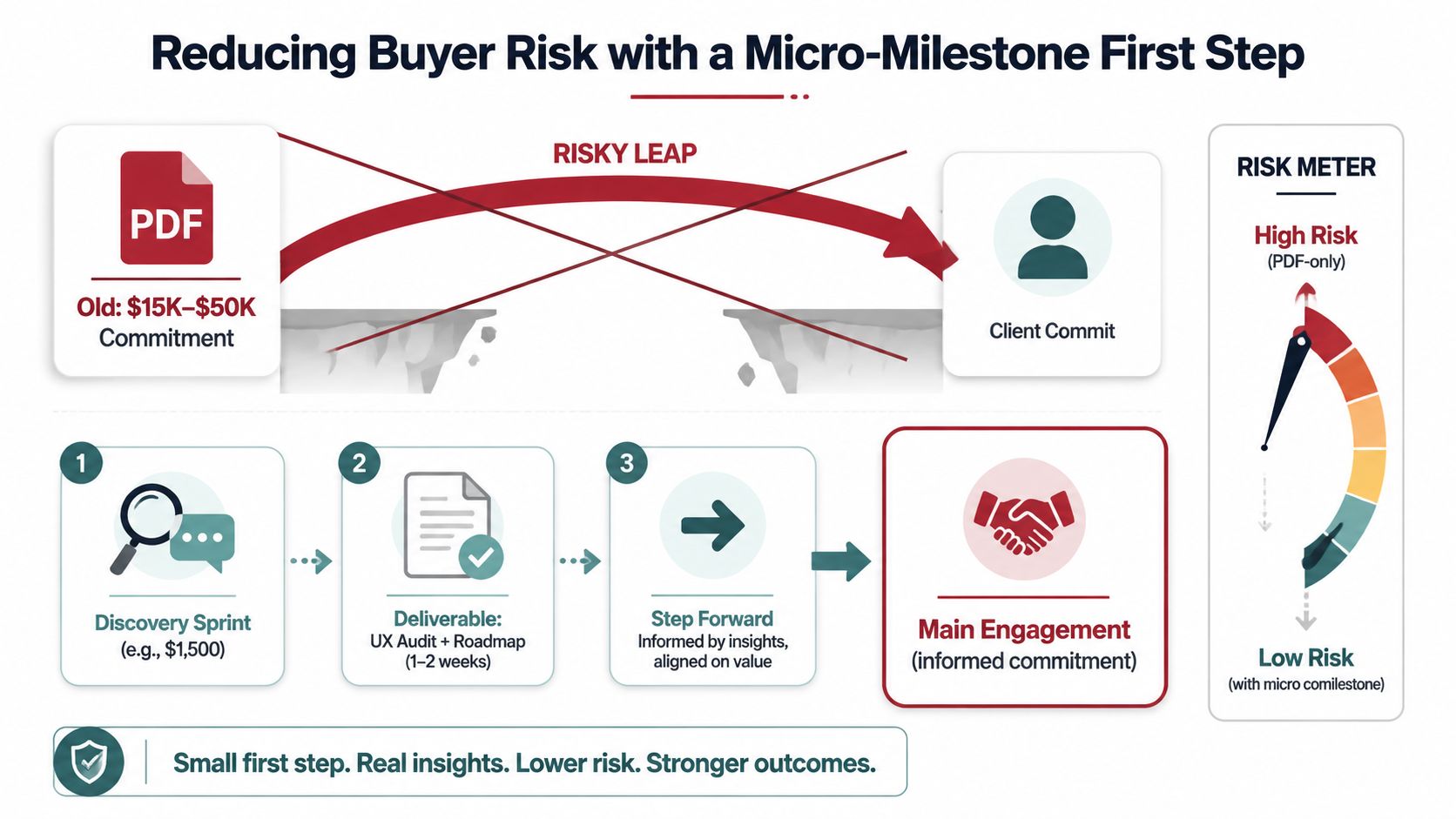
Reducing Buyer Risk with a Micro-Milestone First Step
A client reviewing a full redesign proposal must approve the plan before seeing how you interpret their product, users, and constraints. That makes internal approval harder, particularly when several stakeholders must defend the purchase.
A micro-milestone gives the buyer a smaller decision to make first. It could be a UX audit, heuristic evaluation, or discovery sprint that produces usable evidence and clarifies the later scope. Paid discovery is often a safer entry point than presenting the entire engagement as one commitment. Proposify's user experience design proposal template provides a useful reference for keeping that first step specific.
Define the first handoff precisely
Make the first milestone easy to picture and evaluate. Possible acceptance criteria include:
- Annotated interface review: screenshots marked with usability issues and supporting observations.
- Prioritized issue log: findings grouped by severity, confidence, affected user goal, and recommended next action.
- Research plan: agreed research questions, participant criteria, method, and decision points.
- Stakeholder readout: a focused session that confirms priorities and records unresolved assumptions.
The client should receive a useful decision artifact even if the broader engagement does not continue. That artifact also keeps you from designing a full solution around assumptions that discovery could disprove.
Use language like this:
“This paid discovery phase gives both teams a decision-ready view of the current experience. At completion, you'll receive the audit, prioritized roadmap, and research plan. We'll then confirm whether the broader design engagement should proceed, and if so, update the later scope using the evidence gathered.”
Do not promise that discovery automatically rolls into the full project. That can make the first commitment feel predetermined. State instead how its findings will shape a later proposal, while leaving the continuation decision with the client.
The milestone also gives stakeholders a smaller approval to secure internally. The discussion shifts from funding an entire redesign to approving a focused investigation that clarifies what should happen next.
The best first step is not cheap. It is decision-dense. Each artifact should remove a specific unknown, establish a shared fact base, or make the larger investment easier to assess.
Handling Common Client Objections Before They Arise
A client reviewing two proposals may reject yours before asking a question. If the fee looks high, the concern may be unclear business value. If research seems unnecessary, the pressure may be schedule. Treat each objection as a risk signal, then address it beside the scope or milestone that resolves it.
Client ObjectionUnderlying ConcernReframe Strategy“Your rate seems high.”The fee feels disconnected from business valueConnect the investment to the important user journey, decisions, and evidence the work will produce“We need more deliverables for this price.”The buyer is counting artifacts instead of evaluating usefulnessExplain which deliverables answer which questions and remove redundant outputs“Can we start with wireframes?”The client wants visible progress quicklyOffer a focused first milestone, while showing which assumptions wireframes depend on“We don't have time for research.”Research appears to threaten schedulePropose minimum viable research tied to the highest-risk decision“What if we don't like the direction?”The client fears losing controlAdd review gates, explicit approval criteria, and a defined iteration path
Place the answer in the relevant scope section rather than hiding it in an FAQ. The buyer can then see the trade-off, the decision it supports, and the condition for continuing.
For the rate objection, write:
“I understand you're comparing proposals by fee. This scope includes the evidence-gathering and validation needed to avoid approving a polished direction that doesn't solve the underlying flow problem.”
For the research objection:
“We can keep research focused. The first phase will answer the highest-risk questions rather than attempt a broad study, so the team has evidence before committing to detailed UI.”
For the direction objection:
“You'll review the problem framing and core flow before high-fidelity design begins. Each approval gate gives you a chance to redirect the work while changes are still contained.”
The proposal should also define what happens if a deliverable changes the recommendation. State whether the next milestone pauses, which approval is required, and how the scope will be revisited. That turns uncertainty into a manageable decision instead of an implied promise.
These responses use a practical sequence: acknowledge the concern, identify the assumption behind it, then connect the proposed work to a measurable decision. The client expectation management tips can help you place these commitments where clients naturally look for them.
A separate guide to objection handling can help you rehearse the conversation, but the proposal should prevent unnecessary objections. If the answer affects approval, state it before the client has to ask.
Upwork-Specific Optimizations for Higher Response Rates
Upwork clients often decide whether to continue from the first lines. Open with evidence that you understood the brief, then show how your first decision will reduce risk.
Use the opener to establish three things:
- Name two brief-specific details. Refer to the product, audience, platform, constraint, or business concern.
- Propose one concrete first action. Choose the smallest useful step that can test the riskiest assumption.
- Define acceptance. State what the client will review and what condition marks the work complete.
- Add relevant proof. Include one Figma view, short walkthrough, or annotated artifact tied to the same problem.
- Make the reply simple. Offer a short call or an async outline with clear questions.
For example:
“You're redesigning a desktop dashboard for product managers, and the main concern is helping them compare retention cohorts quickly. I'd begin with a focused flow map and mid-fidelity prototype, then agree on review criteria before expanding into visual design. You would approve the comparison flow against those criteria before the next milestone begins.”
Respond promptly when a suitable job appears. Timing research reports that submissions within 24 hours are about 2x more likely to close than later submissions, while performance falls sharply after three days. Agiled's proposal timing statistics support treating alerts and saved searches as part of the sales process.
Your profile should confirm the proposal's position. If you claim “B2B SaaS UX,” align the title, portfolio thumbnails, skills, and featured case study with that work. A boosted proposal can increase visibility, but it cannot fix a generic opener or weak evidence. Improve the message and proof before paying for more placement.
Use Upwork milestones to make the proposal a decision document. Start with a focused audit or discovery deliverable, define its acceptance condition, and state which finding determines the next scope. If the evidence changes the recommendation, pause the following milestone until the client approves the revised direction and any scope change. This structure makes submitting a proposal on Upwork part of a controlled approval sequence rather than a list of promises.
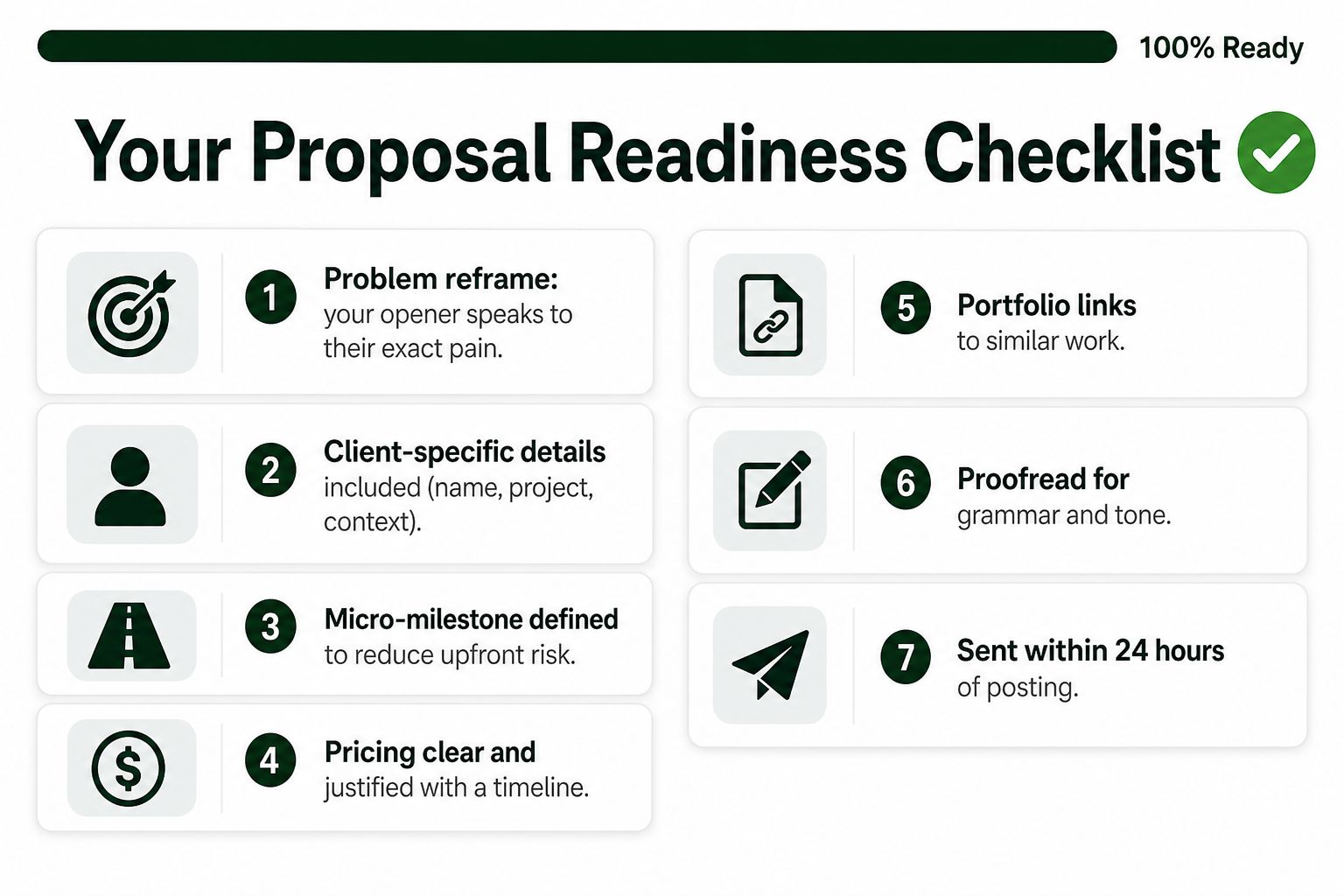
Your Proposal Readiness Checklist
Run this quality gate before sending. If an answer is no, revise the proposal instead of hoping the client will infer what you meant.
- Problem reframe: Does the opening describe the client's specific user and business concern?
- Client evidence: Did you include relevant product, audience, platform, or constraint details?
- Decision sequence: Can the buyer see what they'll approve before high-fidelity work begins?
- Micro-milestone: Is there a focused first step with tangible acceptance criteria?
- Scope boundaries: Have you stated both what's included and what's excluded?
- Outcome measures: Does each important deliverable connect to a metric or decision?
- Pricing clarity: Is the investment visible, explained, and matched to the project's uncertainty?
- Dependencies: Have you named the access, feedback, and stakeholder input you need?
- Proof selection: Did you include only the most relevant case studies or artifacts?
- Objection prevention: Does the document answer concerns about price, research, revisions, and direction changes where they arise?
- Upwork opener: Are the first two lines specific enough to earn the click?
- Response speed: Can you send the customized proposal within 24 hours, a timing practice supported by proposal benchmark research from Proposify?
- Tracking plan: Do you know whether the recipient opened and reviewed the document? A practical sales proposal PDF tracking guide can help you choose an appropriate follow-up process.
A template gives you consistency, but customization creates relevance. The senior consultants who close complex UX work don't send the longest documents. They send proposals that make the next decision obvious, expose uncertainty early, and give the buyer a safe way to begin.
Earlybird AI connects to your Upwork account to search for suitable projects, personalize proposals, and reply to client messages automatically, with analytics, profile optimization, and multi-user workflows for agencies. Visit Earlybird AI to see how it can support a faster, more consistent proposal process while you focus on the UX work clients hire you to deliver.