
← Back To Blog
What Does a Proposal Writer Do in 2026

You've got an RFP open, three subject-matter experts waiting for questions, a shared document filled with conflicting edits, and a submission deadline approaching faster than expected. Or you're a freelancer staring at a blank Upwork cover-letter box, trying to sound specific without repeating the same generic promise as everyone else.
That's the environment where proposal writers work. They turn incomplete information, client requirements, technical input, pricing details, and strict instructions into a response that is accurate, persuasive, and ready to submit. The keyboard matters, but the calendar, compliance checklist, stakeholder calls, and review process matter just as much.
The Real Job Behind the Job Title
A proposal writer is the person who helps an organization or freelancer decide whether to pursue an opportunity, how to respond, and how to deliver the response cleanly before the deadline. In Canada, the occupation is established as a specialized labor-market role, with demand and supply expected to be broadly in line for 2024–2033, according to the Government of Canada Job Bank outlook for proposal writers. That points to steady demand for the skill set rather than a temporary niche.
The role appears in at least three common settings:
- Corporate RFP responses, where a company bids for procurement contracts, grants, or large client engagements.
- Agency new-business pitches, where the writer helps present a marketing, technology, consulting, or creative solution.
- Freelance platform bidding, including Upwork-style opportunities where the writer must qualify a job, tailor a short response, and move quickly.
The title can sound like a document-production role. In practice, it's closer to sitting in the middle of a sales and delivery team. The writer may speak with a sales lead about the opportunity, ask a solution architect to verify a technical claim, request financial information from a pricing specialist, and then convert all of that input into language a buyer can evaluate.
The chair comes before the keyboard
Before drafting begins, a proposal writer asks whether the opportunity is worth pursuing. Does the client need what the team can deliver? Can the team meet the deadline? Is the requested format clear enough to answer? Does the organization have relevant experience, available people, and a credible solution?
That judgment protects the team from spending days on a proposal with little chance of success. A formal request may require responses to an RFP, RFI, RFQ, or grant-style solicitation, and each format can carry different requirements. Steerlab's overview of proposal writing describes the role as turning customer requirements and SME input into a clear, compliant, persuasive document.
Practical rule: A proposal writer doesn't begin by asking, “What should I write?” They begin by asking, “What must this buyer believe, and what evidence can our team provide?”
The writing is still important. A vague executive summary can weaken a strong solution, while a precise response can make complex capabilities easier to understand. But the finished prose is only the visible layer. Underneath it sits qualification, research, coordination, requirement tracking, editing, version control, and deadline management.
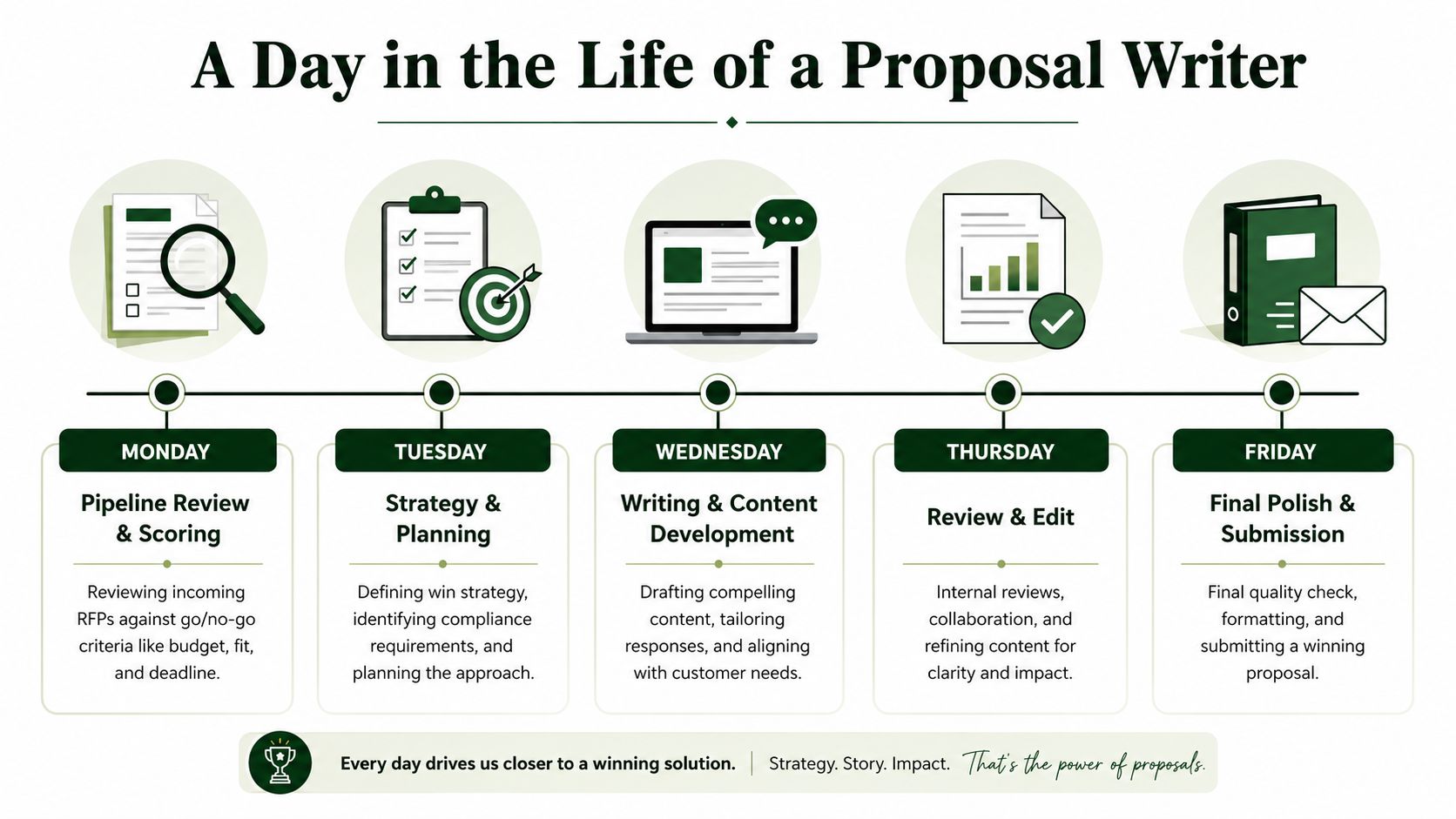
A Day in the Life of a Proposal Writer
A proposal writer's week rarely follows a neat office schedule, but a staged workflow makes the job easier to understand.
Monday starts with opportunity judgment
The writer reviews incoming RFPs, RFIs, RFQs, or freelance invitations and separates promising work from distractions. They check fit, deadline feasibility, client needs, available evidence, and the team's ability to deliver. In a corporate setting, this may become a formal go or no-go discussion. On a freelance platform, it may be a quick decision based on the client's brief, scope, budget signals, and history.
The writer then opens a workspace for the opportunity. That may include the source request, a requirements tracker, a content-library folder, a calendar, and a list of people who need to contribute.
Tuesday turns expertise into buyer language
A discovery call with a subject-matter expert often produces useful but unusable material. The expert may explain architecture, implementation steps, security controls, or delivery methods in language designed for colleagues. The proposal writer extracts the business meaning and asks follow-up questions.
What changes for the client? What risk is reduced? What proof supports the claim? Which details are confirmed, and which still need approval?
Wednesday makes compliance visible
The writer builds or updates a compliance matrix. Each requirement receives a location in the response, an owner, a status, and often a note about the evidence needed. Mandatory forms, page limits, formatting rules, attachments, signatures, and evaluation criteria all need a home.
This stage prevents a common failure: a persuasive document that misses a mandatory instruction. Technical Writer HQ explains the proposal writer's role in decomposing requirements and mapping responses to evaluation criteria.
Thursday creates controlled disagreement
Drafting happens alongside reviews, not before them. A writer may prepare an executive summary, solution section, staffing response, and implementation narrative, then route the material through structured reviews. A proposal manager may challenge the win theme, an SME may mark a technical statement as inaccurate, and a contracts lead may request safer compliance language.
Version control becomes a practical skill here. The writer has to know which document is current, which edits are approved, and which comments still need resolution.
Friday closes the loop
The final day may include a pricing review, formatting inspection, file-name check, portal upload, and submission confirmation. Afterward, the writer records what worked, what slowed the team, and what should be improved in the content library.
The job isn't just “write a proposal.” It's move an opportunity through a controlled process without losing accuracy, persuasion, or compliance.
Core Skills That Actually Matter
Proposal writing skills fall into three connected buckets. Each one is tested inside the document, not just on a résumé.
Writing turns information into a decision
The writing bucket includes executive-summary craft, benefit-led phrasing, clear structure, and editable layouts in tools such as Microsoft Word or Canva templates. The writer's job isn't to decorate technical information. It's to make the buyer understand why the proposed approach fits the stated need.
A generic capability paragraph might say that a company provides “scalable solutions.” A stronger version identifies the client's situation, connects a specific capability to that situation, and explains the practical result without making unsupported promises.
The writer also has to respect the format. A visually attractive response that breaks page limits or makes required information difficult to find creates risk rather than confidence.
Research gives the response credibility
Research includes client discovery, competitive scanning, industry context, and retrieval of relevant case-study evidence from an approved library. The writer reads the request closely, identifies the buyer's language, and looks for the details that distinguish the opportunity from previous work.
That might mean finding a relevant implementation example, confirming the team's experience, or asking whether a claimed result is documented. Research protects the response from empty persuasion. It also helps the writer avoid using a technically correct example that doesn't match the buyer's priorities.
Process keeps the promise intact
The process bucket includes kickoff facilitation, compliance-matrix construction, review coordination, deadline tracking, and version control. This is where the role starts to resemble project management.
A writer may spot a missing attachment while checking a long RFP, discover that two sections promise different delivery dates, or notice that an SME answered only part of a mandatory question. Those interventions often matter more than another round of stylistic polishing.
| Skill Bucket | What It Covers | Where You Use It |
|---|---|---|
| Writing | Executive summaries, benefit-led language, structure, editable layouts | Turning a technical solution into a buyer-focused response |
| Research | Client discovery, competitive context, approved proof points | Selecting evidence that matches the opportunity |
| Process | Compliance matrices, kickoff meetings, reviews, version control | Keeping the submission complete, consistent, and on time |
AI fluency now touches all three buckets. A writer may use an AI tool to summarize a request, suggest research questions, or create a first draft. The writer still owns the facts, strategy, tone, compliance decisions, and final approval.
Inside a Real Proposal Section
Consider a hypothetical SaaS implementation bid. The client asks for a partner that can improve reporting, support adoption, and provide a transparent implementation plan. The RFP's evaluation criteria focus on solution fit, delivery approach, and commercial clarity.
The proposal writer's first move isn't to write a grand opening. It's to extract those criteria, identify the client's stated pain points, and decide which win theme can unify the response. The opening sentence mirrors the buyer's language about implementation confidence and measurable visibility. Within the first part of the executive summary, the writer states the central idea: the proposed team combines a controlled rollout with clear reporting and an accessible support model.
The next paragraph connects the client's problems to the solution. If teams struggle with fragmented reporting, the response explains how the implementation approach creates a shared reporting structure. If adoption is a concern, it describes training, stakeholder involvement, and support responsibilities. If pricing transparency matters, the section points the reader toward the commercial structure and identifies what is included.
That paragraph may look simple when finished. It isn't simple to produce.
The hidden review behind the paragraph
The writer asks a solution architect to validate the implementation language. The architect confirms what the platform can support and removes anything that sounds broader than the actual capability. A project manager checks the timeline and ownership statements. A contracts lead reviews compliance language, assumptions, and commitments. A sales lead checks whether the section supports the broader pursuit strategy.
The writer then reconciles the comments, checks the section against the evaluation criteria, and confirms that the claims have evidence. Guidance on client-centered structure and clear proposal language can also be found in this resource on how to improve closing rates with Zemith.
A polished executive summary is often the final result of several conversations, not the product of uninterrupted writing time.
The same pattern appears in cover letters, grant responses, capability statements, and platform bids. The proposal writer makes the final text readable, but the quality comes from connecting requirements, evidence, expertise, and buyer priorities.
KPIs and Outcomes That Define Success
A proposal writer influences outcomes through controllable inputs. Win rate matters, but it shouldn't be the only measure because buyers make decisions for reasons the writer can't fully control.
A useful measurement system separates leading indicators from lagging outcomes. Leading indicators include first-pass compliance, SME turnaround, review completion, response clarity, and submission punctuality. Lagging outcomes include shortlist results, interviews, wins, and revenue associated with submitted proposals.
The numbers need context
Independent benchmarking from Shipley reports that organizations moving from ad hoc proposal work to defined processes can improve win rates from below 35% to 51–80%, with roughly two-times win-rate gains on large strategic programs. The same source reports that opportunities reaching the proposal stage have about a 47% win rate, while follow-up that extends beyond 50 days can reduce that rate to 20% or less. These figures support a practical conclusion: process quality and timely follow-up affect commercial performance, but they don't turn every loss into a writing failure. Shipley's win-rate diagnostic and performance benchmarking provides the underlying benchmarks.
| KPI | What It Measures | Practical Target | Writer Action That Moves It |
|---|---|---|---|
| Qualified win rate | Results among opportunities the team chose to pursue | Track the baseline before changing the process | Improve qualification, evidence, and message alignment |
| Proposal cycle time | Time from request release to submission | Reduce avoidable waiting and rework | Set input deadlines and resolve comments quickly |
| First-pass compliance | Completeness against mandatory requirements | Aim for no unresolved mandatory items | Maintain the matrix and run a final checklist |
| Shortlist conversion | Movement from submission to further discussion | Compare results by opportunity type | Strengthen executive summaries and proof points |
| Revenue per proposal | Commercial value associated with submitted work | Review by qualified opportunity, not volume alone | Prioritize fit and improve pursuit quality |
A self-audit can be short. Before submission, the writer checks whether every mandatory requirement has an owner and response location, every numerical or technical claim has been verified, the executive summary reflects the evaluation criteria, reviewers have resolved their comments, and the final file matches the requested format.
For broader operational thinking, Oviond's guide to efficiency measurement offers useful context for connecting activity measures with business outcomes. Proposal teams can also pair these measures with client engagement metrics to understand what happens after submission.
Proposal Writing in Upwork and AI-Assisted Bidding
Upwork-style bidding compresses the traditional proposal workflow. A freelancer still has to qualify the opportunity, understand the client's need, select relevant proof, tailor the response, and follow up. The difference is cadence. Several decisions may happen before the freelancer has time to write a long narrative.
A practical workflow starts with scanning job posts for fit and warning signs. The freelancer checks whether the scope matches their skills, whether the client's description contains a real problem, and whether the conversation is likely to produce a sensible next step. They then mirror the client's wording in the opening sentences, use a relevant example from a case-study library, and ask a question that moves the discussion forward.
The response should feel selected, not assembled. A reusable library helps with speed, but the writer must choose the right example rather than paste the same paragraph into every bid.

Where AI fits
AI assistants can summarize job posts, create a cover-letter scaffold, suggest questions, compare the brief with a skills profile, and identify sections that need personalization. They can also help organize reusable content. A platform such as Earlybird AI connects to an Upwork account to search for opportunities, draft personalized proposals, send replies, and support follow-up workflows. Used responsibly, that type of automation can reduce repetitive work without removing the need for judgment.
The human still decides whether the client is credible, whether the project is properly scoped, whether the pricing makes sense, and whether the proposed example is accurate. AI can produce fluent language that makes an unsupported claim sound convincing. That's precisely why final review stays with the writer.
Teams that move content between systems also need a clean publishing process. For example, a workflow built around publishing from Notion to Substack shows why structured source content and controlled handoffs matter, even outside formal procurement.
A reliable AI-assisted bidding checklist looks like this:
- Verify every factual claim: Remove or confirm details the model has invented.
- Rotate proof deliberately: Choose examples based on the client's need, not convenience.
- Personalize manually: Add one observation that clearly comes from the job post.
- Review the scope: Don't let a polished draft hide an unclear deliverable.
- Protect the conversation: Use the response to start discovery, not to pretend every answer is already known.
For a wider tool comparison, see AI tools for proposal writing, then judge each tool by how well it supports accuracy, process control, and authentic communication.
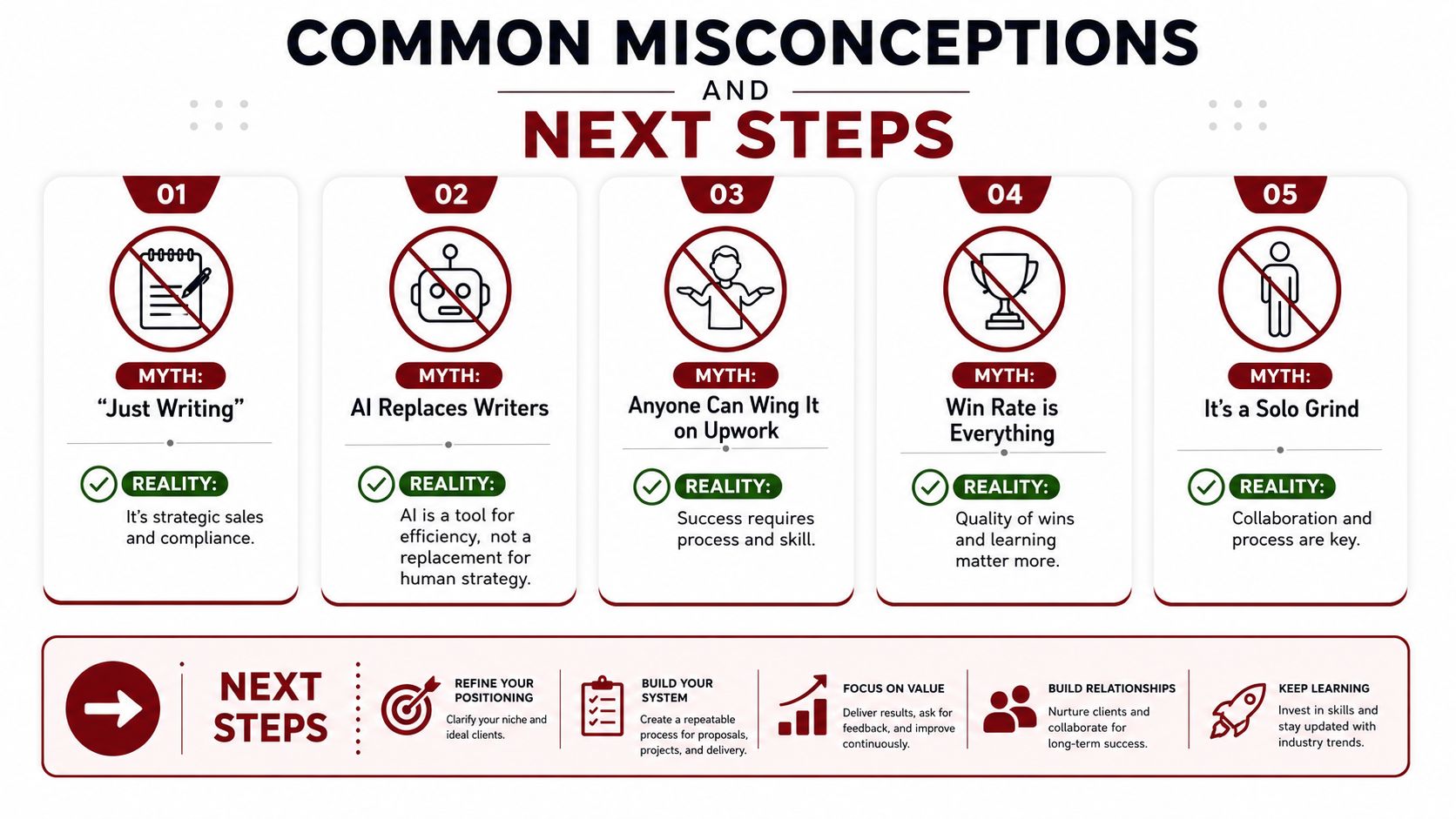
Common Misconceptions and Practical Next Steps
The most persistent misconception is that proposal writing is just writing. The writer may produce the final words, but the job also involves opportunity qualification, requirement analysis, SME coordination, review management, and submission control. The role is both editorial and operational.
A second myth says AI replaces the writer. AI can accelerate research, organize information, and create drafts. It can't reliably decide whether a client's requirement is ambiguous, whether a claim is safe to make, whether a technical answer is correct, or whether an opportunity deserves the team's time.
The third myth is that anyone can improvise on Upwork. A freelancer can submit a quick message, but consistent bidding requires a repeatable system for screening opportunities, selecting proof, tailoring language, tracking conversations, and learning from outcomes.
Five assumptions worth challenging
- Win rate is purely a sales metric: Sales owns relationships and commercial strategy, but writers influence qualification, clarity, compliance, turnaround, and follow-up.
- More proposals always produce more wins: More volume can create more noise, rushed personalization, and weaker fit. A smaller set of well-qualified responses may teach the team more.
- Proposal writers work alone: Strong responses depend on sales, SMEs, delivery leads, finance, contracts, compliance, and reviewers.
- Templates make proposals generic: A controlled template can preserve structure while the writer customizes the buyer language, evidence, and solution.
- A loss proves the proposal failed: A loss may reflect price, incumbent preference, timing, scope, or buyer priorities. The writer should still inspect the process for useful lessons.
A practical route forward
New freelancers should build a focused portfolio, study several winning proposals in their niche, and track the movement from bid to interview rather than relying on impressions. In-house writers can map the RFP pipeline, establish a baseline for current results, and test one AI-assisted research workflow with human review.
Hiring managers should assess more than polished samples. A useful scorecard weighs domain understanding, deadline discipline, compliance habits, collaboration, and writing quality. Ask candidates how they'd handle conflicting SME edits or a missing mandatory attachment. Their answer may reveal more than a beautifully formatted document.
This week, take five actions:
- Review one recent proposal against its requirements.
- Remove unsupported claims from your reusable content.
- Create a simple owner and deadline list for contributors.
- Choose one AI task that can be reviewed safely.
- Record one lesson from a submitted or rejected opportunity.
Proposal writing is a fit for people who enjoy turning ambiguity into a clear plan, coordinating specialists, and protecting details under pressure. If you want to reduce repetitive Upwork prospecting while keeping personalization and review in the workflow, visit Earlybird AI to explore how its proposal, messaging, analytics, and follow-up tools support freelance bidding operations.