
← Back To Blog
What Is a Bid Proposal and How to Win on Upwork
A bid proposal is a formal response to a client's scope, designed to be scored against clear criteria. On Upwork, it usually combines a price offer with your approach, relevant credentials, and delivery plan.
You've probably seen the pattern: a new Upwork job matches your skills, you send a quick message, and then nothing happens. Your reply may be polite and grammatically perfect, but it reads like an application rather than a commercial response. The client still has to work out whether you understood the project, what you'll deliver, how you'll deliver it, and whether your price makes sense.
That distinction matters because competitive bidding is a low-conversion activity. One independent industry source reports that competitive bid win rates typically average 5% to 20%, with government contracts often at the lower end and specialized B2B services performing somewhat better. Your proposal must therefore make the buying decision easier, not add another document for the client to decode.
The Freelancer's First Impression Problem
You open an Upwork job for a website redesign. The client wants a clearer homepage, stronger mobile performance, and a launch plan. You write, “Hi, I'd love to help. I have experience with websites and can start immediately.” You attach a portfolio link and submit.
Nothing in that message is necessarily false. The problem is that it gives the client almost no basis for comparison. It doesn't show which part of the brief you understood, how you'd organize the work, what the client would receive first, or why your experience fits this particular project.
A bid proposal is a structured response to a defined opportunity. It normally connects four pieces:
- Scope understanding: What problem is the client asking you to solve?
- Approach: What will you do, and in what order?
- Commercial offer: What will the work cost, and how will payment or milestones work?
- Evidence: Why should the client trust you with this scope?
On Upwork, the words “bid” and “proposal” often overlap. A client may ask for a bid when they really want a short proposal, or request a proposal while focusing heavily on price and availability. The terminology changes, but the required evidence usually doesn't. The client wants to see whether you can understand the assignment, meet the requirements, price it sensibly, and deliver without creating unnecessary management work.
Practical rule: Treat every serious Upwork application as a small competitive document, not as a cover letter.
A cover letter can introduce you. A bid proposal must help a client choose you. For a useful distinction between conversational introductions and structured responses, compare this guide to cover letter proposals.
Bid vs Proposal vs Quote on Upwork
The difference comes down to how much uncertainty the client needs you to remove.
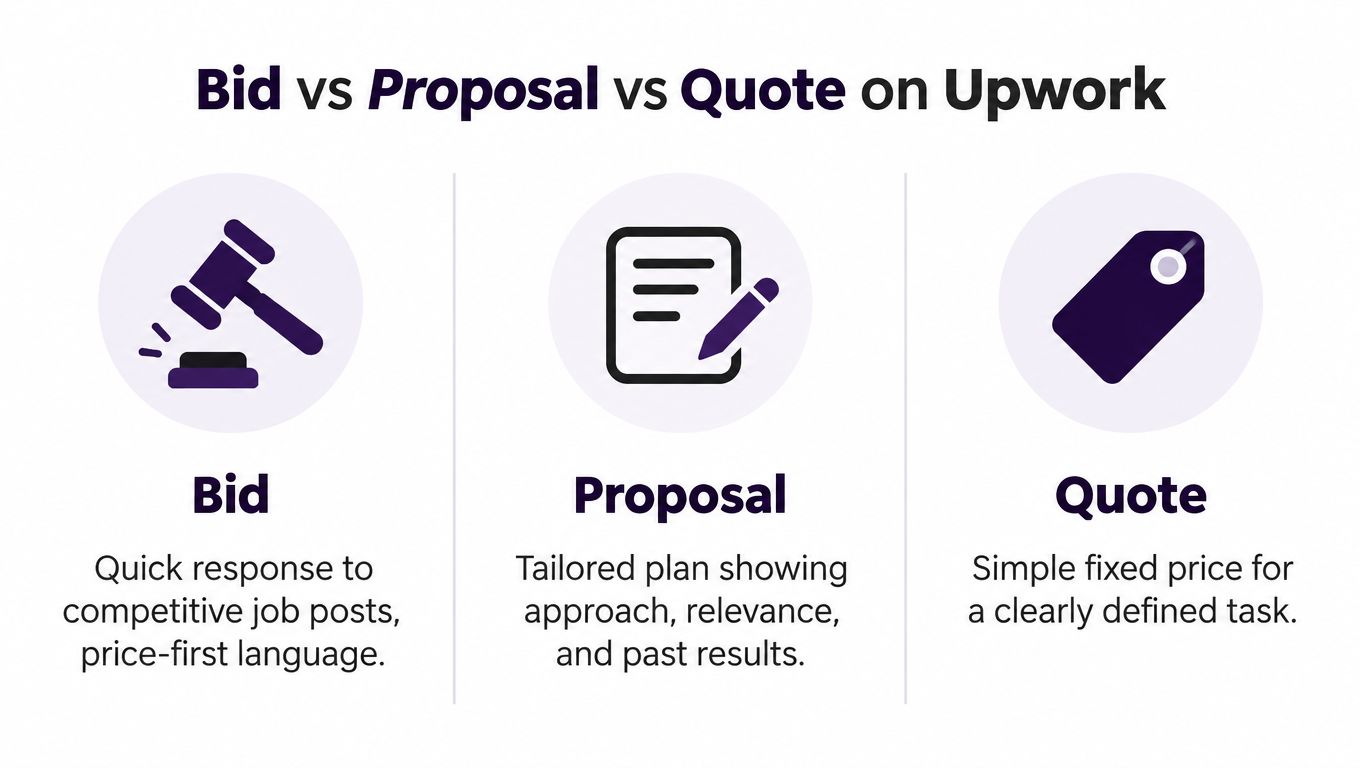
A bid usually responds to a defined job where price, availability, and compliance carry significant weight. A proposal goes further by explaining your solution, qualifications, timeline, and reasoning. A quote is narrower. It gives the client a price for a clearly described task, often without a detailed delivery strategy.
Use the job post to identify which format the buyer expects:
- Use a concise bid when the deliverables are fixed, the client asks for a rate or total price, and the main concern is whether you can complete the work as described.
- Use a fuller proposal when the post asks how you'd approach the project, requests examples, or mentions strategy, research, risk, or phased delivery.
- Use a quote when the task is tightly defined, such as adapting a single landing page, editing a specified number of pages, or creating one clearly described asset.
The practical mistake is choosing the wrong level of detail. A short price-only response can look careless when the client wants a technical plan. A long essay can hide your offer when the client needs a quick comparison between freelancers who all understand the task.
A useful test is to count the decisions the client must make. If the client only needs to confirm whether you can perform a specified task at a stated price, keep the response compact. If the client must judge your method, experience, timeline, and risk management, write a proposal that makes those factors easy to find.
A Wichita procurement FAQ highlights why this distinction matters. Most explanations of what a bid proposal is stop at the definition, while the more practical question is whether the buyer wants a bid, estimate, quote, or full proposal. Upwork clients may use these terms loosely, but their evaluation behavior still reveals the difference.
What Makes a Strong Bid Proposal
A strong submission follows the client's decision process. It doesn't begin with your biography. It begins by proving that you understood the assignment.
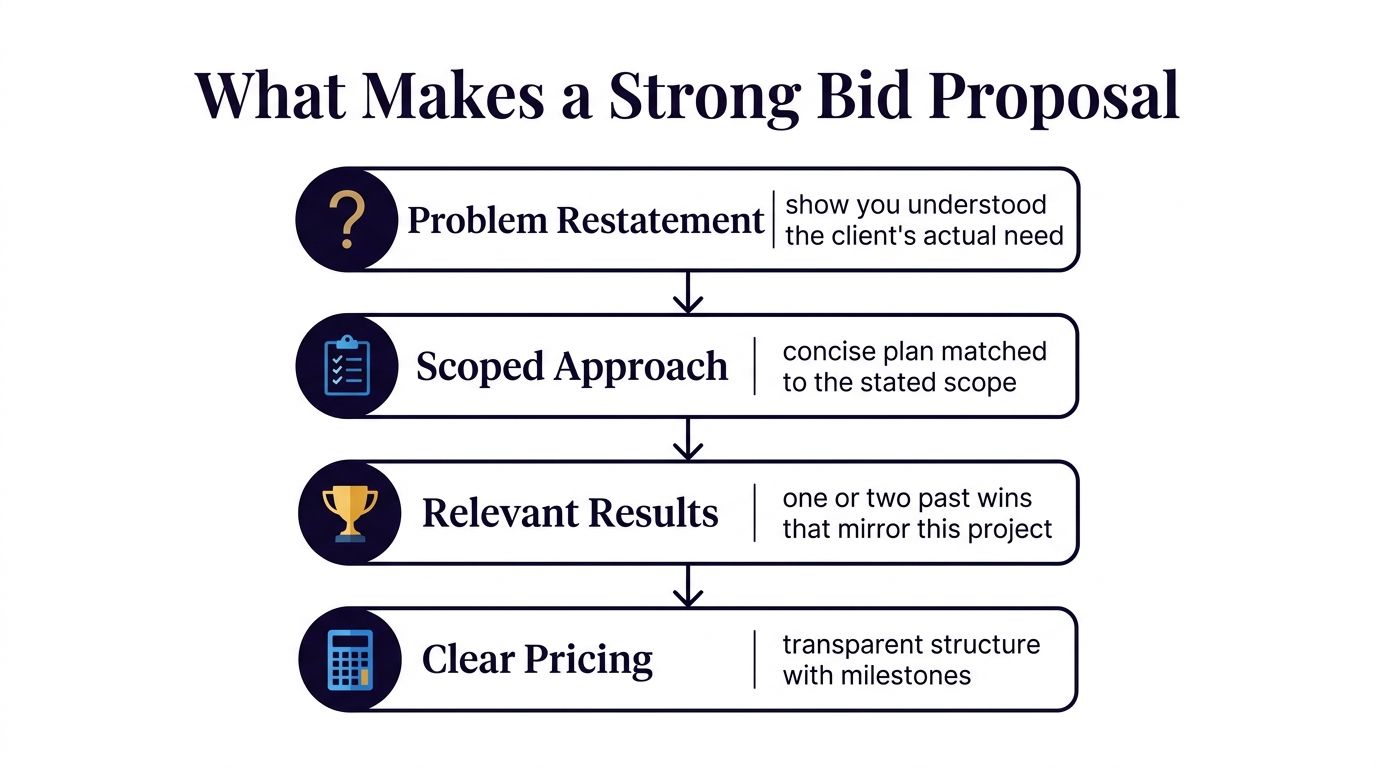
Start with the problem restatement
Open with the client's actual need in plain language. For a conversion-focused website project, write:
“You're not asking for a visual refresh alone. You need a clearer path from the homepage to the demo request, with mobile layouts that preserve that path.”
That sentence does more work than “I'm a creative web designer with extensive experience.” It shows you noticed the business problem behind the deliverables.
Describe a scoped approach
Give the client a compact sequence of actions. For example:
- Review the current homepage, analytics notes, and target-user assumptions.
- Map the primary conversion path and identify friction points.
- Produce revised wireframes for desktop and mobile.
- Build the approved page and complete an accessibility and responsive check.
- Deliver the launch-ready files with a short handoff guide.
This is specific without becoming a project diary. It also exposes assumptions early. If the client expects copywriting, analytics implementation, or multiple revision rounds, you can name those items instead of allowing them to disappear inside “full redesign.”
Select relevant proof
Choose evidence that mirrors the current job. A product-page redesign is better supported by a product-page example than by a general list of every service you've ever delivered. State your role, the work completed, and the result you can verify. Don't claim a metric you can't document.
Make pricing readable
A client should understand what the price covers without sending a clarification message. Separate phases or deliverables where that improves comparison, and state what isn't included when exclusions could affect the total.
Major procurement guidance says evaluation criteria should be proportionate to the procurement type, market conditions, complexity, risk, value, and objective, and should be quantifiable or convertible to monetary terms wherever practicable, according to the World Bank evaluation-criteria guidance. On Upwork, you can apply the same logic by connecting each price component to a deliverable, milestone, or clearly stated assumption.
If you need a starting format for organizing sections and adapting presentation materials, customizable Word and Canva templates can help you build a reusable structure. Personalize every section before submitting. A template should reduce formatting work, not replace judgment.
Finish with a direct next step: “If this scope matches your priority, I can confirm the first milestone and start with the current homepage review.” That gives the client an easy reply.
How Clients Actually Score Submissions
Clients rarely evaluate an Upwork proposal as a piece of writing. They scan it for buying evidence.
Traditional procurement guidance describes technical bids as being assessed through rated non-price factors, including quality, risk mitigation, sustainability, experience, compliance, and other measurable attributes that can be scored separately from cost, as explained in the World Bank guide to rated criteria. An Upwork client may not use a formal scorecard, but the same mental process appears in a simpler form.
They're asking:
- Did this freelancer answer the actual request?
- Does the proposed method fit the project?
- Have they done comparable work?
- Do the milestones make sense?
- Is the price clear enough to compare?
- Will this person create risk through vague scope or poor communication?
That's why the cheapest response doesn't automatically win. A low price paired with a weak plan can look more expensive if the client expects rework, supervision, or missed requirements. A technically stronger offer can justify a different price when it explains how the work will be controlled and delivered.
Itemized pricing helps because it connects cost to the client's requested output. Instead of writing “I can do the whole project for one fixed amount,” write “Phase one covers the audit and prioritized recommendations. Phase two covers the approved implementation. Additional requests outside those deliverables are quoted separately.” The exact structure depends on the work, but the principle is consistent: remove ambiguity before the client has to ask about it.
Government guidance also requires evaluation criteria and their application method to be disclosed in the solicitation, and only stated criteria may be used during evaluation, according to the World Bank procurement guidance. For Upwork, this translates into a simple habit. Read every question and requested deliverable as a scoring signal. If the client asks for a relevant example, answer it directly. If they ask for availability, include it. If they ask for a fixed price, don't bury the price at the end.
Track what happens after submission with relevant client engagement metrics. Replies, interviews, and follow-up questions can show which parts of your proposal create confidence and which leave gaps.
Bid Proposal Examples and Common Mistakes
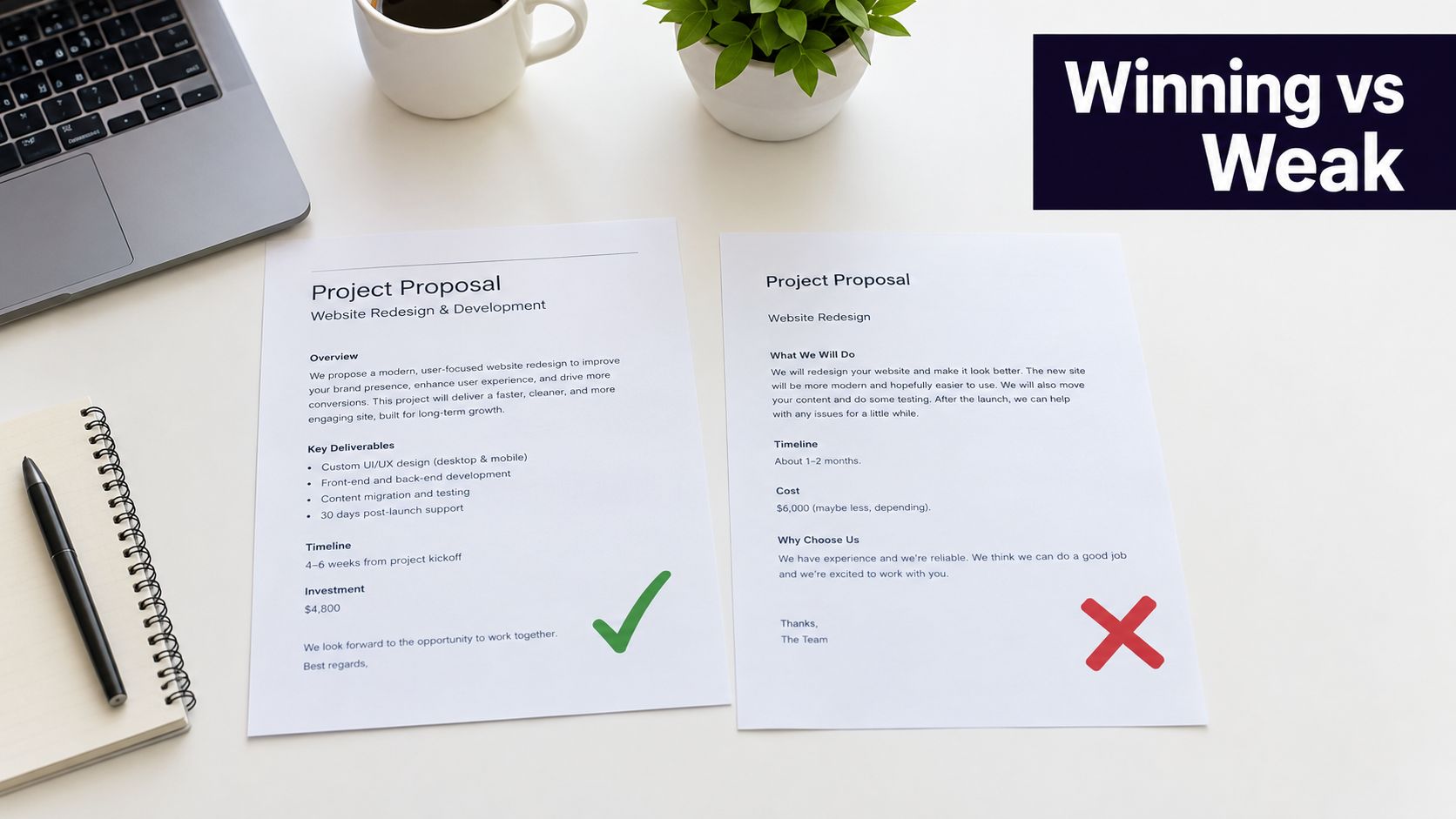
The first two lines often determine whether the client reads the rest. Compare these openings:
Weak: “Hello, I'm a highly motivated freelancer and would love the opportunity to work on your project.”
Stronger: “Your brief points to two issues, unclear service positioning and a homepage that makes visitors work to find the next step. I'd address the message hierarchy first, then redesign the page around the primary inquiry path.”
The stronger version doesn't rely on exaggerated enthusiasm. It names the problem and proposes a sensible starting point.
The same contrast applies to scope:
Weak: “I'll handle the complete website redesign and make sure everything looks modern.”
Stronger: “I'll audit the current homepage, create a revised desktop and mobile structure, build the approved page, and provide a launch handoff. Copywriting, new illustrations, and additional pages would be treated as separate scope unless you'd like them included in the initial plan.”
Pricing should follow the same standard. A vague total forces the client to guess what they're buying. A clearer structure connects the price to milestones, deliverables, and assumptions. You don't need to create a formal procurement document for every small Upwork task, but you should make the commercial offer easy to understand.
Mistakes that quietly remove you from consideration
- Missing the requested format: If the client asks for a specific answer, attachment, or structure, follow it before adding creative detail.
- Copying an old template: Generic wording makes relevant experience look irrelevant.
- Hiding the price: A client shouldn't have to search through paragraphs to find your commercial offer.
- Skipping proof: “I can do this” is weaker than a relevant example that explains your role and deliverable.
- Ignoring assumptions: State dependencies such as access, source files, approvals, or client-provided content.
- Submitting late: A strong response can lose its opportunity when the client has already shortlisted other freelancers.
Deadlines are part of compliance, not administrative decoration. Government solicitations include a submission deadline for bids or proposals, and when discussions occur, agencies may also set a common deadline for final proposal revisions, as described in this procurement deadline explanation. Upwork's process is less formal, but clients still compare submissions within a limited attention window. Submit a relevant response while the job is active, and make revisions consistent if the client asks follow-up questions.
Why Speed and Personalization Now Matter More
A polished proposal that arrives after the client has interviewed several suitable freelancers has less practical value than a concise, relevant response delivered while the decision is still open. Speed alone won't save a generic message, but speed combined with specificity can preserve your chance to be considered.
Recent guides describe a meaningful trend toward proposal automation and analytics, with buyers increasingly expecting faster, more personalized responses rather than static templates, as discussed in Zoom's bid proposal guide. That doesn't mean handing every decision to software. It means using tools to reduce repetitive work while keeping the reasoning human.
A practical workflow stores reusable evidence, service descriptions, qualifying questions, and scope boundaries. Automation can help identify suitable jobs, draft a first response, and maintain follow-up consistency. You still need to verify the client's requirements, remove unsupported claims, check the price, and ensure the message sounds appropriate for the project.
For freelancers and agencies handling repeated Upwork opportunities, automating Upwork proposals can support that workflow by helping with job discovery, personalized drafting, proposal sending, and client-message follow-up. Use automation as a quality-control system for speed, not as permission to send identical replies.
The best short proposal may be better than the longest one. It answers the client's question, fits the stated scope, and gives a clear next step without making the buyer assemble the meaning themselves.
Your Next Steps for Winning Proposals
Before submitting, run five checks:
- Format: Did you answer every requested question in the requested order?
- Scope: Does your price match the named deliverables and milestones?
- Fit: Did you include evidence that resembles this project?
- Clarity: Can the client understand your approach without a call?
- Responsiveness: Are you submitting while the opportunity is still active?
Keep a short record of which proposals receive replies, interviews, and clarifying questions. That feedback will improve your structure faster than endlessly polishing one template. If you want a broader framework for finding and converting freelance opportunities.
A bid proposal wins by making the client's decision simpler. Build the habit of responding quickly, matching the requested format, and proving relevance with specific scope and evidence.
Earlybird AI helps freelancers and agencies find suitable Upwork jobs, draft personalized proposals, send responses quickly, and manage client follow-up in one workflow. Visit Earlybird AI to see how it can support a faster, more consistent bid proposal process.


