
← Back To Blog
What Is LinkedIn Profile Optimization: 2026
Complete LinkedIn profiles are 40 times more likely to receive opportunities through the platform, while profiles with complete information can generate 21 times more profile views and 36 times more messages. LinkedIn profile optimization is the strategic alignment of profile completeness, semantic keywords, and engagement signals to improve search visibility and convert profile visitors into conversations.
The popular advice is still stuck on keyword stuffing, generic job titles, and filling every field once before moving on. That checklist misses how LinkedIn works now. Your profile has to make sense to people, search systems, and increasingly AI-assisted matching workflows. It also has to stay current and support the activity that brings qualified visitors back to your page.
For freelancers, agency owners, and sales leaders, the practical definition is simple: optimization turns a profile from a static résumé into a searchable, understandable, and conversion-ready business asset. The strongest profiles don't merely say what someone does. They clarify who that person helps, which problems they solve, how they work, and what a prospect should do next.
Redefining Profile Optimization for Modern Search
Profile optimization is no longer a form-completion exercise with keywords added to the headline. LinkedIn's profile strength guidance explains that the strength meter increases as members add suggested sections, and that stronger completeness can improve discoverability in search results and profile appearances. LinkedIn's profile strength guidance points to the practical issue: structured information helps LinkedIn interpret and surface a profile.
The better question is whether a recruiter, buyer, or AI-assisted matching system can identify your expertise quickly. That requires the headline, About section, Experience entries, Skills, Featured content, and services description to reinforce one another. A profile that says “growth consultant” in the headline, discusses demand generation in the About section, then lists only vague responsibilities in Experience creates conflicting signals.
From digital résumé to matching asset
Modern optimization combines three layers:
- Completeness: Fill the structured sections that establish professional context.
- Semantic clarity: Use the terms ideal clients, recruiters, and AI-assisted search tools use for the problem, audience, method, and outcome.
- Engagement: Publish, comment, and build relevant relationships so the profile stays connected to current conversations.
Keyword stuffing fails because repeated terms such as “SEO,” “marketing,” or “agency” do not explain how your work connects a specific audience with a specific result. Search systems can detect the words, while human visitors still see a generic offer.
A practical starting point is the Legacy Builder LinkedIn profile advice, which covers neglected profile sections and first-impression improvements. Apply that foundation consistently. Each section should clarify the same positioning instead of functioning as an isolated checkbox.
For agencies and freelancers, the profile also needs to support the acquisition process described in LinkedIn demand generation. Content creates initial interest, the profile confirms relevance, and the call to action gives a qualified visitor a clear next step. Profile optimization works when those elements agree, not when a page contains more keywords.
How Completeness and Freshness Drive Discoverability
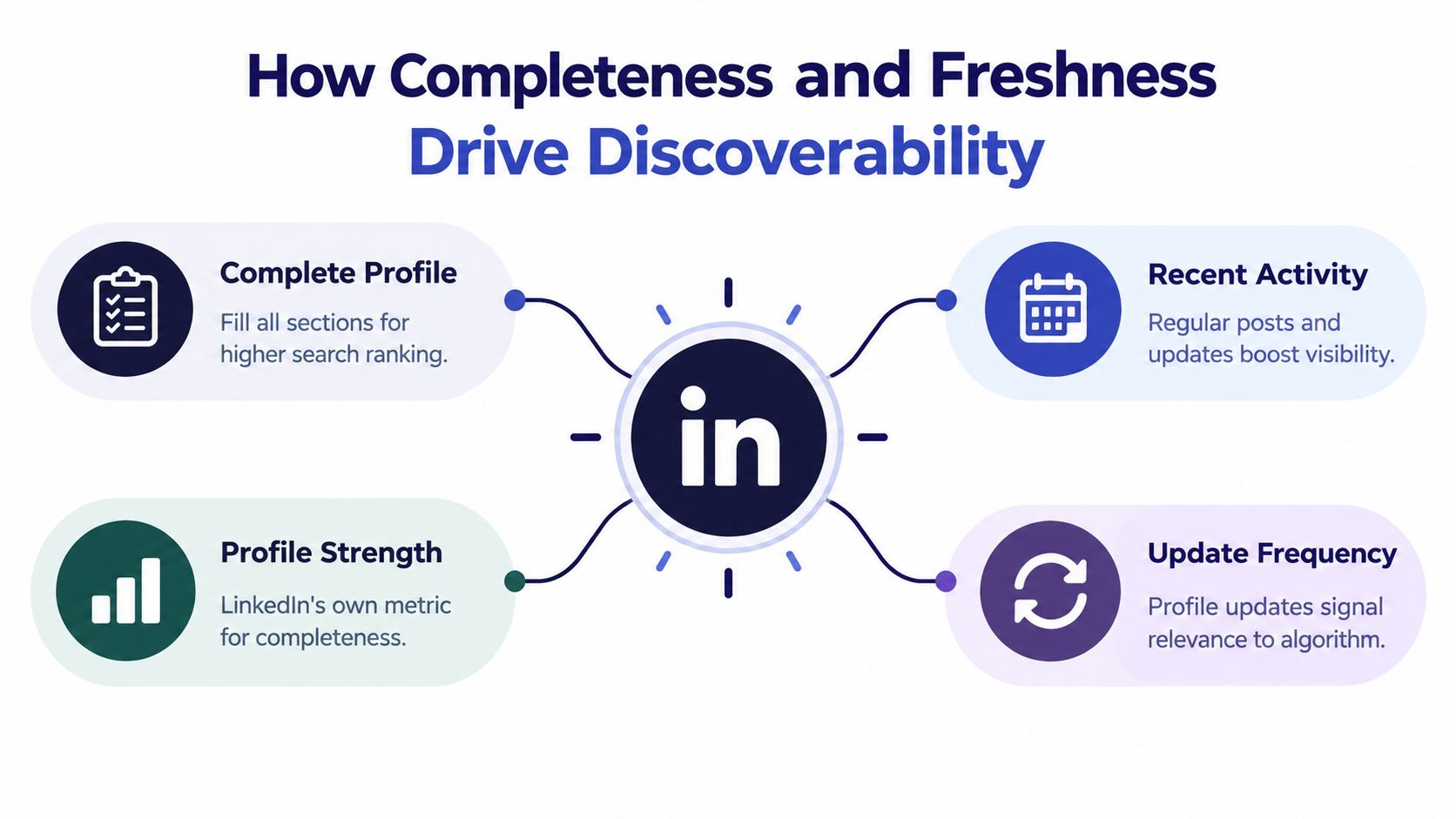
LinkedIn discovery depends on more than repeating a target phrase. Keyword relevance, profile completeness, connection proximity, activity level, and engagement signals all influence how a profile is found, as outlined in LinkedIn benchmark guidance from Oktopost. Relevance identifies a possible match, while complete context helps LinkedIn and AI-assisted search systems understand the person, service, audience, and outcomes behind that match.
Completeness gives semantic structure to the profile. A headline that includes “B2B content strategist” may identify a topic, but Experience, Skills, About copy, and Featured content should confirm what that work involves. The goal is not to repeat the same keyword across every field. It is to connect related concepts clearly, so a search system can interpret the profile and a prospective client can judge its relevance.
Why freshness changes the maintenance model
LinkedIn's newer completeness scoring gives greater weight to elements members control, including Skills, and considers profile freshness. That makes optimization an ongoing maintenance task rather than a one-time profile rewrite.
Freshness does not require daily edits. It means keeping the professional story aligned with current work. Add a service when the offer changes, refine Skills when the specialization becomes clearer, update Experience as responsibilities evolve, and replace Featured content when older proof no longer represents the strongest work.
A practical review should ask:
- Does the headline match the work you want now? An outdated role can attract irrelevant searches.
- Do Skills reinforce the same category? Select capabilities your Experience and content can support.
- Does the About opening reflect current relevance? Visitors should understand the value before expanding the section.
- Does recent activity support the positioning? Posts and comments should make the profile's claims credible.
Freshness also affects lead generation. A profile can describe a strong service yet remain disconnected from the conversations where potential clients are paying attention. LinkedIn lead generation guidance places profile visibility within a wider acquisition process. Content creates interest, the profile confirms relevance, and a clear next step converts attention into a conversation.
Core Elements of a High-Converting Profile
A high-converting profile answers four questions quickly: what do you do, who do you help, how do you create value, and why should someone trust you? Every major section should contribute to those answers without repeating the same sentence in different formats.
Start with the visible promise
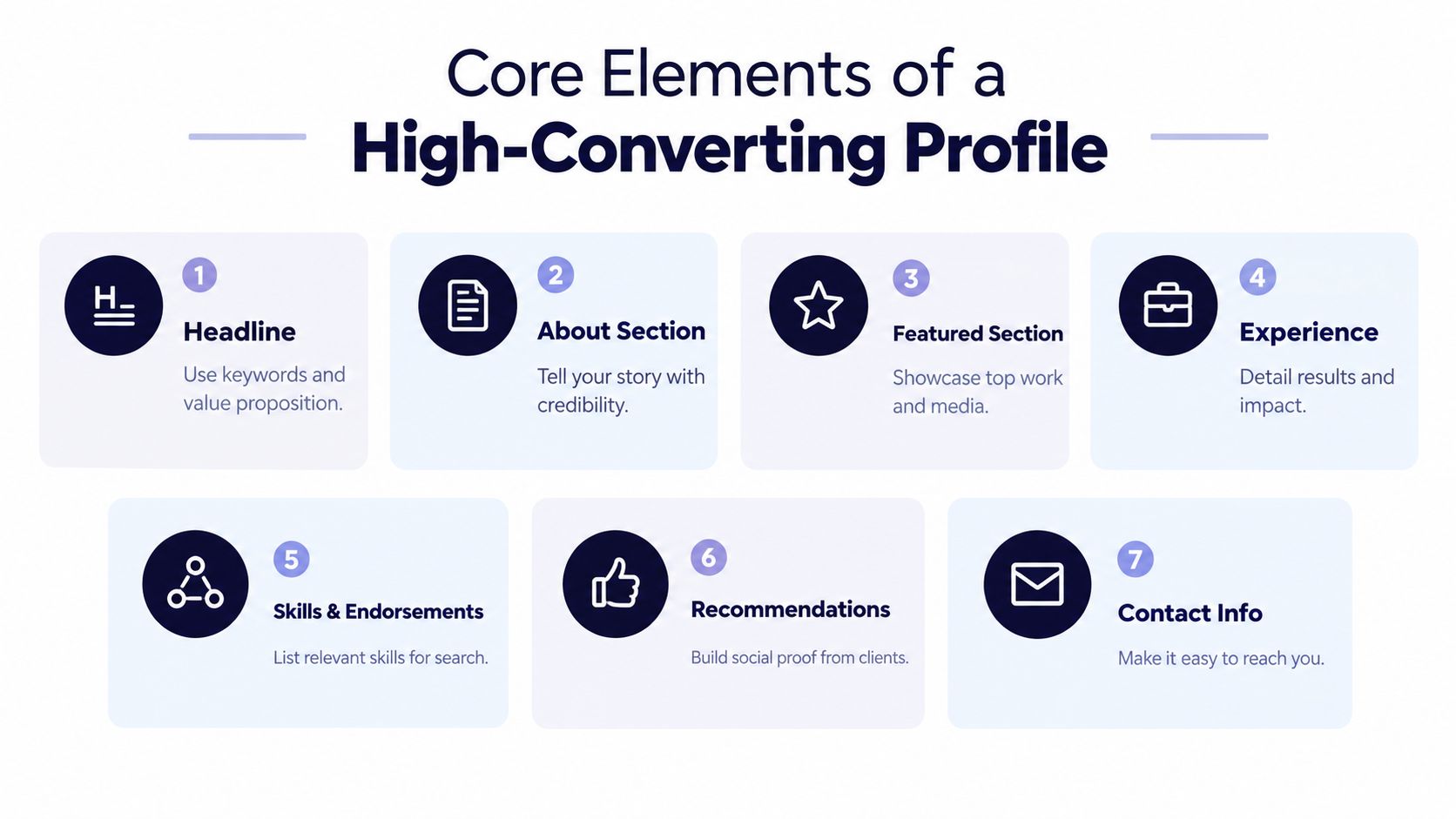
Your headline needs more than a job title. Combine the audience, service, and problem you address. “Founder at a marketing agency” identifies a role, while “Helping B2B SaaS teams turn LinkedIn content into qualified sales conversations” communicates a market position. Keep the wording natural. A search term belongs there because it describes your work, not because you want to repeat it.
The banner should reinforce that promise visually. Use a concise service statement, a recognizable category, or a clear next step. Decorative artwork can support your brand, but it shouldn't compete with the message.
The About section has a hard cap of 2,600 characters, and recent guidance notes that only the first roughly 200–300 characters appear before the “see more” expansion, as explained in CareerBldr's About section guide. Treat the opening as landing-page copy. State the audience and problem first, then explain your approach, credibility, and next action.
Practical rule: Write the first lines for a busy visitor who has never heard of you, not for a former colleague who already knows your career history.
Turn proof into a path
Use the Featured section to make proof easy to access. Add a relevant case study, portfolio item, interview, webinar, lead magnet, or service page. The right asset depends on your audience, but the principle stays the same: move visitors from a claim to evidence without making them search through your activity history.
In Experience, lead with impact and context. Instead of listing “managed campaigns,” explain the type of client, the business problem, the work performed, and the resulting change. If a result can't be disclosed, describe the scope and decision-making clearly rather than inventing a metric.
The Skills section should support your target category. Choose relevant abilities that appear naturally in your headline, About copy, and Experience. Endorsements and recommendations add social proof, while Contact Info removes friction for visitors who are ready to ask a question.
For another practical perspective on combining profile copy, proof, and conversion paths, see RedactAI's LinkedIn profile guide. The strongest profiles don't sound like biographies. They read like focused explanations of a professional solution.
Measuring Success Through Conversion Metrics
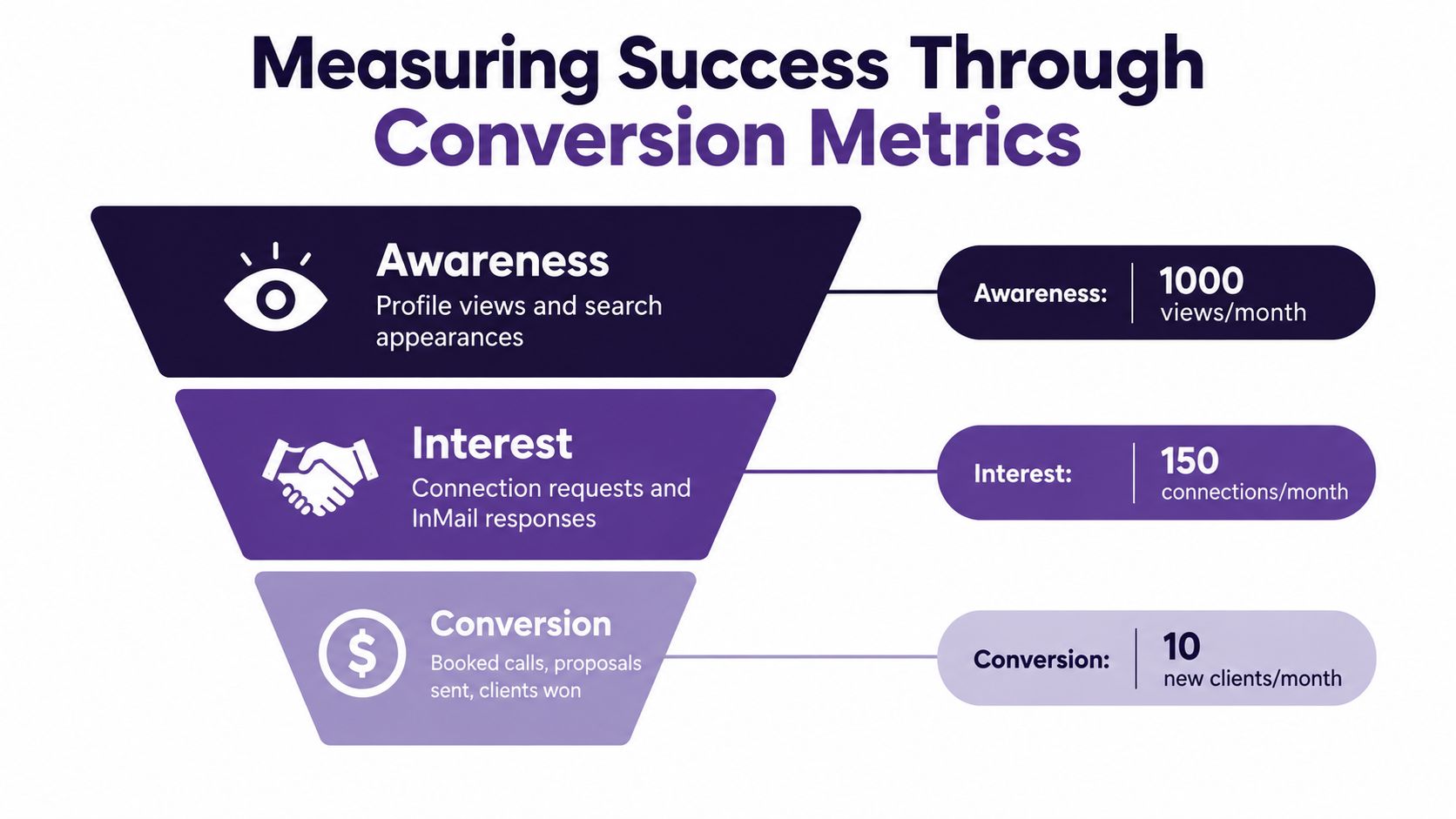
Profile views are useful, but they aren't the business outcome. A profile can attract attention from people who have no buying authority, no relevant need, or no reason to start a conversation. Agencies and freelancers should evaluate the page as a funnel, from discovery to interest to a qualified next step.
Diagnose the bottleneck, don't guess
A low connection conversion rate can come from several different problems:
- Weak positioning: The headline doesn't explain why the visitor should care.
- Poor targeting: The outreach reaches people outside the service's natural market.
- Thin proof: The profile makes claims without Featured assets, recommendations, or specific Experience context.
- Unclear next step: The visitor understands the service but doesn't know how to begin.
The final stage is conversion, which may mean a booked call, a proposal request, a referral, or a qualified direct message. Record the source and context of those conversations so you can identify which profile changes affect lead quality.
A profile isn't successful because it gets attention. It succeeds when the right people understand the offer and take a relevant next step.
Test one meaningful variable at a time. Refine the headline, then observe the quality of visitors and connection conversations. Improve the About opening, then compare the relevance of inbound messages. This approach prevents vanity metrics from dictating decisions and gives your positioning a measurable feedback loop.
Why Static Profiles Fail Without Active Engagement
A polished profile can still lose momentum when its owner disappears from LinkedIn. Profile optimization improves how the platform and visitors interpret your professional identity, but activity gives that identity current context. Posting, commenting, and responding also create more opportunities for the right people to encounter your name before they visit the profile.
Independent 2025 algorithm analysis covering 1.8 million posts, 58,000 profiles, and 31,000 company pages reported year-over-year declines in views of -50%, engagement of -25%, and follower growth of -59%. The findings are documented in ContentIn's LinkedIn algorithm analysis. The practical implication is not that every profile will experience the same decline. It's that platform-wide distribution changes can overpower a static optimization effort.
Build a sustainable visibility loop
You don't need to publish empty opinions just to appear active. Use a small set of recurring themes tied to your offer:
- Teach: Explain a process, mistake, decision, or useful distinction from your work.
- Interpret: Add a clear point of view to an industry development your audience already follows.
- Demonstrate: Share an anonymized workflow, portfolio explanation, or lesson from a completed project.
- Participate: Leave specific comments on posts written by prospects, partners, and respected specialists.
Comments matter because they place your expertise in conversations that already have an audience. A thoughtful response can introduce your profile to people who would never search for your job title directly. Replies to your own posts also reveal the language your audience uses, which can inform future headline, About, and Experience revisions.
The cadence should fit your capacity. A freelancer who can sustain useful comments and occasional posts will build more credibility than someone who publishes aggressively for a short period and then vanishes. Treat engagement as the distribution layer that sends qualified visitors to the profile, where your positioning and proof can do the conversion work.
Positioning Strategies for Agencies and Freelancers
Agency and freelance profiles face a specific problem. They must communicate personal expertise while making the delivery capability of a broader service business credible. A profile that says only “agency owner” can feel distant, while one that lists every possible service becomes difficult to classify.

Give each profile a distinct commercial role
The founder's profile can carry the point of view and market narrative. A specialist's profile can establish delivery depth. A sales leader's profile can reduce friction around process, communication, and fit. These profiles should share core service language, but they shouldn't be duplicate pages with identical headlines and About sections.
Use the company page for organizational proof, while personal profiles explain the humans behind the work. Add relevant case studies, testimonials, portfolio assets, and service descriptions to the Featured sections of the people most likely to receive buyer attention. The profile should show not only what the agency sells, but how the team thinks and delivers.
For B2B outreach, B2B lead generation on LinkedIn provides a useful commercial context. A clear profile won't rescue an offer aimed at everyone. Define the ideal client, name the problem in the client's language, and connect the service to a practical business outcome.
Use a named metric for team improvement
LinkedIn's Social Selling Index uses four components: establishing a professional brand, finding the right people, engaging with insights, and building relationships. LinkedIn says the score is updated daily on a 0–100 scale, as described in this Social Selling Index overview. It isn't a substitute for pipeline reporting, but it can help teams discuss visibility and relationship-building using a shared metric.
For multi-user workflows, define who owns profile updates, who supplies proof assets, and who reviews inbound conversations. Tools can help organize research, proposals, and follow-up, but each profile still needs a human voice and accurate evidence.
An agency may also use Earlybird AI for automated Upwork prospecting, personalized proposals, client-message replies, analytics, profile optimization tools, and multi-user workflows. That can complement LinkedIn positioning when the team treats both channels as connected parts of its sales process, rather than copying the same message everywhere.
Building Your Continuous Optimization Routine
Optimization works best as an operating habit. Set a recurring review for your profile, compare the visitors and conversations it attracts, and update the language when your offer, role, or target market changes. The profile should evolve with the business, not preserve an outdated version of it.
A practical routine has three layers:
- Review the structure: Check the headline, About opening, Experience, Skills, Featured content, and contact path for consistency.
- Review the signals: Look at search appearances, profile views, relevant connections, replies, and the quality of conversations.
- Review the market language: Read current client questions, job descriptions, competitor positioning, and comments from your target audience to identify terms people use.
A freelancer might notice that profile visitors understand the service but ask for a different deliverable than the one promoted. That isn't just a sales issue. It may indicate that the headline, Featured asset, or About copy is attracting an adjacent audience. Adjust the positioning, then watch whether the next conversations become more specific.
Keep engagement connected to the same routine. Publish useful insights, respond to relevant discussions, and let audience questions shape future profile edits. For help developing that publishing habit, this guide to LinkedIn publishing offers a useful content-planning reference.
The central principle is straightforward: make the profile complete, make the meaning clear, make the proof accessible, and keep the professional signal current. That combination is more durable than stuffing keywords into a page and hoping search rankings do the rest.
Earlybird AI helps freelancers and agencies automate Upwork lead generation through project discovery, personalized proposals, client-message replies, analytics, profile optimization tools, and multi-user workflows. Visit Earlybird AI to connect your outreach process with a clearer, more conversion-focused professional presence.


